
Hotel-Style Digital Locks in India (2026): Cards, Codes and the Front-Desk System
The RFID-card and PIN locks built for many rotating guests, run from a front-desk encoder that issues a per-stay credential and expires it at checkout, with a who-entered-when audit trail, for PGs, hostels, homestays and serviced apartments.
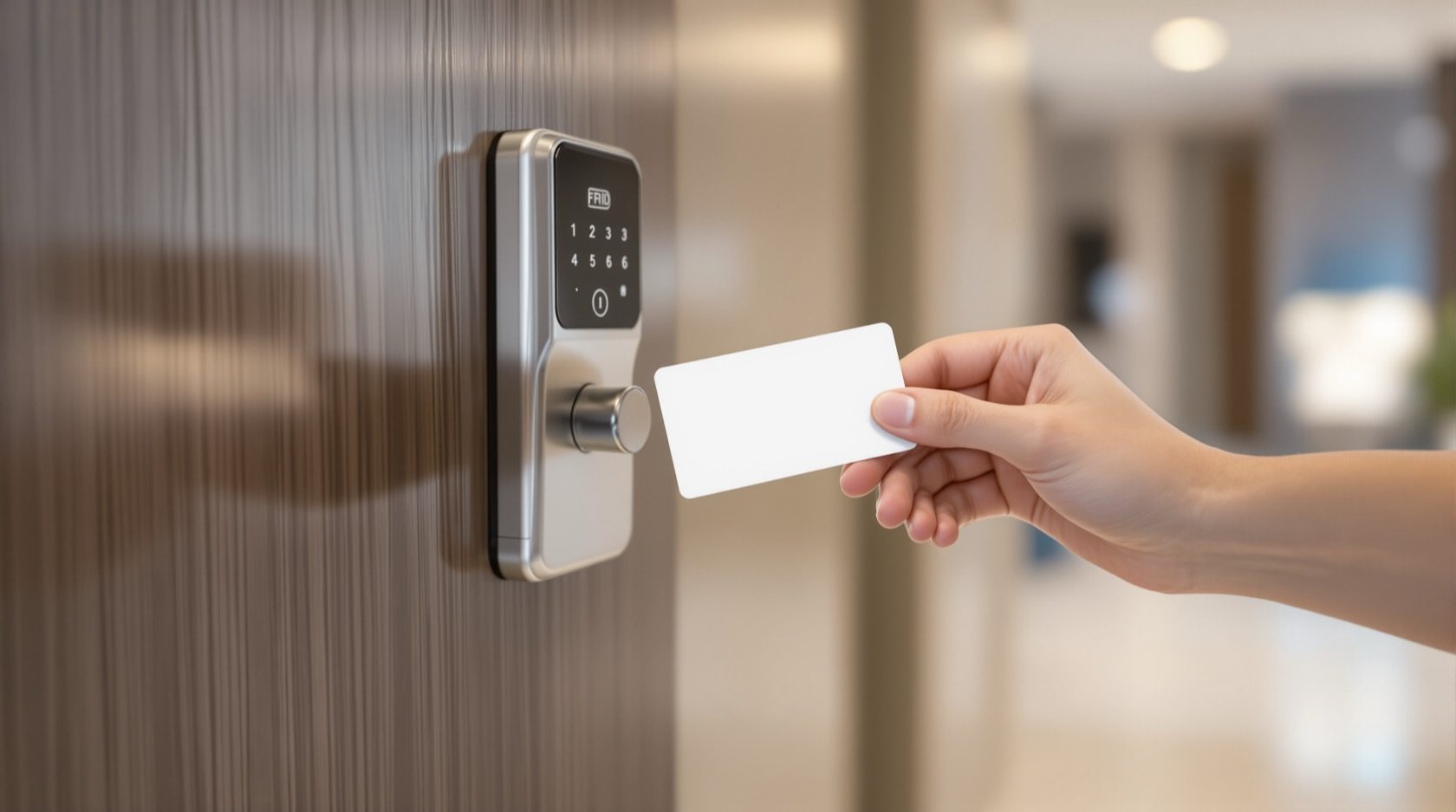
Walk into almost any hotel, and the lock on your room door is not the same kind of smart lock you would put on a family home. It has no app you download, no fingerprint you enrol, and no long relationship with you. Instead, the moment you check in, the front desk taps a blank plastic card on a small desk unit and hands it over. That card opens exactly one room, only for the nights you have booked, and stops working the minute you check out. Multiply that across a hundred rooms and a thousand guests a month, and you have a completely different design problem from a home lock.
Hotel-style digital locks are locks built for many rotating people rather than one household. This guide, part of Studio Matrx's Smart Locks and Access Control hub, is about that lock form and the little management system behind it: how a per-stay card or code gets issued and auto-expires, how housekeeping gets limited rights, how a who-entered-when log works, and — crucially in India — where this kind of lock earns its keep well beyond hotels: paying-guest (PG) homes, hostels, homestays, serviced apartments, co-living, guesthouses and short-lets.
Scope, egress and safety. This guide helps you plan, choose and run a guest-room lock system; the door hardware, any mains wiring and any fire-alarm interlock are a licensed professional's job. A guest-room door is an escape route: the inside handle must always let a person walk straight out even when the door is "locked", and the lock must comply with the fire-egress provisions of the local code. Keep a mechanical key override and a spare-battery plan for every door. A guest's stay and entry log is personal data under the Digital Personal Data Protection Act, 2023. This is educational guidance, not legal advice.
What makes a lock "hotel-style"
A home smart lock and a hotel-style lock can look almost identical on the door. The difference is the system behind the credential. A home lock stores a handful of permanent users — the family, maybe a maid — enrolled once and rarely changed. A hotel-style lock assumes the person at the door is a stranger who will be gone in a day or two, and that a new stranger will arrive after them, forever.
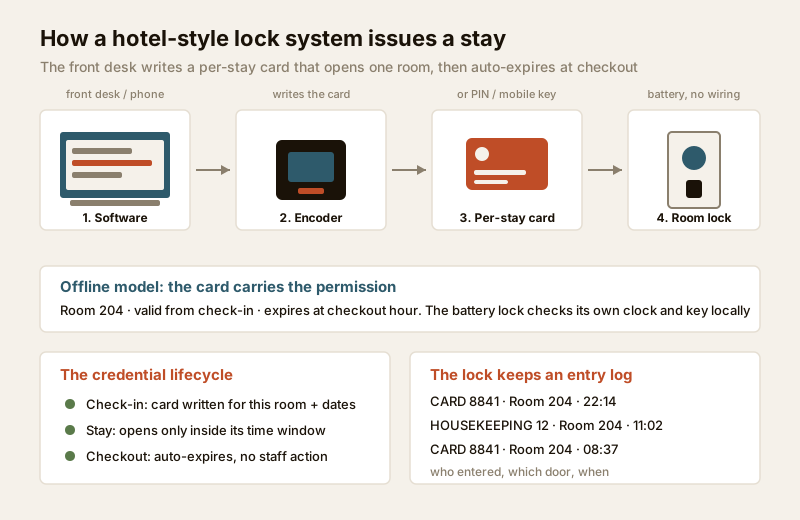
So the whole design is about issuing and expiring credentials fast and safely, in bulk, without ever re-touching the lock on the door. Three ideas define the form:
- A per-stay credential. Each guest gets a card or a code that is theirs alone, tied to one room and a start-and-end time. It is born at check-in and dies at check-out — no one has to go and delete it.
- A management layer. A small piece of software plus a card encoder (a desk unit that writes cards) sits at the front desk or in the owner's phone. This is where credentials are made, staff rights are set, and the entry log is read.
- An audit trail. The lock remembers, in order, which card opened it and when. That is genuinely a miniature access-control system — the same plan-permit-log logic a company uses for staff doors, shrunk to a guesthouse.
Contrast that with the credential-first guides in this hub — RFID card locks, PIN-code locks, fingerprint locks — which are about how you prove who you are. Hotel-style is about how the property manages many short-lived proofs at once. The lock body is usually a mortise fitting suited to Indian doors, but the defining feature is the front-desk workflow, not the metal.
Where hotel-style locks fit in India, beyond hotels
The reason to understand this lock form is that a lot of Indian property is really "many rotating guests" wearing a different name. If you run any of these, a home-style lock will fight you and a hotel-style system will fit:
| Property type | Why hotel-style fits | The daily pain it solves |
|---|---|---|
| PG / paying-guest home | Tenants change every few months; deposits and dues ride on access | Issue a card per bed/room; deactivate instantly when someone leaves without chasing a physical key |
| Hostel / student housing | High turnover, shared corridors, staff and wardens | Room cards plus limited staff cards; a log if a shared room is entered |
| Homestay / guesthouse | You are not always at the door; guests self-arrive | A code or card issued for the exact stay; no key handover in person |
| Serviced apartment / short-let | Airbnb-style back-to-back bookings | A fresh credential per booking that dies at checkout, so the last guest cannot return |
| Co-living | Many private rooms plus shared amenities | Per-room access plus common-area rights, managed centrally |
| Small boutique hotel / lodge | The classic case | Front-desk issuance, housekeeping cards, master recovery |
The common thread is turnover without your constant presence. The instant a stay ends, the credential should stop working — and you should not have to physically visit the door or recover a metal key to make that happen. That single property is what makes the extra cost of a managed system worth it for a busy PG or homestay, and overkill for a family flat where a simple PIN-code or app-controlled lock is plenty.
How the credential lifecycle actually works
The magic word is expiry. A hotel-style credential is not just "valid" or "invalid" — it carries a time window. Here is the life of a single guest card:
1. Check-in. The manager selects the room and the dates in the software and taps a blank card on the encoder. The card is written with: this room, valid from now, expiring at the checkout hour.
2. Stay. The guest taps the card; the lock checks its clock against the card's window and opens only inside it. Housekeeping's own card opens the same room but under different rules (see below).
3. Auto-expiry. At the checkout time, the card simply stops working — no staff action, no visit to the door. The next guest's freshly written card takes over.
4. Re-issue on loss. If a guest loses a card, the manager writes a new card for that room; on most systems the new card cancels the old one the next time either is used, so the lost card becomes useless. (Ask your vendor exactly how their cancellation works — it is a key buying question.)
The subtle, important part is how the lock knows the card is valid without being wired to anything. That is the offline model.
The offline model: the card carries the permission
Most Indian hotel-style installs are offline (also called "standalone" or "data-on-card"). The lock on the door is a battery-powered unit with no wiring back to a server. It does not phone home to check if your card is genuine. Instead, the card itself carries the encrypted permission — the room, the dates — and the lock reads it, checks it against its own internal clock and key, and decides.
This matters enormously in India:
- No cabling to every door. You do not have to run a data cable to a hundred rooms; each lock runs on batteries. That is cheaper, faster to retrofit, and survives the network going down.
- It keeps working in a power cut or network outage. Because the decision is local, load-shedding or a dead router does not lock everyone out — a real advantage over a fully-online system.
- The trade-off is freshness. In a pure offline system, if you cancel a card at the desk, the door only learns about it when a newer card is used on it, or when a staff card syncs it. Truly instant, remote "lock this door now" needs an online or Wi-Fi-connected system, which costs more and needs reliable connectivity.
A middle path is increasingly common: offline locks that a housekeeping or maintenance card syncs — carrying updates and collecting the entry log as staff do their rounds — or a Bluetooth/gateway bridge that lets the manager push changes to the door from a phone.
| Model | How the lock decides | Best for | Watch-out |
|---|---|---|---|
| Offline / data-on-card | Card carries the permission; lock checks locally | Most PGs, homestays, small hotels; power-cut-prone sites | Cancelling a card is not instant at the door |
| Data-on-card + staff sync | Staff cards carry updates and collect logs on rounds | Mid-size hostels/hotels | Depends on staff doing rounds |
| Online / networked | Lock talks to a server (wired or Wi-Fi) | Larger hotels wanting instant control | Needs cabling or solid Wi-Fi; power/network dependent |
Cards, codes and the move to mobile keys
Hotel-style systems traditionally hand out a physical RFID card — the same contactless technology covered in the RFID locks guide. Cards are cheap, need no charging, and are easy for any guest to use. But three credential styles now co-exist:
- RFID cards. The workhorse. Robust, familiar, cheap to replace. You do need to buy and manage a stock of blank cards, and guests do walk off with them.
- PIN codes. No physical object to hand over — ideal for a self-check-in homestay where you send the guest a code by message for their exact stay. Watch code hygiene: a code shared once can be re-shared, so per-stay codes that expire are essential.
- Mobile keys. The clear trend: the booking app or a link issues a phone-based key over NFC or Bluetooth, and the guest's own phone becomes the card. No plastic, no desk visit, and the credential can be sent before arrival. The catch is that it depends on the guest's phone, app and connectivity — so a card or code fallback is still wise in India.
For a small owner-run homestay, a per-stay PIN or a mobile key can remove the front desk entirely. For a busy PG or hostel with staff and shared corridors, cards plus a proper management layer usually still win. The smart-lock selector can help you weigh card versus code versus mobile for your property.
Staff cards, master recovery and the audit trail
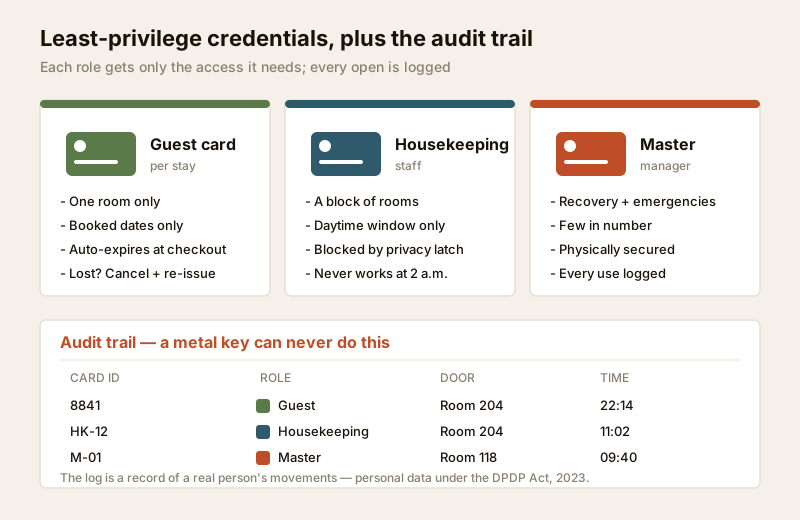
A guest is only one kind of user. The management layer's real job is handling everyone else safely, with the least access each role needs — the same "minimum necessary" idea that runs through good building security.
- Housekeeping / staff cards. These open a block of rooms, but usually only within a daytime window and only when the room is not set to "privacy" from the inside. A cleaner's card should never work at 2 a.m., and should never override a guest who has engaged the privacy latch.
- Manager / master cards. A tightly-controlled recovery credential that can open rooms for emergencies (a guest locked out, a medical situation). Because it is powerful, it should be few in number, logged like everything else, and physically secured.
- The audit trail. Every open is recorded on the lock — which card, which door, at what time — and pulled into the software (in offline systems, collected by staff sync or a reader). This is the feature a metal key can never offer: if there is a dispute or an incident, you can see who entered and when.
That audit trail is exactly why a hotel-style lock is a miniature access-control system, and exactly why the privacy rules below matter: the log is a record of a real person's movements.
Deactivating a lost card, safely
The single most common live task is a guest reporting a lost card. The safe drill:
1. In the software, cancel the lost card for that room and issue a replacement.
2. On an offline system, understand that the door enforces the cancellation when the new card (or a staff card) is next used on it — so hand the guest the new card and have them use it.
3. If the loss is a security worry (a card that could open shared or high-value space), send staff to sync that specific door, or use the manager card to re-key that room's credentials per the vendor's procedure.
4. Log the incident. Note the room, time and action — both for the guest's protection and yours.
The reason to know your system's cancellation mechanism before you buy is that "how fast can I kill a lost card at the door?" is a genuine difference between offline, hybrid and online systems.
Egress and life-safety: a guest-room door is an escape route
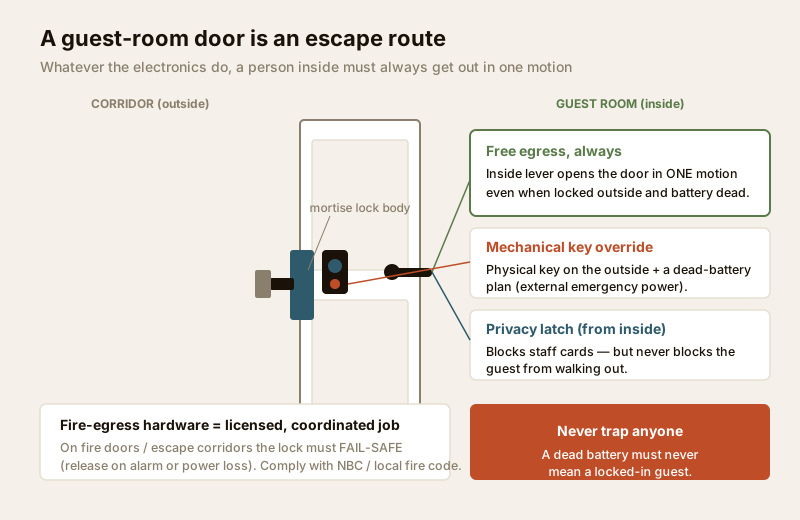
This is the non-negotiable part. A guest-room door is a door that a sleeping stranger must be able to escape through in a fire, in the dark, in a panic — possibly a child or an elderly guest who has never seen your lock before.
- Free egress always. The inside handle or thumb-turn must open the door in one motion, even when the door is "locked" from outside and even when the battery is dead. A person inside must never be trapped by the electronics. This is a hard rule, not a feature.
- Fire-code compliance. The lock and door assembly on an escape route must meet the fire-egress and exit provisions of the local building code and the National Building Code of India; on designated fire doors and along escape corridors, the hardware and any electric interlock must fail-safe (release on a fire-alarm signal or power loss). Selecting and interlocking this is a coordinated, licensed job — not a DIY swap.
- A mechanical key override and battery plan. Keep a mechanical key override on guest-room doors and a clear plan for a dead battery (external emergency power, or a master mechanical key held securely). Guests get locked out; batteries die at the worst moment. Design for it.
- Privacy latch, not a trap. The inside privacy function should stop staff cards entering, but must never stop the guest leaving.
Privacy: a guest's stay is personal data
The audit trail is powerful, and power over other people's data comes with duties. Under the Digital Personal Data Protection Act, 2023, a guest's booking details and — importantly — the record of when they entered and left their room are that person's personal data. Running a PG, hostel or homestay makes you a data fiduciary for it.
- Collect and keep the minimum. You need the entry log to run the property safely; you do not need to keep it forever. Set a sensible retention period and delete old logs.
- Delete a departed guest's data. When a stay ends and any dispute window has passed, the credential is already dead; the associated log should be aged out on your retention schedule, not hoarded.
- Control who can see the log. Access to the audit trail is a manager-level right, not something every staff card exposes. Treat it like the access-control logs it really is.
- On-device vs cloud. A cloud-managed system is convenient but puts guest movement data on a third-party server — check where it is stored and who can read it. An offline system keeps the log local, which is simpler to reason about for privacy but harder to back up.
- Tell guests, briefly. A short line that room access is electronically logged for security, and how long it is kept, is honest and increasingly expected.
This is the same duty that governs CCTV footage and door logs across the hub — the technology changes, the responsibility does not.
Batteries, power cuts and the Indian environment
Because the offline lock lives on batteries, its upkeep is a running task, not a one-off:
- Battery life and warning. Good locks give a low-battery signal (a light or a beep) well before they die. Have a replacement routine so no door goes dark, and know the external emergency power point (many locks accept a 9V battery or USB on the outside to give one opening if the internal cells are flat).
- Clock drift. Because expiry depends on the lock's internal clock, that clock must stay accurate. Systems handle this differently (staff sync, periodic re-sync); confirm how yours keeps time, or an expired card might open a room a few minutes early or late.
- Environment. Corridor locks are usually indoors, but any lock exposed to a veranda, a courtyard or coastal humidity needs a suitable weather and dust rating and corrosion-resistant finish — India's monsoon, heat and salt air are hard on hardware.
- Door compatibility. Most Indian room doors take a mortise lock, not a US-style deadbolt; confirm the lock body suits your door thickness and stile before ordering. See the mortise smart-lock guide.
What it costs, roughly
Treat these as planning ballparks to sanity-check a quote, not fixed rates — they move with brand, features, mobile-key support and system size.
| Item | Typical Indian range | Notes |
|---|---|---|
| Battery RFID room lock (per door) | ₹6,000 – ₹18,000 | Mortise body; more for mobile-key and metal finishes |
| Desktop card encoder + software | ₹15,000 – ₹60,000+ | One per property; higher for cloud/PMS-linked systems |
| Blank RFID cards | ₹20 – ₹60 each | Consumable; keep a stock |
| Mobile-key / gateway module | ₹5,000 – ₹25,000+ | Optional; enables phone keys and remote changes |
| Fitting per door (licensed) | ₹800 – ₹2,500 | Door prep, alignment, egress check |
For a small homestay with three or four rooms, a per-stay PIN or mobile key can skip the encoder entirely. For a PG or hostel with many rooms, the encoder-plus-software investment pays back in never chasing a physical key again. Use the smart-lock cost calculator to model your room count.
When to bring in a professional. You can run the daily workflow yourself — issuing cards, setting staff rights, reading the log, changing batteries. Hand the lock and door-hardware fitting, egress compliance, any fire-alarm interlock and any mains or network wiring to licensed professionals, and coordinate the fire-egress design with your architect or fire consultant per the electrical and building-code rules. Never accept a guest-room lock that a person cannot open from the inside in one motion with a dead battery. Get the system's card-cancellation and clock-sync behaviour demonstrated on site before you sign off.
Key takeaways
- Hotel-style digital locks are a system, not just a lock — a front-desk encoder and software issue a per-stay card or code that auto-expires at checkout, so you never chase a physical key or re-touch the door.
- They fit far beyond hotels in India — PGs, hostels, homestays, serviced apartments, co-living and short-lets all have the same "many rotating guests" problem the form was built for.
- Most Indian installs are offline — the card carries the permission and the battery lock decides locally, which survives power cuts and needs no cabling, but means cancelling a lost card is not instant at the door; know your vendor's cancellation and clock-sync method before buying.
- It is miniature access control — staff cards with least-privilege, a master card for recovery, and a who-entered-when audit trail; that log is a guest's personal data under the DPDP Act, 2023, so minimise it, secure it and delete it on a retention schedule.
- A guest-room door is an escape route — the inside handle must always open in one motion even with a dead battery, fire-egress hardware must comply with the code and fail-safe where required, and a mechanical override plus a battery plan are mandatory; fitting and interlock are licensed, coordinated work.
References
- Digital Personal Data Protection Act, 2023 — a guest's booking and room-entry log is personal data; obtain consent where required, collect and retain the minimum, restrict who can read the audit trail, and delete a departed guest's data on a defined retention schedule.
- Manufacturer specifications — verify the lock body type and door compatibility, RFID/mobile-key technology, card-cancellation and clock-sync behaviour, battery life and emergency-power method, and weather/dust rating on the maker's own datasheet before ordering.
- National Building Code of India (SP 7), Bureau of Indian Standards, and local fire-service and municipal bye-laws for fire-egress, escape-route and exit-hardware requirements on guest-room and corridor doors; verify the current edition via the BIS catalogue: https://www.services.bis.gov.in/
This is an educational overview, not legal advice. Door-hardware fitting, fire-egress compliance, fire-alarm interlock and any electrical or network wiring are qualified professional tasks — engage licensed professionals, coordinate egress design with a fire consultant, and verify any standard's current status via the BIS catalogue before relying on it.
Export this guide
Related Guides — Deep-dive reading
Access Control Maintenance in India (2026): Readers, Locks and Fail-Safe Egress
How to keep a card, keypad, fingerprint or face access-control system reading reliably and locking securely — and, above everything, how to test that its doors still release on a fire alarm and on power loss, so an access-controlled door never becomes a life-safety trap.
SecurityFire-Egress Compatibility for Smart Locks in India (2026): Never Trap Anyone
How to make sure a smart lock or access-controlled door on an escape route always lets people out in a fire or emergency: fail-safe hardware, free egress, fire-rated doors, and the fire-alarm interlock.
SecurityOffline Access Control in India (2026): Standalone Locks That Work Without a Network
How standalone, non-networked access control works when the permission lives on the door or on the card, where offline is the right choice, how you manage it, and the honest trade-offs versus a live cloud system.
SecurityRelated Tools — Try Free
Door Lock Selector
Answer a few questions and get the right lock type — mortise, multipoint, deadbolt, privacy or smart — for any door.
Door ToolSmart Lock Cost Calculator
Estimate smart door lock cost by access type, tier and number of doors — and compare it to a mechanical lock.
Door CalculatorSmart Lock Door Compatibility Checker
Tell us your door build, existing lock or prep, thickness and location and find out which smart-lock form factor fits — mortise, deadbolt, rim, gate or a special case — plus the measurements to take.
Compatibility