
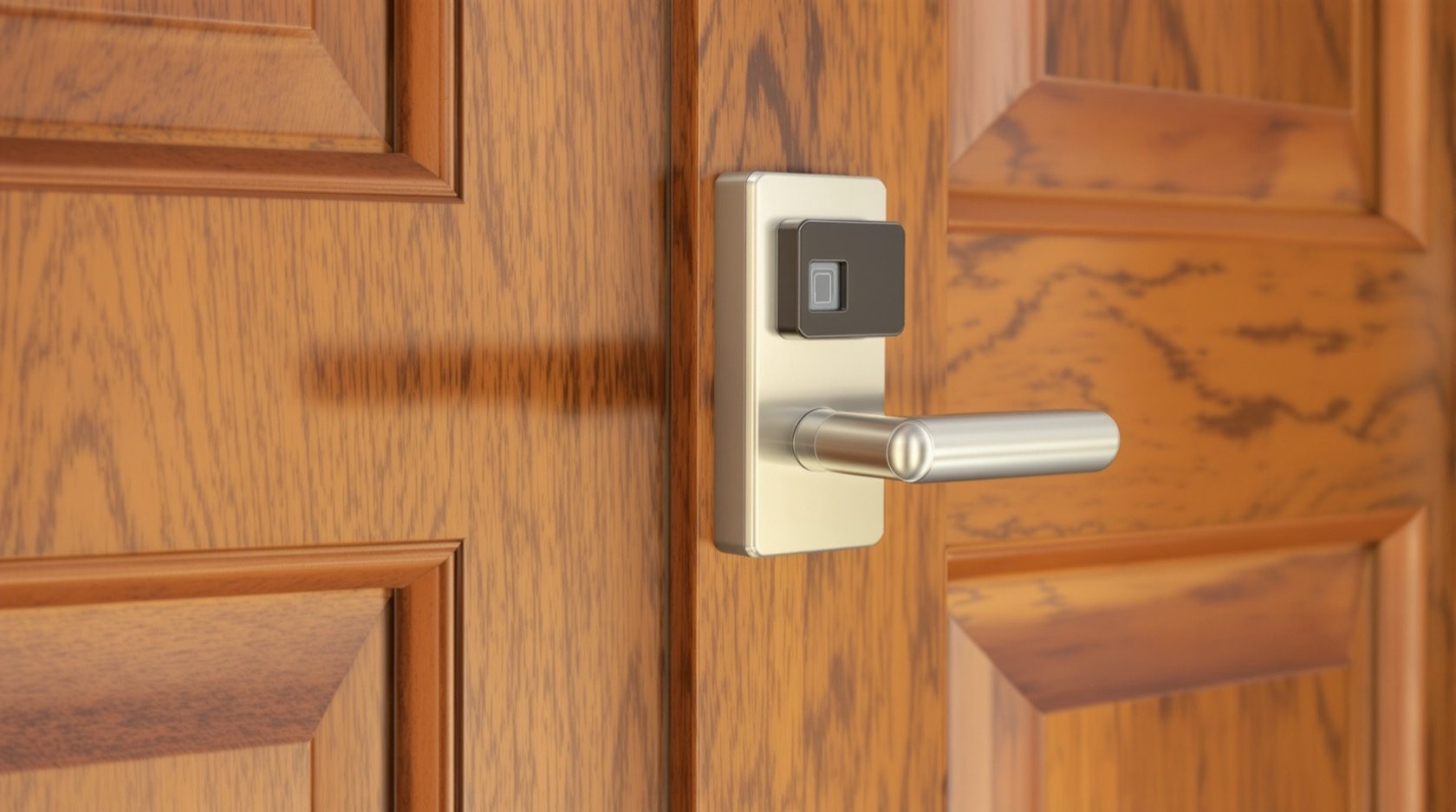
Mortise Smart Locks in India (2026): The Default Main-Door Choice
Why a smart mortise handle-set is the natural upgrade for most Indian main doors, how the case sits inside the door edge, what to measure before you retrofit, and how you still get in when the battery dies.
Walk up to almost any front door in India and put your hand on the long vertical handle. Behind that handle, buried inside the thickness of the door, is a single rectangular metal box. That box is a mortise lock, and it is the reason mortise smart locks are the most important lock form for Indian homes. If you upgrade one door in the house to a smart lock, it is almost always this one, and it is almost always a mortise.
This guide is part of the Studio Matrx smart locks and access control hub, sitting alongside its siblings on the deadbolt and rim body types. Where those two cover the American-style bolt-on and the surface-mounted styles, this one covers the format your main door was very likely built to take. It explains what a mortise lock actually is, why it suits heavy Indian doors, what a smart mortise handle-set contains, how to check a new one will fit your door, and the two questions that matter most on any lock people escape through: how you get out, and how you get in when the battery is flat.
Scope & safety. This guide helps you plan, choose and supervise a main-door lock; it is not a fitting manual. Cutting or enlarging a mortise pocket, and any wiring for door-phone or fire-alarm integration, is a licensed carpenter's and electrician's job. Your main door is an escape route: the inside lever or thumb-turn must always let anyone walk out in one motion without a code or key, and you must keep a working mechanical key override plus a spare credential for the day the battery dies. Biometric and log data is sensitive personal data under the Digital Personal Data Protection Act, 2023. This is educational guidance, not legal advice.
What a mortise lock actually is
"Mortise" is a woodworking word for a pocket cut into a piece of timber. A mortise lock is a lock whose whole mechanism lives inside a rectangular pocket chiselled into the edge of the door, rather than bolted onto the face or through a round hole. One steel case, sunk into the door edge, carries everything: the handle mechanism, the spring latch that clicks shut on its own, and the deadbolt that throws to lock. From the outside you see only a slim panel and the handle; the muscle is hidden in the door.
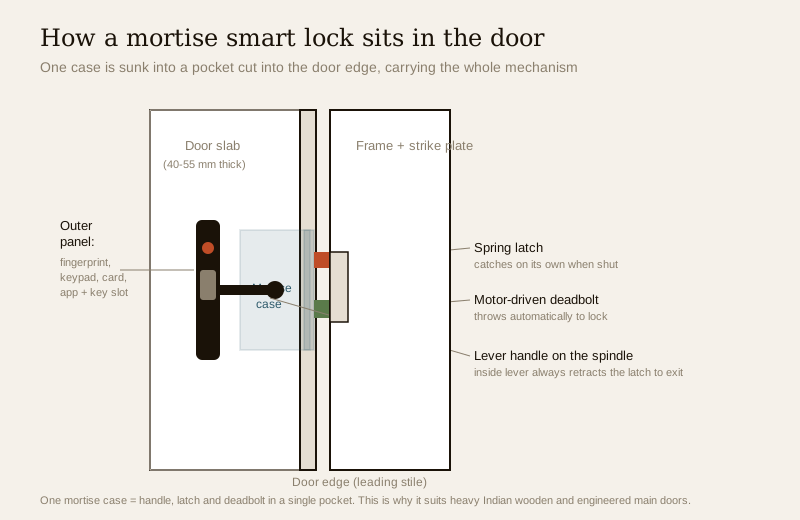
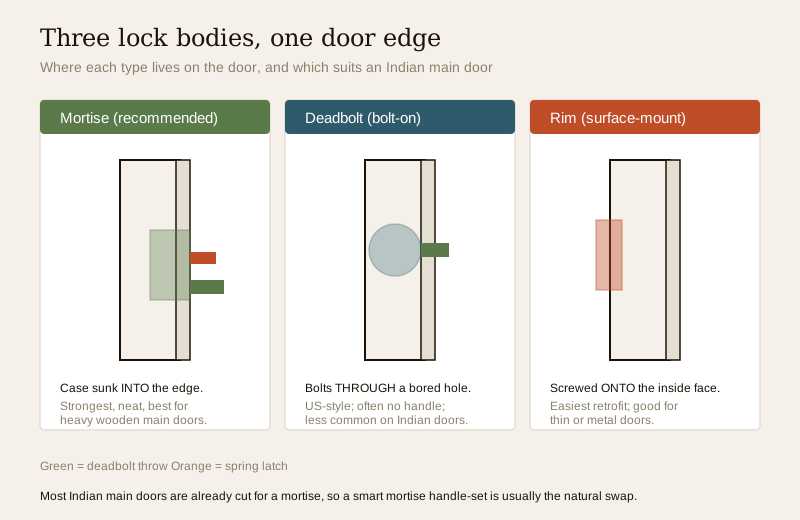
This is a fundamentally different idea from the other two body types, and the difference decides which one you can use:
- A mortise lock is let into the door edge. Strong, neat, and the traditional Indian main-door fitting.
- A deadbolt is bolted through a round bored hole, US-style, and often has no handle of its own.
- A rim lock is screwed onto the inside face of the door, the easiest retrofit and the friend of thin or metal doors.
Because your existing main door almost certainly already has a mortise pocket cut for its current lock, a smart mortise handle-set usually drops into the space the old lock leaves behind, which is exactly why it is the default recommendation for a main door.
Why the mortise suits heavy Indian doors
Indian main doors are, by global standards, substantial. Solid teak or sal, engineered hardwood, thick flush doors on a hardwood frame, forty to fifty-five millimetres of it. That mass is a security asset, and the mortise lock is the format that makes the most of it:
- Strength through the door, not on it. Because the case sits inside the timber and the deadbolt throws deep into a strike plate in the frame, the load is spread through the thickest part of the door. There is no surface box to lever off and no reliance on a few face screws.
- A proper grip handle. Heavy doors need a substantial handle to pull them shut against a frame and a weather seal. The mortise handle-set gives you that long grip, which is why Indian main doors feel the way they do.
- It fits what you already own. Most homes are not building a new door; they are swapping the lock on an existing one. The mortise is the format the door was made for.
- A clean, premium look. With the mechanism hidden, only the slim escutcheon and handle show, which reads as a finished piece of hardware rather than a gadget bolted on.
For a fuller comparison of when each body type wins, the complete guide to smart locks and the interactive smart lock selector walk through door type, tenancy and budget together.
Inside a smart mortise handle-set
A "smart mortise lock" is really a smart handle-set: the traditional mortise case, upgraded with a motor and an electronic reader, wrapped in inner and outer panels. Understanding the parts helps you read a spec sheet and avoid paying for features you will not use.
| Part | What it does | Why it matters |
|---|---|---|
| Grip handle | The long pull you already know, on the outside face | Ergonomics on a heavy door; the family will use this daily |
| Reader panel | Fingerprint sensor, touch keypad, card/tag zone and app radio on the outer panel | Your unlock methods; choose by household, see credential guides below |
| Spring latch | Clicks shut on its own when the door closes | Keeps the door held even before it is fully locked |
| Motor-driven deadbolt | Throws automatically or on command to truly lock the door | The actual security; auto-locking removes the "did I lock it?" worry |
| Inner lever / thumb-turn | Always retracts the latch and bolt from inside in one motion | Life-safety: this is your unconditional exit, no code needed |
| Key cylinder | A hidden mechanical keyway | Your dead-battery and dead-electronics fallback |
| Battery bay | Usually four AA cells inside the door | Powers the motor and reader; typically 6-12 months |
The reader is where you actually make a choice. A mortise handle-set can carry a fingerprint sensor, a PIN keypad, an RFID card or tag, NFC phone-tap, Bluetooth or Wi-Fi app unlock, and on premium models face recognition. Most main-door sets bundle three or four of these; pick the mix by who lives there rather than by the longest feature list. This guide is about the body, so it links out to those credential guides rather than repeating them.
Auto-locking and multi-point locking
Two mechanical behaviours separate a good main-door mortise lock from a basic one.
Auto-locking means the deadbolt throws by itself a few seconds after you close the door, so the door is never left merely latched. On a family main door this is genuinely valuable: no one has to remember to lock up, and children going in and out do not leave the house on the latch. The trade-off is that you must never step out "for a second" without a credential on you, or you can auto-lock yourself out; on a home door this is exactly why the mechanical key override matters.
Multi-point locking is found on taller or premium doors: turning the handle or throwing the bolt drives not one but several bolts, top, middle and bottom, into the frame at once. It resists forcing and warping far better than a single point and is common on tall villa entrance doors and better uPVC or engineered doors. It is worth asking for on a tall main door, though it needs a door and frame built to take it, which is a fitting question for your carpenter.
Will it fit? The retrofit check
This is where mortise upgrades succeed or fail. A smart mortise handle-set is not one universal size; it must match the pocket and door you already have. Before you buy, or before your installer does, four measurements decide whether the new lock drops in or needs the carpenter to re-cut the door.
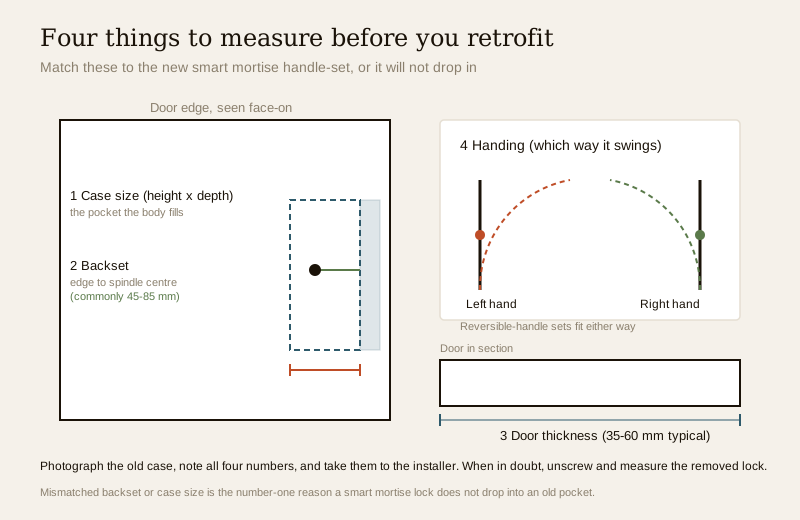
| What to check | Why it matters | Rough Indian range |
|---|---|---|
| Mortise case size | The new case must fit the existing pocket, or the door must be re-cut | Varies by brand; match the removed case |
| Backset | Distance from the door edge to the centre of the spindle; wrong backset and the handle sits in the wrong place | Commonly 45-85 mm |
| Door thickness | The panels and through-bolts are sized for a range; too thin or too thick and it will not clamp | Typically fits 35-60 mm |
| Handing | Which side is hinged and which way the door swings, left or right | Match, or buy a reversible-handle set |
The safest way to get all four right is to remove the old lock, photograph it, and measure the case and backset directly, then take those numbers to the installer. A reversible-handle set solves handing by working either way. If the new case is a slightly different size, a carpenter can usually enlarge the pocket, but that is a woodworking job to leave to a professional, not a DIY chisel session on your one good main door. For a retrofit that turns out awkward on a thin or metal door, a rim lock is often the easier answer, and for a door that already has only a round bored hole, an electronic deadbolt may suit better.
Retrofit versus a new door
If you are keeping your door, a mortise smart handle-set that matches your measurements is the cleanest upgrade: same pocket, same handle position, a familiar look. If you are building or replacing the door, tell the door supplier you want a smart mortise handle-set from the start, so the door is cut for the exact case, backset and, if you want it, multi-point strikes. Getting the door and lock specified together avoids every fit problem above.
Getting in when the battery dies
The single most common worry, rightly, is what happens when the lock is dead. A mortise smart lock on a home main door should always give you at least two ways past a flat battery, and you should confirm both before you rely on the lock:
- The mechanical key override. Every home mortise smart lock should retain a real key cylinder. When the electronics are dead, the physical key still throws the bolt. Keep two keys off-site with someone you trust, exactly as you would for any front door, and test the key on installation day so you know it works.
- Emergency power. Many models have external contacts on the outer panel where you can hold a 9V battery or a power bank to wake the lock just long enough to unlock with your fingerprint or code. This is a get-in-now measure, not a fix; change the cells afterwards.
- Low-battery warnings. A good lock beeps and shows a low-battery signal on the app for days or weeks before it dies. Do not ignore it. Keep a spare set of the right AA cells in a drawer.
For the full picture on chemistry, life and warnings across lock types, the smart lock battery guide goes deeper; the principle for a mortise main door is simply: never let the mechanical key and a spare credential be the thing you have not tested.
Fire-egress: you must always get out
A main door is an escape route, and this is non-negotiable. Whatever clever locking the outside does, the inside must always let a person leave in a single motion, no code, no app, no key hunt. On a mortise handle-set this is the inside lever or thumb-turn: pressing the lever retracts both the latch and the deadbolt together, and the door opens. Confirm this behaves correctly before you accept the install, with the door locked from outside, someone inside must get out instantly by the lever alone.
Two cautions follow from this:
- Be wary of double-locking or "passage lock" modes that disable the inside handle to stop a child opening the door. On a main escape door, any mode that stops a person walking out is a life-safety risk; if you use such a feature at all, understand exactly how it releases and never leave it engaged while people are inside.
- Integration must fail safe. If you tie the lock into a video door phone or a building fire-alarm system, the interlock and wiring must be designed so the door is escapable on power loss or alarm, and that is a coordinated, licensed job, not a plug-and-play accessory. See the electrical hub and treat any fire-alarm interlock as a professional design task governed by the National Building Code.
What it costs in India
Prices move fast, so treat these as sanity-check bands for a main-door mortise handle-set, hardware only, before fitting.
| Tier | Typical price (hardware) | What you usually get |
|---|---|---|
| Entry | ₹8,000 - ₹15,000 | Fingerprint + PIN + mechanical key; single-point deadbolt; local only |
| Mid | ₹15,000 - ₹28,000 | Add card/tag + app (Bluetooth/Wi-Fi); auto-lock; better fingerprint sensor |
| Premium | ₹28,000 - ₹60,000+ | Face recognition, multi-point locking, video/door-phone integration, sturdier build |
Add roughly ₹800-₹3,000 for professional fitting on a matching pocket, more if the carpenter must re-cut the door. Use the smart lock cost calculator to build a full figure for your door, and read the credential guides linked above to decide which unlock methods actually earn their place.
Privacy and your household
If your mortise lock stores fingerprints or keeps an access log of who came and went, that is sensitive personal data under the DPDP Act, 2023. Practical, not legal, habits: enrol only the fingerprints you need, prefer on-device storage over cloud where the lock offers it, delete a departed helper's or tenant's credential the day they leave, and be honest with the household about what the lock logs. The remote access locks guide covers the extra care an internet-connected lock deserves.
When to bring in a professional. Choosing the lock and taking the four measurements you can do yourself. Cutting or enlarging the mortise pocket, hanging or re-hanging the door, and any wiring to a door phone or fire-alarm interlock are licensed carpenter's and electrician's work, see the electrical hub. Always have the installer demonstrate, before you sign off, that the inside lever opens the locked door in one motion and that the mechanical key works. For apartments and gated communities, check any society or RWA rules on main-door hardware first.
Key takeaways
- The mortise is the default main-door lock in India because most main doors are already cut for one; a smart mortise handle-set usually drops into the existing pocket, which is why it is the natural upgrade.
- It suits heavy doors by hiding a single strong case inside the door edge, giving a proper grip handle and a deadbolt that throws deep into the frame; ask for multi-point locking on tall doors.
- Measure before you buy: mortise case size, backset, door thickness and handing decide whether it fits, or a reversible-handle set solves handing; leave any re-cutting to a carpenter.
- Plan for a dead battery: keep a tested mechanical key override, a spare credential and spare AA cells, and never ignore the low-battery warning.
- It is an escape door first: the inside lever must always open it in one motion, keep any handle-disabling mode off while people are inside, and treat any fire-alarm interlock as a licensed, fail-safe design job.
References
- Digital Personal Data Protection Act, 2023 — fingerprints and access logs stored by a lock are sensitive personal data; enrol the minimum, prefer on-device storage, delete departed users, and be transparent with your household.
- Manufacturer specifications — confirm mortise case size, backset compatibility, supported door-thickness range, handing/reversibility, battery type and life, and the mechanical-override method on the maker's own datasheet before buying.
- National Building Code of India (SP 7), Bureau of Indian Standards — for escape-route hardware and any fire-alarm or electrical interlock on a main door; verify the current edition via the BIS catalogue: https://www.services.bis.gov.in/
This is an educational overview, not legal advice. Cutting a door, hanging hardware and any electrical or fire-alarm interlock are qualified professional tasks — engage a licensed carpenter and electrician, and verify any standard's current status via the BIS catalogue before relying on it.
Export this guide
Related Guides — Deep-dive reading
Access Control Maintenance in India (2026): Readers, Locks and Fail-Safe Egress
How to keep a card, keypad, fingerprint or face access-control system reading reliably and locking securely — and, above everything, how to test that its doors still release on a fire alarm and on power loss, so an access-controlled door never becomes a life-safety trap.
SecuritySmart Locks in India (2026): The Complete Guide to How They Work, How to Choose and How to Fit One Safely
The umbrella guide to smart locks for Indian homes: what a smart lock actually is, the credential that opens it, the lock body it lives in, and the safety, power and privacy calls every buyer must make.
SecurityVideo Door Phones with Smart Locks in India (2026): See, Then Unlock
How to pair a video door phone with a home smart lock so you can video-verify a visitor and let them in without walking over or handing out keys, with a hard focus on mechanical override, power-cut behaviour and egress safety.
SecurityRelated Tools — Try Free
Smart Lock Door Compatibility Checker
Tell us your door build, existing lock or prep, thickness and location and find out which smart-lock form factor fits — mortise, deadbolt, rim, gate or a special case — plus the measurements to take.
CompatibilityDoor Lock Selector
Answer a few questions and get the right lock type — mortise, multipoint, deadbolt, privacy or smart — for any door.
Door ToolApartment Video Door System Planner
Enter flats, entrances, floors and guard desk for a first-pass building intercom plan — door stations, indoor monitors, guard station, the right architecture and an indicative cost band.
Building Planner