
Smart-Lock Door Compatibility in India (2026): Will It Actually Fit Your Door?
The measure-before-you-buy checklist: door type and build, your existing lock prep, thickness, backset, mortise case size, handing and cross-bore, and which smart-lock form factor each Indian door situation actually needs.
The most expensive smart-lock mistake in India is not buying the wrong brand. It is buying a lock that will not physically fit the door you already own, discovering it only when the installer arrives, and then either sending it back or paying to modify or replace a perfectly good door. Smart-lock door compatibility is a set of measurements and door facts you can check in fifteen minutes with a tape measure and a torch, long before any money changes hands.
This guide is the "will it fit?" step in Studio Matrx's smart locks and access control hub. It walks through the door details that decide compatibility, maps each common Indian door situation to the smart-lock form factor that suits it, and ends with a short list of the exact things to measure before you buy. For the wider picture of choosing a lock at all, start with the complete guide to smart locks in India; for what the fitting day itself needs, see installation requirements.
Scope & safety. This guide helps you plan and measure so you buy a lock that fits. The actual fitting, any door modification, and especially anything on a fire-escape route is a licensed door-hardware trade's job, coordinated where needed with an electrician and a fire-safety consultant. Any lock on an escape-route door must fail-safe and keep a manual way out, and every home door should keep a mechanical key override and a backup way in. This is educational guidance, not legal advice.
Why "will it fit?" comes before "which brand?"
A smart lock is not a single universal shape. It is a family of very different mechanisms, each designed to drop into a specific kind of door preparation. A lock built for an American tubular deadbolt bore will not go anywhere near an Indian mortise pocket. A slim rim lock that surface-mounts in ten minutes cannot drive the multipoint hooks in a uPVC door. Get the form factor wrong and no amount of brand quality saves you.
Two India-specific realities make this the first question, not an afterthought:
- Mortise dominance. Most Indian main doors — solid wood or engineered flush doors on a timber frame — already carry a mortise lock: a rectangular steel case buried in a pocket cut into the door edge, worked by a lever handle-set on both faces. This is a different world from the US home, where a round tubular deadbolt through a bored hole is the norm. A lock sold as a "smart deadbolt" often assumes that American bore and simply will not suit a typical Indian mortise door.
- Retrofit reality. Very few people are buying a brand-new door to suit a lock. You are almost always retrofitting onto a door that is already hung, already drilled, and already load-bearing on its hinges. The lock has to respect the holes and pocket that are already there — or you are into carpentry, and a modified door is rarely as strong or as neat as it was.
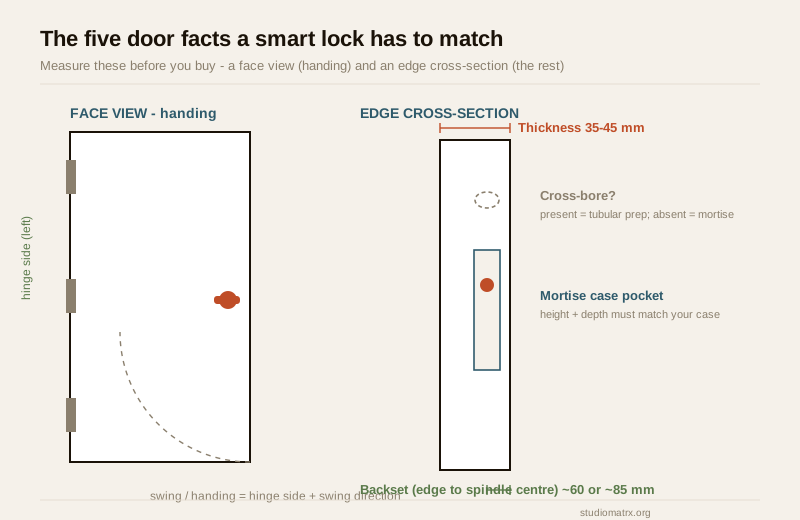
The five measurements that decide it
Every compatibility question reduces to a handful of numbers and one or two facts about how the door is built. Take these before you shortlist anything, and feed them into the smart-lock door compatibility checker.
1. Door type and build
What the door is made of decides both which locks can mount and how much the fixings can bite.
- Solid wood / seasoned hardwood. The friendliest case. Deep, strong, holds screws and takes a mortise pocket. Almost any form factor works if the other measurements line up.
- Engineered flush door (hollow-core or solid-core). Very common on internal and lighter main doors. A solid-core flush door is fine; a hollow-core one has only a thin lock-block of solid timber where the existing lock sits — a heavier smart lock must land on that block, not on the hollow field, or the fixings will pull out.
- Metal (steel gate, MS door, industrial). Needs a lock rated for a thin metal stile, often a narrow-style mortise or a surface rim lock, plus the right drilling and backing. See smart gate locks for gates and grille doors.
- uPVC / aluminium (with a multipoint mechanism). These almost always run a euro-cylinder inside a multipoint lock that throws hooks top and bottom. Compatibility here is about the cylinder and the mechanism, not a stand-alone lock body.
- Glass (framed or frameless). A special case that needs a patch-fitting or glass-door lock designed for the panel thickness and any existing cut-out; you cannot drill a frameless toughened glass panel after the fact.
2. Existing lock and door prep
This is the single biggest compatibility fork, because a smart lock has to reuse — or at least respect — the preparation already cut into the door.
| Existing prep | What it looks like | Natural smart-lock fit |
|---|---|---|
| Indian mortise handle-set | Lever handles both sides, a rectangular case in the door edge, a keyhole below the handle | Mortise smart lock sized to the case |
| US-style tubular / cylindrical bore | A round ~54 mm (2-1/8 in) hole through the face plus a smaller edge bore | Smart deadbolt or knob-set replacement |
| Rim lock / night-latch | A lock body surface-mounted on the inside face, latch on the door edge | Rim smart lock — easiest retrofit |
| uPVC / aluminium multipoint | Lever lift-up handle, euro-cylinder keyway, hooks along the edge | Smart euro-cylinder in the existing multipoint |
| Glass patch lock | Metal patch at the door corner clamping the glass | Purpose-made glass/patch smart lock |
Matching the lock to the prep is what turns a two-hour job into a twenty-minute one. A rim smart lock surface-mounts and barely touches the existing prep, which is why it is the go-to for a clean, reversible retrofit on a solid door.
3. Door thickness
Every smart lock lists a supported door-thickness range, because the two halves (outside reader and inside unit) join through the door with a spindle and bolts of a fixed length. Too thin and the units do not clamp; too thick and the spindle or fixings will not reach.
- Typical Indian main doors run about 35 mm to 45 mm; many solid doors are 40 mm.
- Older or premium hardwood doors can be 50 mm or more — check the lock supports it, or ask about a thick-door spindle/extension kit.
- Thin internal or metal doors (under 35 mm) need a lock that explicitly supports the thin end of the range, sometimes with spacers.
Measure the actual door, not the frame, at the lock height. If you are near the edge of a lock's range, treat it as incompatible unless the maker sells a matching extension kit.
4. Backset and mortise case size
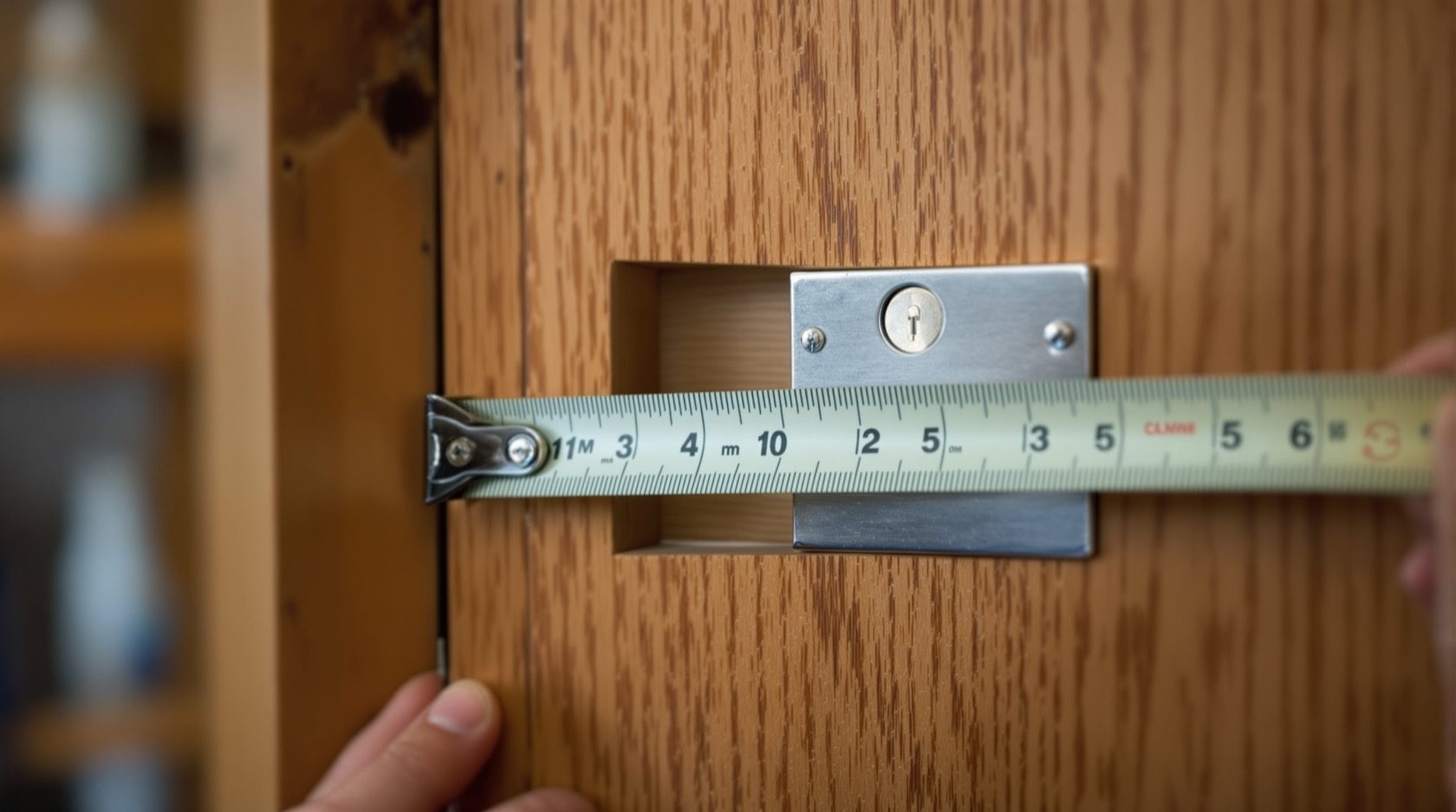
The backset is the horizontal distance from the door edge to the centre of the spindle (the handle/knob axis). If the smart lock's backset does not match the hole already in your door, the handles will not line up with the existing bore, and you are drilling again.
- Common Indian mortise backsets are around 60 mm and 85 mm; tubular deadbolts abroad use 60 mm (2-3/8 in) or 70 mm (2-3/4 in).
- For a mortise replacement, you also need the case dimensions: the case height, the case depth (how far the pocket goes into the edge), and the spindle-to-cylinder (PZ) distance and cylinder position. A mortise smart lock must match the pocket you already have, or the pocket has to be recut — carpentry best left to the door-hardware trade.
The safest mortise retrofit is a smart lock whose case matches your existing case size exactly, so it drops straight into the pocket. The mortise smart locks guide covers how to read a case size and why it matters most on Indian main doors.
5. Handing and any cross-bore
- Handing (left / right). Doors are handed by which side the hinges are on and which way the door swings. Many smart locks are reversible or field-adjustable, but some are handed out of the box, and a lever must point the right way. Note your handing before ordering; if in doubt, describe it as "standing outside, hinges on the left/right, door opens away/towards me."
- Cross-bore. A tubular-bore door has a second, smaller hole drilled through the edge that the latch passes through. A deadbolt or tubular smart lock relies on that cross-bore; a mortise door does not have one. Knowing whether your door has a cross-bore tells you instantly whether it was prepared for a mortise or a tubular lock.
Mapping your door to the right form factor
Once you have the five facts, the form factor usually chooses itself. This is the core of smart-lock door compatibility: matching the door situation to the mechanism designed for it.
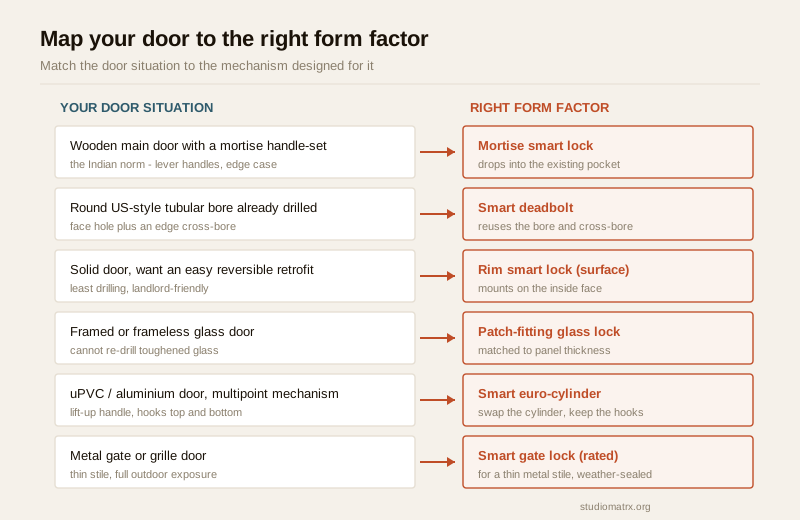
| Your door situation | Right form factor | Why |
|---|---|---|
| Typical Indian wooden main door with a mortise handle-set | Mortise smart lock | Drops into the existing pocket; matches Indian norm; strong multi-throw latch |
| Door already has a round US-style tubular bore | Smart deadbolt | Reuses the existing bore and cross-bore; quick swap |
| Any solid door, want an easy reversible retrofit | Rim smart lock | Surface-mounts inside; least drilling; landlord-friendly |
| Framed or frameless glass door | Patch-fitting / glass smart lock | Made for the panel thickness; you cannot re-drill toughened glass |
| uPVC or aluminium door with a multipoint mechanism | Smart euro-cylinder | Swaps the cylinder only; the existing hooks still do the locking |
| Metal gate or grille door | Smart gate lock | Rated for a thin metal stile and outdoor exposure |
If your door genuinely fits more than one path — say a solid wooden door with a mortise pocket where you would also accept a surface rim lock — weigh neatness against effort: mortise is the most integrated and secure but needs an exact case match; rim is the fastest and most reversible. The smart-lock selector can help you weigh security, form factor and features together.
The special cases that trip people up
Glass doors
A glass door — common on shopfronts, balconies and some interiors — cannot be treated like a timber door. Frameless toughened glass is drilled and cut before tempering; you cannot make new holes afterwards. You need a patch-fitting lock matched to the glass thickness (often 8-12 mm) and to any existing cut-out, and frequently a strike patch on the frame or floor. Treat this as a specialist supply-and-fit, not an off-the-shelf retrofit.
Metal gates and grille doors
An outdoor metal gate has a thin stile, no timber to bite into, and full sun, dust and monsoon exposure. Use a lock explicitly rated for metal doors and outdoor use, with the right weather sealing, and expect drilling and backing plates. The smart gate locks guide covers the outdoor and thin-stile issues in full.
Thin and thick doors
Both extremes bite. A thin door (a light internal or metal door under about 35 mm) needs a lock that supports the thin end of its range, sometimes with spacers so the two halves clamp properly. A thick hardwood door (50 mm or more) needs a longer spindle and fixing kit; without it the outside and inside units simply cannot join. Always check the number against the door you own, not the "standard" door.
Fire-rated doors: a rated lock, not just any lock
A fire-rated door is a certified assembly — the door, frame, hinges, seals and lock are approved together. Fitting an ordinary smart lock, or cutting a bigger pocket into a fire door, can void its rating and, worse, compromise the escape route. On any escape-route or fire-rated door the lock must:
- Be rated to match the door and fitted without destroying the assembly's certification.
- Fail-safe — release on power loss and on a fire-alarm signal — and always keep a manual, single-action way out from the inside so no one is ever trapped. See fire-egress compatibility and the wider emergency door release guidance.
- Be selected and fitted as a coordinated licensed job under the National Building Code and local fire rules — a door-hardware trade plus a fire-safety consultant, not a DIY swap.
Use the fire-door rating checker to understand what a rated door needs before you touch it, and never let a smart lock be the reason someone cannot get out.
Measure these before you buy
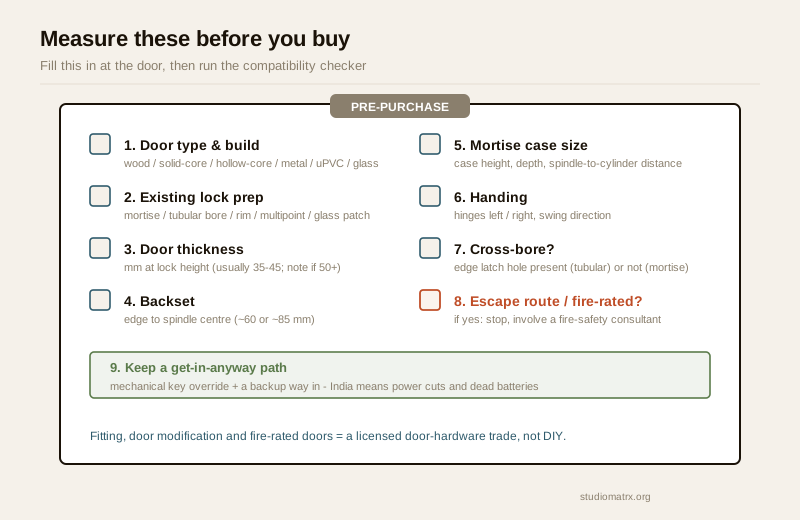
Copy this list, walk to your door, and fill it in before you order anything:
1. Door type and build — solid wood, solid-core or hollow-core flush, metal, uPVC/aluminium multipoint, or glass. For hollow-core, confirm the lock lands on the solid lock-block.
2. Existing lock prep — mortise handle-set, US-style tubular bore, rim/night-latch, multipoint with euro-cylinder, or glass patch.
3. Door thickness — measure the door leaf in millimetres at lock height (typically 35-45 mm; note if 50 mm+).
4. Backset — edge of door to centre of the spindle/handle axis (commonly ~60 mm or ~85 mm).
5. Mortise case size (if mortise) — case height, pocket depth, and the spindle-to-cylinder distance and cylinder position.
6. Handing — hinges on the left or right as you stand outside, and which way the door swings.
7. Cross-bore — is there a separate hole through the door edge for a latch (tubular) or not (mortise)?
8. Escape route / fire rating — is this a fire-rated or sole-escape door? If yes, stop and involve a fire-safety consultant before buying.
9. Get-in-anyway path — confirm the lock keeps a mechanical key override and plan a backup, since India means power cuts and dead batteries; see power and battery planning.
Feed the first eight into the door compatibility checker; it will point you to the form factors that suit your door.
When to bring in a professional. Measuring is a homeowner job; cutting a door is not. Hand the actual fitting, any pocket or bore modification, thin/thick-door kits, glass and metal work, and every fire-rated or escape-route door to a licensed door-hardware trade — coordinated with an electrician for any mains or network wiring and a fire-safety consultant for the egress interlock. If a shortlisted lock needs the door recut to fit, that is a red flag to reconsider the lock, not the door. Always keep a mechanical key override and a backup way in.
Key takeaways
- Compatibility comes before brand. A smart lock is a family of very different mechanisms; the door decides which one can fit, and the wrong form factor cannot be rescued by quality.
- Most Indian main doors are mortise, not tubular. A "smart deadbolt" often assumes a US-style bore your door does not have; a mortise smart lock that matches your case size is usually the right main-door answer.
- Five facts decide it — door type and build, existing lock prep, thickness, backset and mortise case size, and handing plus any cross-bore. Measure all of them before you order.
- Special cases need special locks — glass needs a patch fitting, uPVC needs a smart euro-cylinder, a metal gate needs a rated gate lock, and thin or thick doors need the right spindle/spacer kit.
- Fire-rated and escape-route doors need a rated lock, fail-safe egress and a coordinated licensed fit — never a DIY swap; keep a mechanical override and a backup way in on every home door.
References
- Digital Personal Data Protection Act, 2023 — smart-lock access logs and any fingerprint or face templates are sensitive personal data; minimise, keep on-device where possible, and restrict access. Educational summary, not legal advice.
- Manufacturer datasheets and fitting templates — verify each lock's supported door-thickness range, backset, mortise case dimensions, handing and any thick-door or spacer kit on the maker's own specification sheet before ordering.
- National Building Code of India (SP 7), Bureau of Indian Standards, and local fire and municipal rules for fire-rated doors, escape-route hardware and any electrical work; confirm the current edition and any product standard via the BIS catalogue: https://www.services.bis.gov.in/
This is an educational overview, not legal advice. Fitting, door modification, fire-rated and escape-route hardware, and any mains or network wiring are qualified professional tasks — engage a licensed door-hardware trade, electrician and fire-safety consultant as needed, and verify any standard's current status via the BIS catalogue before relying on it.
Export this guide
Related Guides — Deep-dive reading
Fire-Egress Compatibility for Smart Locks in India (2026): Never Trap Anyone
How to make sure a smart lock or access-controlled door on an escape route always lets people out in a fire or emergency: fail-safe hardware, free egress, fire-rated doors, and the fire-alarm interlock.
SecurityReinforced Wooden Doors in India (2026): Making the Timber Main Door Actually Secure
A homeowner's decision guide to choosing or upgrading the wooden main or flat door most Indian homes actually have, so it genuinely resists a break-in, without pretending a hollow flush door is secure.
SecuritySmart-Lock Installation Requirements in India (2026): What to Plan Before You Fit One
What a smart-lock install actually needs — the door prep, the power, the network, the mechanical override and the fire-egress rules — so you plan it right and know exactly what to hand your installer.
SecurityRelated Tools — Try Free
Smart Lock Door Compatibility Checker
Tell us your door build, existing lock or prep, thickness and location and find out which smart-lock form factor fits — mortise, deadbolt, rim, gate or a special case — plus the measurements to take.
CompatibilityDoor Lock Selector
Answer a few questions and get the right lock type — mortise, multipoint, deadbolt, privacy or smart — for any door.
Door ToolAccess-Control Battery-Backup Calculator
Size the standby battery so an access system keeps running through a power cut, with an egress life-safety note.
Battery Backup