
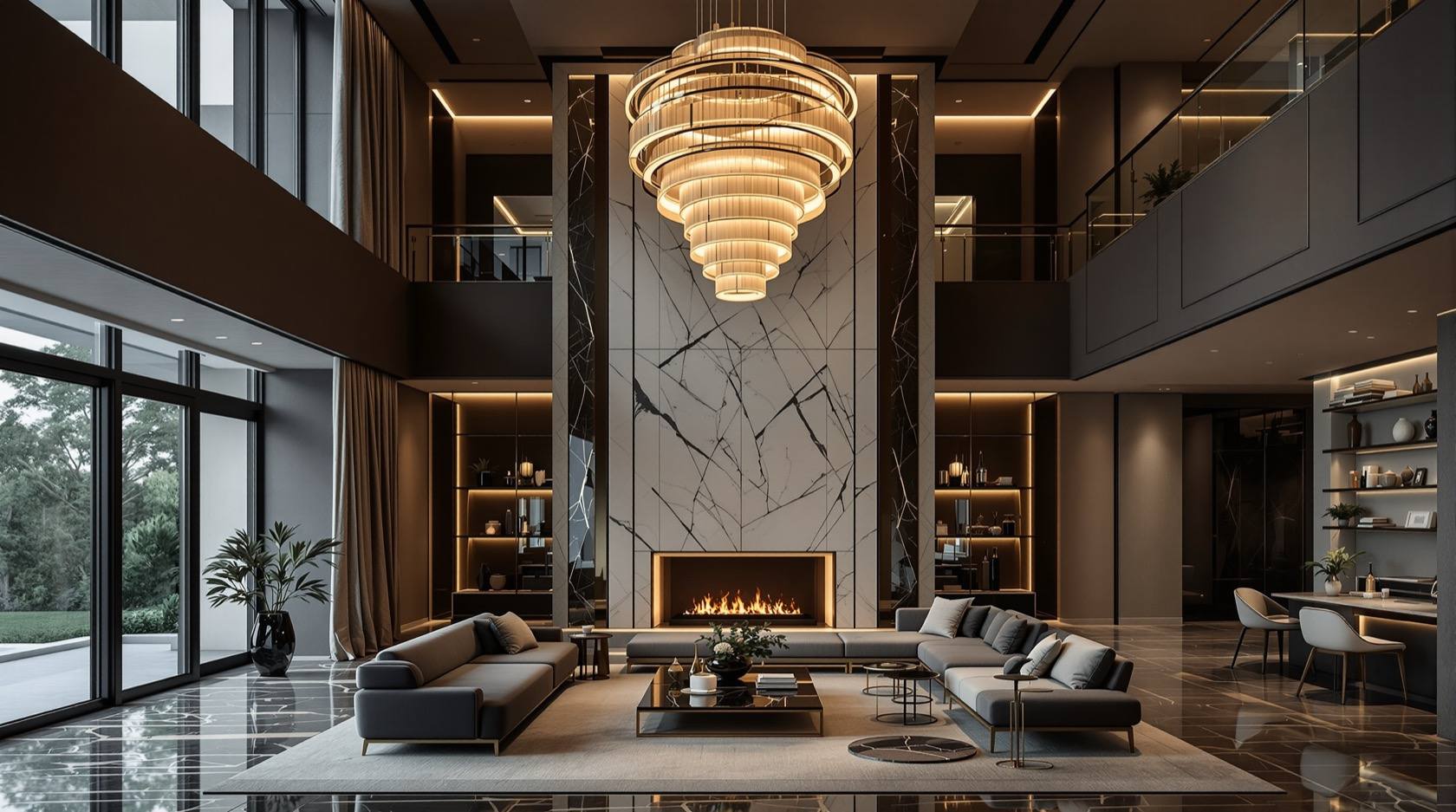
Luxury & Statement Lighting: Drama, Sculpture & Scale (2026)
How to design lighting that actually feels luxurious in an Indian home — layered scenes, deep shadow-and-highlight contrast, hidden sources and premium materials — and how to place one sculptural statement fixture as the jewel of a room without over-lighting the whole thing.
Walk into a genuinely luxurious room after dark and the first thing you feel is not brightness — it is depth. There are bright things and dark things, a sculptural fixture pulling your eye, a wall that glows from a source you cannot see, and a warmth that makes marble and brass look expensive. Now walk into a house where someone spent lavishly on a big chandelier and then wired the whole ceiling to one bright switch, and it reads like a showroom: flat, even, and oddly cheap despite the price tag.
That gap is the whole subject of this guide. Luxury lighting is not a shopping list of costly fixtures. It is layers, control and quality of light — plus, often, one bold statement piece used as a jewel. This is the style guide for high-drama, high-end schemes in the Studio Matrx Lighting hub; it sits alongside modern and contemporary, minimalist and Scandinavian and traditional Indian lighting, and it deliberately does not repeat the deep buyer's coverage in designer lighting for luxury homes or the whole-home aesthetic in the luxury interiors hub — cross-link, then go there.
Scope & how to read this. This is a design-and-specify guide, not a wiring manual. Every wattage band, dimension and rupee range below is indicative to help you plan, brief a designer and set a budget — get local quotes and confirm lux and safety values against IS 3646 (interior illumination), NBC (SP 7:2026) and IS 10322 / IEC 60598 (luminaire safety). All electrical work is safety-critical: circuits, load, dimmer and driver installation, and hanging a heavy chandelier from a slab must be designed and executed by a licensed electrician — a statement fixture can weigh 30-plus kg and a bad fixing over a stairwell is a real hazard. Automation belongs to the smart lighting guide; the deep lumens/CRI/LED-buying technicals live in the Electrical hub.
What actually makes lighting feel luxurious
Ask most people and they will say "a big chandelier". The chandelier is the visible half-second; the feeling comes from four quieter things.
- Layers, not a single source. Rich rooms stack ambient (a soft general wash, often from a cove), task (where you read, cook, work), and accent (narrow beams on art, objects and texture). A ceiling of even downlights is one flat layer — the opposite of luxe. The layered lighting guide is the foundation; this guide is what you do once you have mastered it.
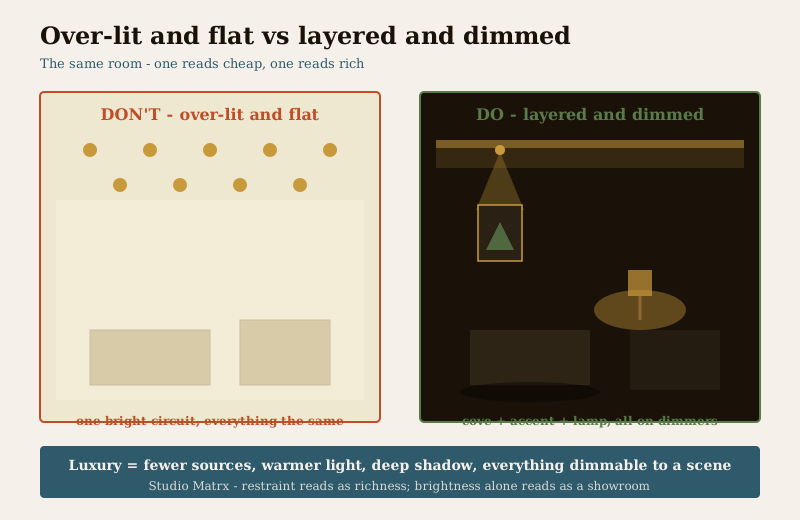
- Control — dimming and scenes. The single biggest upgrade is putting everything on dimmers and saving a few one-touch scenes. Dimmed-to-40% warm light with deep shadow reads as expensive; the same fixtures at full blast read as a hotel lobby at noon.
- Quality of light. Premium schemes use high-CRI sources (Ra 90+) so skin, wood, marble and fabric look true, and a warm colour temperature (roughly 2400-2700K) for the evening. Cheap cool-white LED flattens everything. Set the mood with the colour temperature selector and read the technical detail in colour temperature and CRI.
- Contrast — highlight and shadow. Luxury lives in the ratio between the brightest and darkest thing in the room. Pools of light with genuine darkness between them create drama; a wall-to-wall even level erases it.
Hold those four in mind and the fixtures almost choose themselves. A modest home lit with layers, warm high-CRI light and good dimming will out-feel a costly home lit flat, every time.
The statement piece — one jewel per space
Now the visible star. A statement fixture — a sculptural chandelier, a bold cluster of pendants, an oversized single pendant — is the focal jewel of a room. It earns its place by three rules.
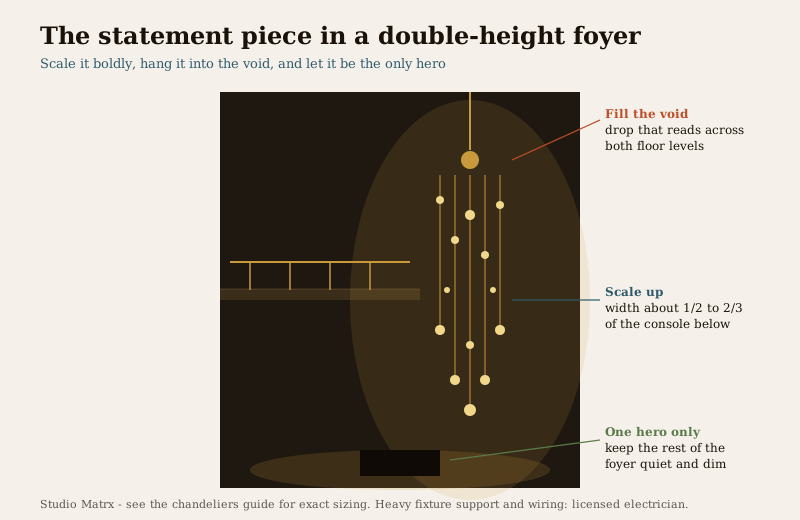
- Scale boldly. The commonest luxury mistake is a fixture that is too small and too timid. Over a dining table, size the fixture to the table, not the room; in a tall or double-height volume, go dramatically larger than instinct suggests. Get the actual numbers — width, drop, mounting height over a table, clearance over a stair — from the chandeliers guide and pendant lighting guide rather than eyeballing it.
- One hero, no competition. A statement piece needs quiet around it. One sculptural fixture per space; let the rest of the room be recessive — recessed downlights on low dimmers, a cove, a lamp or two. Two loud fixtures in one room cancel each other and both look cheaper.
- Light it, do not just hang it. The statement itself is often a soft or decorative source. Surround it with a graze or an accent so it is seen as sculpture even when dimmed, and so the room still has usable light. A dark chandelier in a dark room is a missed jewel.
The statement is where a real budget can go — but it is the last decision, not the first. Layers and control come first; the jewel sits on top.
| Space | Statement move | Scale cue (indicative) | Keep the rest quiet with |
|---|---|---|---|
| Double-height foyer | Cascading chandelier dropped into the void | Reads across both floor levels; roughly half to two-thirds the console width | Cove at the upper floor line, one accent on art |
| Formal dining | Oversized single pendant or linear cluster over the table | About half to two-thirds the table width; base ~75-85 cm above the top | Dimmed downlights, a sideboard lamp |
| Living / drawing room | Sculptural pendant or a bold floor lamp as anchor | Big enough to hold the seating group's centre | Cove wash, accent-lit art, table lamps |
| Stairwell / atrium | Vertical drop or a stacked cluster following the flight | Long enough to be seen from top and bottom landings | Step lights, a grazed stone wall |
| Primary bedroom | A pair of sculptural pendants beside the bed, or one over the foot | Balanced to the bed width, hung so they clear sightlines | Bedside dimmers, a cove behind the headboard |
Materials and finishes that read as premium
Fixtures are jewellery for the ceiling, and material is where the money shows. In Indian luxury homes a few families of finish do most of the work:
- Crystal and cut glass — the classic foyer and dining statement; sparkle and refraction, still the wedding-grand choice for many families.
- Hand-blown glass — Murano-style clusters and coloured globes; softer, more contemporary, and forgiving of scale.
- Brass and bronze — warm metal that ages beautifully and reads richer than chrome under warm light; antique or brushed finishes over polished for a quieter luxury.
- Marble, alabaster and onyx — as bases, shades and, most dramatically, backlit slabs (below). Ties the lighting to the stone that already defines many Indian luxury interiors.
- Bespoke and artisan — a commissioned or limited-run fixture is the surest signal of a considered scheme; explore the ready-made high end in designer lighting for luxury homes before commissioning.
Finish matters more than fixture count. One brass-and-alabaster pendant on a dimmer will out-class five glossy chrome fittings at full brightness.
Drama techniques — the designer's toolkit
These are the moves that turn "well-lit" into "cinematic". Each is a design decision; the electrician executes the wiring.
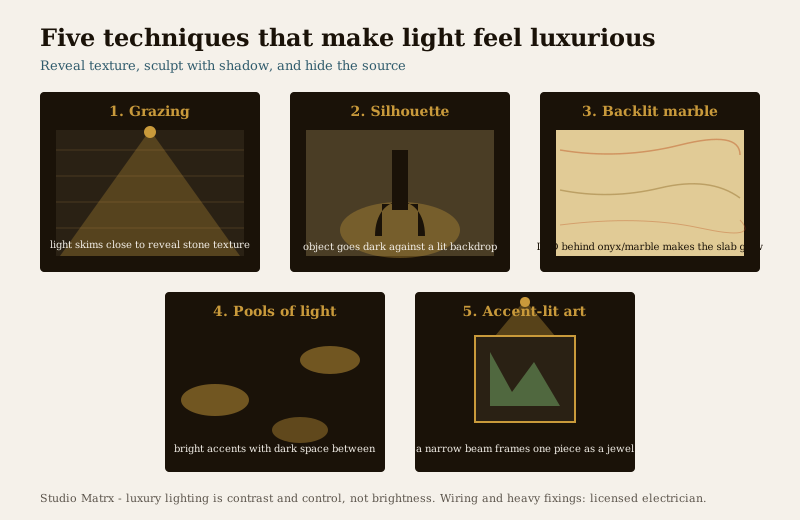
- Grazing — a source placed close to a textured surface (stone cladding, fluted plaster, a jaali) skims across it so every ridge throws a shadow. It reveals material and is the reason luxury walls look "expensive". A near-parallel wall wash does the softer, even version.
- Wall-washing — an even, gentle flood down a plain feature wall to lift the whole plane; use it behind a statement piece or on a gallery wall.
- Silhouetting — light the backdrop, leave the object dark. A screen, a plant or a sculpture goes to a crisp black shape against a glow — pure drama, almost free.
- Pools of light with dark between — the single most under-used luxe move in Indian homes, where the reflex is to light everything. Deliberate darkness between accents is what creates depth. See the do/don't below.
- Backlit onyx, marble or glass — LED strip hidden behind a translucent slab makes a bar front, a console, a bath panel or a headboard glow from within. Spectacular for a lit bar or display niche; specify the strip and diffusion with the strip and profile lighting guide.
- Cove and indirect glow — a concealed uplight in a ceiling recess or behind a bulkhead gives a soft, sourceless luxe ambient layer; the whole craft is in cove and indirect lighting.
- Accent-lit art and objets — a narrow-beam track or spotlight or picture light framing one painting, a bronze, or a display shelf turns it into a focal point. Match the beam angle to the object.
- The lit bar or display — a home bar, a whisky wall or a curio cabinet with backlit shelves and a graze is a signature luxury flourish and a natural evening focal point.
| Technique | What it does | Where it shines in an Indian home | Watch-out |
|---|---|---|---|
| Grazing | Reveals surface texture with raking shadow | Stone/jaali feature walls, fluted plaster, foyer cladding | Needs a truly textured surface; flat walls look patchy |
| Wall-washing | Even lift of a plain feature plane | Gallery walls, backdrop behind a statement fixture | Too bright kills the contrast you want elsewhere |
| Silhouetting | Object dark against a lit backdrop | Screens, plants, sculpture, a jaali partition | Keep the object genuinely unlit for the effect |
| Pools + dark | Depth through highlight/shadow ratio | Living, dining, lounge, bar | Resist the urge to fill the dark gaps |
| Backlit stone/glass | A slab or panel glows from within | Bar front, console, bath panel, headboard | Even diffusion and heat/driver access are the hard part |
| Cove / indirect | Soft, sourceless ambient glow | Living, foyer, primary bedroom, ceilings | Detail the recess so the strip is never directly visible |
| Accent on art | Frames one piece as a jewel | Art walls, niches, display, deity/idol displays | Right beam angle; avoid glare and UV on delicate art |
Scene control is the real luxury
If you take one thing from this guide, take this: the most luxurious lighting feature in a home is not a fixture — it is a keypad that dims everything and recalls scenes with one touch. A room where you can drop the whole scheme to a warm evening setting — cove low, accents up, statement glowing, downlights off — instantly feels considered and expensive. The same room on plain switches never will.
- Dim everything. Every layer on a dimmer, ideally to warm-dim sources that shift warmer as they lower (like a candle). This alone transforms a room.
- Save scenes. A handful of one-touch presets — Welcome, Dining, Evening, Movie, Night — recalled from a keypad, app or voice. Guests notice this more than any fixture.
- Zone and separate. The point of scenes only works if the layers are on separate circuits, which the electrician wires and the automation controls. Plan the zones early.
This is the handshake to automation: design the scenes and layers here, then implement them via the smart lighting guide, choosing smart lighting and the Smart Home hub. Set the evening mood palette for those scenes in mood and scene lighting.
Restraint — why over-lit reads cheap
The paradox of luxury lighting is that less is more. The instinct in many Indian homes — understandably, given years of dim, uneven lighting — is to add more fixtures and more brightness. But an over-lit room has no shadow, no focal point and no depth: it reads as a shop, not a home. A layered, dimmed, warm scheme with real darkness between the highlights reads as rich even on a modest budget.
Restraint also means editing the statement. One jewel, not five. One backlit slab, not a house full of glowing surfaces. The discipline of leaving things dark is exactly what the common lighting mistakes guide warns about from the other direction — and it is the hardest part to get a client to accept.
Grand foyers and double-height drama — the India set-piece
The double-height foyer or living volume is where Indian luxury lighting is most often decided — the villa entrance that greets guests, the space built for the wedding-grand moment at home. Get it right and it carries the whole house.
- Fill the void, do not float a small fixture in it. A cascading chandelier, a stacked cluster, or a long vertical drop that reads from both the ground and the upper landing. See the chandeliers guide for the drop and clearance maths.
- Add a soft base layer. A cove at the upper-floor line or a wall graze on the stone gives the volume ambient depth so the statement is not fighting darkness.
- Light the approach. Step and stair lights, an accent on the console and its art or idol, and a warm pool at the entrance make arrival feel composed. Cross-check the flow with staircase and corridor lighting.
- Plan access for maintenance. A tall foyer fixture must be cleanable and re-lampable — a real constraint the electrician and designer settle before it goes up.
Indicative budgets here span a wide band: a decent statement chandelier might start in the low lakhs, with bespoke crystal or designer pieces climbing far higher — treat these as relative bands and get quotes.
How it connects
- Master the base first: the Lighting pillar, layered lighting, and functional vs ambient vs accent.
- Choose your overall direction with how to choose a lighting style, then compare siblings — modern and contemporary and traditional Indian lighting.
- Size the jewel with the chandeliers guide and pendant lighting guide; build the soft glow with cove and indirect lighting.
- Shop the high end in designer lighting for luxury homes and set the whole-home context in the luxury interiors hub.
- Make it controllable via the smart lighting guide; tune warmth with the colour temperature selector; gather a look in moodboards.
Key takeaways
- Luxury is layers, control and quality — not an expensive chandelier. Dimmed, warm, high-CRI light with deep contrast beats bright, flat, costly light every time.
- Scene control is the real luxury. Put everything on dimmers and save one-touch scenes; a keypad that recalls an evening mood is the feature guests remember.
- One statement jewel per space, scaled boldly. Let it be the only hero; keep the rest recessive, and get exact sizing from the chandeliers and pendants guides.
- Materials read as money — crystal, hand-blown glass, brass, marble, alabaster and bespoke pieces, best seen under warm light.
- Drama comes from technique — grazing, silhouetting, backlit stone, cove glow, accent-lit art, and pools of light with genuine darkness between.
- Restraint reads as richness — over-lighting is the cheap-looking mistake; edit the scheme and leave things dark.
- Design here, wire elsewhere — circuits, load, dimmers and hanging a heavy fixture are safety-critical and belong to a licensed electrician.
References
- IS 3646 — code of practice for interior illumination (recommended lux levels; named generally).
- NBC (SP 7:2026), Bureau of Indian Standards — general illumination and lighting provisions.
- IS 10322 / IEC 60598 — luminaire safety and construction (named generally).
- IS 16107 — performance of LED luminaires; BEE star rating for LED efficiency (named generally).
- IP ratings per IS/IEC 60529 — ingress protection classes for fixtures in wet or splash zones.
- Licensed electrician and lighting designer — circuit design, load, dimmer/driver installation, and safe fixing of heavy statement fixtures.
All wattage bands, dimensions and cost ranges here are indicative planning aids only; confirm illumination and safety values against IS 3646, NBC (SP 7:2026) and luminaire safety codes, get local quotes for cost, and have a licensed electrician design and execute all wiring, dimming and the fixing of any heavy statement fixture.
Export this guide
Related Guides — Deep-dive reading
Lighting Controls & Dimming Design: Zones, Scenes & Switches (2026)
How to plan lighting control so an Indian home's light is flexible — split each room's layers onto separate switches, choose dimmers that actually work with LEDs, add two-way switching where you need it, and layer scenes on top. The design decisions you must settle before the electrician wires.
LightingChandeliers Guide: Sizing, Placement & Care for Indian Homes (2026)
How to choose, size and hang a chandelier as the statement fixture of a room — the room length-plus-width sizing rule, the right height over a foyer void or a dining table, the styles that suit Indian homes, and why the fixing and wiring must go to a licensed electrician.
LightingLighting Design Principles: The Rules Good Schemes Follow (2026)
The design rules that separate a room that feels considered from one that feels like a floodlit hall — layering on separate controls, glare control, colour-temperature discipline, direction and shadow, lighting at different heights, and washing the walls — written for the Indian home.
LightingRelated Tools — Try Free
Home Colour Studio
Colour every room — living, bedroom, dining, kitchen, bathroom — surface by surface in any HEX/RGB/CMYK colour, or from 80+ curated Indian shades.
Colour StudioApartment Furniture Size Chart
Standard furniture dimensions for Indian apartments — sofas, beds, tables, dining, storage.
Reference ChartCross-Ventilation Analyzer
Estimate airflow and air changes per hour (ACH) from room size, window areas, layout, and local wind — with NBC 2016 Part 8 compliance check.
Ventilation Calculator