
Modern & Contemporary Lighting: Clean Lines & Layered Glow (2026)
How to light a modern or contemporary Indian home and the fixtures that define the look - hidden architectural glow, clean geometric forms, matte monochrome finishes, warm-neutral colour, and a few sculptural statement pieces, layered the modern way.
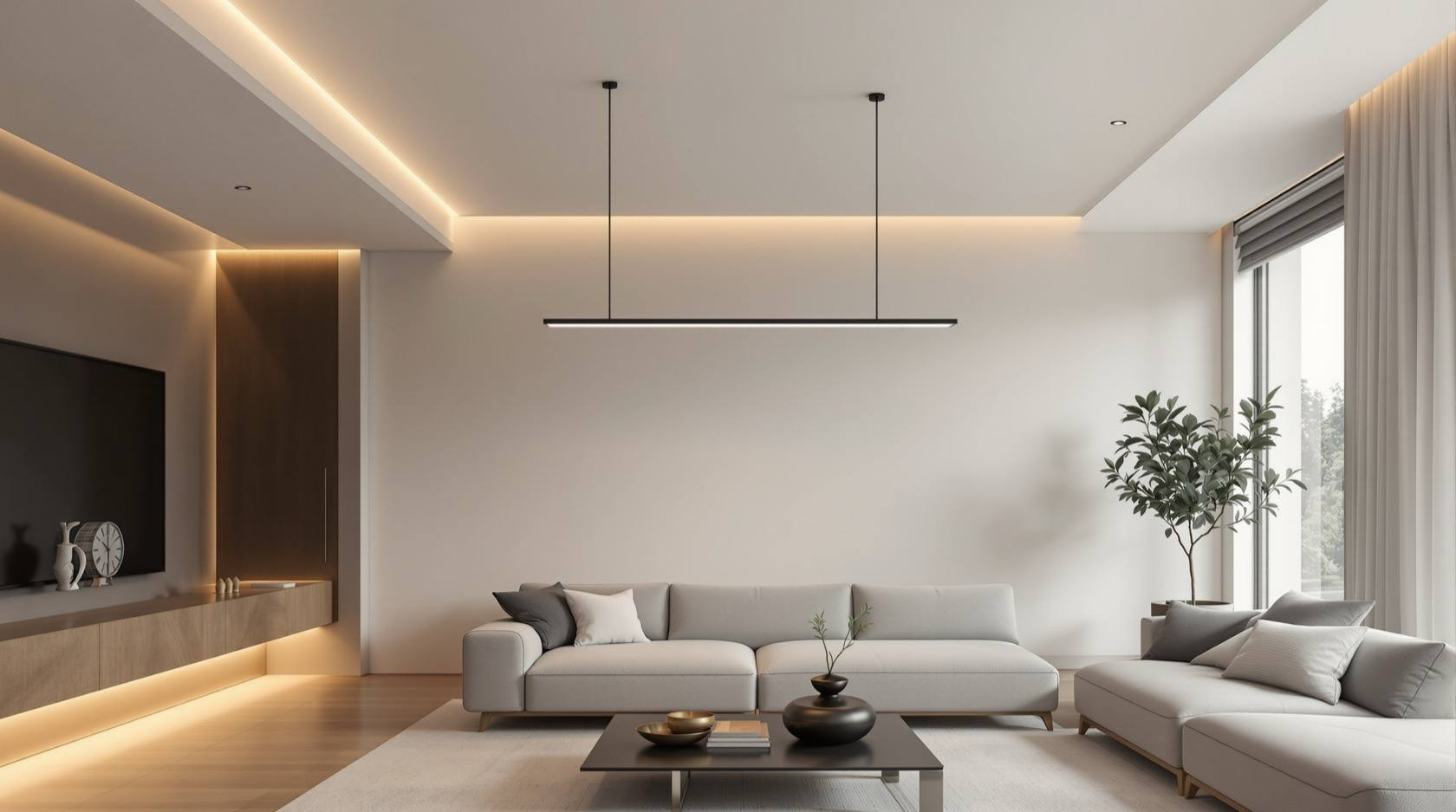
Modern lighting is less about the light fittings you add and more about the ones you hide. The look that reads as "modern" in a 2026 Indian home - clean ceilings, glow that seems to come from the architecture itself, one or two sculptural pieces that earn their place, and a warm, even wash you can dim to a scene - is built on restraint. Get the fixture language, the finishes and the colour temperature right and a modest flat feels considered and calm; overload the ceiling with cold downlights and the same room reads as a departure lounge.
This guide is the style companion for the Lighting hub. It is deliberately lighting-specific: the fixtures, forms, finishes, colour temperature and placement that define the modern and contemporary look. For the whole-room styling decision - furniture, materials, palette - cross-link the interior styles hub rather than repeating it here. If you have not yet settled on a look, start with how to choose a lighting style.
Scope & how to read this. This is a design-and-specify guide: it helps you plan the scheme, pick fixtures and set the mood. It is not a wiring manual. All electrical work - circuits, load, dimmer and driver installation, earthing - is safety-critical and must be designed and certified by a licensed electrician; get this wrong and it can kill. Automation and scenes are covered in the Smart Home hub and smart lighting guide; the deep lumens, CRI and LED-buying technicals live in the Electrical hub. Costs here are indicative bands only - always get local quotes.
The modern lighting language
Modern lighting has a vocabulary. Once you can name it, you can shop for it and brief a designer without hand-waving.
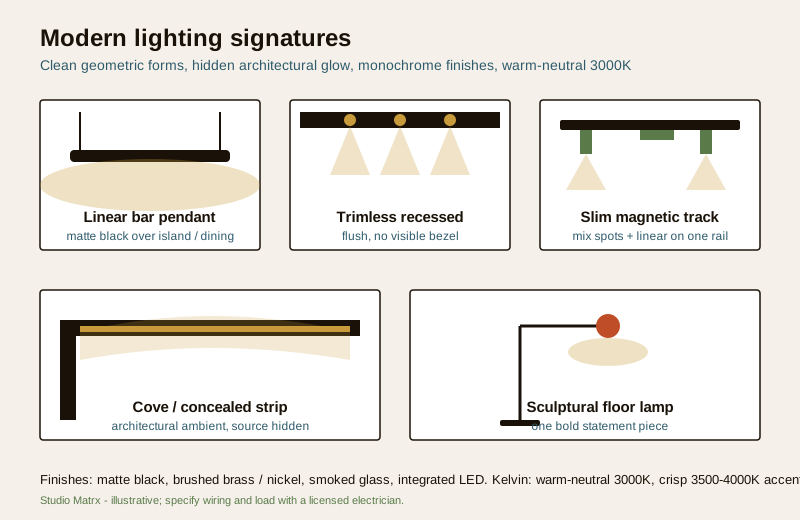
- Clean geometric forms. Straight lines, discs, cylinders, thin rectangles and simple globes - fixtures read as pure shapes, not ornament. A linear bar, a spun-metal cone, a frosted sphere.
- Hidden and architectural light. The signature move. Light emerges from cove channels, slim linear profiles, trimless recessed spots with no visible bezel, and backlit panels - the source disappears and the surface glows. See the cove and indirect lighting and strip and profile lighting guides for the how.
- Slim magnetic track. A single recessed rail that carries interchangeable spots, floods and mini-linears in one clean line - flexible, minimal, very "of the moment". More in track and spotlight lighting.
- A few sculptural statement pieces. Modern is not fixture-free; it allows one or two hero pieces - an oversized linear pendant, a sculptural floor lamp - placed for impact, not repeated around the room.
- Monochrome finishes. Matte black, brushed brass or nickel, gunmetal, smoked or clear glass, white. One finish family per room keeps it disciplined.
- Integrated LED. The light source is built into the fixture as a hidden strip or COB, so you see glow, not a bulb. This is what lets fittings be so slim.
Modern vs contemporary - the nuance
The two words are used interchangeably in showrooms, but they are not the same, and the difference changes what you buy.
- Modern is rooted in the mid-century modern movement: clean lines, honest materials, restraint, a slight retro warmth. Think the classic arc floor lamp, the Nelson bubble pendant, spun-aluminium cones. It is a defined, stable aesthetic.
- Contemporary means "of this moment" - it evolves. Today that reads as ultra-slim profiles, magnetic track, trimless everything, warm dimmable LED and a preference for concealed light. In five years it will mean something slightly different.
In practice most Indian homes want a modern-contemporary blend: the clean-lined discipline of modern with the concealed, integrated-LED tech of contemporary. You do not have to be a purist - just avoid mixing a heavily ornate or rustic piece into the scheme, which breaks the language. If your taste leans warmer and simpler still, the minimalist and Scandinavian lighting guide is the neighbour; if it leans plush and dramatic, see luxury and statement lighting.
The palette - warm-neutral, monochrome, crisp accents
Colour temperature is where most "modern" schemes quietly succeed or fail. The rule for an Indian home:
- Ambient and general light: warm-neutral 3000K. Warm enough to feel like home in the evening, neutral enough to keep whites clean and materials true. This is the backbone temperature - use it for cove, downlights and pendants.
- Task and crisp accents: 3500K-4000K. A slightly cooler note works for a kitchen worktop, a study desk or grazing a stone feature wall to show texture. Keep it targeted.
- Avoid cold 5000K-6500K in living spaces. Daylight-white light reads clinical, flattens skin tones and kills the warmth that makes modern feel calm rather than corporate. Reserve it for utility, garage and deep-task areas only.
Two more palette disciplines: keep fixtures monochrome (one finish family per room), and keep colour temperature consistent across a sightline - mixing 3000K and 5000K bulbs in the same room is the single most common thing that makes a nice room look cheap. For the technical detail on temperature and colour rendering, cross-link colour temperature and CRI and try the colour temperature selector.
| Layer | Temperature | Why |
|---|---|---|
| Cove / architectural ambient | 3000K | Warm even glow, the room's base mood |
| General downlights / pendants | 3000K | Consistent with ambient, no colour clash |
| Kitchen / study task | 3500K-4000K | Crisper for detail work and food prep |
| Accent wall wash / art | 3000K-3500K | Warm reveal of texture and colour |
| Utility / garage only | 4000K-5000K | Function over mood |
Layering the modern way
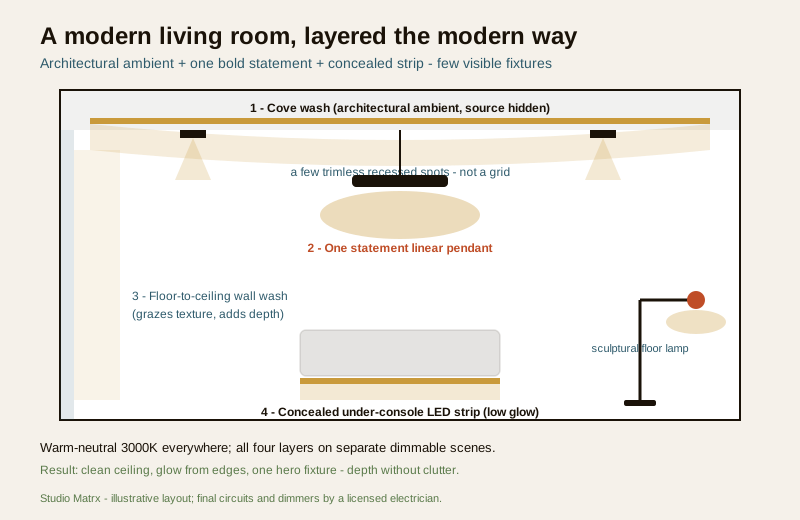
Every good scheme is layered, but modern layers with a light hand. The recipe is architectural ambient + minimal visible fixtures + one bold statement + a concealed strip - four layers, few fittings. The full theory is in the layered lighting guide; the modern application is:
1. Architectural ambient. A continuous cove or perimeter linear profile does the "fill" job that a dozen downlights would do in an ordinary scheme - but the source is hidden and the ceiling stays clean.
2. Minimal visible fixtures. A handful of trimless recessed spots or a single magnetic track for task and accent - placed where light is needed, never as a decorative grid.
3. One bold statement. A linear pendant over the island or dining table, or a sculptural floor lamp by the sofa. This is the piece people notice.
4. A concealed strip. Under a floating console, behind the TV unit, under the bed or along a stair - a low glow that adds depth and a night-time layer.
Avoid the traps
Modern schemes go wrong in predictable ways. Watch for these:
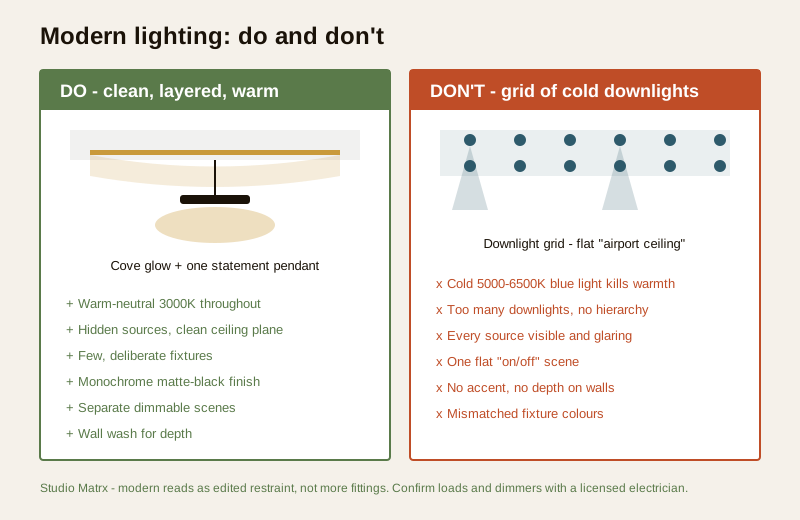
- The "airport ceiling". Too many downlights in a uniform grid gives flat, shadowless, institutional light. Modern wants fewer, better-placed fixtures with a clear hierarchy - let the cove do the fill.
- Cold blue light. 6500K "cool daylight" bulbs are cheap and everywhere, and they kill the warmth instantly. Insist on 3000K for living spaces.
- Mixed colour temperatures. One warm bulb, one cold bulb, one somewhere between - the room looks broken. Buy one temperature per space.
- Mixed finishes. A chrome fan, a brass pendant and a black track in one room fight each other. Pick one finish family.
- Statement overload. Two or three "hero" pieces competing cancel each other out. One statement per room; everything else recedes.
- Visible strip dots and glare. A cheap exposed LED strip shows individual diodes and dazzles. Use a diffused profile channel and tuck it out of the direct sightline. See common lighting mistakes.
Signature moves that define the look
If you do only a few things, do these - each is a recognisably modern gesture:
- Linear pendant over the island or dining table. A single slim bar - matte black or brass - at roughly 75-90 cm above the table. The defining modern kitchen-diner move.
- Floor-to-ceiling wall wash. A recessed or profile grazer that washes a full-height feature wall (stone, fluted panel, textured plaster) reveals material and gives the room quiet drama without a visible fixture.
- A sculptural floor lamp. One arc or cantilever lamp by the sofa adds a hero silhouette and a warm reading pool - a modern staple.
- Backlit panels and niches. A backlit onyx-look panel, a glowing headboard recess or a lit shelving niche turns a surface itself into the light source.
- A clean, near-empty ceiling. Counter-intuitively, the strongest modern move is what you leave out - a ceiling with just a cove line and one pendant reads far more expensive than a busy one.
Modern lighting signatures at a glance
| Element | Modern choice | Contemporary lean |
|---|---|---|
| Fixtures | Clean geometric - discs, bars, cones, globes | Ultra-slim, trimless, integrated |
| Concealed light | Cove and linear profile | Magnetic track + trimless + backlit panels |
| Statement piece | Arc floor lamp, linear pendant | Oversized sculptural pendant, LED "object" |
| Finishes | Matte black, brushed brass, white | Gunmetal, smoked glass, monochrome |
| Colour temperature | Warm-neutral 3000K | 3000K with crisp 3500-4000K accents |
| Light source | Integrated LED (hidden) | Fully integrated, dim-to-warm |
| Ceiling feel | Clean, few fittings | Near-empty, glow from edges |
Get the look - shopping & placement
Indicative bands to plan and brief with - always confirm with local quotes and a licensed electrician for the install.
| Buy this | Where it goes | Placement note | Indicative band |
|---|---|---|---|
| Linear bar pendant (matte black / brass) | Over dining table or island | 75-90 cm above the surface, centred | Rs 6,000 - Rs 30,000+ |
| Aluminium cove / profile channel + LED strip | False-ceiling perimeter, feature wall | Diffused channel, 3000K, source hidden | Rs 200 - Rs 700 per metre |
| Trimless recessed spots | Task points, art, worktop edge | Placed by need, not in a grid | Rs 800 - Rs 3,500 each |
| Slim magnetic track + modules | Living, kitchen, gallery wall | One clean rail, mix spot + linear | Rs 1,500 - Rs 6,000 per metre |
| Sculptural floor lamp | Beside sofa / reading chair | One per room, warm 3000K | Rs 4,000 - Rs 25,000+ |
| Backlit panel / niche strip | Feature wall, headboard, shelving | Even wash, no visible dots | Rs 400 - Rs 1,000 per metre |
| Smart dimmer / dimmable driver | Every layer on its own scene | Confirm compatibility with fittings | Rs 1,500 - Rs 6,000 per zone |
India context - open plans and false ceilings
Two things about Indian modern homes shape the scheme. First, the open-plan flat - living, dining and kitchen in one continuous volume - means colour temperature and finish must stay consistent across the whole sightline, or the space fractures visually. Decide 3000K once and hold it. Second, the false ceiling is near-universal in Indian apartments and villas, which is a gift for modern lighting: it is the natural home for cove channels, linear profiles and trimless recessed spots, letting you hide almost every source. Design the false-ceiling section and the lighting together - the false ceiling guide covers the build side. For a modern living-room scheme end to end see living room lighting, and browse real rooms in living room design ideas.
Also plan for festivals and pooja: modern homes still need a warm, gentle scene for evenings and celebration, which is exactly what a dimmable 3000K cove plus a low concealed strip gives you at the turn of a dial.
Smart & dimmable integration
Modern lighting is designed to change through the day, and that needs dimming and scenes, not more switches. Put each layer - cove, downlights, statement, strip - on its own dimmable circuit or smart channel so you can move from a bright "clean" scene to a warm "evening" one. Prefer dim-to-warm LED where you can, so the light glows warmer as it dims, mimicking a sunset. This is a design decision here; the products, hubs and set-up are in the smart lighting guide and choosing smart lighting, and every dimmer, driver and circuit must be specified and installed by a licensed electrician - dimmer-LED compatibility and load matter for safety and flicker-free performance.
How it connects
- Start at the Lighting hub pillar and, if undecided, how to choose a lighting style.
- Compare neighbouring styles: minimalist and Scandinavian lighting and luxury and statement lighting.
- Go deep on the modern fixtures: cove and indirect lighting, track and spotlight lighting and strip and profile lighting.
- Master the method with the layered lighting guide and dial temperature with the colour temperature selector.
- Cross-link the whole-room look at the interior styles hub, and the architectural technique in architectural lighting design.
- Browse real spaces in living room design ideas.
Key takeaways
- Modern lighting is defined by hidden, architectural light and restraint - fewer, cleaner fittings, not more.
- The language is clean geometric forms, cove and profile glow, slim magnetic track, one or two sculptural statements, monochrome finishes and integrated LED.
- Modern is mid-century-rooted clean lines; contemporary is of-the-moment and evolving - most Indian homes want a blend.
- Keep the palette warm-neutral 3000K with crisp 3500-4000K accents; never let cold blue light into living spaces, and never mix colour temperatures on one sightline.
- Layer the modern way: architectural ambient + minimal visible fixtures + one bold statement + a concealed strip.
- Avoid the airport-ceiling downlight grid, mixed finishes and statement overload.
- India's false ceilings and open plans are ideal for concealed modern light - design the ceiling and the lighting together, and dim each layer to a scene.
- All costs are indicative and all wiring, dimmers and drivers are the domain of a licensed electrician.
References
- National Building Code of India, NBC (SP 7:2026), Bureau of Indian Standards - general illumination and lighting provisions (named generally).
- IS 3646 - code of practice for interior illumination and recommended lux levels (named generally).
- National Lighting Code and IS 16107 - LED luminaire performance guidance (named generally).
- IS 10322 / IEC 60598 - luminaire safety; IP ratings per IS/IEC 60529 for damp or wet locations (named generally).
- ECBC and BEE star rating - lighting power density and LED energy efficiency guidance (named generally).
- A licensed electrician - circuit design, dimmer and driver selection, load and safe installation.
All colour-temperature notes, placement heights and cost bands here are indicative design aids only; confirm the governing values against IS codes, NBC (SP 7:2026) and product data, get local quotes for cost, and have a licensed electrician design and certify all wiring, dimming and installation.
Export this guide
Related Guides — Deep-dive reading
Living Room Lighting Design for Indian Homes (2026)
The design guide to lighting the most-used, most-layered room in the house - how to build a flexible, dimmable, multi-scene living room scheme with ambient, task, accent and decorative layers, warm evening light, a comfortable TV wall and open-plan zoning.
LightingLuxury & Statement Lighting: Drama, Sculpture & Scale (2026)
How to design lighting that actually feels luxurious in an Indian home — layered scenes, deep shadow-and-highlight contrast, hidden sources and premium materials — and how to place one sculptural statement fixture as the jewel of a room without over-lighting the whole thing.
LightingCove & Indirect Lighting: The Soft Glow Done Right (2026)
The design guide to cove and indirect lighting for Indian false ceilings — what it really is, why it is so loved and so often botched, and the depth, lip, setback, strip density and colour rules that separate a smooth ceiling wash from a strip of visible dots.
LightingRelated Tools — Try Free
Apartment Furniture Size Chart
Standard furniture dimensions for Indian apartments — sofas, beds, tables, dining, storage.
Reference ChartCircadian Light Meter
Patient-centric circadian lighting visualizer for Indian healthcare design — time-of-day × intensity → CCT, melanopic lux (EML / mEDI), melatonin suppression, and an alertness curve. Calibrated against WELL v2 L03 Circadian Lighting Design, CIE S 026:2018, Brainard 2001, and Lucas et al. 2014.
Circadian ToolDesign Style Finder Quiz
Answer 10 visual questions to discover your Indian interior style profile with materials and colours.
Interactive Quiz