
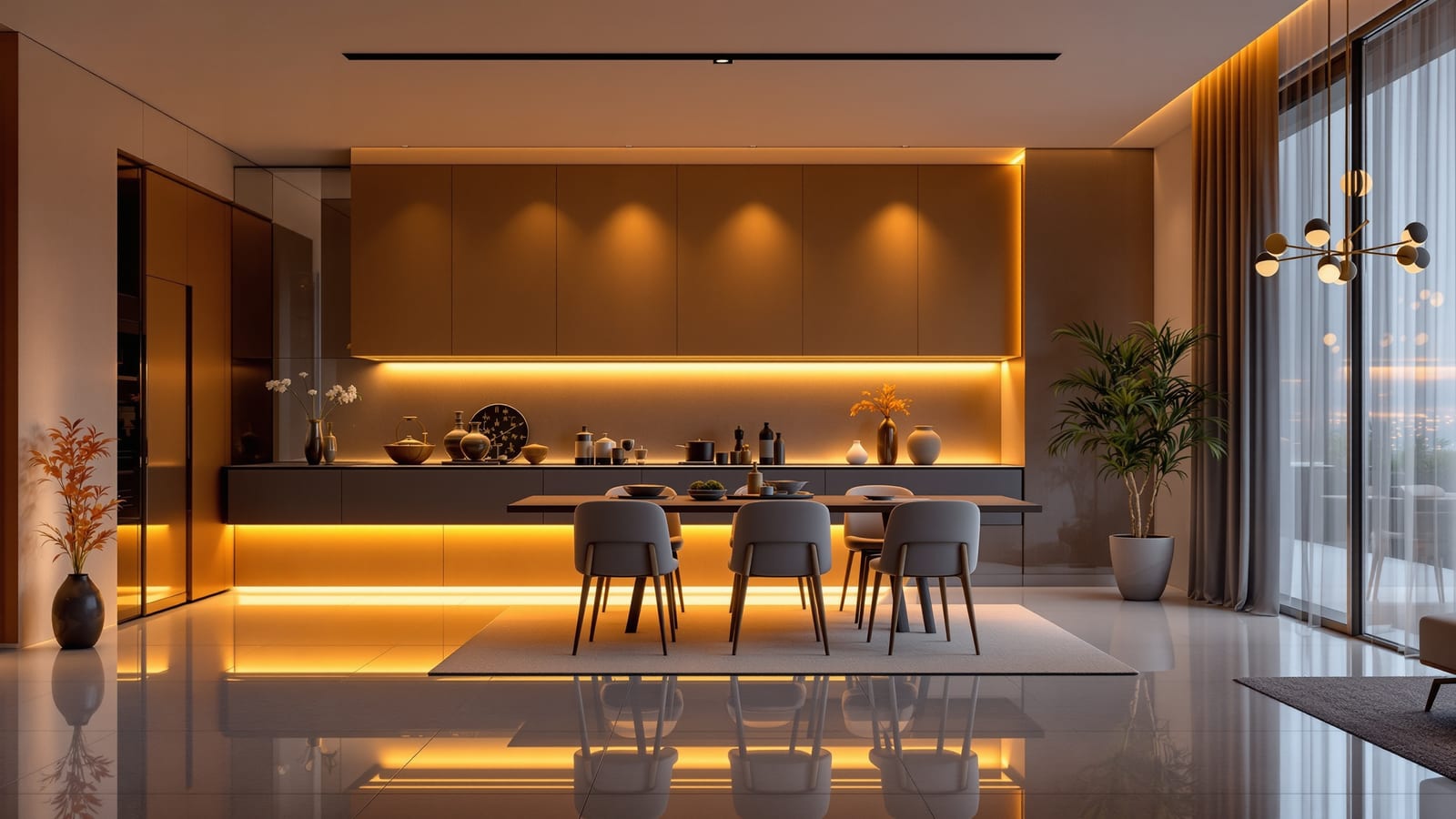
Smart Lighting for Indian Homes: Switches, Scenes, Circadian & Sensors
The one honest decision that shapes your whole system (switch or bulb), plus dimming, tunable white, circadian light, motion sensors and the automations that actually earn their keep — with real Indian brands and rupee costs.
Smart lighting is where most Indian homes start their automation journey, and for good reason: a single bulb costs less than a dinner out, the payoff is immediate, and you feel it every evening. But it is also where people waste the most money — buying twelve colour bulbs when four switches would have been smarter, or filling a home with lights that turn "dumb" the moment someone flips the wall switch out of habit. This guide walks through every real decision, in the order you should make it, for Indian conditions, Indian wiring and Indian prices.
Good smart lighting is not about how many colours a bulb can show. It is about the light being right — warm and dim at night, bright and cool at your desk — without you thinking about it. Automation, not novelty, is the goal.
If you are planning a whole home rather than one room, read this alongside the ultimate guide to smart homes in India and our broader home automation guide for India. Lighting is one pillar; security is the other, covered in our companion smart home security systems guide.
The one decision that shapes everything: smart switch or smart bulb
Before you buy a single product, settle this. Almost every mistake in home lighting traces back to getting this choice wrong for a particular room.
A smart bulb (Philips Hue, Wipro Garnet, Syska, Havells Glamax) is a normal-looking bulb with a radio inside. You screw it in and control it from an app or voice. It can change colour and brightness, but it only works if power is reaching it — so if someone switches off the wall switch, the bulb is dead and unreachable.
A smart switch (Legrand, Schneider, Wipro, GM, Anchor by Panasonic) replaces the wall switch itself. It controls whatever is wired to that circuit — ordinary bulbs, tubelights, even fans — and the physical switch still works for guests and grandparents. But it cannot change a bulb's colour, because it only cuts or dims the power.
When to use which
| Room or use | Better choice | Why |
|---|---|---|
| Living room, bedroom (main ceiling lights) | Smart switch | You want the wall to keep working; grandparents and guests won't fight an app |
| Bedside lamp, study lamp | Smart bulb | You want warm-to-cool tuning and dimming for reading and sleep |
| Pooja room, feature niche, false-ceiling cove | Smart bulb or strip | Colour and scene control add real ambience |
| Balcony, staircase, corridor | Smart switch + motion sensor | Automation matters more than colour |
| Rented flat (no rewiring allowed) | Smart bulb | Nothing behind the wall changes; take it with you when you leave |
| A room with fans on the same board | Smart switch (fan-rated module) | Only a switch can control a fan; a bulb cannot |
A practical rule for most Indian homes: switches for the general lights, bulbs and strips for the accents. You get reliable everyday control plus the fun colour scenes exactly where they matter, without paying for twenty colour bulbs you will set to warm-white and never change.
The catch with switches is the neutral wire. Older Indian wiring often runs only the live wire to the switch box, and most smart switches need neutral to power their radio. Some brands (Legrand Celiane with Netatmo, a few Wipro modules) offer no-neutral variants, but check before buying. If your switch boxes lack neutral and you cannot rewire, smart bulbs become the sensible default. This choice is closely tied to which wireless standard your devices use, which we cover in the smart home protocols guide for India.
Dimming: the most underrated smart feature
Ask people what smart lighting gave them and few say "colours" a year later — but almost everyone says "we dim it every night." Dimming is where the daily value lives.
There are two ways to dim. A smart dimmer switch (Legrand, Schneider, Wipro) varies the power to ordinary dimmable LED bulbs on the circuit — smooth, wall-controllable, one device for many bulbs. A dimmable smart bulb dims itself over its radio. Both work; the pitfall is buying cheap non-dimmable LED bulbs and expecting a dimmer to work — they flicker, buzz or refuse to go low. Always pair a dimmer with bulbs labelled dimmable, and prefer 2700K to 3000K warm bulbs for living spaces so a low dim reads cosy rather than grey.
Tunable white and colour temperature
This is the feature most worth understanding, because it improves your home even if you never touch a single colour.
Colour temperature is measured in Kelvin (K). Lower numbers are warmer and yellower; higher numbers are cooler and bluer.
| Kelvin | Looks like | Best for |
|---|---|---|
| 2200-2700K | Candle to warm bulb | Bedrooms at night, dining, lounge, unwinding |
| 3000-3500K | Soft white | Living rooms, general everyday comfort |
| 4000K | Neutral white | Kitchens, bathrooms, wardrobes, dressing |
| 5000-6500K | Daylight to cool | Study desks, workshops, garages, task work |
A tunable white bulb (Philips Hue White Ambiance, Wipro, Syska) slides across this whole range on demand. This alone justifies smart bulbs at a desk or bedside: cool and bright at 5000K while you work or read, warm and dim at 2700K an hour before sleep. If your budget is tight, tunable-white bulbs cost far less than full-colour ones and deliver most of the everyday benefit.
Circadian and human-centric lighting
Our bodies read light as a clock. Bright, cool, bluish light in the morning signals "be awake"; warm, dim light in the evening signals "wind down." Bright cool light late at night suppresses melatonin and makes sleep harder. Circadian or human-centric lighting simply automates your tunable-white bulbs to follow the sun across the day, so the light is doing quietly what daylight would.
Philips Hue has a built-in "Natural light" routine that does this automatically. On other systems you can build it with a sunrise-to-sunset schedule that shifts bulbs from ~2700K at night to ~5000K midday and back. It is subtle, and that is the point — you should notice you sleep and focus better, not that the lights are performing.
RGB, colour and accent lighting
Full-colour bulbs and RGB LED strips (Philips Hue Lightstrip, Wipro Next, Syska, plus the cheap generic strips everywhere) are what people photograph, but be honest about where they earn their place. Colour is genuinely lovely in a cove above a false ceiling, behind a TV or headboard, in a display niche, along a staircase, or in a child's room. It is wasted on a main ceiling light you will keep on warm-white 360 nights a year.
For strips, buy ones sold as smart and dimmable, check the length and cut-points, and prefer a decent driver — the biggest failure point with cheap strips is a flickering or dying power adapter, not the LEDs.
Motion and occupancy sensors
Sensors are where lighting stops being a gadget and starts being genuinely useful. A motion (PIR) sensor turns lights on when it detects movement and off after a set delay. Ideal spots in Indian homes: staircases, corridors, utility balconies, garages, store rooms, and — a favourite — the bathroom at night, dimmed to 10 percent so a 3am trip does not blast you awake.
An occupancy approach keeps lights on while a room is used and off when empty, which quietly trims your bill in rooms people forget to switch off. Philips Hue, Wipro and Aqara all sell battery PIR sensors; pair them with switches for corridors (control the existing tubelight) or with bulbs for a bathroom nightlight. Set sensible timeouts — too short and the light dies while you are standing still; too long and it defeats the savings.
Scenes and automations that earn their keep
A scene is a saved combination of lights at set brightness and colour, recalled in one tap or one voice command. The trap is building thirty clever scenes you never use. Here are the ones real families keep:
| Scene or automation | What it does | Why it lasts |
|---|---|---|
| Good Morning | Bedroom to soft cool white, slowly brightening | Gentler than an alarm; helps you actually get up |
| Movie | TV backlight on low warm, rest off | Used every single weekend |
| Dinner | Dining warm at 40 percent, kitchen bright | One tap sets the mood |
| Good Night | Everything off, bedside dim warm | Replaces walking the whole house |
| Away lights | Random on and off in evenings when you are out | Home looks occupied; a real security aid |
| Corridor at night | Motion to 15 percent warm, off after 60 seconds | Safe, invisible, saves power |
The "Away" scene ties lighting to security — simulated occupancy is one of the cheapest deterrents there is, and it works well alongside the cameras and sensors in our smart home security systems guide and the wider approach in the smart home design guide for India.
Outdoor and landscape lighting
Outdoor is worth its own thought because the environment is harsher. For gates, compound walls, gardens and porches, insist on an IP65 (or higher) weather rating — India's monsoon and dust will kill anything less. Useful outdoor plays: gate and path lights on dusk-to-dawn schedules or motion; garden spike lights on a warm scene for evenings; a bright security-white flood on the driveway that a motion sensor snaps on. Philips Hue has a full outdoor range (pricey); Wipro, Havells and Syska cover the budget-to-mid tier. Pair outdoor lighting with cameras so movement triggers both a light and a recording — a strong, low-cost deterrent.
Voice control
Voice is the interface most Indian families actually adopt, because it needs no app and everyone can use it. All the major brands work with Amazon Alexa and Google Home; Apple HomeKit support is thinner and pricier here. Put an Echo or Nest speaker in the living room and bedroom and you get "turn off all lights," "set bedroom to warm," and "movie time" hands-free. One honest caveat: Wi-Fi bulbs sometimes lag or drop off voice control when your router is busy — a Zigbee-based system with a hub (Hue, Aqara) tends to respond faster and more reliably, which is again a protocols decision.
Cost bands and energy savings
Prices move, so treat these as 2026 planning bands, not quotes.
| Item | Typical India price (2026) | Notes |
|---|---|---|
| Budget Wi-Fi colour bulb (Syska, Halonix, Mi) | ₹500 - ₹900 | Fine for accents; app can be clunky |
| Mid tunable-white bulb (Wipro, Havells) | ₹700 - ₹1,200 | Best everyday value |
| Philips Hue colour bulb | ₹2,500 - ₹4,500 | Premium reliability, needs Hue Bridge |
| Smart dimmer or switch module (Legrand, Wipro, Schneider) | ₹1,800 - ₹5,000 per point | Plus electrician labour |
| RGB LED strip, 5m with driver | ₹1,200 - ₹6,000 | Hue strips at the top end |
| Motion sensor (Aqara, Wipro, Hue) | ₹1,000 - ₹3,500 | Battery, easy to place |
| Hub or bridge (Hue Bridge, Aqara hub) | ₹3,000 - ₹6,500 | One per home, optional for Wi-Fi bulbs |
For a realistic whole-home estimate tuned to your rooms, use the smart home cost calculator.
On savings: the honest figure is modest. LEDs already sip power, so the bulb itself is not where you save. The savings come from behaviour — motion sensors killing lights in empty corridors, dimming that runs bulbs below full, and schedules that stop lights burning all night. Expect a few hundred rupees a month in a mid-size home, more if you were leaving a lot of lights on. Treat energy savings as a welcome bonus, not the reason to buy.
Retrofit versus new construction
If you are building or renovating, this is the moment to do it right: run neutral wires to every switch box, plan false-ceiling coves for strips, size conduit for future sensors, and standardise on one ecosystem. It costs little extra during civil work and saves enormous pain later — the same logic laid out in the home automation guide for India.
If you are retrofitting a finished home, work backwards from what your wiring allows. No neutral at the switch box usually means smart bulbs plus a few no-neutral switches. Renting almost always means bulbs and plug-in modules only. Either way, start small — one room, lived with for a month — before you scale, because the room that teaches you what you actually use is worth more than any spec sheet. Lighting also pairs naturally with entry devices like smart door locks; a "coming home" automation that unlocks the door and lights the hall is one of the first delights people build.
References
- BIS IS 16106: LED lamps for general lighting — performance requirements
- Bureau of Energy Efficiency — Standards and Labelling programme
- Philips Hue — official support and getting started
- IEC 60529 — Degrees of protection provided by enclosures (IP Code)
- Wipro Smart Lighting — product range and app
- Legrand India — connected wiring devices
Export this guide
Related Guides — Deep-dive reading
Retrofit Smart Home India: Automate Without Rewiring
You do not need to break a single wall to make an existing Indian flat smart. Here is the honest, room-by-room retrofit playbook — the neutral-wire problem and its workarounds, wireless-first devices, rental-friendly options, and where retrofit genuinely hits its limits.
Smart HomeSmart Bathroom Lighting India: App & Voice Control, Tunable White, Scenes & Safe Wiring
A practical India-first guide to smart bathroom lighting — app and voice control, tunable-white grooming and relax-bath scenes, occupancy and time automation, dimming, and how to layer mirror, cove and spot lighting safely in a wet, humid, load-shedding home.
BathroomsLighting Controls & Dimming Design: Zones, Scenes & Switches (2026)
How to plan lighting control so an Indian home's light is flexible — split each room's layers onto separate switches, choose dimmers that actually work with LEDs, add two-way switching where you need it, and layer scenes on top. The design decisions you must settle before the electrician wires.
LightingRelated Tools — Try Free
Circadian Light Meter
Patient-centric circadian lighting visualizer for Indian healthcare design — time-of-day × intensity → CCT, melanopic lux (EML / mEDI), melatonin suppression, and an alertness curve. Calibrated against WELL v2 L03 Circadian Lighting Design, CIE S 026:2018, Brainard 2001, and Lucas et al. 2014.
Circadian ToolSmart Home Cost Calculator
13 device categories across 5 ecosystems (Apple HomeKit, Alexa, Google Home, Mi, Wipro). Live floor-plan that lights up as you add devices, per-room and per-category breakdown.
Smart Home CalculatorFalse Ceiling Cost Estimator
Live ₹/sqft across 8 ceiling types — POP, gypsum, designer, metal, PVC, wooden — with cove and spot lighting for 20 Indian cities.
Cost Calculator