
Designer Lighting Guide for Luxury Homes
Why lighting is the single biggest multiplier of perceived luxury — and how to get it right
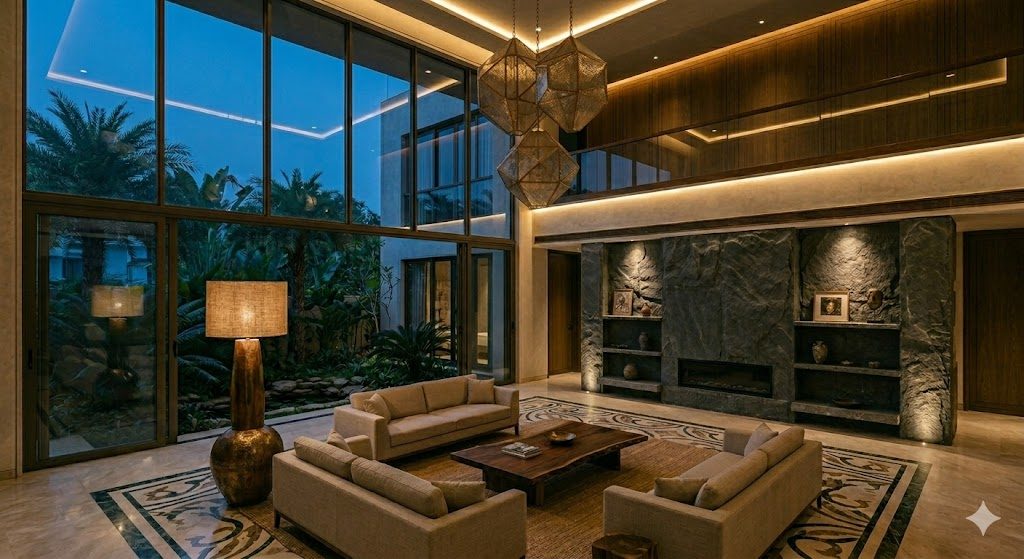
Walk into two apartments with identical floor plans, identical Italian marble, identical Poliform wardrobes — and one will feel like a five-star suite while the other feels like a well-stocked showroom. The difference is almost never the furniture. It is the light. One room is washed in soft, warm, layered glow that falls exactly where the eye should land; the other is flooded by a grid of cool white downlights that flatten every surface and erase every shadow. Same money, completely different result.
This guide is about that gap. It covers why lighting is the single biggest multiplier of perceived luxury in an Indian home, the four layers every luxury room choreographs, the colour-temperature and CRI discipline that lets your expensive materials read true, the techniques that designers actually use (cove, profile, grazing, backlit stone, statement fixtures), scene control and smart integration, a room-by-room recipe, and the real budget you should set aside. It names real brands sold in India and real price bands for 2026.
The core idea is simple and expensive to ignore: luxury is not how much light you have, it is how much control you have over it. A luxury interior is one where light is composed in layers, kept warm and high-fidelity, and dimmable into scenes — not a ceiling sprayed with spotlights. Lighting is also the most under-budgeted, highest-impact layer in almost every Indian project, which is exactly why getting it right is the cheapest way to make a home look far more expensive than it cost. For the broader definition of what separates premium from merely pricey, start with our pillar guide on what defines luxury interiors in India.
Why lighting separates luxury from expensive
Most Indian homes are over-lit and under-designed. The default brief handed to an electrician is "give me bright, even light in every room", and the default solution is a uniform grid of recessed downlights — what lighting designers privately call the "airport runway". It is bright, it is even, and it is the surest way to make a ₹2-crore interior look like an office.
The problem is that the human eye reads luxury through contrast, not brightness. A flat field of even light has no shadow, no depth, no hierarchy — nothing for the eye to settle on. The instant you introduce layers — a wall washed here, a sculpture grazed there, a pool of warm light over the dining table and darkness in between — the same room acquires depth and intent. That intent is what registers, subconsciously, as "designed".
Lighting is also where the spend-to-impact ratio is most lopsided. A luxury Indian interior commonly runs ₹2,500–6,000 per sqft. Lighting — fixtures, drivers, profiles, control — typically lands at ₹150–600 per sqft, or roughly 5–12% of the interior budget. Yet it is the layer that determines whether everything else photographs and feels the way it should. Spend ₹40 lakh on finishes and ₹3 lakh on lighting and you can still undo the whole effect with the wrong colour temperature. The lesson designers learn early: cutting the lighting budget to save the furniture budget is exactly backwards.
You can feel a beautifully lit room the moment you step in, long before you can name a single fixture. That feeling — not the chandelier — is what people are paying for.
The four layers of luxury lighting
Every well-lit room is built from four functional layers. Cheap interiors use one (a flat ambient grid). Luxury interiors choreograph three or four, each on its own circuit and dimmer.
| Layer | Job | Typical fixtures | The luxury move |
|---|---|---|---|
| Ambient | Soft, shadowless fill so the room is comfortable | Cove / coffer LED, indirect uplight, a few wide spots | Bounce it off ceiling/walls so the source is hidden |
| Task | Focused light for an activity | Pendants, under-cabinet profile, reading lamps, mirror lights | Put it exactly where the hands/eyes are, not overhead |
| Accent | Draw the eye, create drama, 2–3x ambient on the target | Framing spots, wall-graze, picture lights, backlit stone | Highlight the best thing in the room and let the rest fall dark |
| Decorative / feature | The fixtures you are meant to see | Chandeliers, sculptural pendants, table & floor lamps | One genuine "wow" piece per key room, never more |
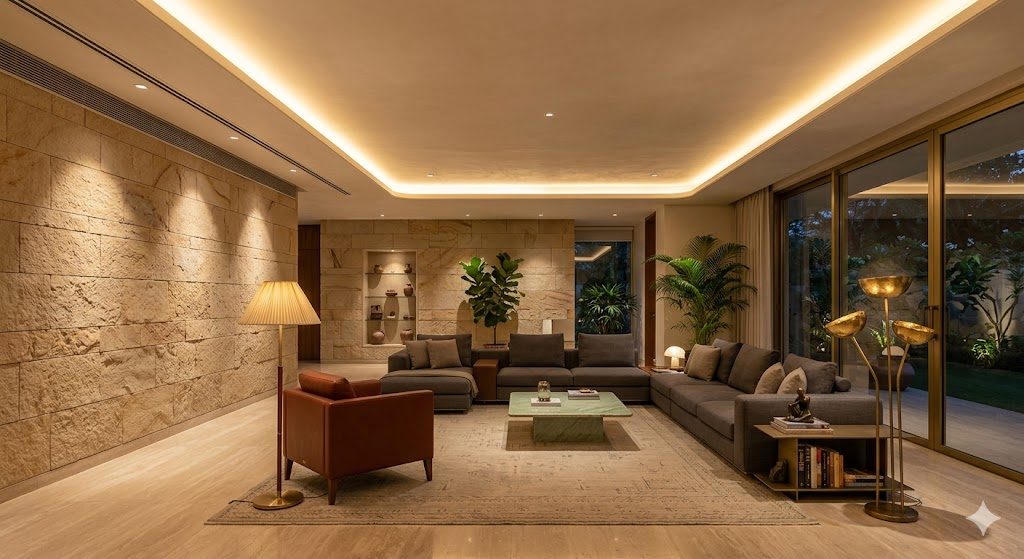
The discipline is not adding more light — it is keeping the four jobs separate and dimmable. A living room with cove ambient at 30%, two lamps at full, an art spot at 60% and zero ceiling downlights will read as luxurious. The same room with twelve downlights blazing at 100% will not, no matter what is on the walls. For the architectural mechanics of how these layers are detailed into the ceiling and structure, see our companion guide on architectural lighting design in India.
Colour temperature and CRI — the two dials that decide everything
If you change nothing else after reading this guide, change these two specifications. They cost almost nothing and they are the difference between materials reading true and materials reading cheap.
Colour temperature (CCT) is the warmth of the white, in Kelvin. Lower is warmer (candle/sunset), higher is cooler (overcast daylight). Luxury residential lighting lives at 2700K — the warm, golden tone of old incandescent bulbs — for living rooms, bedrooms, dining and foyers. Kitchens and bathrooms can step up to 3000K for a slightly crisper working light. Anything 4000K and above belongs in a study desk, utility or garage — never in a room meant to feel like home. The single most common mistake in Indian projects is 4000K or 6500K "cool white" everywhere, which makes even ₹1.5 crore of interiors look like a clinic.
The non-negotiable companion rule is consistency: pick one CCT per visual zone. A 2700K cove married to a 4000K downlight in the same living room creates a chromatic conflict the eye reads as "wrong" without being able to explain why. Lock the same Kelvin across ambient, task and accent within a room; vary only when you cross into a different space.
CRI (Colour Rendering Index) measures how truthfully a light source shows colour, on a scale to 100. This is the one most homeowners have never heard of and the one that quietly ruins luxury. Under cheap CRI-80 LED, your Statuario marble greys out, your walnut veneer goes flat and lifeless, your brass looks dull, and skin looks tired. Under CRI 90+ (ideally 95 for art and stone), the same surfaces snap to life — the marble's veining reads, the wood's grain glows, skin flatters. Pay particular attention to the R9 value (saturated reds): a fixture can claim CRI 90 yet render reds poorly, which is exactly what makes skin and food look off.
| Spec | Bargain default | Luxury standard | Why it matters |
|---|---|---|---|
| CCT (living/bed/dining) | 4000K cool white | 2700K warm white | Cool light kills the warmth luxury depends on |
| CCT (kitchen/bath) | 6500K daylight | 3000K | 6500K is clinical; 3000K stays inviting |
| CRI | 80 | 90+ (95 for art/stone) | Decides whether materials read true |
| R9 (deep reds) | unspecified | 50+ | Flattering skin and rich food/art colour |
| Consistency | mixed across fixtures | one CCT per zone | Mixed CCT looks broken |
The cost of this upgrade is trivial — roughly ₹150–500 more per fixture for CRI 90 versus CRI 80, and zero extra for choosing 2700K over 4000K. On a 2,000 sqft home that is a rounding error against the interior budget, yet it is the spec that decides whether the whole project looks the part.
The techniques that create the look
Layers and specs are the strategy; these are the tools designers reach for to execute it.
- Cove (coffer) lighting — a continuous LED strip hidden in a recess at the ceiling perimeter or in a dropped coffer, washing the ceiling with indirect ambient light. The source is invisible; only the glow shows. This is the backbone of layered luxury ambient lighting and a staple of every false-ceiling design. Use a high-density strip (120+ LEDs/m) so you see a smooth wash, not a dotted line.
- Profile / linear LED — aluminium extrusions with a diffuser that house the strip cleanly, used under cabinets, along skirting, in niches, on stair risers and under floating vanities. They give crisp linear light with no visible dots and a finished edge. Häfele, Light@Home and Wipro all sell good residential profiles.
- Wall grazing vs wall washing — grazing places the source close to the wall (15–25cm out) so light skims down it at a sharp angle, dramatising texture (stone cladding, fluted wood, brick). Washing places it further out (60–90cm) for an even, flat glow on a plain wall or to make a room feel larger. Grazing is the more "luxury" of the two because it creates shadow and drama.
- Recessed spots with anti-glare — when you do use downlights, specify deep-recessed, darklight or honeycomb-baffle trims so you see the pool of light, not the glowing source. Cheap flush LED panels glare straight into the eye; a good anti-glare spot disappears into the ceiling. Use them sparingly and aimed at objects, not sprayed across the floor.
- Backlit stone and onyx — translucent stones (onyx, certain marbles, backlit quartz/sintered slabs) lit from behind become glowing feature panels — a bar back, a headboard, a bath niche, a foyer wall. One of the highest-impact luxury moves; pairs naturally with the material choices covered in Italian marble versus quartz.
- Statement chandeliers and sculptural pendants — the one decorative layer you are meant to see. Indian studio Klove makes blown-glass pieces used in hotels and luxury homes; international names like Vibia, Flos and Bocci sit at the top end. The rule is restraint: one genuine hero per key space (foyer, dining, stairwell), not a chandelier in every room.
- Table and floor lamps as a layer — the most under-used tool in Indian homes, which tend to rely entirely on ceiling light. Lamps bring light down to eye and seating level, create pools of warmth, and let you switch off the ceiling entirely at night. A pair of good lamps does more for a living room's atmosphere than four extra downlights ever will.
Dimming and scene control — where luxury becomes intelligent
Layers only deliver luxury if you can control them independently. A single room should be able to shift from "bright and functional" at breakfast to "soft and intimate" at dinner to a low glow at midnight — all from one tap. That requires dimming and scene control, the part most Indian homes skip and then regret.
The baseline is dimmable drivers on every layer, controlled by quality dimmers. The mid-tier is a scene controller — a keypad or app that recalls preset combinations ("Entertain", "Movie", "Goodnight") that set every circuit to a chosen level at once. The high end is a whole-home control protocol.
| Control level | What it does | Typical system | Indicative cost |
|---|---|---|---|
| Basic dimming | Each circuit dims independently | Quality TRIAC/0–10V dimmers | ₹500–2,000 per dimmer |
| Scene control | One tap sets many circuits | Lutron Caséta, Wipro/Philips smart, app-based | ₹50,000–2,00,000 / home |
| DALI | Addressable, per-fixture digital control | DALI-2 drivers + gateway | ₹2,00,000–6,00,000+ |
| Whole-home luxury | Lighting + shades + AV integrated | Lutron HomeWorks, Crestron | ₹5,00,000–25,00,000+ |
DALI (Digital Addressable Lighting Interface) is the protocol serious lighting designers specify when every fixture needs to be tuned individually — it talks to each driver digitally, allows precise dimming curves, and scales cleanly. Lutron is the global benchmark for residential dimming and whole-home control (Caséta at the accessible end, HomeWorks at the luxury end). For homes going fully connected — lighting plus shades, climate and AV on one brain — this overlaps with everything covered in smart luxury homes in India. The practical advice: even if you defer the full smart system, wire for it now (neutral at every switch, dimmable drivers everywhere), because retrofitting control into a finished luxury home is painful and expensive.
Lighting room by room
Different rooms want different light. This is the recipe luxury homes follow — target illuminance at the surface that matters, the right colour temperature, and the signature technique that lifts each space.
- Foyer — the first impression. One statement chandelier or sculptural pendant plus concealed cove. This is the room to spend the decorative budget; aim for a single "wow" moment, 2700K, gently dimmable.
- Living — the layering showpiece. Cove ambient, accent spots on art and feature walls, table and floor lamps, and ideally no visible downlight grid. If you must have spots, deep-recessed anti-glare aimed at objects only.
- Dining over the table — a pendant or linear fixture hung 75–90cm above the table surface, sized to roughly two-thirds the table width, dimmable down to a candle-like glow for evenings. This single fixture defines the room.
- Kitchen — the one place to prioritise function: 300–500 lux on the counter from under-cabinet profile light (so you are not working in your own shadow), island pendants for task and decoration, 3000K. Premium kitchen detailing here pairs with our premium kitchen hardware guide.
- Master bedroom — soft and low. Bedside reading lights (wall-mounted or pendant, not a harsh overhead), a gentle headboard graze, cove for ambient. Keep glare out of the line of sight when lying down; 2700K, deeply dimmable.
- Bathroom — light the face, not the ceiling. Vertical light at the sides of the mirror eliminates the under-eye shadows that overhead light creates. Add a backlit niche or mirror, waterproof-rated (IP-rated) fixtures in wet zones, 3000K, CRI 90+ so skin reads true. See luxury bathroom moodboards for the full treatment.
- Art and stone features — the accent layer's home. Framing spots or wall-graze at roughly 3x the ambient level on the target, CRI 95 so the work reads correctly, backlit treatment for translucent stone. This is where drama is manufactured.
A useful planning sanity check: count your proposed downlights, then halve it. Most Indian ceiling plans have at least twice as many recessed spots as a luxury scheme needs. To pressure-test a layout and rough the fixture count and budget, run it through our lighting planner.
Lux, lumens and why to hire a lighting designer
Two quick terms worth knowing. Lumens measure the total light a fixture emits. Lux measures how much of that light actually lands on a surface (lumens per square metre). Luxury lighting is specified in lux at the surface that matters — 300 lux on a kitchen counter, 150 lux average in a living room, 100 lux in a bedroom — not in "how many watts of bulbs". IS 3646 and NBC 2016 give recommended illuminance ranges worth checking against, though luxury residential design usually aims for the lower, moodier end with strong accent contrast rather than uniform brightness.
This is precisely why a dedicated lighting designer earns their fee on a serious project. An interior designer or architect handles the layers conceptually; a lighting designer (or a good lighting consultant from a brand's specification team) calculates beam angles, spacing, lux levels, glare and dimming curves, and produces a proper reflected ceiling plan and fixture schedule. On a luxury home, expect a lighting design fee of roughly ₹40–150 per sqft, or a lump sum from ₹1.5 lakh upward — and it routinely pays for itself by preventing the over-lit grid, the wrong colour temperature, and the expensive fixtures bought for the wrong spots.
The brands and the budget
India now has a mature lighting market spanning value to genuine luxury. A working map for 2026:
| Tier | Brands available in India | Best for |
|---|---|---|
| Statement / decorative | Klove (Indian, blown glass), Vibia, Flos, Bocci | Chandeliers, sculptural pendants, hero pieces |
| Architectural / technical | Flos Architectural, Light@Home, Wipro premium, Philips premium | Spots, profiles, cove, anti-glare trims |
| Linear / profile & hardware | Häfele, Light@Home, Wipro | Under-cabinet, niche, skirting, stair profiles |
| Control systems | Lutron (Caséta / HomeWorks), Jaquar lighting controls, Häfele | Dimming, scenes, whole-home |
| Premium mainstream | Wipro, Philips/Signify premium ranges, Jaquar lighting | High-CRI residential fixtures at sensible cost |
A realistic budget for the lighting layer alone in a luxury Indian home:
| Scope | Indicative range (per sqft) | Notes |
|---|---|---|
| Good high-CRI fixtures + cove, basic dimming | ₹150–250 | The sensible floor for "luxury" |
| Above + profile detailing + scene control + statement pieces | ₹250–400 | Where most premium projects land |
| Full lighting-designer scheme + DALI/Lutron + imported decorative | ₹400–600+ | Top-tier, hotel-grade |
On a 2,500 sqft luxury apartment, that is roughly ₹4–15 lakh for lighting — and it is the line item most worth protecting from value-engineering. The hotel-grade end of this is exactly the territory explored in hotel-inspired residential design, and the planning discipline for apartments specifically is covered in our apartment lighting planning guide.
Get it right, in order
1. Set the spec first. Lock 2700K (3000K for kitchen/bath) and CRI 90+ on every fixture before anything else. This costs the least and changes the most.
2. Design in layers. Plan ambient, task, accent and decorative as four separate circuits per key room — and put each on its own dimmer.
3. Kill the downlight grid. Count your proposed spots and halve them. Replace floods with cove ambient, lamps, and aimed accents.
4. Choreograph the heroes. One statement decorative piece per foyer, dining and stairwell — no more.
5. Wire for control now. Even if you defer the smart system, install dimmable drivers and neutrals everywhere; retrofitting later is painful.
6. Light the face and the feature. Mirror lights at the sides, accents at 3x ambient on art and stone, backlit translucent stone for drama.
7. Hire the discipline. On a serious project, bring in a lighting designer for the reflected ceiling plan, lux calcs and fixture schedule.
Lighting is the cheapest luxury upgrade and the easiest one to get wrong. If you plan your scheme on DesignAI, you can visualise layered lighting, colour temperature and accent placement room by room before a single profile is cut — and pressure-test the fixture count, lux and budget against a real plan rather than discovering the "airport runway" only after the ceiling is closed.
References
- Bureau of Indian Standards (2022) IS 3646: Code of Practice for Interior Illumination. BIS, New Delhi.
- Bureau of Indian Standards (2016) National Building Code of India 2016, Part 8 — Building Services (Lighting & Ventilation). BIS, New Delhi.
- International Commission on Illumination (2017) CIE 13.3: Method of Measuring and Specifying Colour Rendering Properties of Light Sources. CIE, Vienna.
- Illuminating Engineering Society (2021) The IES Lighting Handbook, 11th Edition. IES, New York.
- Russell, S. (2012) The Architecture of Light: A Textbook of Procedures and Practices for the Architect, Interior Designer and Lighting Designer. Conceptnine.
- Major, M., Speirs, J. & Tischhauser, A. (2005) Made of Light: The Art of Light and Architecture. Birkhäuser.
- DALI Alliance (2024) DALI-2 and D4i — Specifications for Digital Addressable Lighting Interface. Digital Illumination Interface Alliance.
Part of the Studio Matrx Luxury Interiors series — continue with what defines luxury interiors in India, smart luxury homes, hotel-inspired residential design and architectural lighting design.
Export this guide
Related Guides — Deep-dive reading
Luxury & Statement Lighting: Drama, Sculpture & Scale (2026)
How to design lighting that actually feels luxurious in an Indian home — layered scenes, deep shadow-and-highlight contrast, hidden sources and premium materials — and how to place one sculptural statement fixture as the jewel of a room without over-lighting the whole thing.
LightingLayered Lighting Explained: Ambient, Task & Accent for Indian Homes (2026)
The single most important idea in lighting design, in plain language: why one central light flattens a room, and how three working layers — ambient, task and accent — plus a decorative sparkle layer combine on separate dimmable controls to make an Indian home feel lit, useful and alive.
LightingLighting Design Principles: The Rules Good Schemes Follow (2026)
The design rules that separate a room that feels considered from one that feels like a floodlit hall — layering on separate controls, glare control, colour-temperature discipline, direction and shadow, lighting at different heights, and washing the walls — written for the Indian home.
LightingRelated Tools — Try Free
Circadian Light Meter
Patient-centric circadian lighting visualizer for Indian healthcare design — time-of-day × intensity → CCT, melanopic lux (EML / mEDI), melatonin suppression, and an alertness curve. Calibrated against WELL v2 L03 Circadian Lighting Design, CIE S 026:2018, Brainard 2001, and Lucas et al. 2014.
Circadian ToolCross-Ventilation Analyzer
Estimate airflow and air changes per hour (ACH) from room size, window areas, layout, and local wind — with NBC 2016 Part 8 compliance check.
Ventilation CalculatorInterior Layout Planner — Printable Graph Grid
Printable graph grid to sketch room layouts to scale before committing to furniture placement.
Layout Tool