
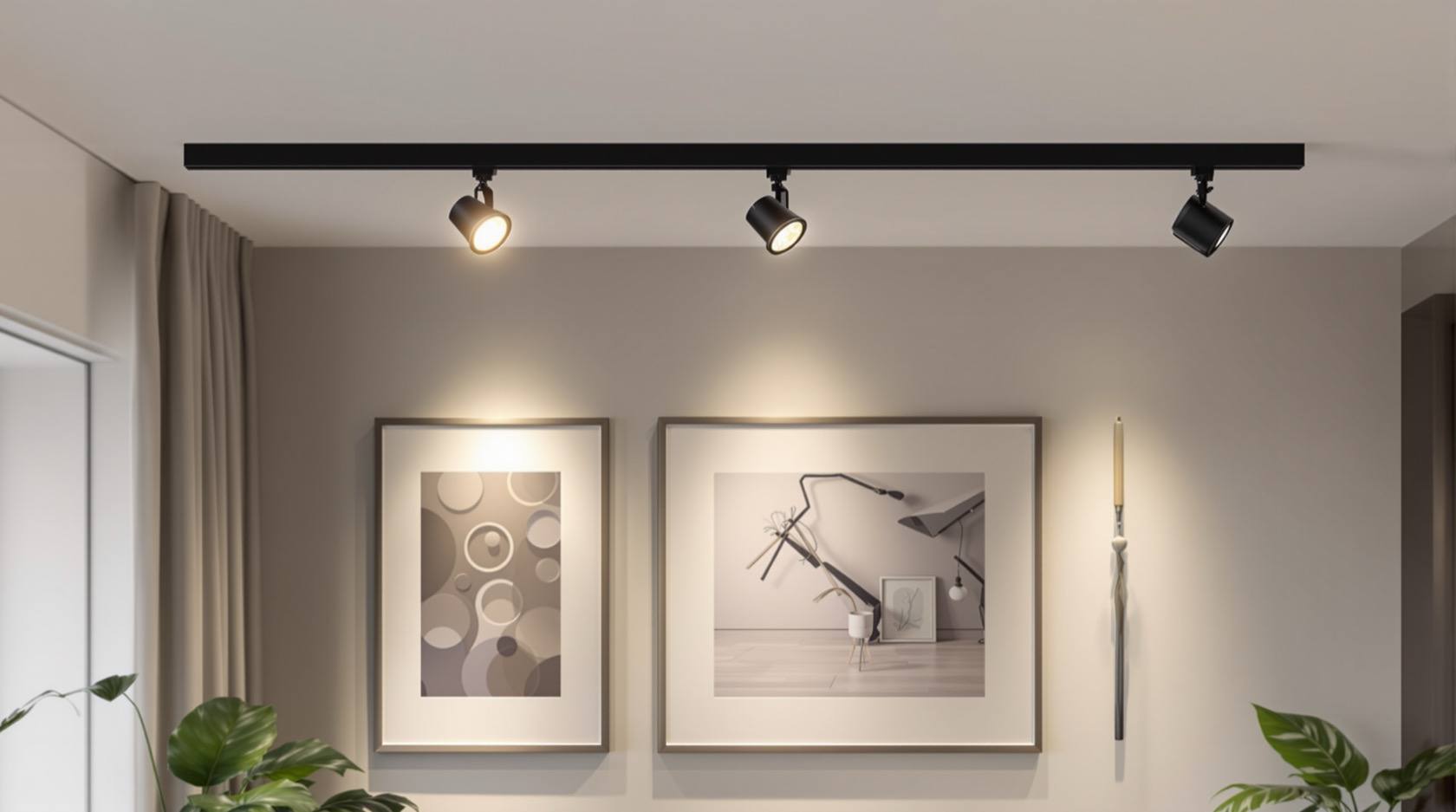
Track Lighting & Spotlights: Flexible Accent Light (2026)
The design guide to track lighting and directional spotlights for Indian homes — the aimable accent workhorse. How to light art, feature walls, open shelving and the pooja niche; single vs multi-circuit and slim magnetic track; aiming, beam angle and the accent contrast ratio; and where a downlight is the cleaner choice.
Most ceilings in India are lit for the floor. A grid of downlights washes the room evenly, and everything on the walls — the paintings, the carved panel, the open crockery shelf, the deity niche — sits in the same flat light as the sofa. Track lighting is the fix. It is the one fixture family built to be aimed: heads that swivel and tilt to throw a controlled beam exactly where you want emphasis, and that you can slide, add to or re-point in an afternoon when the art moves. It is the accent workhorse, and it is what turns a decorated room into a composed one.
This guide is the design brief for track and spotlights — what they are, the track and head types worth knowing, and the three ideas that separate a good accent scheme from a hardware-store guess: aiming, beam angle and contrast. It sits inside the complete guide to lighting and pairs with functional vs ambient vs accent lighting — track is the accent layer of that scheme made physical.
Scope & how to read this. This is a design and specification guide: it helps you choose fixtures, plan the aim and set the mood. It is not a wiring manual. Track carries live mains or low-voltage power along its length, and mounting it, wiring the feed and putting it on the right dimmer are electrical work a licensed electrician must design, install and certify — treat that as non-negotiable. Beam angles, offsets and cost bands here are typical and indicative planning aids; confirm lux and photometrics against IS 3646 and NBC (SP 7:2026), and get local quotes. Automation belongs to the smart lighting guide.
What track and spotlights actually are
A spotlight is any directional fixture that throws a defined cone of light rather than a broad wash — it has a reflector or lens that concentrates the beam, and usually a joint that lets you point it. A track is the powered rail it clips onto: a conductor-carrying channel that lets you place several heads anywhere along its length and move them later. You can buy spotlights as individual surface or recessed fittings; track just makes them plural, flexible and re-configurable.
The superpower is aimability plus adjustability. Unlike a fixed downlight cut into plaster, a track head can be re-pointed by hand and the whole array re-planned without touching the ceiling. That makes track the natural choice wherever the thing being lit might change or needs precise emphasis:
- Art and photo/gallery walls — one controlled beam per piece.
- Feature and texture walls — stone cladding, a fluted panel, an accent-paint wall grazed to reveal relief.
- Open shelving and display — crockery units, a book wall, curios, a bar.
- The kitchen — track along a run to light worktops and the backsplash where recessed points are awkward.
- The pooja niche or deity wall — a discreet warm spot that makes the shrine the visual anchor of the room.
- Retail-at-home — a boutique, home studio or a designer's client-facing wall.
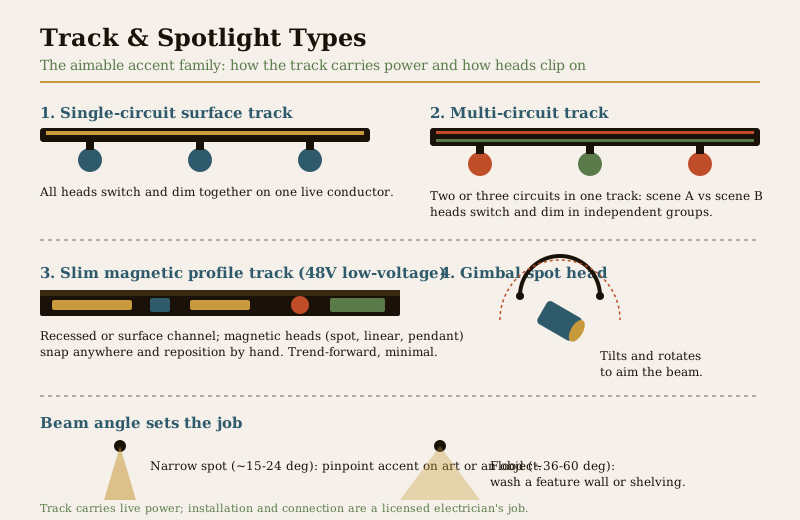
Track types worth knowing
Single-circuit vs multi-circuit
A single-circuit track carries one live conductor: every head on it switches and dims together. It is cheaper, simpler and perfect when all the heads do one job — lighting a single gallery wall, say. A multi-circuit track carries two or three independent circuits in the same rail, so you can group heads and switch or dim them separately — accent the art on one scene, wash the shelving on another, and drop to a single warm head for the evening. If you want scenes from one track, buy multi-circuit and plan the grouping with your electrician up front; you cannot retrofit circuits into a single-circuit rail.
Surface track vs recessed magnetic profile
Surface-mounted track screws onto the finished ceiling or a beam — the traditional, robust, easy-to-add option, and the only realistic choice on a solid RCC slab with no false ceiling. Recessed magnetic track is the trend-forward system: a slim aluminium channel set flush into a false ceiling (or a shallow surface profile) running a safe low-voltage 48V bus, onto which magnetic heads — spots, adjustable linear bars, mini-pendants, even wall-wash blades — simply snap and slide. It reads as a clean architectural reveal rather than a fixture, and it is genuinely re-configurable: change the whole lighting story by re-clicking heads. It costs more and must be planned into the false ceiling before the gypsum goes up, so decide early. This is the system the architectural lighting design guide leans on for minimal, high-control interiors.
| Track / mount type | Relative cost | Best for | Watch-outs |
|---|---|---|---|
| Single-circuit surface | Low | One-job accent walls; retrofits on a slab | No scene control; heads all dim together |
| Multi-circuit surface | Medium | Scenes from one rail; mixed accent + wash | Plan circuit grouping before install |
| Recessed magnetic (48V) | Medium to high | Minimal false-ceiling interiors, max flexibility | Design into the ceiling early; needs a driver |
| Surface magnetic profile | Medium | Magnetic flexibility without recessing | Reads chunkier than a recessed reveal |
Spotlight heads: fixed, gimbal, on-track vs individual
Heads are where the aiming happens. A fixed spot points one way — fine for a permanent target. A gimbal (or eyeball) head tilts and rotates on a yoke so you can aim it precisely and re-aim it when the art changes — the default for any accent job. On a track, heads share one feed and move freely along the rail; as individual fittings (single surface spots or recessed adjustable downlights) each needs its own point but can sit exactly where you want without a visible rail. As a rule: reach for track when you want several aimable beams, flexibility, or a run you will re-plan; reach for individual recessed adjustable spots when you want the cleanest ceiling and the targets are fixed — the crossover with recessed downlights is real, and often the answer is a few of each.
The three ideas that make accent light work
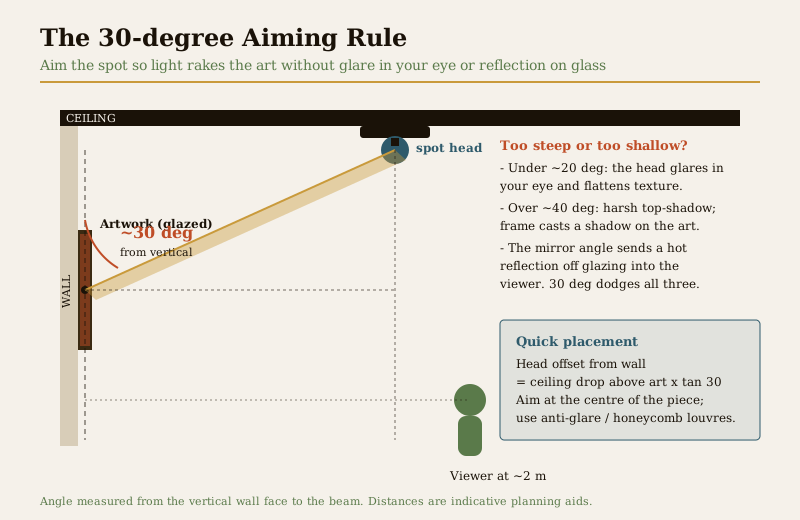
1. Aiming — the 30-degree rule
The single most useful number in accent lighting is roughly 30 degrees from vertical. Aim a spot at the centre of an artwork along a line about 30 degrees off the vertical wall face and you get even coverage, a little raking to bring out texture, and — critically — you keep the fixture out of your line of sight and keep the mirror reflection off glass or glossy paint away from the viewer's eyes. Go much steeper (under ~20 degrees) and the head glares down into the room and light flattens; go much shallower (over ~40 degrees) and the frame casts a hard shadow across the piece and hotspots appear. On glazed art, 30 degrees is what dodges the glare bounce. Practically, that means the track sits offset from the wall — the offset is roughly the ceiling drop above the art multiplied by the tangent of the aim angle — and you finish by eye on site. For shiny surfaces, add anti-glare snoots or honeycomb louvres to the heads.
2. Beam angle — spot for accent, flood for wash
Beam angle decides the job. A narrow spot (~15-24 degrees) is a tight, punchy cone — use it to pinpoint a single painting, a sculpture or an object so it reads brighter than its surroundings. A flood (~36-60 degrees) spreads a soft, even wash — use it to graze a whole feature wall, light open shelving top-to-bottom, or wash a curtain. Match the angle to the target size and the throw distance: a small object far away wants a narrow beam; a wide shelf close overhead wants a flood. Mixing narrow and flood heads on one track is exactly how you build a layered wall — punctuation on the pieces, a gentle wash between them.
3. Contrast — the 3x accent ratio
Accent light only reads as accent if it is meaningfully brighter than the room around it. The useful working target is an accent object lit to roughly three times the ambient level on the wall — enough to draw the eye and feel intentional, not so much it looks like a shop window. If the whole room is already bright, your accents have to climb higher to register, which is one more reason to put track on its own dimmer circuit: dim the ambient down in the evening and the same accents suddenly sing. Contrast, not raw brightness, is what makes a room feel designed — the theme the layered lighting guide builds on.
Spacing and how many heads
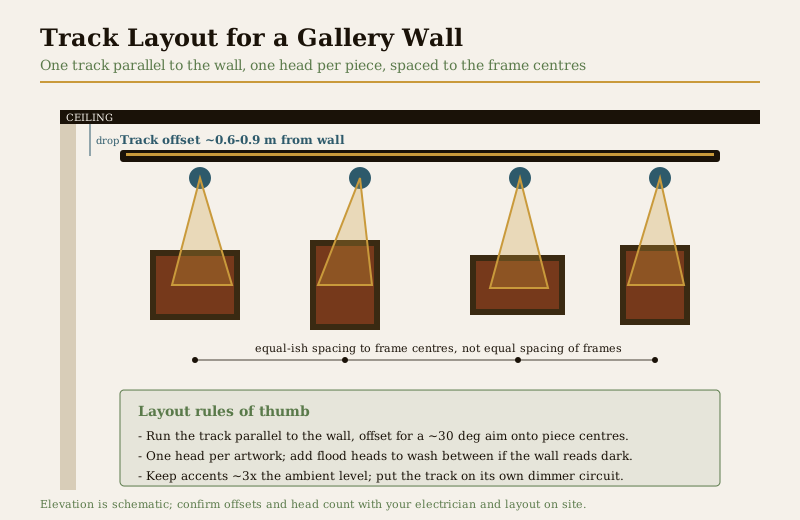
There is no single formula, but sensible defaults get you close. For a gallery or feature wall, plan one head per artwork, positioned so each aims at its piece's centre — that usually means the heads are spaced to the frame centres, not evenly along the rail. For a continuous wash of a long feature wall or shelving run, space flood heads so their cones overlap slightly — commonly a head every 0.9 to 1.2 m, with the track offset 0.6 to 0.9 m from the wall for a clean 30-degree aim. Keep beams off the ceiling-wall junction unless you want to highlight it. For a first-cut count and layout, the fixture quantity calculator and the lighting spacing calculator turn wall length, mounting height and beam angle into a starting number to refine on site.
An art-accent aiming quick table
Indicative starting points for a spot aimed at the centre of a piece at roughly the 30-degree rule — refine by eye on site.
| Distance head-to-art (throw) | Beam to try | Track offset from wall (approx) | Typical use |
|---|---|---|---|
| ~1.5 m (low ceiling, close) | Flood ~36 deg | ~0.6 m | Small framed cluster, close overhead |
| ~2.0 m (standard room) | Medium ~24-30 deg | ~0.8 m | Single painting or gallery wall |
| ~2.5 m (higher ceiling) | Narrow spot ~15-24 deg | ~1.0 m | Large canvas, sculpture, statement piece |
| ~3 m+ (double height) | Very narrow ~10-15 deg | ~1.1 m+ | Tall feature wall, atrium art |
Where track shines vs where recessed is cleaner
Track is unbeatable when you want flexibility and precise, changeable emphasis — art you rotate, a shop-like display, a wall you are still styling, or a slab ceiling where cutting in recessed fittings is impractical. It is honest about being visible: the rail is part of the look, industrial or minimal depending on the profile. Choose recessed adjustable downlights instead when you want the ceiling to disappear, the targets are permanent, and a clean plane matters more than re-configurability — the trade-off is set out in the recessed and downlight guide. Neither replaces the soft, glare-free layer that wall lights and sconces add at eye level; a good scheme uses accent track, ambient recessed and decorative wall light together.
Colour temperature and CRI for art and objects
What you light matters as much as how. For art, textiles, wood and skin tones, use a high-CRI source (Ra 90+) so colours read true — a cheap low-CRI spot makes a warm painting look muddy and greys out reds. Keep the accent colour temperature consistent with the room's warm layer — around 2700K-3000K for most Indian living and pooja spaces — so the beam feels like emphasis, not a different light. Cooler crisp whites suit a modern gallery look or a display of metal and glass. This is the deep end covered in colour temperature & CRI; for track, the takeaway is simple: buy high-CRI heads for anything you care about seeing accurately, and match the kelvin across the array.
Dimming and control
Accent light without a dimmer is a wasted opportunity. Put the track on its own dimmable circuit so you can lift the accents at night as the ambient drops, and specify heads and a driver that are dimming-compatible — mismatched LED drivers and dimmers cause flicker and buzz. For scenes without smart gear, multi-circuit track plus two dimmers already gives you day and evening moods; for app or voice scene control, hand off to the smart lighting guide. The dimmer and driver selection and any wiring are, again, the electrician's call.
India context: feature walls, the pooja niche and open kitchens
Track earns its keep in the way Indian homes are actually decorated. The feature wall — accent paint, stone cladding, a wooden jaali or a large religious canvas — is where a couple of well-aimed spots transform a flat plane into the room's focal point. The pooja niche or deity wall deserves a single discreet warm high-CRI spot: it makes the shrine glow as the anchor of the space without a harsh downlight overhead, and on a magnetic track you can add a second head for festival displays and remove it after. In open-plan kitchens and island layouts, a short track along the run lights worktops and the backsplash precisely where ceiling downlights would be blocked by cabinets or cast shadows off your own shoulders. And for the art collector or home gallery, track is simply the correct tool — the same instrument museums use, scaled to a home.
How it connects
- Start with the complete guide to lighting for the whole scheme, then place track as the accent layer described in functional vs ambient vs accent lighting and built up in layered lighting.
- Decide track vs a clean ceiling with the recessed and downlight guide, and add the eye-level layer with wall lights and sconces.
- Get colours right on art and objects with colour temperature & CRI, and design the minimal magnetic-track look with architectural lighting design.
- Size the array with the fixture quantity calculator and set the spacing with the lighting spacing calculator.
Key takeaways
- Track lighting is the accent workhorse — aimable, movable, re-configurable — ideal for art, feature walls, open shelving, the pooja niche and open kitchens.
- Choose single-circuit for one-job walls and multi-circuit for scenes from one rail; surface track for slabs and retrofits, slim magnetic 48V track for a minimal, flexible false-ceiling look designed in early.
- Use gimbal heads to aim precisely; reach for individual recessed spots when the ceiling must stay clean and targets are fixed.
- Master the three ideas: aim at ~30 degrees to light art without glare or reflection, pick narrow spot for accent and flood for wash, and light accents to about 3x the ambient for contrast.
- Plan one head per artwork, offset the track 0.6-0.9 m from the wall, and put it on its own dimmer with high-CRI (Ra 90+) heads matched to the room's warm kelvin.
- Every figure here is indicative — confirm lux and photometrics against IS 3646 and NBC (SP 7:2026), and get local quotes.
- Wiring, mounting, drivers and dimmers are electrical work — a licensed electrician designs, installs and certifies them.
References
- National Building Code of India, NBC (SP 7:2026), Bureau of Indian Standards — general provisions for interior illumination and lighting.
- IS 3646 — code of practice for interior illumination, recommended lux levels for tasks and display (named generally).
- IS 16107 / IEC 60598 — LED luminaire performance and luminaire safety (spotlights and track fittings; named generally).
- IP ratings per IS/IEC 60529 — ingress protection classes for indoor (dry) fittings; confirm the class for kitchen or damp locations.
- ECBC (Energy Conservation Building Code) and BEE star rating — lighting power density and LED efficiency guidance (named generally).
- Licensed electrician and lighting designer — track feed, circuiting, driver and dimmer selection, and photometric confirmation for your room.
All beam angles, offsets, spacings, colour-temperature and cost notes here are indicative design and planning aids only; confirm lux and photometrics against IS 3646 and NBC (SP 7:2026), get local quotes for cost, and have a licensed electrician design, install and certify all wiring, track feeds, drivers and dimmers.
Export this guide
Related Guides — Deep-dive reading
Lighting Controls & Dimming Design: Zones, Scenes & Switches (2026)
How to plan lighting control so an Indian home's light is flexible — split each room's layers onto separate switches, choose dimmers that actually work with LEDs, add two-way switching where you need it, and layer scenes on top. The design decisions you must settle before the electrician wires.
LightingBathroom Mirror Lighting India: Shadow-Free Vanity Light, Colour Temp, CRI & Cost (2026)
Why a single ceiling downlight throws ugly shadows on your face, how vertical sconces either side of the mirror beat a light bar above, when a backlit mirror is glow not task light, plus the colour temperature, CRI, mounting height, IP rating and 2026 rupee costs that actually get make-up and shaving right.
BathroomsLiving Room Lighting Design for Indian Homes (2026)
The design guide to lighting the most-used, most-layered room in the house - how to build a flexible, dimmable, multi-scene living room scheme with ambient, task, accent and decorative layers, warm evening light, a comfortable TV wall and open-plan zoning.
LightingRelated Tools — Try Free
False Ceiling Cost Estimator
Live ₹/sqft across 8 ceiling types — POP, gypsum, designer, metal, PVC, wooden — with cove and spot lighting for 20 Indian cities.
Cost CalculatorCross-Ventilation Analyzer
Estimate airflow and air changes per hour (ACH) from room size, window areas, layout, and local wind — with NBC 2016 Part 8 compliance check.
Ventilation CalculatorBrise-Soleil Visualizer
Interactive horizontal-louvre cut-off angle calculator — sun altitude, louvre depth, and spacing inputs with a live shadow preview. Computes θ = arctan(spacing/depth) for façade shading, ECBC envelope compliance, hospital daylight design, and tropical sun-control detailing.
Sun Shading Tool