
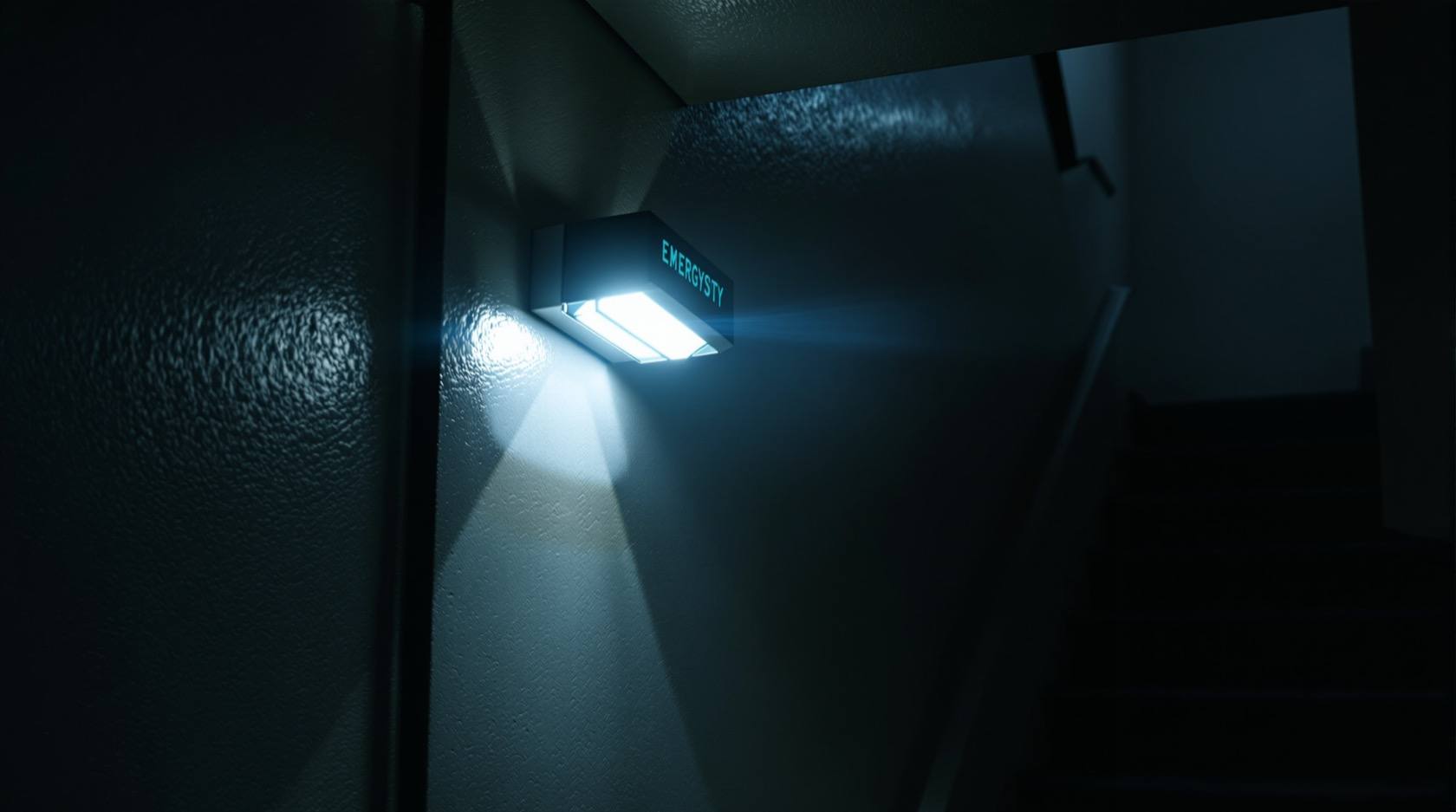
Emergency Lighting Testing in India (2026): The Function Test, the Duration Test and the Battery That Quietly Dies
Emergency lighting is what gets people out of a building in a power cut or a fire — and it is useless if its batteries have silently gone flat. This professional guide covers what emergency lighting is, the two tests that keep it honest (the short frequent function test and the longer periodic duration test that catches dying batteries), what to test across escape routes, stairs and exit signs, the statutory test log, and the safe split of who does what.
There is a category of building system that spends almost its entire life doing nothing, and is asked to work perfectly for the few minutes that decide whether people get out alive. Emergency lighting is exactly that. On an ordinary day it hangs on the wall of a corridor or over a door, drawing a trickle of charge, apparently pointless. Then the mains fails — a grid cut, a tripped board, a fire that takes out the supply — and in that instant every escape-route fitting and every exit sign is supposed to light on its own battery and stay lit long enough for a full building to walk out in the dark. The whole means of escape depends on it. And the cruel truth is that the part most likely to have failed is invisible until the moment it is needed: the battery, sitting inside a sealed fitting, has quietly lost its capacity, and nobody knew because nobody tested it.
That is what this guide is about. Not designing an emergency lighting scheme — that is covered in the emergency lighting guide — but keeping an installed one demonstrably alive through a proper testing regime. Emergency lighting is life-safety equipment and part of the code-governed means of escape, sitting alongside fire alarm, extinguishers and egress in the fire-safety library. Its testing is not a nicety you fit in when convenient; it is a scheduled, recorded discipline, and the one test people habitually skip is the very one that catches the dying battery.
Scope & safety. This is an upkeep and coordination guide for facility managers, building owners, electrical and fire-safety professionals — not an installation manual. The critical split runs through everything here: routine function checks and record-keeping can be done in-house by a trained facility person pressing test switches and logging results, but duration testing, any wiring or circuit work, battery replacement and statutory certification are for a competent electrician or fire-safety contractor. Emergency lighting is life-safety and its testing is statutory and scheduled, governed by the National Building Code (NBC = SP 7:2026) and relevant BIS practice for emergency lighting and its batteries — verify the current editions and your local fire bye-laws before relying on any of it. This is not a price guide (budgets belong in the cost library) or a buying guide; keep it about upkeep. Never run a full duration test when the building cannot then be safely evacuated on flat batteries — schedule it.
What emergency lighting actually is
Before you can test it you have to know what you are looking at, because "emergency lighting" is a family of things and they are tested the same way but do different jobs.
- Escape-route (escape) lighting — luminaires along corridors, at every change of direction, over stairs, at doors and at final exits, whose job is to illuminate the path out when the mains fails, so people can find and follow the escape route in the dark.
- Illuminated exit signage — the green running-man signs over exit doors and at decision points, which must be lit and visible so people know which way is out. A dark exit sign is as dangerous as a dark stair.
- Maintained vs non-maintained luminaires — this distinction matters for testing. A non-maintained fitting is off during normal use and only lights on mains failure (common on escape routes). A maintained fitting is lit all the time from the mains and switches to its battery on failure (common in exit signs and places lit continuously). Both carry a battery; both must be proven to work on that battery, but a maintained fitting being lit tells you nothing about whether its battery still works — which is the whole trap.
The battery is the consumable at the heart of all of it. Whether the fitting is a self-contained unit with its own cells, or fed from a central battery system, the stored energy is what carries the load when the mains is gone, and stored energy is exactly what degrades quietly with heat, age and charge cycles.
The two tests that keep it honest
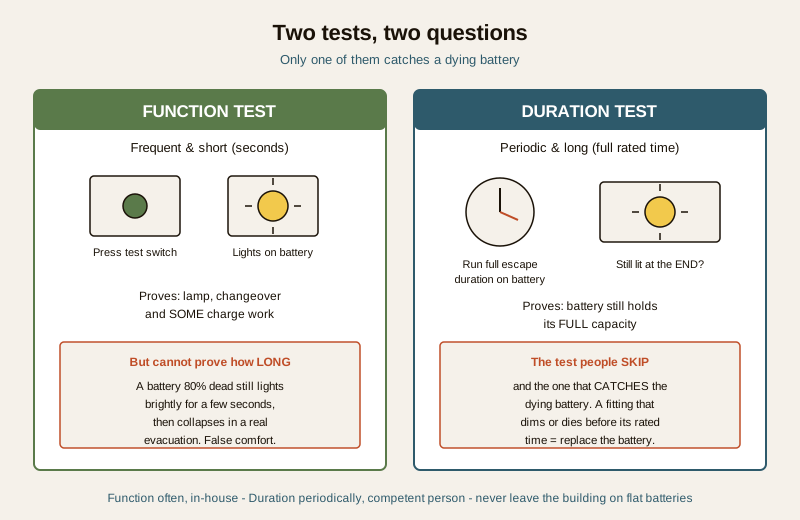
Everything in emergency lighting testing comes down to two tests that answer two different questions. Confusing them, or doing one and calling it the other, is the commonest and most dangerous mistake.
The function test — does it light at all?
The function test (sometimes called a flick test) is short and frequent. You operate the test switch, or press the test button, or throw the test facility for the circuit, which simulates a mains failure to that fitting. You confirm two things: that the fitting lights on its battery, and that the exit sign is illuminated and its charge indicator is healthy. It takes seconds per fitting, it is done often, and because it is brief it can be run in-house by a trained facility person without leaving the building unprotected. It proves the lamp works, the changeover works and there is at least some charge.
What the function test does not prove is how long the fitting will last. A battery that is 80 percent dead will still light brightly for the few seconds of a function test and then collapse minutes into a real evacuation. That is precisely why the function test alone gives false comfort.
The duration test — does it last the whole way out?
The duration test (also called a full-rated-duration or discharge test) is longer and periodic. You put the fittings onto battery and leave them there for their full rated duration — commonly the required escape duration for the building — and confirm each one is still lit, at adequate output, at the very end. This is the test that catches the dying battery, because it is the only test that measures capacity rather than mere function. A fitting that dims or dies before its rated time has a failing battery and must be flagged for battery replacement.
The duration test is the one people skip, because it is long, it discharges every battery in the building, and it needs coordination. It is also the one that matters most. It should be run by, or under the supervision of, a competent electrician or fire-safety contractor, and its results certified.
Life-safety — do not skip, and time it right. A duration test deliberately runs the batteries down. Never run a full duration test at a time when the building could not then be safely evacuated on flat batteries — because straight after the test, until the batteries recharge, the emergency lighting is at its weakest. Schedule duration tests for periods of low occupancy, ensure the mains supply is healthy so recharge begins immediately, and confirm recharge before the building fills again. This timing discipline is not optional; it is the difference between a test and a hazard.
What to test, everywhere it matters
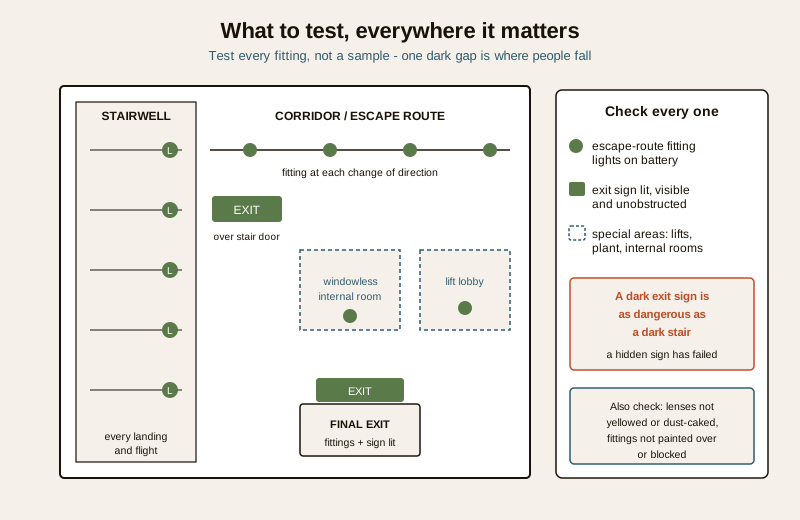
A test regime is only as good as its coverage. Emergency lighting fails one fitting at a time, and the fitting that fails is always the one nobody checked. Test every fitting, not a sample — the point is that there is no dark gap on the way out.
- Escape routes and corridors — every escape-route luminaire, at every change of direction and at intersections, lights on battery.
- Stairs — stairwell fittings in particular, because a dark stair in a smoke-filled evacuation is where people fall. Test every landing and flight.
- Final exits and exit doors — the fittings at and over the doors people actually leave by.
- Illuminated exit signs — every green running-man sign lit, unobstructed and visible from the direction of approach. A sign hidden behind a new partition or a stacked pallet has failed even if it glows.
- Special areas — lifts and lift lobbies, plant and generator rooms, any windowless internal room, and areas of assembly, all per the design.
Coverage is also a housekeeping check: signs that are clean and unobstructed, fittings that are not painted over or blocked, and lenses that are not yellowed or dust-caked so their output has quietly halved.
The battery is the consumable — replace on schedule, not on failure
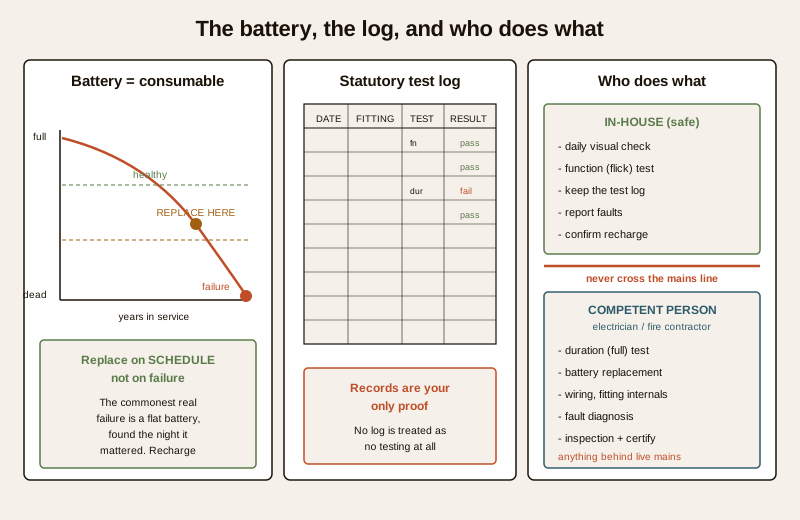
If you take one idea from this guide, take this: the battery is a wear item, like a tyre or a filter, and it must be replaced on a schedule, not merely when it fails. Waiting for failure means the failure is discovered by a test at best, and by a real emergency at worst. Batteries in emergency fittings live a hard life — they sit at temperature, on continuous trickle charge, in fittings often mounted high where heat collects — and their usable capacity falls steadily years before they refuse to work at all.
- Plan replacement by design life, not by breakdown. Self-contained emergency battery packs have a rated service life; replace them as that life approaches, across the installation, rather than one at a time as each dies. A battery that passes this year's duration test by a whisker will fail next year's.
- Battery replacement is a competent person's job. It involves opening the fitting, correct polarity and connector type, the right chemistry and rating, and safe handling and disposal of the old cells. Leave it to the electrician or fire-safety contractor.
- Recharge is part of the test. After any duration test, the fittings must be left to recharge fully; note the recharge and confirm the charge indicators return to healthy before the system is relied on again.
A maintained cheap fitting with a fresh battery will outperform an expensive one whose cells died two summers ago. The commonest real-world failure of emergency lighting is not a blown lamp; it is a flat battery, found the night it mattered.
The test log — statutory, and your only proof
For life-safety equipment, the record is not paperwork for its own sake; it is the evidence that the system was maintained, and it is often statutory. Keep a dedicated emergency lighting test log — bound or controlled — recording every function and duration test: the date, who did it, every fitting tested, the result for each, any fault found, and the action taken (battery replaced, fitting repaired, retested pass). This log sits within the wider security maintenance logbook discipline and should feed the building's fire-safety maintenance calendar.
An absence of records is treated, correctly, as an absence of testing. When a fire officer, an insurer or an investigator asks whether the emergency lighting worked, the log is the answer — and "we press the buttons sometimes" is not one. Schedule the tests on the building's security maintenance calendar so they cannot slip.
The test schedule — function often, duration periodically
The two tests run on very different frequencies, and the schedule is the backbone of the regime. Adopt intervals no longer than your code and the equipment manufacturer require; when in doubt, test more often, not less.
| Task | Typical frequency | Who | What it proves |
|---|---|---|---|
| Visual check — signs lit, fittings clean, unobstructed | Daily / on rounds | In-house facility staff | Nothing is dark, blocked or damaged |
| Function (flick) test — each fitting lights on battery | Frequent (e.g. monthly) | In-house, trained | Lamp, changeover and some charge work |
| Duration (full-rated) test — each fitting lasts its rated time | Periodic (e.g. annually) | Competent electrician / fire contractor | Battery still holds its full capacity |
| Battery replacement | On design life (planned, not on failure) | Competent electrician / fire contractor | Capacity restored before it fails |
| Full inspection + certification | Periodic per code | Competent person | System compliant and documented |
| Recharge confirmation after any duration test | Immediately after each duration test | In-house verify + contractor | System restored to full standby |
Treat the exact intervals as governed by the current code, your fire NOC conditions and the manufacturer's instructions, not by this table alone. The pattern is the durable part: short tests often, the long test periodically, replacement ahead of failure, and everything written down.
Who does what — the safe split
Emergency lighting testing divides cleanly, and keeping the line clear keeps people safe and the regime honest.
- In-house, safely done by trained facility staff — the daily visual check that signs are lit and fittings unobstructed; the routine function test using the provided test switches and buttons; keeping the test log current; noticing and reporting faults; confirming recharge indicators.
- Competent electrician or fire-safety contractor only — the duration test and its scheduling; any wiring, circuit or fitting internals work; battery replacement; fault diagnosis behind the fitting; and the periodic full inspection and certification the code requires. Anything behind live mains or inside a sealed fitting is not in-house work.
This mirrors the whole hub's stance: a facility person can and should do the simple, frequent, no-tools checks that catch most problems early; the qualified professional does the mains-electrical, statutory and capacity work. When in doubt, call the contractor — this is life-safety, not a light bulb.
Signs of trouble
These are the symptoms that a fitting or a battery is failing, or that the regime itself has lapsed. Any of them is a reason to act, and several of them are reasons to call the contractor now.
- A fitting does not light on test — the changeover, lamp or battery has failed outright; that spot on the escape route is dark in an emergency.
- A fitting dims or dies before its rated duration — the battery is losing capacity; it will not carry a full evacuation. Flag it for replacement.
- A charge indicator that is off, red or flickering — the fitting is not charging; the battery will not be ready when needed.
- An exit sign that is dark, dim or obstructed — people will not find the way out; treat a hidden or unlit sign as a failure even if it technically works.
- Fittings painted over, dust-caked or yellowed — output has quietly dropped; the light is there but too weak to see by.
- No test records, or a log with long gaps — the most dangerous sign of all, because it means nobody knows the state of the system. An untested emergency lighting installation should be assumed unreliable until proven otherwise.
Key takeaways
- Emergency lighting is life-safety and part of the means of escape — its testing is statutory and scheduled, not optional, and sits alongside fire alarm and extinguishers in the fire-safety regime.
- Two tests, two questions. The function test is short and frequent and proves a fitting lights on battery; the duration test is periodic and long and proves it lasts its full rated time. Only the duration test catches a dying battery.
- The duration test is the one people skip and the one that matters most — never run it when the building cannot then be safely evacuated on flat batteries, and confirm recharge before occupancy returns.
- Test every fitting across escape routes, stairs, final exits and every illuminated exit sign — no sample, no dark gap.
- The battery is a consumable — replace it on its design life across the installation, not one at a time as each fails; battery work is a competent person's job.
- Keep the statutory test log — it is your only proof the system was maintained; no records is treated as no testing.
- Split the work safely — in-house function checks and record-keeping, competent electrician or fire contractor for duration testing, wiring, battery replacement and certification.
Where to go next
- Emergency lighting — designing and specifying the scheme this guide keeps alive.
- Fire-safety maintenance calendar and security maintenance calendar — where the function and duration tests get scheduled so they cannot slip.
- Security maintenance logbook — the record-keeping discipline the statutory test log belongs to.
- The security-system maintenance guide pillar, the maintenance library, the fire-safety library and the main security hub.
References
- National Building Code of India (SP 7), Bureau of Indian Standards — means of escape, escape-route and emergency lighting, and illuminated exit signage provisions. Verify the current edition (SP 7:2026) via the BIS catalogue: https://www.services.bis.gov.in/
- Bureau of Indian Standards practice for emergency lighting and for the batteries used in emergency fittings — refer to the current applicable standards for design, rated duration and battery service life, and verify their status before relying on them.
- Local State fire service rules and fire NOC conditions — periodic testing, record-keeping and inspection obligations for emergency lighting as part of a building's life-safety systems vary by State; confirm the requirements that apply to your building.
- Equipment manufacturer's instructions — the definitive source for a specific fitting's rated duration, test procedure, battery type and replacement interval; follow them alongside the code.
This is an educational upkeep and coordination overview for facility managers, building owners and electrical and fire-safety professionals — not legal advice or an installation manual. Emergency lighting is life-safety equipment; duration testing, wiring, battery replacement and certification are for a competent electrician or fire-safety contractor, and statutory testing and record-keeping are not optional. Verify every standard's current status via the BIS catalogue and confirm your local fire bye-laws before relying on anything here.
Export this guide
Related Guides — Deep-dive reading
Emergency Lighting in India (2026): Seeing Your Way Out When the Power Fails
The battery-backed luminaires that keep escape routes, stairs and exit doors visible when a fire or an ordinary power cut kills the mains - how they work, the duration the code demands, and why so many are dead when needed.
SecurityFire Safety Inspection in India (2026): The Routine Checks That Catch Failures Early
The cheap, frequent in-house walk-round - are exits clear, extinguishers charged, the alarm panel normal, fire doors closing - that catches the drift toward a neglected building before it can matter, and the log that proves you looked.
SecuritySprinkler System Maintenance in India (2026): Keeping a Life-Safety System Ready
A fire sprinkler system is a life-safety installation that must work on the one day it is needed — this professional guide covers the scheduled checks, statutory tests and record-keeping that keep a wet, dry or pre-action system live: water supply and pressure, valves in the correct open position, control and alarm valves, sprinkler heads kept clear, and the roles of the competent fire contractor versus the facility manager.
SecurityRelated Tools — Try Free
Cross-Ventilation Analyzer
Estimate airflow and air changes per hour (ACH) from room size, window areas, layout, and local wind — with NBC 2016 Part 8 compliance check.
Ventilation CalculatorAcoustic Privacy (STC) Visualizer
Indian healthcare acoustic visualizer — compare wall assemblies and noise sources, see received SPL after STC attenuation, and check FGI 2018 / IS 1950 / NABH speech-privacy compliance with live dual-canvas waveform.
Acoustic ToolElectrical Safety & Load Audit
Home electrical audit — 10 categories, 65+ checkpoints across earthing, RCCB, MCB, wiring, switchboards, appliance circuits, DG/inverter backup.
Safety Audit