
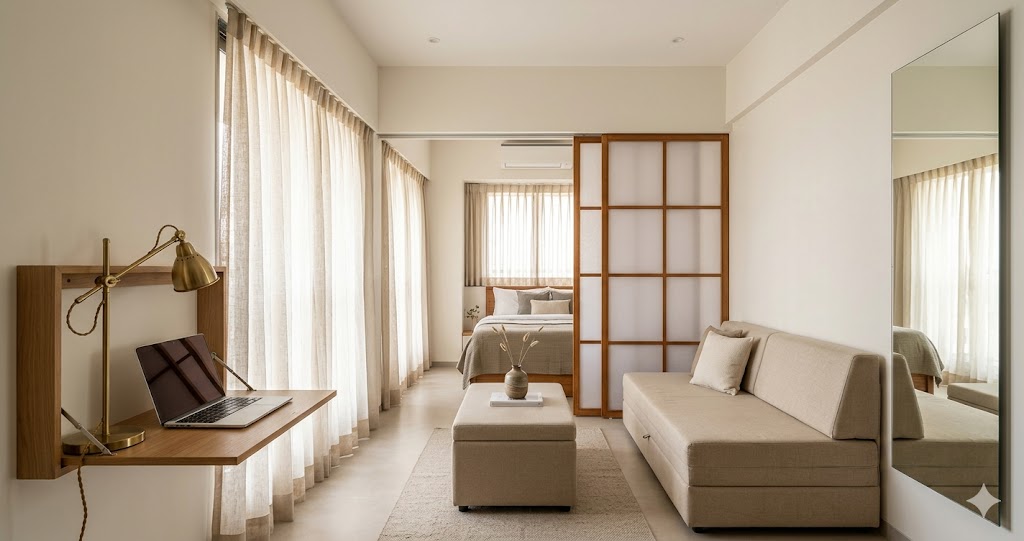
Space-Efficient Homes — A 2026 Working Reference for Compact Indian Apartments
Five spatial multipliers · Floor plan tricks · Dual-purpose furniture
Indian urban apartments shrunk 15-20% in the last decade. The median 1 BHK in Mumbai, Bengaluru and Pune is now 450-580 sft (down from 580-700 in 2015); the median 2 BHK is now 700-950 sft (down from 950-1,200). Carpet area shrunk while household demands grew — WFH since 2020, joint-family overflow guests, hybrid school for kids. Space efficiency is the single most valuable discipline in 2026 Indian interior design. It is the discipline that recovers 100-150 sft of perceived liveable space without moving a single wall.
This is a 22-minute working reference for homeowners and designers building space-efficient interiors in Indian apartments. It covers what space efficiency actually means (recovered space, not smaller furniture), the five spatial multipliers, floor plan tricks with sqft saved per move, a catalogue of dual-purpose and multi-function furniture, annotated layouts for an optimised 1 BHK (480-580 sft) and 2 BHK (700-950 sft), three budget tiers, ten common pitfalls including the small-furniture trap, and how space-efficient design differs from minimalist and maximalist styles.
Most Indian flats waste 25-35% of their footprint to under-engineered furniture, dead corners, and visual clutter. Space efficiency does not require knocking down walls or buying a bigger home — it recovers 100-150 sft of perceived liveable space inside the carpet area you already own, through the disciplined application of five spatial multipliers and a small library of dual-purpose moves.
For complementary depth see Warm Minimal Interiors, Japandi Apartment Interior Guide, Compact Luxury Apartment Guide, Smart Storage Interiors, Budget Luxury Interiors, Modular Kitchen Design Guide, Wardrobe Finish Ideas, and False Ceiling Design Guide.
This guide refreshes every 12 months — furniture catalogues and joinery hardware shift annually. Last verified: May 2026 · Next verify: May 2027.
What "Space-Efficient" Actually Means — Recovered Space, Not Smaller Furniture
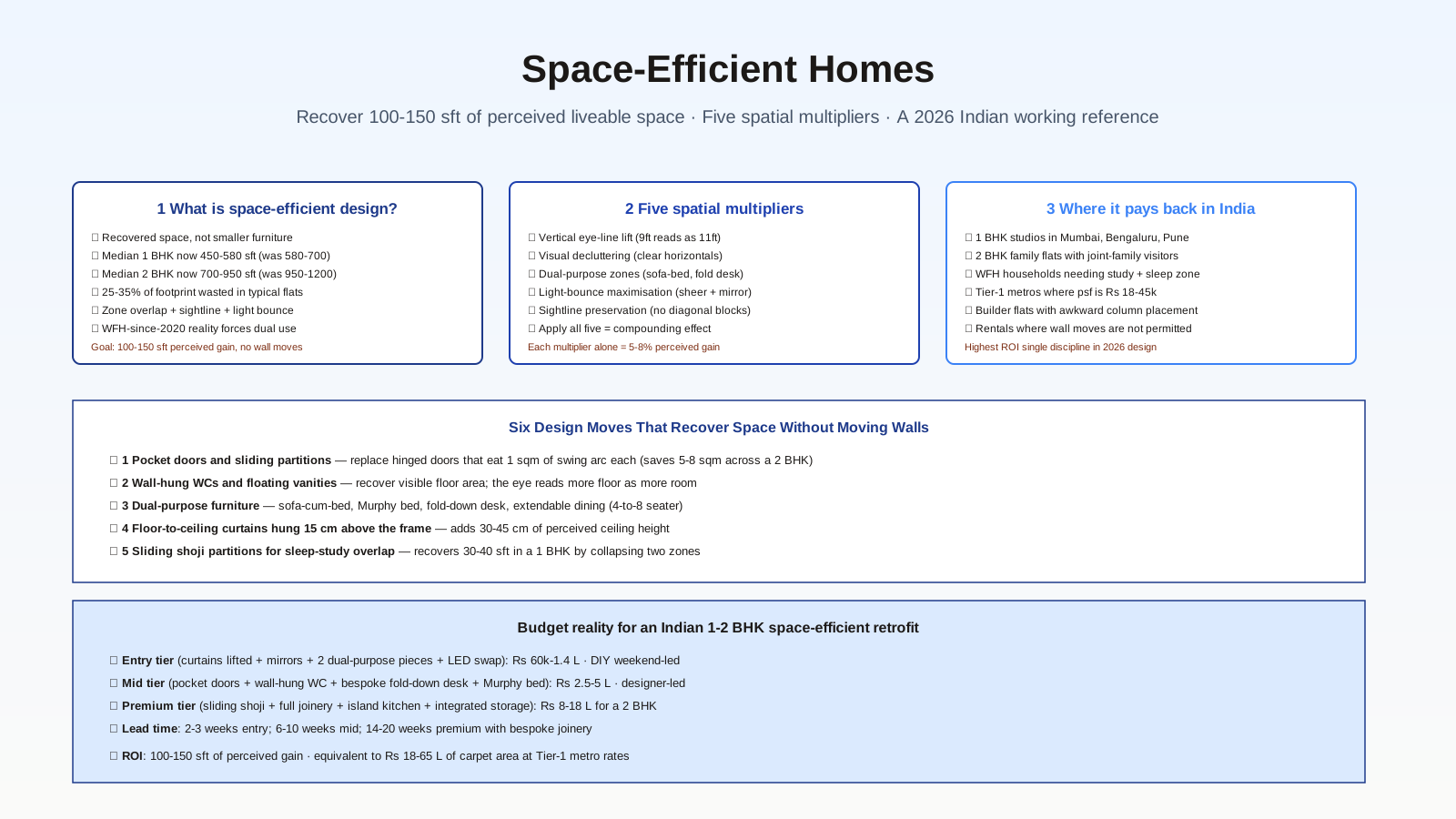
The single most common misunderstanding about space efficiency is that it means buying smaller furniture. It does not. A 60-inch sofa in a 480 sft 1 BHK is not space-efficient — it is uncomfortable. A 36-inch dining table that seats two when you regularly host four is not space-efficient — it is undersized. Smaller furniture is not the answer; recovered space is.
Space efficiency is the discipline of:
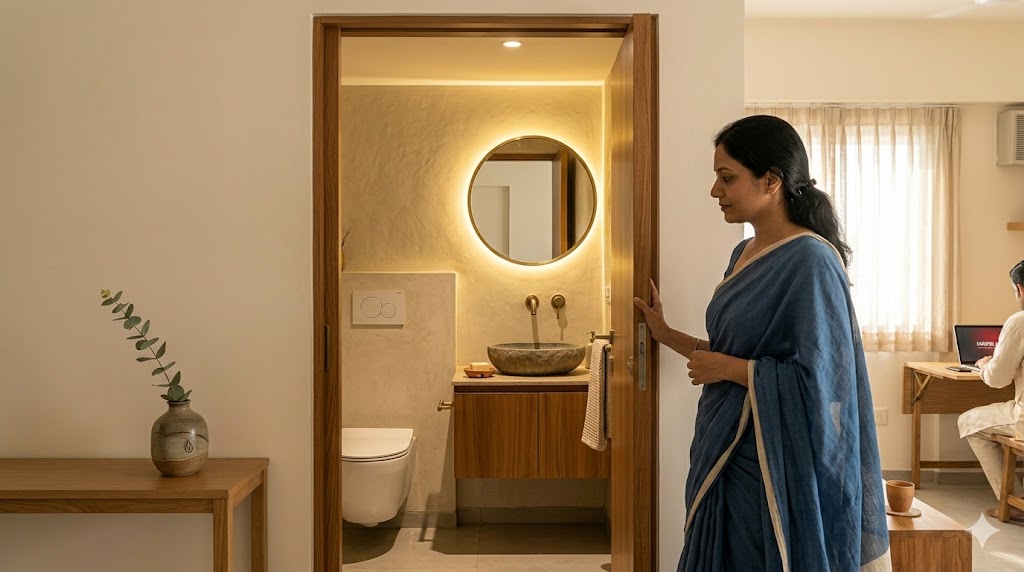
1. Recovering literal square feet through joinery and layout moves (pocket doors, wall-hung sanitaryware, sliding partitions, open-plan kitchen islands) that eliminate dead area without removing function.
2. Recovering perceived square feet through five spatial multipliers — vertical eye-line lift, visual decluttering, dual-purpose zones, light-bounce maximisation, sightline preservation — that make the existing footprint feel 20-30% larger.
3. Absorbing a second function into the same footprint through dual-purpose furniture (sofa-cum-bed, fold-down desk, extendable dining, Murphy bed) that time-shifts one room across two uses.
The diagnostic question: stand at the front door of your apartment and look across the diagonal. How many distinct surfaces can you see? In an under-engineered Indian flat the answer is 2-3 (entry door, corridor wall, corner of the living room). In a space-efficient flat the answer is 6-7 (entry, foyer, living, kitchen island, bedroom shoji partition, balcony beyond). More visible surfaces = more perceived room. That is the core mental model.
Five things space efficiency is NOT
1. Not minimalism. Minimalism is an aesthetic discipline (fewer objects, edited palette). Space efficiency is a functional discipline (more recovered area). A space-efficient home can be maximalist in colour and texture.
2. Not "small space living." Small-space living is an acceptance of the constraint. Space efficiency is an engineering response to it. The mindset is different.
3. Not "smart furniture" alone. A house full of transforming furniture but with wall-swing doors and dead corridors is not efficient — it is gimmicky.
4. Not Japanese minimal. Japanese compact homes assume futons, sliding fusuma, and tatami modular planning. Indian compact homes assume mattresses, swing doors, and Western fixed furniture. The vocabulary is different.
5. Not a 9-ft ceiling cope. The 9-ft (2,750 mm) Indian apartment ceiling is the constraint, not the enemy. Space efficiency works with it — through curtain placement, mirror geometry, and low furniture — not against it.
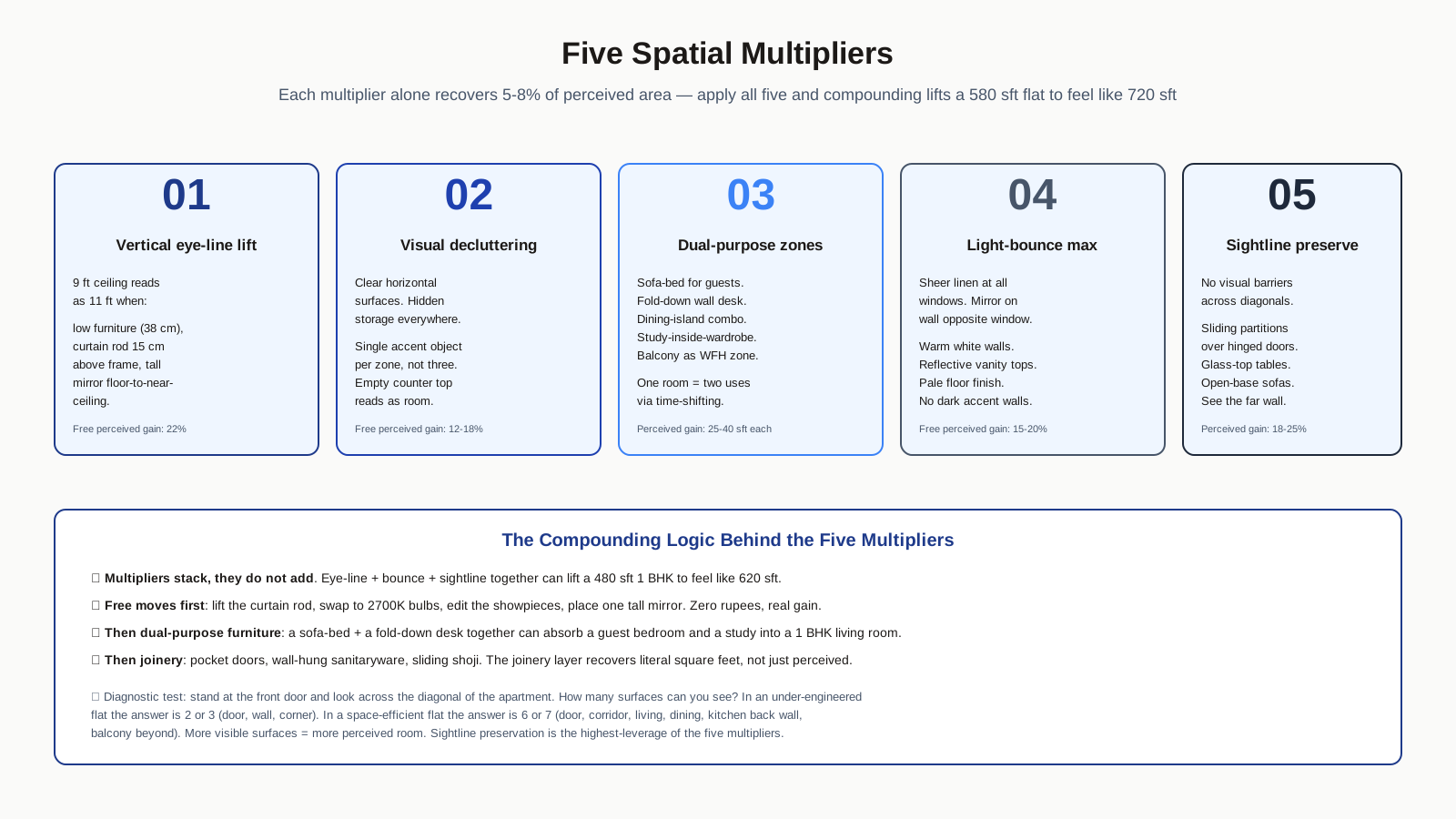
The Five Spatial Multipliers
1. Vertical eye-line lift
A 9-ft Indian apartment ceiling can read as 11 ft with three moves that cost almost nothing. Drop the furniture — sofa seat height 38-42 cm instead of the standard 45-48 cm. Lift the curtain rod — install 15 cm above the window frame, not at the frame, with floor-to-ceiling sheer linen. Add a tall mirror — frameless, 200 cm tall, floor-to-near-ceiling, on the wall opposite the largest window. The mirror reflects ceiling into ceiling and reads as continuous overhead space.
The compounding effect: a 9-ft ceiling with low furniture + lifted curtains + tall mirror reads 22-28% taller than the same room with standard 45 cm sofa + frame-mounted curtains + no mirror. This is a free perceived gain. It costs the price of a curtain alteration and a mirror.
2. Visual decluttering
Clear horizontals. Hidden storage. Single accent objects. The discipline test: photograph the room and ask if there is more than one focal point per visual quadrant. If there is, you have arranged rather than edited. Coffee tables hold one tray with two objects, not seven. Kitchen counters hold the kettle and the fruit bowl, not eight appliances. Console tables hold one ceramic and one stack of books, not a parade of family photos.
Hidden storage is the structural enabler — every horizontal surface that needs to stay clear requires somewhere off-stage for what would have lived on it. Ottoman storage absorbs the throws. Under-bed hydraulics absorb the seasonal clothes. Tall pantries absorb the appliances. The compounding effect: a decluttered 700 sft 2 BHK reads as 800-820 sft because the eye has fewer objects to process and reads the empty surfaces as room.
3. Dual-purpose zones (time-shifting)
A room can be two things at two times of day. The living room is a living room during the day and a guest bedroom at night (sofa-cum-bed). The dining table is a workspace from 9 am to 6 pm and a dining table from 7 pm. The balcony is a WFH zone in the morning and a chai zone in the evening. One room, two uses, separated by time.
The honest constraint: time-shifting works only when both uses do not need to happen simultaneously. A sofa-cum-bed is useless if you have a guest every weekend (just buy a guest bed). A fold-down dining table fails if you eat all three meals at home (just buy a small fixed table). Time-shift only where the second use is occasional (under 30% of waking hours).
4. Light-bounce maximisation
Indian daylight is plentiful and warm. Most flats waste 30-40% of it. The discipline: every photon that enters the apartment should bounce off three surfaces before being absorbed. Sheer linen at all windows (filters but transmits). Mirror or reflective surface on the wall opposite each window. Warm white walls (oat #F5EDE0 reflects ~70% vs grey #B0B7BE at ~45%). Pale floor finish (light oak, sandstone, ivory tile) for under-bounce. Reflective vanity tops (honed limestone, light quartz).
What to avoid: dark accent walls (absorb light), heavy blackout curtains as primary window treatment (use blackout behind the sheer), cool 4000K LED bulbs (compress the warm Indian light spectrum and read clinical). The compounding effect: a 480 sft flat with full light-bounce reads 18-22% larger than the same flat with absorbed light — and significantly happier to live in.
5. Sightline preservation
No visual barriers across the diagonals. Sliding partitions instead of hinged doors. Glass-top tables instead of solid panels. Open-base sofas with visible legs instead of skirted ottomans. The diagonal sightline from the front door to the balcony is the single highest-leverage view in any Indian flat — preserve it and the apartment reads twice as deep. Block it with a hinged bedroom door and you halve the perceived depth.
The hard test: walk in the front door and stand at the entry. Can you see at least 70% of the longest diagonal? If yes, your sightline is preserved. If no, identify the blocker (usually a hinged door, a tall console, or a partition wall) and replace it with a sliding or glass alternative.
Floor Plan Tricks — Square Feet Saved Per Move
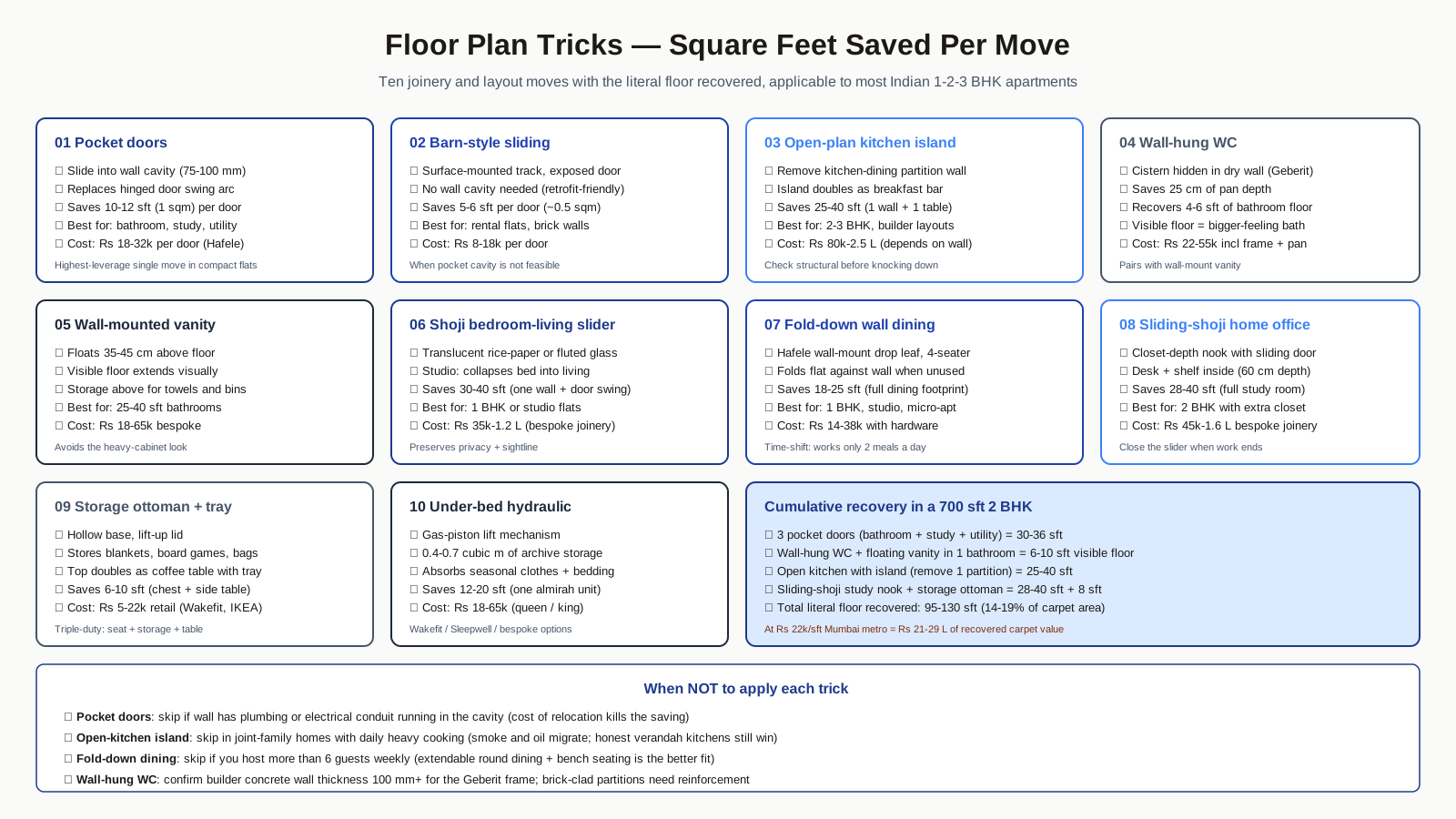
| # | Trick | Saves (sft) | Best for | Cost band |
|---|---|---|---|---|
| 1 | Pocket door (Hafele slider) | 10-12 per door | Bathroom, study, utility | Rs 18-32k each |
| 2 | Barn-style sliding (surface track) | 5-6 per door | Rentals, retrofit | Rs 8-18k each |
| 3 | Open-plan kitchen + island | 25-40 | 2-3 BHK with non-load wall | Rs 80k-2.5 L |
| 4 | Wall-hung WC (Geberit frame) | 4-6 visible floor | All bathrooms | Rs 22-55k |
| 5 | Wall-mounted floating vanity | 4-8 perceived | 25-40 sft bathrooms | Rs 18-65k |
| 6 | Sliding shoji bedroom-living | 30-40 | Studio + 1 BHK | Rs 35k-1.2 L |
| 7 | Fold-down wall dining | 18-25 | 1 BHK, micro-apt | Rs 14-38k |
| 8 | Sliding-shoji home office nook | 28-40 | 2 BHK with extra closet | Rs 45k-1.6 L |
| 9 | Storage ottoman + tray | 6-10 | All living rooms | Rs 5-22k |
| 10 | Under-bed hydraulic archive | 12-20 | All bedrooms | Rs 18-65k |
Cumulative recovery in a 700 sft 2 BHK
Apply five of these tricks to a typical 700 sft 2 BHK and the literal floor recovery adds up:
- Three pocket doors (bathroom + study + utility) = 30-36 sft
- Wall-hung WC + floating vanity in the master bathroom = 6-10 sft of visible floor
- Open kitchen with island (remove one non-load partition) = 25-40 sft
- Sliding-shoji study nook + a storage ottoman = 28-40 sft + 8 sft
- Total literal floor recovered: 95-130 sft (14-19% of carpet area)
At Mumbai metro rates of Rs 22,000-45,000 per sft, that is Rs 21-58 L of recovered carpet value for a total joinery spend of Rs 2.5-5 L. The return is between 4x and 12x depending on metro. Space efficiency is the highest-ROI single discipline available to an Indian homeowner today.
When NOT to apply each trick
- Pocket doors: skip if the wall has plumbing or electrical conduit running in the cavity (relocation cost eats the saving).
- Open-kitchen island: skip in joint-family households with daily heavy Indian cooking — smoke and oil migrate and discolour every fabric in the open-plan zone within 18 months.
- Fold-down dining: skip if you host more than 6 guests weekly (use an extendable round dining + bench seating instead).
- Wall-hung WC: confirm the wall is 100 mm concrete or reinforced to take the Geberit frame load — brick-clad partitions need reinforcement.
- Barn-style sliding: door does not fully seal the room (no acoustic isolation) — skip for bathrooms.
Dual and Multi-Function Furniture Catalogue
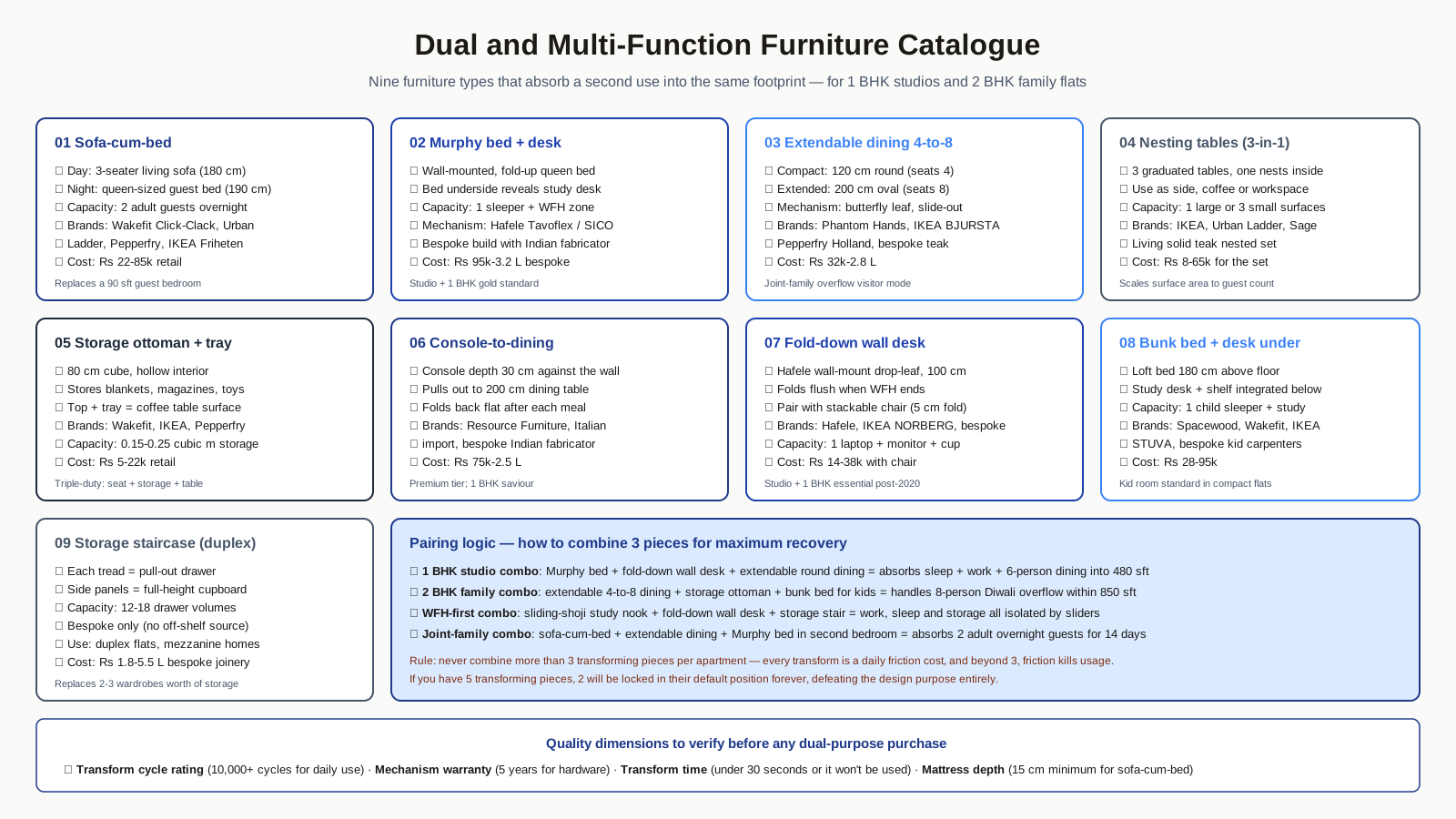
| # | Furniture | Day use | Second use | Capacity | Brands | Cost |
|---|---|---|---|---|---|---|
| 1 | Sofa-cum-bed | 3-seater sofa (180 cm) | Queen guest bed | 2 adults overnight | Wakefit, IKEA Friheten, Urban Ladder | Rs 22-85k |
| 2 | Murphy bed + desk | Wall-fold queen bed | Study desk on underside | 1 sleeper + WFH | Hafele Tavoflex, SICO bespoke | Rs 95k-3.2 L |
| 3 | Extendable dining 4-to-8 | 120 cm round (4 seats) | 200 cm oval (8 seats) | Joint-family overflow | Phantom Hands, IKEA BJURSTA | Rs 32k-2.8 L |
| 4 | Nesting tables (3-in-1) | 3 small surfaces | 1 large + 2 stowed | Scales to guest count | IKEA, Urban Ladder, Sage | Rs 8-65k |
| 5 | Storage ottoman + tray | Seat / footrest | Coffee table + chest | 0.15-0.25 m³ storage | Wakefit, IKEA, Pepperfry | Rs 5-22k |
| 6 | Console-to-dining | 30 cm console | 200 cm dining table | Studio + 1 BHK saviour | Resource Furniture, bespoke | Rs 75k-2.5 L |
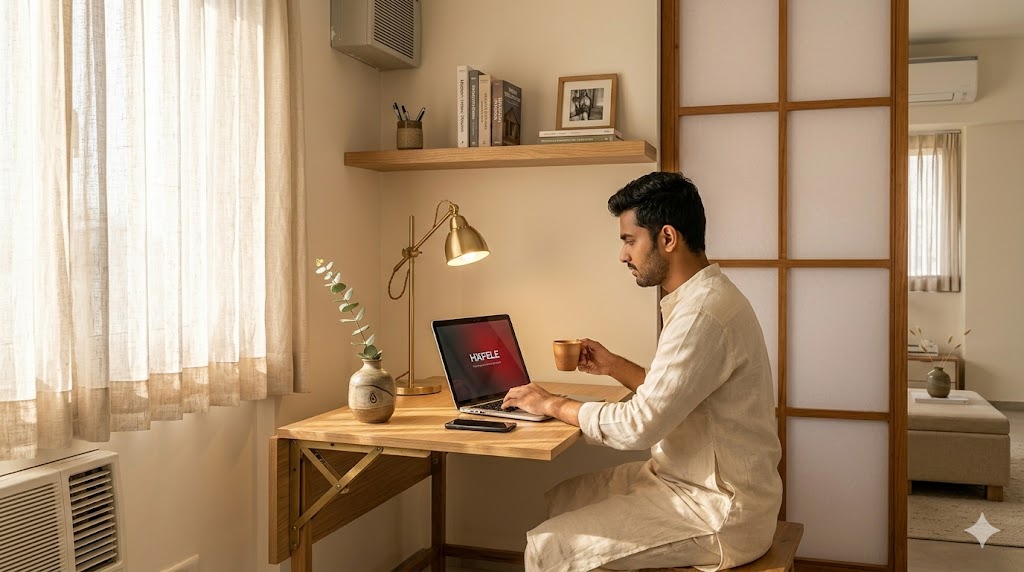
| 7 | Fold-down wall desk | Folded flat | 100 cm desk + chair | WFH zone | Hafele wall-mount, IKEA NORBERG | Rs 14-38k |
| 8 | Bunk + desk under | Loft bed 180 cm up | Study desk + shelf below | 1 child + study | Spacewood, Wakefit, IKEA STUVA | Rs 28-95k |
| 9 | Storage staircase | Stair to loft / mezzanine | 12-18 drawer storage | Duplex flats only | Bespoke only | Rs 1.8-5.5 L |
The pairing rule — never more than three transforms per home
Each transforming piece carries a daily friction cost. Folding a Murphy bed is 90 seconds. Extending the dining is 45 seconds. Folding the wall desk is 20 seconds. Friction adds up. Three transforms per apartment is the practical maximum — beyond three, two of them will be locked in their default position forever, defeating the design purpose entirely.
Recommended combinations:
- 1 BHK studio combo: Murphy bed + fold-down wall desk + extendable round dining = absorbs sleep + work + 6-person dining into 480 sft
- 2 BHK family combo: extendable 4-to-8 dining + storage ottoman + bunk bed for kids = handles Diwali 8-person overflow inside 850 sft
- WFH-first combo: sliding-shoji study nook + fold-down wall desk + storage staircase = work, sleep and storage isolated by sliders
- Joint-family combo: sofa-cum-bed + extendable dining + Murphy bed in the second bedroom = absorbs 2 adult overnight guests for 14 days without disrupting daily routine
Quality dimensions to verify before any dual-purpose purchase
- Transform cycle rating: minimum 10,000 cycles for daily-use pieces (sofa-cum-bed, fold-down desk).
- Mechanism warranty: 5 years on hardware (hinges, gas pistons, slider tracks) is the floor.
- Transform time: under 30 seconds, or it will not be used daily.
- Mattress depth: 15 cm minimum for any sofa-cum-bed used regularly — anything thinner becomes a guest complaint within 12 months.
- Closed-state aesthetics: the folded form is what you live with 80% of the time — it must look composed, not gadget.
Annotated 1 BHK Layout — 480 to 580 sft
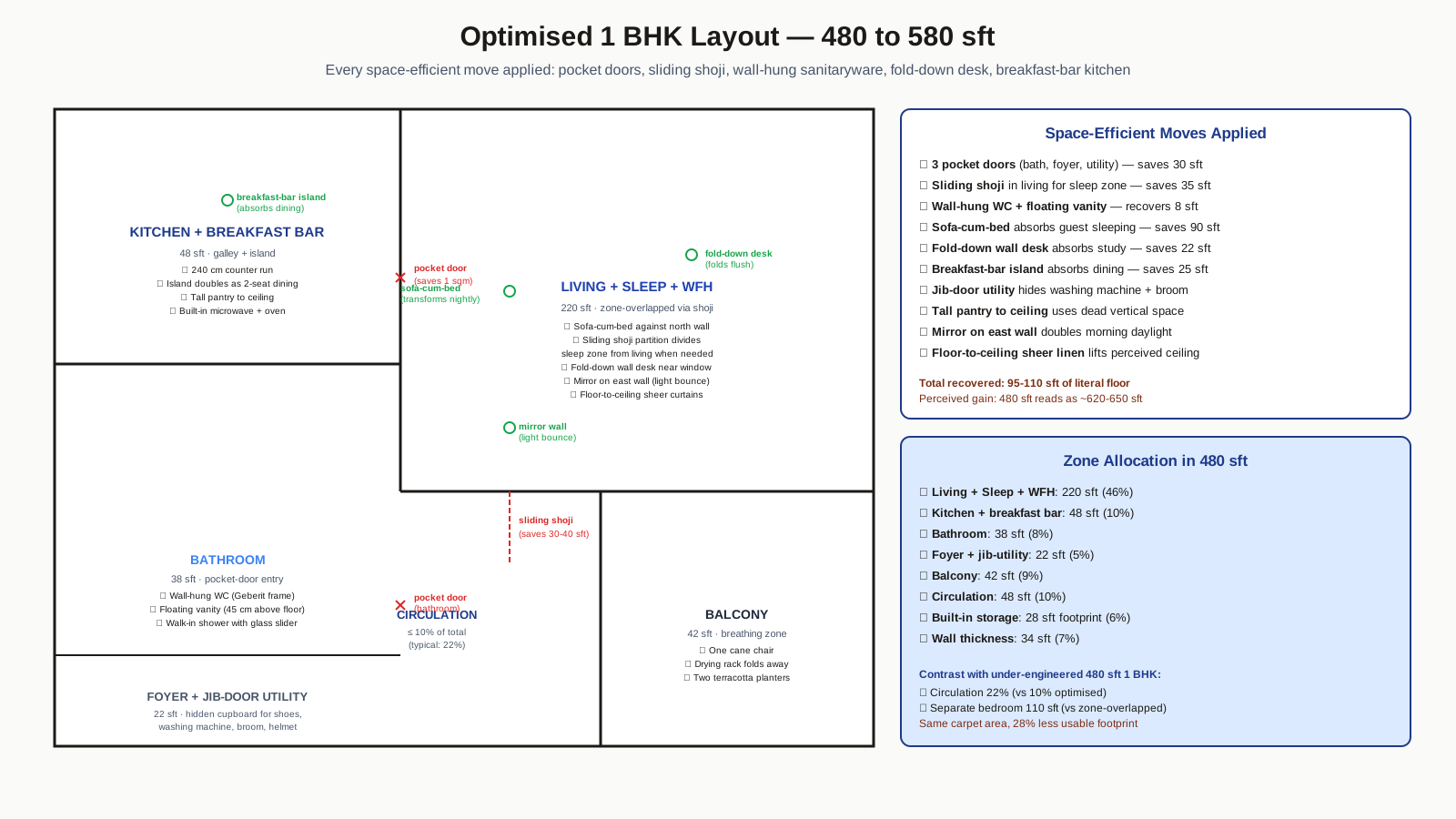
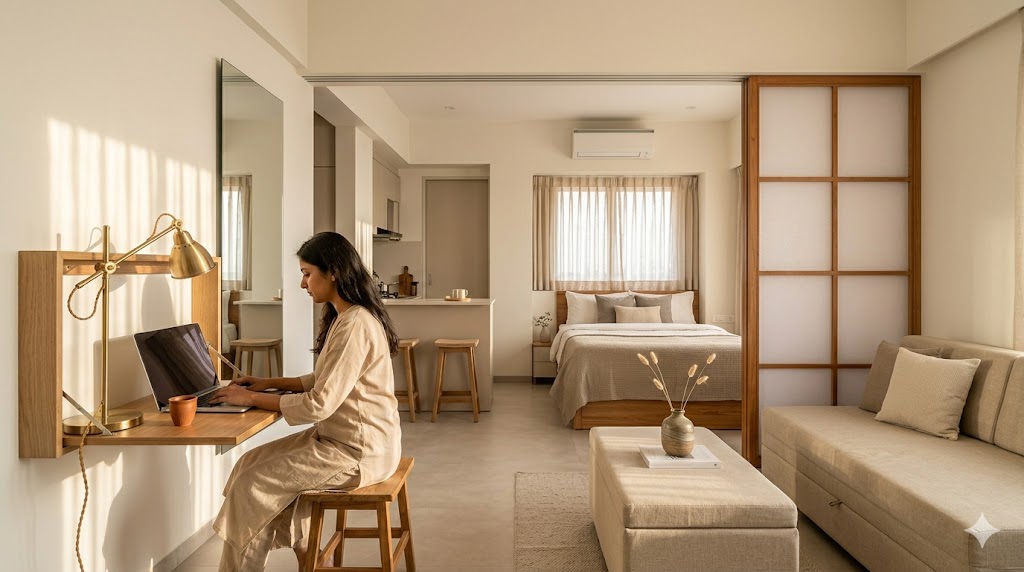
A well-engineered 480-580 sft 1 BHK in 2026 looks fundamentally different from a builder default. The builder default carves out a separate 110 sft bedroom, a 130 sft living, a 65 sft kitchen, a 35 sft bathroom, and burns 22% of the carpet area on circulation corridors. The optimised version collapses bedroom-into-living via a sliding shoji, replaces the wall-swing kitchen door with a pocket door, and adds an island that absorbs the dining function.
Zone allocation (480 sft optimised)
| Zone | Area | % | Notes |
|---|---|---|---|
| Living + Sleep + WFH (overlapped) | 220 sft | 46% | Shoji partition divides only when sleeping |
| Kitchen + breakfast-bar island | 48 sft | 10% | Island doubles as 2-person dining |
| Bathroom | 38 sft | 8% | Pocket door, wall-hung WC, floating vanity |
| Foyer + jib-door utility | 22 sft | 5% | Hidden washing machine + shoe storage |
| Balcony | 42 sft | 9% | Breathing zone; one cane chair |
| Circulation | 48 sft | 10% | (Down from 22% builder default) |
| Built-in storage footprint | 28 sft | 6% | Tall pantry, hydraulic bed, fold-down desk |
| Wall thickness | 34 sft | 7% | Structural floor |
Space-efficient moves applied (and what they save)
- 3 pocket doors (bathroom + foyer + utility) — saves 30 sft of swing arcs
- Sliding shoji in living for the sleep zone — saves 35 sft (no separate bedroom corridor)
- Wall-hung WC + floating vanity — recovers 8 sft of visible bathroom floor
- Sofa-cum-bed absorbs guest sleeping — saves a 90 sft guest bedroom
- Fold-down wall desk absorbs the study function — saves 22 sft
- Breakfast-bar island absorbs dining — saves 25 sft of a dining set
- Jib-door utility hides washing machine + broom + helmets — saves a separate utility cupboard
- Tall pantry to ceiling uses dead vertical space — adds 0.6 m³ of storage with zero floor footprint
- Mirror on east wall doubles the morning daylight — perceived gain 12-18%
- Floor-to-ceiling sheer linen lifts perceived ceiling 30-45 cm
Total literal floor recovered: 95-110 sft. Perceived gain: a 480 sft flat reads as ~620-650 sft.
Annotated 2 BHK Layout — 700 to 950 sft
A 750 sft 2 BHK family flat with both parents WFH, two school-age kids, and quarterly joint-family overnight guests is the most common compact-apartment challenge in 2026 India. The optimised version applies eight space-efficient moves:
| Zone | Area | Moves applied |
|---|---|---|
| Living + dining (open-plan) | 220 sft | Open kitchen island; storage ottoman; sliding-shoji study nook on one wall |
| Master bedroom | 130 sft | Under-bed hydraulic 0.6 m³; wall-hung wardrobe to ceiling; pocket door bathroom |
| Kid bedroom | 105 sft | Bunk bed with desk under; tall wardrobe with study cubby |
| Kitchen (semi-open) | 70 sft | Tall pantry to ceiling; pull-out racks; breakfast-bar island shared with dining |
| Master bathroom | 38 sft | Pocket door; wall-hung WC; floating vanity; mirror cabinet |
| Common bathroom | 32 sft | Pocket door; wall-hung WC; floating vanity |
| Foyer + utility | 28 sft | Jib-door washing machine + shoe storage |
| Balcony | 45 sft | WFH morning + chai evening dual-use |
| Circulation | 50 sft | 7% (down from 18-22% builder default) |
| Built-in + wall | 82 sft | Structural |
The WFH compromise
The single hardest constraint in a 750 sft 2 BHK with two WFH parents is simultaneous video calls. A sliding-shoji study nook handles one parent. The second parent has three options: the dining table (works if calls are not back-to-back), the balcony (works year-round in Bengaluru, only Oct-Mar in Mumbai/Delhi), or rotating the kid bedroom desk into a co-working slot when the kids are at school. There is no perfect solution at 750 sft — accept the compromise or scale to 950 sft.
The joint-family overflow
Quarterly visiting parents need a sleeping zone. The sofa-cum-bed in the open living absorbs 2 adults for 3-5 nights without disrupting daily routine. The Murphy bed option in the kid bedroom adds another 2 adults if the kids share for the week. Beyond 4 adult guests for more than a week, no 750 sft flat can absorb it gracefully — book a service apartment instead.
Three Budget Tiers
Entry tier — Rs 60k to 1.4 L for a 1 BHK (DIY-weekend-led)
The free-and-cheap moves first. Lift the existing curtain rod to 15 cm above the frame; switch to oat sheer linen ready-made drapes (Fabindia, Urban Ladder); install one tall frameless mirror (200 cm, Rs 4-12k); swap every bulb to 2700K CRI 90 LED; add a sofa-cum-bed (Wakefit or IKEA Friheten); add a fold-down wall desk (Hafele or IKEA NORBERG); add a storage ottoman (Wakefit). Lead time 2-3 weeks.
What this tier achieves: 40-60 sft of perceived gain. The sofa-cum-bed and fold-down desk absorb two functions. The lifted curtains and mirror lift the ceiling and bounce the light. The 60k entry tier delivers more perceived space per rupee than any other Indian interior intervention available.
Mid tier — Rs 2.5 to 5 L for a 2 BHK (designer-led, 6-10 weeks)
The joinery layer. Three pocket doors (Hafele systems, Rs 60-90k installed). Wall-hung WC + floating vanity in one bathroom (Rs 50-80k including Geberit frame and plumbing). One bespoke fold-down wall desk in oak veneer. One bespoke breakfast-bar island in the kitchen (semi-open layout, no structural change). Storage ottoman + nesting tables + under-bed hydraulic in master. Lead time 6-10 weeks designer-led.
What this tier achieves: 70-100 sft of literal floor recovered plus 80-120 sft of perceived gain. The 2 BHK starts feeling like a 2.5 BHK. This is the sweet spot for most Indian homeowners — the marginal rupee returns more perceived space than at any other tier.
Premium tier — Rs 8 to 18 L for a 2 BHK (bespoke, 14-20 weeks)
Full sliding-shoji partitions in fluted teak or solid oak frame with rice-paper or fluted-glass infill. Murphy bed with integrated desk in the second bedroom. Open-plan kitchen with full island and integrated dining (structural confirmation required). Wall-hung sanitaryware + floating vanities in both bathrooms. Bespoke storage staircase if duplex. Full DALI dimming with scene control for time-shifted lighting. Resource Furniture or bespoke console-to-dining if extreme compactness. Lead time 14-20 weeks bespoke.
What this tier achieves: 120-160 sft of literal floor recovered plus 150-200 sft of perceived gain. A 750 sft 2 BHK starts performing as a 950 sft 3 BHK in lived experience. This is where the ROI breaks even with buying a larger flat in tier-1 metros — the Rs 12 L spend recovers carpet value of Rs 25-45 L at Mumbai metro rates.
Hidden costs to budget for
- Pocket door wall cavity inspection: confirm no plumbing/electrical conduit before quoting (Rs 5-15k for inspection + relocation if needed)
- Wall-hung WC reinforcement: brick-clad partitions need 100 mm concrete strip (Rs 8-18k structural work)
- Sliding shoji custom dimensions: bespoke joinery to 2,400 mm height runs 30-50% more than standard 2,100 mm (Rs 25-45k extra)
- Murphy bed mechanism: Hafele Tavoflex hardware alone is Rs 35-55k before any cabinet
- Bespoke fabricator quality variance: get three quotes and reference-visit two completed projects before commit — quality on transforming furniture is unforgiving
Ten Common Pitfalls — The Small-Furniture Trap
1. Buying smaller furniture instead of recovering space. A 48-inch sofa in a 480 sft 1 BHK does not save space — it loses comfort. Buy full-size furniture and recover space through joinery and multipliers instead.
2. Hanging curtains at the window frame, not 15 cm above. This is the single most common free-fix-able mistake in Indian apartments. Lift the rod, gain 30-45 cm of perceived ceiling.
3. 4000K cool-white bulbs throughout. Cool LED compresses the warm Indian daylight spectrum and reads clinical. The ceiling looks lower. Switch to 2700K CRI 90 throughout.
4. Heavy blackout curtains as primary window treatment. Blocks all daylight and kills bounce. Layer blackout behind sheer linen — sheer always in front during the day.
5. Hinged bedroom doors that block the diagonal sightline. Replace with pocket door or sliding shoji. The diagonal from the front door to the balcony is the single highest-leverage view in any flat.
6. Skirted sofas and ottomans that block visual depth. Open-base furniture with visible legs adds 10-15% of perceived depth. Skirts read as walls.
7. Five mismatched dining chairs around a fold-down table. The fold-down advantage is lost if the chairs cannot stack or fold. Use 4 stackable chairs (IKEA NILS, Wakefit fold-flat) or one bench + 2 chairs.
8. Dark accent walls in a compact room. They absorb light and read as visual barriers. Save accent walls for rooms over 200 sft; in compact zones keep all walls warm white.
9. Buying 3+ transforming furniture pieces in a single flat. Friction kills usage — beyond 3, two will be permanently locked in default position. Stick to 2-3 transforms maximum.
10. Forgetting the closed-state aesthetic of dual-purpose pieces. The folded Murphy bed, the closed shoji nook, the stacked nesting tables — these are what you live with 80% of the time. They must look composed, not gadget. Spend extra on the closed-state finish.
The diagnostic question
Walk into your apartment, stand at the front door, and ask: "If I had Rs 5 L to spend on this flat, where would the marginal rupee buy me the most perceived liveable space?" If the honest answer is "I would buy a bigger TV" or "I would re-tile the bathroom" — you have not yet engaged with space efficiency as a discipline. The space-efficient answer is always one of: pocket doors, wall-hung sanitaryware, sliding shoji partition, fold-down desk, lifted curtain rod, a tall mirror, or a Murphy bed. Those seven moves are the entire repertoire. Every other intervention is decoration, not efficiency.
How Space-Efficient Differs from Minimalist and from Maximalist
| Dimension | Space-Efficient | Minimalist | Maximalist |
|---|---|---|---|
| Primary goal | Recover liveable area | Visual restraint | Expressive richness |
| Furniture count | High (dual-purpose) | Low | Very high |
| Storage strategy | Hidden + dual-purpose | Hidden | Often displayed |
| Palette discipline | None (any palette OK) | Tight (3-5 neutrals) | Loose (10-20 tones) |
| Wall treatment | Light, bounce-maximised | Light, neutral | Saturated, layered |
| Sightlines | Preserved aggressively | Preserved | Often interrupted |
| Best for | Compact urban flats | Premium spaciousness | Heritage, collectors |
| Compatible with each other? | Yes — space-efficient minimalism | Yes — space-efficient maximalism | Yes — space-efficient maximalism |
Critical clarification: space efficiency is not a style. It is a functional discipline that overlays any style. A maximalist 750 sft 2 BHK with saturated walls, dense art layering and a hand-knotted rug can still apply pocket doors, a fold-down desk, and wall-hung sanitaryware — and it should. Space efficiency is what makes the maximalist flat survive its own visual richness without becoming claustrophobic.
The Indian context: warm minimalism (see Warm Minimal Interiors) pairs naturally with space efficiency because both share the bias toward light walls and curated objects. But the Indian craft-led maximalist (Khurja pottery clusters, Kutch textile layering, brass accents) also benefits from the joinery layer of space efficiency — pocket doors and floating vanities work just as well in an earthy palette as they do in an oat one.
When Full Space Efficiency Isn't Worth It
Space efficiency has diminishing returns above 1,100 sft. Apply it aggressively below 700 sft; selectively between 700-1,100; lightly above 1,100. Specifically:
- Above 1,400 sft per BHK: most spatial multipliers stop adding perceived value; the apartment already breathes. Stop spending on Murphy beds and sliding shoji.
- Daily heavy Indian cooking households: skip the open-plan kitchen island; preserve the closed kitchen with strong exhaust. The smoke-and-oil migration cost outweighs the 25-40 sft saving.
- Households with weekly long-stay guests: skip the sofa-cum-bed; buy a proper guest bed. Transforming furniture for daily-use guests is a daily friction tax.
- Tenants in 11-month leases: skip the pocket doors and wall-hung WCs; these are landlord-improvements, not tenant-improvements. Focus on multipliers, lifted curtains, mirrors, dual-purpose furniture (which moves with you).
- Heritage flats with structural constraints: many heritage buildings cannot take Geberit wall-frame loads or pocket-door cavities. Honour the original plan and apply only the lightweight multipliers (curtains, mirrors, light, sightline).
- Joint-family flats with 6+ residents: storage volume needs exceed what dual-purpose furniture can absorb. Build conventional tall wardrobes and tall pantries instead.
In any of these cases, see Smart Storage Interiors for the storage-led path or Compact Luxury Apartment Guide for the premium-finish-led path.
Where to Go Next
- For storage volume optimisation — Smart Storage Interiors
- For compact + premium combined — Compact Luxury Apartment Guide
- For palette + style overlay — Warm Minimal Interiors
- For low-furniture Japandi compact — Japandi Apartment Interior Guide
- For tight-budget pathway — Budget Luxury Interiors
- For modular kitchen island + breakfast-bar specs — Modular Kitchen Design Guide
- For wardrobe finish and floor-to-ceiling joinery — Wardrobe Finish Ideas
- For false ceiling planning in compact rooms — False Ceiling Design Guide
References
1. Bureau of Indian Standards (1988, reaffirmed 2018). IS 12480 — Code of Practice for Layout of Multi-storey Buildings and Group Housing Schemes. New Delhi: BIS. (Indian housing space standards baseline.)
2. National Building Code of India (2016). NBC Part 4 — Fire and Life Safety, Part 6 — Structural Design, Part 8 — Building Services. Bureau of Indian Standards. (Minimum room sizes and circulation widths for Indian apartments.)
3. Susanka, S. (1998). The Not So Big House — A Blueprint for the Way We Really Live. The Taunton Press. (Foundational reference for quality-over-quantity compact dwelling.)
4. Susanka, S. (2004). Home by Design — Transforming Your House into Home. The Taunton Press. (The companion volume on spatial multipliers and sightline preservation.)
5. Chapin, R. (2011). Pocket Neighborhoods — Creating Small-Scale Community in a Large-Scale World. The Taunton Press. (Compact community planning principles, adaptable to Indian apartment context.)
6. Doshi, B. V. (2012). Paths Uncharted. Vastushilpa Foundation. (Compact dwelling philosophy from Aranya Low-Cost Housing onward.)
7. Robson, D. (2002). Geoffrey Bawa — The Complete Works. Thames & Hudson. (Tropical compact dwelling reference; sightline and verandah-as-room logic.)
8. Phantom Hands (2025). Extendable Dining Table Catalogue — Wegner Reissues + Custom Solid Teak. Bangalore. Available at phantomhands.in. (Indian dual-purpose furniture sourcing reference.)
9. Häfele India (2024). Compact Furniture Hardware Catalogue — Pocket Door Systems, Tavoflex Murphy Bed Mechanism, Drop-Leaf Wall Desk. Häfele India Pvt Ltd. (Hardware specs for joinery and dual-purpose furniture.)
10. Wakefit (2025). Space-Saving Furniture Catalogue — Sofa-cum-Bed, Hydraulic Storage Beds, Bunk Beds. Bangalore. Available at wakefit.co. (Entry-tier Indian source.)
11. IKEA India (2025). Small Spaces Catalogue — BJURSTA Extendable, FRIHETEN Sofa-Bed, NORBERG Wall-Mounted Drop-Leaf, STUVA Loft Bed. IKEA India. (Mid-tier compact furniture reference.)
12. Geberit (2024). Sigma In-Wall Cistern System — Technical Installation Guide for Wall-Hung WCs. Geberit AG. (Wall-hung WC engineering reference.)
13. Resource Furniture (2023). Transforming Furniture Catalogue — Murphy Beds, Console-to-Dining Systems. New York. (Premium-tier reference, applicable to bespoke Indian fabricators.)
14. Ching, F. D. K. (2014). Architecture — Form, Space, and Order. 4th Edition. Wiley. (Foundational reference on sightlines, volumetric perception, and spatial composition.)
15. Alexander, C. (1977). A Pattern Language — Towns, Buildings, Construction. Oxford University Press. (Patterns 159 "Light on Two Sides of Every Room", 188 "Bed Alcove", 190 "Ceiling Height Variety", 191 "The Shape of Indoor Space" — all directly applicable to space-efficient design.)
Author's note: Space efficiency is the single discipline I would teach first to any Indian homeowner buying a sub-1,000 sft flat in 2026. The reason is leverage — every other interior design discipline (palette, materials, lighting, art) operates on top of the spatial volume you have to work with. Get the spatial volume wrong and no amount of warm minimal palette or earthy material layering can rescue the lived experience. Get the spatial volume right and even a builder-default 480 sft 1 BHK can feel like a 620 sft home — which, at Mumbai metro rates, is the equivalent of buying back Rs 28-65 L of carpet area through joinery and discipline alone. There is no other Rs 5 L spend in Indian interior design that returns this much value.
Disclaimer: Furniture brand availability, hardware costs, and joinery rates are 2026 indicative and shift with currency, import duties, and supply. Verify product specifications with current vendor quotes. Sqft savings are typical ranges from observed Indian apartment retrofits; actual savings vary with apartment geometry, wall thickness, and existing fit-out. Pocket-door installation requires structural verification of the receiving wall cavity. Wall-hung WC installation requires confirmation of wall load-bearing capacity. Vendor mentions (Phantom Hands, Häfele, Wakefit, IKEA, Spacewood, Sleek, Resource Furniture, Geberit) are illustrative; Studio Matrx has no commercial relationship with any brand named. Studio Matrx, its authors and contributors are not responsible for procurement, installation, or structural outcomes based on this guide. Always consult a licensed structural engineer before knocking down any wall, installing a wall-hung WC frame, or cutting a pocket-door cavity in a load-bearing wall.
Export this guide
Related Guides — Deep-dive reading
Space-Saving Furniture — The 12-Category Piece-by-Piece Indian Reference (2026)
Sofa-cum-beds · Murphy beds · Transformer dining · Modular wardrobes · IS 8888 · Indian brand+price tables
Design StylesJapandi Apartment — A 2026 Style Guide for Compact Indian Homes
Japanese restraint × Scandinavian function · Low furniture · Two-wood discipline
Design StylesSmart Storage Interiors — A 2026 Working Reference for Indian Homes
Inventory-driven · Floor-to-ceiling · Hardware-engineered · Zone-mapped
Room PlanningRelated Tools — Try Free
False Ceiling Cost Estimator
Live ₹/sqft across 8 ceiling types — POP, gypsum, designer, metal, PVC, wooden — with cove and spot lighting for 20 Indian cities.
Cost CalculatorApartment Furniture Size Chart
Standard furniture dimensions for Indian apartments — sofas, beds, tables, dining, storage.
Reference ChartCross-Ventilation Analyzer
Estimate airflow and air changes per hour (ACH) from room size, window areas, layout, and local wind — with NBC 2016 Part 8 compliance check.
Ventilation Calculator