
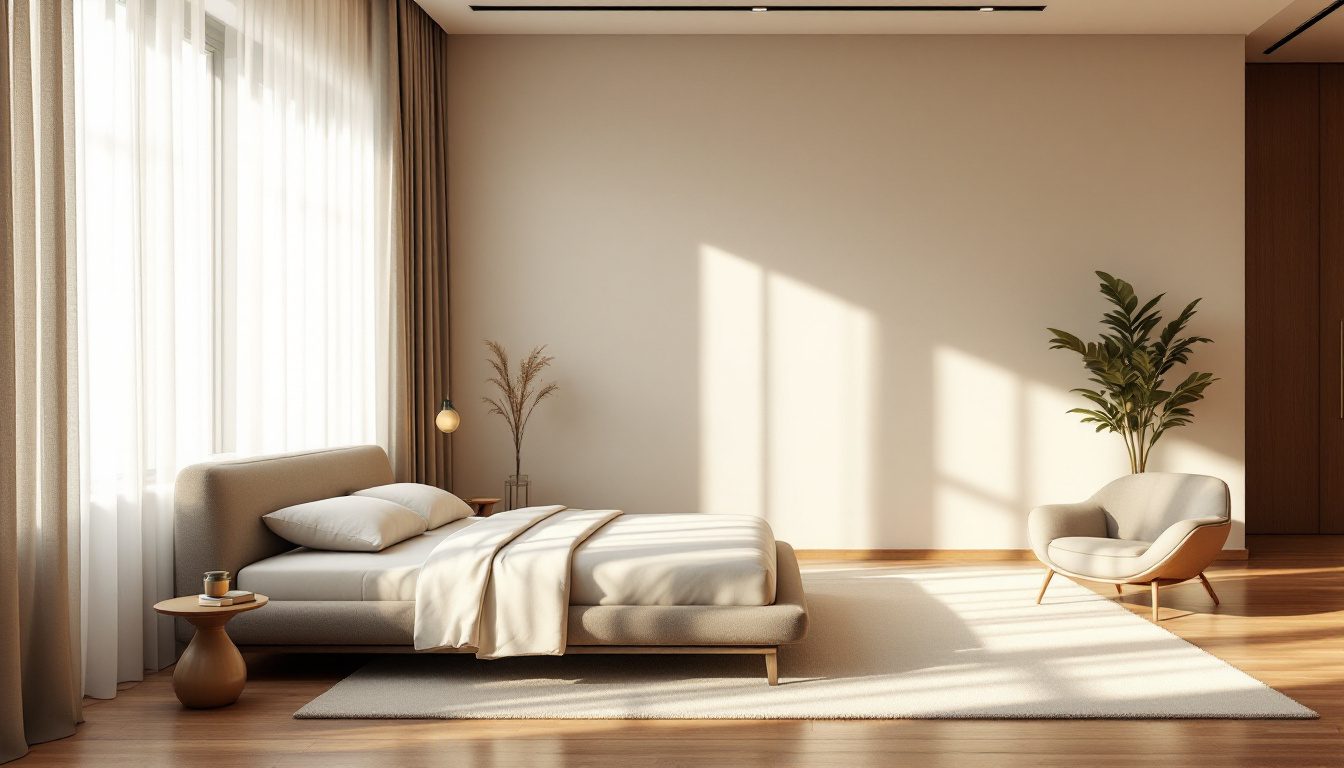
Bedroom Design: Creating a True Retreat at Home
Where the bed really goes, letting wardrobes do the soundproofing, turning a bedroom into a suite, and windows that calm — for Indian homes
A bedroom is not a place to sleep. That sounds wrong until you watch how an Indian home actually uses its bedrooms. The master is where two adults withdraw at the end of a long evening, away from the children, the television, the cooker hiss, the doorbell. A child's room is a private world — homework, sulks, secrets, a place to be alone with the door shut. The guest room carries the weight of who you are as hosts. None of that is about sleep. It is about retreat: the simple, profound act of stepping out of the day and into a room that lets the noise of the house fall away.
That is the lens for everything that follows. Before you choose a bed or a wall colour, ask honestly how each bedroom will really be used. Your idea of bedroom and your neighbour's may be completely different, and a layout that serves one will quietly fail the other.
A bedroom designed as a retreat is the only room in the house whose job is to make the rest of the house disappear.
Start with the question, not the furniture
Two bedrooms can be identical in square footage and feel like rooms from different planets. The difference is almost never the size. It is whether the room was planned around how it is lived in, or simply filled with a bed, a wardrobe, and whatever was left over.
Our home lifestyle quiz is a quick way to surface what each sleeper actually needs from their room before you commit a single wall, and the room programming worksheet turns those answers into a list of must-haves you can size against real dimensions.
So sit with the brief first. The master in a young couple's flat is a sleep-and-recharge room with a reading corner. The master in a family of four is a refuge from the children, and it needs a door that actually closes off sound. A teenager's room is a study-plus-retreat where the desk matters as much as the bed. A grandparent's room near the entry needs an attached bath and no stairs. The worst outcome is one generic bedroom layout stamped four times across a floor plate.
Our home lifestyle quiz is a quick way to surface what each sleeper actually needs from their room before you commit a single wall, and the room programming worksheet turns those answers into a list of must-haves you can size against real dimensions.
Privacy and sound come from position
Because bedrooms — and the bathrooms beside them — are the most private rooms in the house, where they sit on the plan matters more than what goes inside them. A bedroom pushed against the lift shaft, the building corridor, or the street will fight noise every night no matter how thick the curtains. A bedroom tucked behind a buffer of storage and wet areas is quiet for free, which is one of the highest-value moves in the whole guide.
Orientation decides comfort
Which way a bedroom faces decides how much daylight and how much heat it takes through the day, and in the Indian climate this is not a small detail. A west-facing bedroom bakes through the afternoon and is still radiating warmth at bedtime — exactly the wrong time. An east-facing room gets gentle morning light and is cool by night, close to ideal for sleep. Where you can choose, give bedrooms the east and north, and reserve the harsh western exposure for rooms used less in the late day. Where you cannot, plan deep shading, lighter walls, and good cross-ventilation to compensate.
The single most important rule: where the bed goes
Get the bed right and the room presents itself well the moment you walk in. Get it wrong and something feels subtly off that no amount of styling will fix. The bed is the largest object in the room and the one your eye goes to first, so its placement is the placement of the whole room.
Three principles do most of the work.
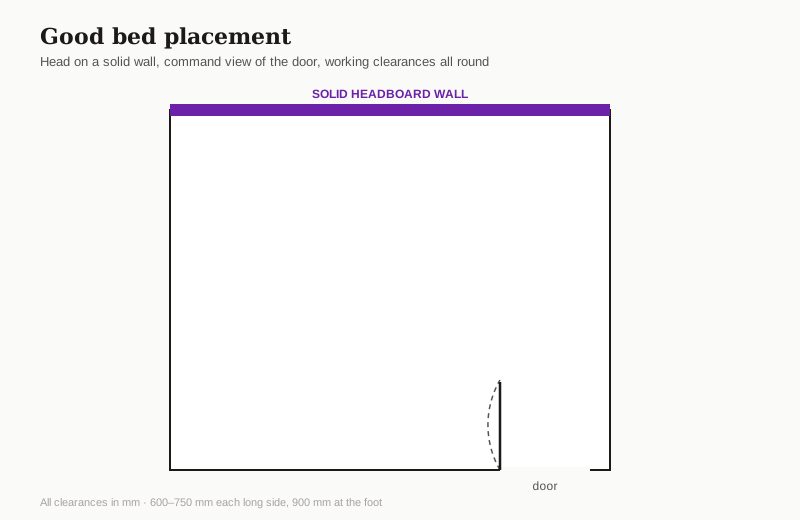
First, the head of the bed belongs against a solid wall — a real wall, not a window, not a door, not a thin partition shared with a noisy room. A solid headboard wall gives a sense of backing the body reads as safety, the difference between a bed that feels anchored and one that feels adrift. The wall must be long enough for the headboard plus a night table on each side. A king needs more wall than a queen, which is why the master should get the longest unbroken wall in the room.
Second, the bed should sit in a command position — placed so that from the pillows you can see the door, but not shoved directly in the doorway's path. The foot can face toward the door, but offset it from the dead-centre line so you are not lying with your feet pointing straight out of the room and the door does not open onto the bed. The aim is a clear, calm view of the entry from where you rest.
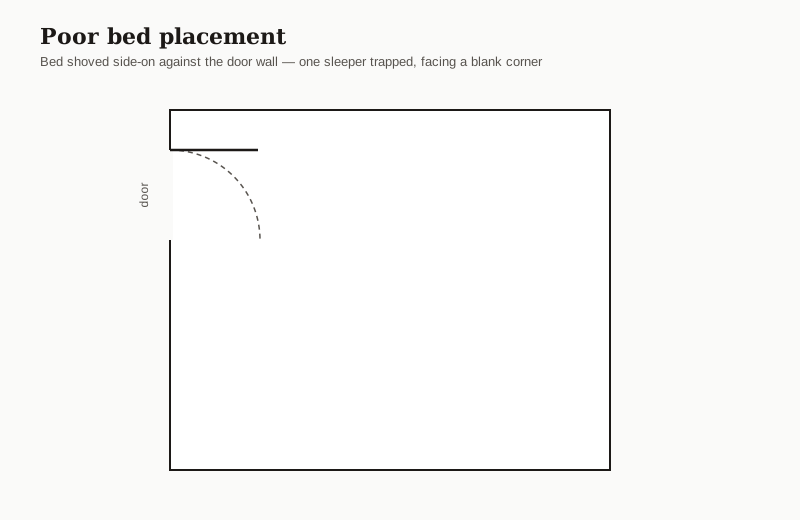
Third, and this is the one most rooms get wrong: never let the side of the bed be the first thing you see when you walk in. A bed greeted side-on looks like furniture pushed against a wall to make space, and it boxes in whoever sleeps on the trapped side. The room reads as awkward even when nothing else is.
Clearances: the silent test of a good plan
A bed can be placed perfectly and still make a room feel mean if there is no space to move around it. Two people sharing a double bed each need to get in and out, make the bed, and open a wardrobe without a daily squeeze. These are the working clearances drawn from anthropometric standards and everyday Indian use.
| Around the bed | Comfortable | Workable minimum | Why it matters |
|---|---|---|---|
| Each long side (double bed) | 750 mm | 600 mm | Room to get in, get out, and make the bed |
| Side against a wall (single, child) | 0 mm (one side) | 0 mm | A single may sit against a wall; keep one open side |
| Foot of the bed | 900 mm | 700 mm | Passing space, and room to open the foot wardrobe |
| In front of a wardrobe shutter | 900 mm | 750 mm | Clear arc to open shutters and stand to choose clothes |
| Beside a night table to the wall | 600 mm | 500 mm | Reach the table and the wall switch without a stretch |
The single most useful number here is the 600 to 750 mm on each long side of a double bed. Drop below it and one person is forever climbing over the other. Our scale and proportion calculator lets you test a bed size against a room size before the masons start, finding the pinch points on screen instead of after the furniture arrives.
A room is not measured by its floor area. It is measured by the space you can actually walk through with your eyes closed at night.
Bed sizes and the rooms that suit them
In India bed sizes are quoted in feet, and they vary a little by manufacturer, so always check the exact frame before you size a room. As a working guide, these are the common sizes and the rooms that hold them comfortably with the clearances above.
| Bed | Mattress (ft) | Mattress (mm) | Comfortable room size | Tight but workable |
|---|---|---|---|---|
| Single | 3 × 6.5 | 915 × 1980 | 2.7 × 3.0 m | 2.4 × 3.0 m |
| Queen | 5 × 6.5 | 1525 × 1980 | 3.3 × 3.6 m | 3.0 × 3.3 m |
| King | 6 × 6.5 | 1830 × 1980 | 3.6 × 4.2 m | 3.3 × 3.9 m |
A queen at 5 × 6.5 ft suits most Indian masters and is the sensible default for a 3.3 × 3.6 m room. A king at 6 × 6.5 ft is a genuine luxury and wants a 3.6 × 4.2 m room to breathe — squeeze a king into a queen-sized room and you win bed and lose the floor. Children do well on a single until their teens, after which a queen is a kinder long-term buy than replacing the frame twice.
Leave the wall opposite the headboard for a dresser or chest of drawers, and decide the television's spot as part of the furniture plan rather than drilling it in later. A wall-mounted screen across from the bed is the usual answer; plan its height and the cable route while the wall is still open.
Let the wardrobes and bathroom do the soundproofing
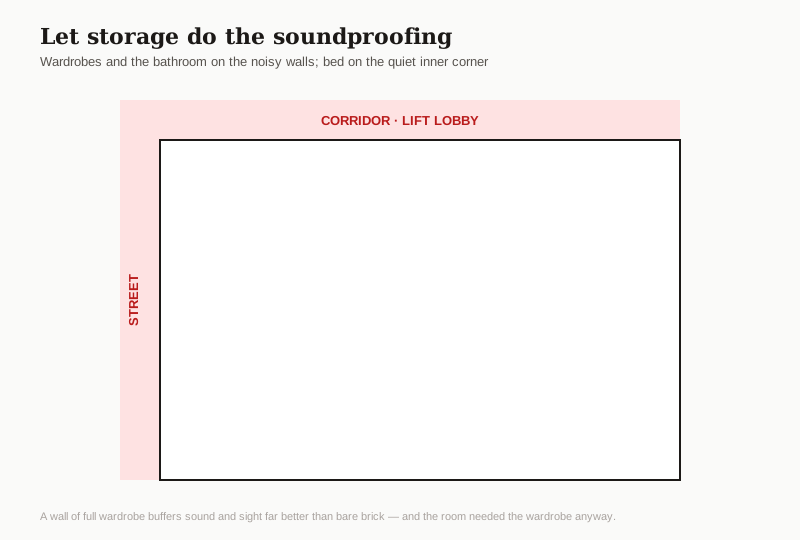
This is the layout move that costs nothing and changes how a home feels at night. A wall of wardrobe is a wall of insulation: packed with clothes and linen, it buffers sound and sight far better than a bare brick partition — and the room needed the wardrobe anyway, so the acoustic benefit is free.
The principle: put the storage and the wet areas on the noisy walls, and keep the bed on a quiet inner wall. If a bedroom backs onto the corridor, the lift, the staircase, or the street, run the wardrobes or the attached bathroom along that wall so the noise is absorbed before it reaches the pillows.
| Noise source | Buffer to place against it | Effect |
|---|---|---|
| Building corridor / lift lobby | Wardrobe run or wardrobe lobby | Absorbs footfall and lift-door clatter |
| Street or main road | Attached bathroom, then bed on inner wall | Wet area takes the traffic noise |
| Adjacent bedroom (sibling, guest) | Stacked wardrobes on the shared wall | Mutual privacy, no shared headboard wall |
| Living room / TV wall | Wardrobe or dresser wall | Hushes evening television and conversation |
| Two bedroom doors near each other | Offset the doors, do not face them | Visual and acoustic privacy across the hall |
Two small habits multiply the effect. Do not place bedroom doors directly facing each other or right beside each other across a passage; offsetting them by even half a metre gives both rooms more privacy. And never share a headboard wall with a noisy room — a bed head against the living-room TV wall or a child's bed head against the master's wall will transmit every sound straight into sleep.
From room to retreat: the sitting area that makes a suite
Add a small sitting area to a bedroom — even just an extension of the main room, or a corner set off by a wide opening — and the room quietly becomes a suite. It is the difference between a place you sleep and a place you withdraw to: somewhere to read before bed or sit with a coffee away from the household. Often this sitting zone holds most of the windows, so it becomes the bright, calm heart of the room while the bed rests in softer light.
You do not need a vast room for this. A two-chair corner, a wardrobe lobby that leads to the bath, and a window seat are all it takes to lift a plain bedroom into a retreat.
| Suite component | Space it needs | What it adds |
|---|---|---|
| Two-chair sitting corner | About 1.8 × 1.8 m | A place to sit that is not the bed |
| Window seat | 500–600 mm deep, 1.2 m+ wide | A built-in away place to read, almost free of floor area |
| Wardrobe lobby to bath | 900 mm walkway | Storage that doubles as a sound buffer to the wet area |
| Reading nook with a lamp | Corner plus a chair | A pool of warm light for winding down |
| Small study desk (teen / WFH) | 1.2 × 0.6 m | Turns the room into a study-retreat |
Windows that calm
Bedrooms genuinely benefit from windows on two walls — cross-light and cross-ventilation, both deeply prized in the Indian home for the through-breeze that cools a room without a fan running all night. Aim for soft morning light rather than harsh afternoon glare, which is another reason east beats west for a bedroom.
For sleep itself, plan for blackout. A bedroom that floods with 5:30 am summer light will wake the household before the alarm; layered curtains — a sheer for the day, a heavy blackout drape for the night — let you choose. And remember the safety rule that codes enforce: every bedroom should have a window large enough and low enough to serve as a secondary means of escape if the door is ever blocked. Do not shrink a bedroom window below that minimum for the sake of more wall.
AC, fans, and the air of the room
Two services quietly decide a bedroom's comfort, and both want planning rather than guesswork.
Place the split-AC indoor unit on a wall where the airflow crosses the room without blowing onto the bed — cold air landing on a sleeper means a stiff neck and a remote war at 2 am. A side wall, angled across the foot of the bed, is usually kindest. Keep the outdoor unit on a shaded, ventilated face, never boxed into a tight duct.
Centre the ceiling fan over the open floor, not over the bed's edge or a wardrobe, so the draught is even. Size the unit honestly: a small bedroom is comfortable on a 1.0 to 1.5 ton AC, while a large master or top-floor room under the sun may need more — a quick load check beats an undersized unit that runs all night and never cools.
Children's, guest, and elders' rooms
Every bedroom is a zone of retreat, but the retreat means something different at each age.
A child's room is their personal world long before it is a bedroom. Give it a clear study zone with good task light, storage they can actually reach, and — if you can — a window seat or a small away corner that becomes the spot they love most. A single bed against a wall frees floor for play when they are small; plan for the queen they will want as teenagers.
For placement, keep guest and children's rooms away from the master for privacy — unless the children are small and you want them close enough to hear at night. As they grow, distance becomes a kindness to everyone. A guest room earns its keep when it doubles as a study or a small sitting room between visits, so plan it with a sofa-cum-bed or a desk rather than leaving it empty eleven months a year.
If parents or in-laws live with you, a ground-floor bedroom with an attached bath ages gracefully and spares them the stairs entirely — one of the most considerate moves in any Indian family home, and far easier to build in now than to retrofit later.
A calm palette and the question of Vastu
A retreat should look like one. The materials and colours of a bedroom do quiet but real work on how restful it feels, and the principle is restraint: muted, warm, low-contrast surfaces that let the eye settle.
| Element | Calm choice | Why |
|---|---|---|
| Walls | Soft off-white, warm beige, muted sage or clay | Low glare, restful at low evening light |
| Flooring | Warm wood, wood-look laminate, matt vitrified | Quiet underfoot, warm to the bare morning foot |
| Headboard | Upholstered fabric or soft wood | Sound-absorbing, soft to lean against |
| Curtains | Sheer day layer plus blackout night layer | Light control for both nap and deep sleep |
| Lighting | Warm 2700–3000 K, layered, dimmable | Warm low light signals the body to wind down |
| Accents | One or two muted tones, natural textures | A focal point without visual noise |
Avoid the bright, busy, high-contrast schemes that suit a living room; a bedroom wants fewer notes, held longer.
On Vastu: many Indian families want their bedroom to sit right with traditional orientation, and that is a perfectly valid lens. The common guidance — the master in the south-west, sleeping with the head toward the south or east, the bed off the direct line of the door — overlaps neatly with sound design, since a solid headboard wall and a command position are good ideas on any reading. Treat Vastu as one lens among several rather than a rulebook that overrides daylight, ventilation, and comfort. Where the two agree, follow both gladly; where they conflict, weigh sleep and air first. Our Vastu compass tool helps you check a room's true orientation on your own plan so you can make that call with the actual directions in front of you, not a guess.
A bedroom's whole job is to let the day end. Place the bed so the room feels calm and protected, let the wardrobes and the bathroom hush the rest of the house, face the windows toward gentle light and a through-breeze, plan the air so it never lands on your neck, and give the room one small away corner to retreat into. Do that, and you have built not just a room but a genuine retreat.
Bring it to life with Studio Matrx
Tell Studio Matrx who sleeps where and how each room is really used, and get bedroom layouts with the bed placed in a command position, wardrobes positioned to buffer the noise, windows planned for your orientation, and a palette tuned for rest. Start with the room programming worksheet to capture the brief, test sizes against your room on the scale and proportion calculator, then let Studio Matrx turn it into a plan you can build.
References
- Bureau of Indian Standards. National Building Code of India (NBC) 2016, Part 4: Fire and Life Safety and Part 8: Building Services — minimum room sizes, window areas, and means of egress.
- Panero, Julius, and Martin Zelnik. Human Dimension and Interior Space: A Source Book of Design Reference Standards. Whitney Library of Design — anthropometric clearances for beds, circulation, and bedroom furniture.
- Bureau of Indian Standards. IS 1929 and related furniture standards — Indian bed and mattress dimension conventions.
- Bureau of Energy Efficiency, Government of India. Eco Niwas Samhita (Energy Conservation Building Code for Residential Buildings) — orientation, openable window area, and natural ventilation for thermal comfort in Indian homes.
- Bureau of Energy Efficiency. Energy Conservation Building Code (ECBC) — guidance on building envelope, shading, and west-facade heat gain relevant to bedroom orientation.
- Neufert, Ernst. Architects' Data. Wiley-Blackwell — standard room layouts, bed clearances, and furniture planning dimensions.
- Ching, Francis D. K. Architecture: Form, Space, and Order. Wiley — principles of spatial enclosure, light, and the sense of refuge that underpin a room designed as a retreat.
- Hirsch, William J. Jr. Designing Your Perfect House: Lessons from an Architect. Dalsimer Press. (A general inspiration for this series' approach to designing a bedroom as a true retreat.)
Export this guide
Related Guides — Deep-dive reading
Orientation, Light & Views: Designing With Your Space, Not Against It
How reading your plot's sun, breeze and views — and placing each room on the right face — gives an Indian home that is cooler, brighter and quietly right, instead of one that fights its site forever.
Design PrinciplesUsing Focal Points to Make Any Room Feel Intentional
Why every room needs one thing the eye lands on first — and how to choose, create and frame a focal point, from the mandir and the jharokha view to the television problem in Indian living rooms.
Design PrinciplesLiving Room Design in India: Built Around How You Actually Live
Resolving the three competing focal points, sizing to people not floor area, the double-height trap, and the formal-vs-family living room question
Room PlanningRelated Tools — Try Free
Cross-Ventilation Analyzer
Estimate airflow and air changes per hour (ACH) from room size, window areas, layout, and local wind — with NBC 2016 Part 8 compliance check.
Ventilation CalculatorAcoustic Privacy (STC) Visualizer
Indian healthcare acoustic visualizer — compare wall assemblies and noise sources, see received SPL after STC attenuation, and check FGI 2018 / IS 1950 / NABH speech-privacy compliance with live dual-canvas waveform.
Acoustic ToolBrise-Soleil Visualizer
Interactive horizontal-louvre cut-off angle calculator — sun altitude, louvre depth, and spacing inputs with a live shadow preview. Computes θ = arctan(spacing/depth) for façade shading, ECBC envelope compliance, hospital daylight design, and tropical sun-control detailing.
Sun Shading Tool