
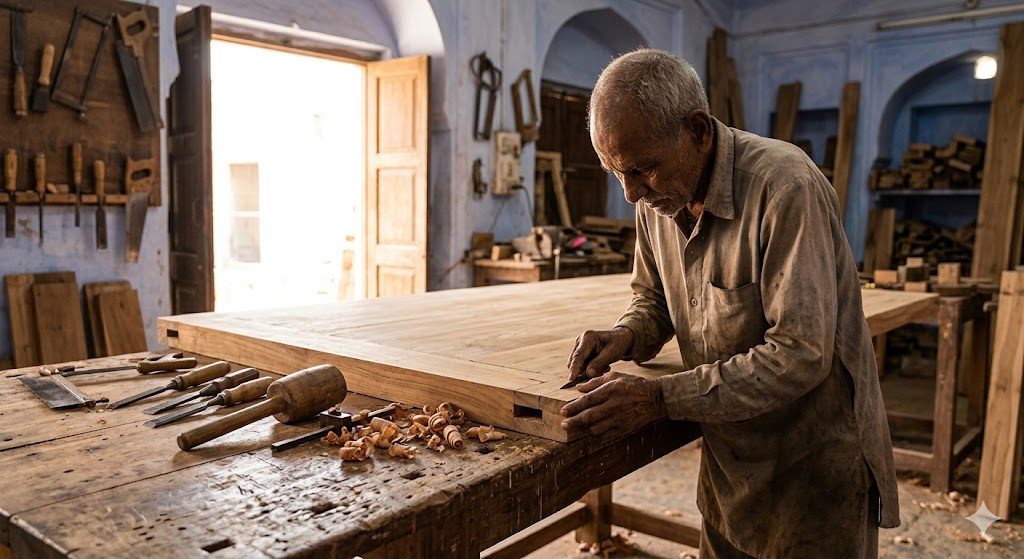
Bespoke Furniture Explained
Why custom-made furniture is the true marker of a luxury interior — and how it is made
Walk into a genuinely luxurious Indian home and the giveaway is rarely the chandelier or the imported marble. It is the dining table whose grain runs unbroken across a four-metre top with no visible join; the wardrobe that meets the ceiling cornice in a shadow-gap so precise it reads as architecture; the sofa whose arm height was set to the owner's exact frame. None of these came off a catalogue. They were drawn, prototyped and built for one room, once. That is bespoke.
This guide explains what "bespoke" furniture actually means — and how it differs from the looser words "custom" and "made-to-order" that get sprayed across every showroom in Mumbai and Bengaluru. It walks through the full spectrum from off-the-shelf imported pieces to fully commissioned artisan work, opens up exactly how a bespoke piece is made in an Indian workshop, names the joinery and hardware that separate furniture-grade work from carpentry, sets out realistic 2026 cost bands, and gives you a commissioning playbook with timelines, milestones and the pitfalls that quietly ruin most "custom" jobs.
The single idea to hold onto: bespoke is not a finish or a price tag — it is a process. A piece is bespoke when it begins as a drawing made for your space, is prototyped before it is built, and is constructed with joinery that would survive without glue. Everything else is decoration sitting on a question mark.
"Bespoke" vs "custom" vs "made-to-order": the words actually mean different things
These three terms are used interchangeably in Indian retail, and the slippage costs clients real money. Bespoke furniture is the clearest marker of a true luxury interior precisely because it cannot be faked at scale — which is why we treat it, in our pillar guide on what defines luxury interiors in India, as one of the load-bearing signals of the genuine article rather than the merely expensive.
Here is the honest hierarchy.
| Term | What it really means | Who controls the design | Tooling | Typical lead time |
|---|---|---|---|---|
| Catalogue / branded | A finished product sold as-is. You pick from existing SKUs. | The manufacturer | Mass / batch | In stock or 4–10 weeks import |
| Made-to-order (MTO) | A catalogue design built after you order, in your chosen fabric/finish/size from a fixed menu | The manufacturer; you pick options | Batch with options | 6–16 weeks |
| Made-to-measure / modular-custom | A standard system (carcass, modules) sized and configured to your wall | Shared — system is fixed, layout is yours | Semi-bespoke | 4–8 weeks |
| Bespoke (true) | Designed from scratch for your space, drawn, prototyped, then hand-built | You and your designer/atelier | One-off | 6–14 weeks |
The litmus test is simple. If a drawing of your specific piece existed before anyone cut material, and a sample or prototype was approved before production, it is bespoke. If you chose a leg, a width and a leather from a menu, it is made-to-order — which can be excellent, but is not the same thing. Most showrooms that advertise "fully customisable" are selling MTO. That is not a criticism; it is a category. The error is paying bespoke money for MTO control.
Why bespoke is the hallmark of luxury
Luxury, at the level this guide concerns, is the absence of compromise. Four things only bespoke can deliver:
- Fit to the exact space. A bespoke media unit is drawn to the millimetre of your niche, including the out-of-plumb wall that every Indian RCC structure hides. A catalogue unit leaves a 40 mm gap you will look at forever.
- Exact material, finish and proportion. You specify the species, the cut of the veneer (crown vs quarter-sawn), the sheen of the lacquer, the radius of an edge. Proportion — the single hardest thing to buy — is set for your ceiling height and your eye.
- Signature pieces. A hand-carved headboard, a single-slab live-edge table, a brass-inlaid console: objects that exist nowhere else and quietly anchor a room.
- Repairability and longevity. Furniture-grade joinery can be taken apart, re-glued, re-finished and handed down. Most branded ready-to-assemble pieces cannot survive one move.
Anyone can buy expensive furniture. Bespoke is the only furniture that can be wrong nowhere — because every dimension answered to your room before it answered to a price list.
This is also why bespoke sits naturally inside the quiet-luxury aesthetic: the value is in the make, not the logo. There is no badge. The flex is the join you cannot find.
The spectrum: from imported off-the-shelf to fully bespoke
It helps to see furniture procurement as a ladder of cost against control, not a binary of "branded vs carpenter."
Rung 1 — Imported off-the-shelf (B&B Italia, Poliform, Minotti, Flexform, Molteni). Superb engineering, iconic design, fixed dimensions. You are buying the designer's intent exactly. In India these arrive through partners in Mumbai, Delhi and Bengaluru with import duty and freight stacked on top — a Minotti sofa lands meaningfully above its European price. This is luxury, but it is not yours; the same piece sits in a hundred other homes.
Rung 2 — Made-to-order from those same houses. Poliform and Molteni in particular let you size wardrobes and configure kitchens within their system, in their finishes. Closer to your wall, still their language.
Rung 3 — Made-to-measure modular. Local premium modular (and the premium kitchen hardware that goes inside it) sized to your room. The carcass is a standard system; the layout, finish and hardware are yours. Excellent value for wardrobes and kitchens.
Rung 4 — Fully bespoke artisan. A piece drawn for your room and built one time by a named workshop or atelier. Maximum control, maximum cost, the only rung that delivers a true signature piece.
The sophisticated home rarely lives on one rung. The usual luxury pattern: a few imported icons (the sofa, a chair) for engineering you cannot replicate locally, modular for kitchens and wardrobes, and bespoke for the pieces that define the room — dining table, bed, console, library.
How a bespoke piece is made in India
This is where the romance meets the workshop. A properly run bespoke job moves through six stages. Skip any and you have carpentry, not furniture.

1. Design and drawing
The piece is drawn — plan, elevation, section, and critically a 1:1 or 1:5 joinery detail — against a measured survey of your actual room. Good ateliers produce shop drawings, not mood images. This is the stage where proportion is fixed.
2. Material selection
The species and substrate are chosen for the job, not the budget alone:
| Material | Best for | Notes |
|---|---|---|
| Solid Burma / plantation teak | Tables, beds, frames, exterior-adjacent | India's benchmark hardwood; stable, ages to honey, repairable forever |
| Solid walnut / oak (imported) | Statement tables, contemporary work | Walnut for dark luxury; American/European oak for pale modern |
| Solid sheesham (Indian rosewood) | Traditional and fusion pieces | Strong, characterful grain; mind movement |
| Veneer on BWP ply / blockboard | Large panels, wardrobes, wall units | Real wood face; dimensionally stable; see our plywood-grades guide |
| MDF / HDF | Lacquer (PU) and membrane panels | Routs cleanly; only for finishes that hide it; never for structure that carries load |
The luxury default in India is solid wood for frames and load paths, veneer-on-ply for large flat panels. A "solid wood" dining table with a veneered top over ply is not a cheat — it is correct engineering, because a four-metre solid top will move and crack. Honesty about where solid stops and veneer begins is the mark of a serious maker.
3. Joinery — the part that actually separates bespoke from carpentry
This is the single most important section in this guide. The joint is the furniture.
| Joint | Where used | Strength | Quality signal |
|---|---|---|---|
| Mortise & tenon | Frames, legs, beds, chairs | Highest for frames; mechanical, not glue-dependent | Heirloom-grade; the gold standard |
| Dovetail | Drawer boxes | Resists pull-apart; self-locking | Hand or machine-cut dovetails = serious drawer |
| Dowel | Panel-to-panel, lighter frames | Good when accurate; alignment-dependent | Acceptable; volume-workshop standard |
| Domino / loose-tenon | Modern equivalent of M&T | Near mortise-and-tenon, faster | Sign of a modern, well-tooled atelier |
| Screwed butt / L-angle | Site carpentry | Weakest; relies on screws into end-grain | Avoid for anything that flexes or carries load |
A bench rule: a true bespoke drawer has a dovetailed box running on soft-close undermount slides (Blum Tandembox, Hettich InnoTech, or Häfele's equivalent). A carpenter's "custom" drawer is a screwed plywood box on a side-mounted channel. Both are "custom." Only one survives a decade of daily use.
4. Finishing
| Finish | Look | Durability | Cost signal |
|---|---|---|---|
| PU (polyurethane) lacquer | Glass-smooth, any colour/sheen | Excellent; the luxury default | High — factory spray booth, multiple coats |
| Melamine | Workhorse clear/tinted | Good | Mid |
| Hand-rubbed oil / wax | Matte, tactile, "raw" wood | Re-oilable; ages live | Premium for the labour, not the material |
| Duco / NC lacquer | Solid colour | Fair; chips show | Mid |
PU done in a controlled booth is the contemporary luxury finish; hand-rubbed oil is the quiet-luxury choice for solid timber you want to feel. The finish should be specified by sheen value, not just "matte" — there is a world between 10% and 30% gloss.
5. Upholstery
The frame of a sofa is hardwood (seasoned, kiln-dried), webbing or pirelli straps, then a foam stack graded by density. Luxury upholstery uses high-resilience (HR) foam over a feather-and-fibre wrap, not a single slab of cheap foam that flattens in a year. Leather grade (full-grain > top-grain > corrected/bonded) and fabric rub-count (Martindale) are specified, not assumed.
6. Quality control and dry assembly
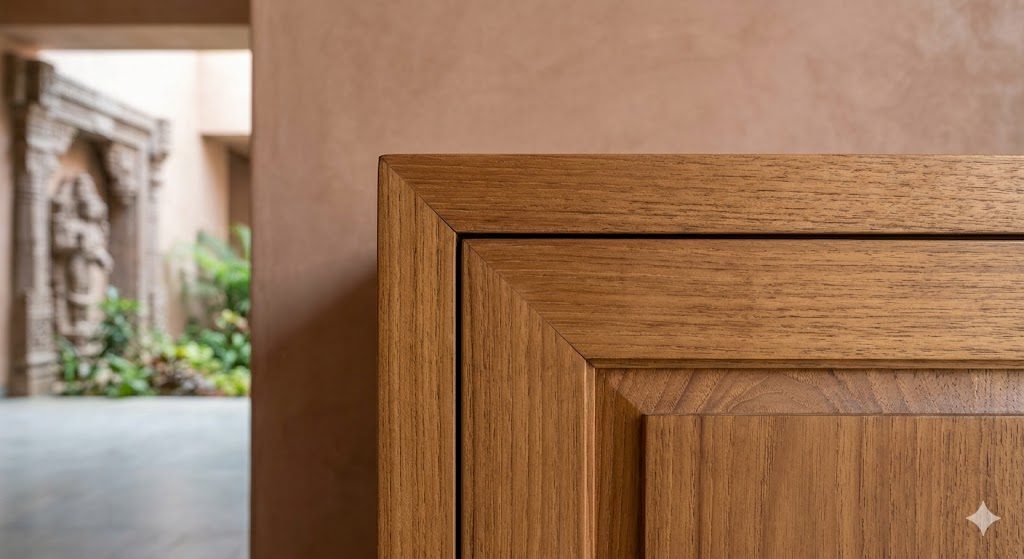
Serious workshops dry-assemble the whole piece, check every reveal and shadow-gap, then disassemble for transport and final on-site assembly. The shadow-gap detail visible below is the kind of tolerance — a deliberate, even 6–10 mm reveal — that only survives this discipline.
The Indian craft ecosystem
India's advantage in bespoke furniture is its living craft base — something most countries lost to industrialisation.
- Karigars — skilled craftsmen, often family-trained, who carry joinery and carving knowledge that no CNC fully replaces. The best bespoke ateliers are built around retaining them.
- Jodhpur (Rajasthan) — the centre of India's solid-wood and colonial-revival furniture industry; sheesham and mango, carving, and a deep export supply chain.
- Saharanpur (UP) — the heart of hand-carved woodwork; intricate jali and relief carving for headboards, screens and signature pieces.
- Channapatna (Karnataka) — lacquered turned wood, increasingly used by designers for accent pieces.
- Modern urban ateliers — Mumbai, Bengaluru, Delhi-NCR and Ahmedabad studios that pair CAD shop-drawings, CNC routing and spray booths with hand-finishing karigars. This hybrid — digital precision plus hand craft — is where the best Indian bespoke now sits.
The sophistication of a city's atelier scene is, frankly, part of what makes high-end interiors there possible at all.
Solid wood vs engineered: choosing correctly for bespoke
A persistent myth says luxury means "all solid wood." It does not. It means the right material in the right place.
| Situation | Use solid wood | Use engineered (veneer-on-ply / blockboard) |
|---|---|---|
| Table/bed/chair frames, legs | ✔ Load paths and joints | — |
| Large flat tops > 1.2 m | Risky — movement, cracking | ✔ Stable, grain-matched veneer |
| Wardrobe carcasses | Overkill, heavy | ✔ BWP/BWR ply, sized to wall |
| Carved or turned elements | ✔ Only solid carves | — |
| Lacquer (PU) colour panels | — | ✔ MDF/HDF routs and sprays best |
| Coastal / high-humidity homes | Seasoned hardwood only | ✔ BWP grade ply (IS 710) |
The intelligent bespoke piece mixes both honestly. A maker who claims a four-metre "solid wood" top with no engineered core is either over-engineering for marketing or hiding movement problems you will meet in monsoon two.
Upholstery, leather and fabric
For upholstered bespoke, three things deserve a written spec:
1. Frame: kiln-dried seasoned hardwood; corner-blocked and mortise-and-tenon or dowelled — never stapled softwood.
2. Suspension and foam: webbing or sinuous springs; HR foam (density quoted in kg/m³) with feather/fibre wrap on the seat for the slow, deep give of luxury seating.
3. Cover: leather grade (aim full-grain aniline or semi-aniline for the top tier) or fabric with a stated Martindale rub-count (40,000+ for daily-use seating). Imported houses such as Élitis, Dedar, Rubelli and Kvadrat fabrics, or leathers from Italian tanneries, are the usual luxury references; specify exactly.
Record all of this — species, substrate, finish sheen, foam density, fabric, hardware — in one place. Our material-schedule tool exists precisely so that nothing gets verbally agreed and silently substituted.
What bespoke costs — and why
Indicative 2026 India bands, for genuinely furniture-grade work (drawn, prototyped, doweled or better, PU or hand-finished). These sit above carpenter "custom" and overlap the lower end of imported branded.
| Piece | Carpenter "custom" | Bespoke atelier | Imported branded |
|---|---|---|---|
| 8-seat dining table | ₹60,000 – ₹1,50,000 | ₹2,50,000 – ₹7,00,000+ | ₹6,00,000 – ₹20,00,000+ |
| King bed (no storage) | ₹40,000 – ₹90,000 | ₹1,50,000 – ₹4,50,000 | ₹4,00,000 – ₹15,00,000+ |
| 3-seat sofa | ₹50,000 – ₹1,20,000 | ₹2,00,000 – ₹6,00,000 | ₹5,00,000 – ₹18,00,000+ |
| Full wall TV/console unit | ₹1,200 – ₹2,200 / sq ft | ₹2,500 – ₹5,000+ / sq ft | n/a (modular system) |
Why bespoke costs more than carpentry: drawings and a prototype are billable engineering before a single panel is cut; furniture-grade joinery and hardware (Blum/Hettich/Häfele soft-close runs ₹2,500–₹12,000 per drawer set) cost real money; PU finishing needs a booth and multiple curing days; and a named atelier carries skilled karigars on payroll, not piece-rate site labour. You are paying for the absence of the gap, the squeak, and the warp — not for marketing.
The fluted, leather and metal finishes that read as expensive are explored in our wardrobe finish guide; the same finish logic applies to all bespoke casework.
How to commission bespoke: the playbook
This is where most homeowners lose money — not on the furniture, but on the loose process around it.
The brief
Bring the room (measured), the use (eight diners? a 2.4 m sofa for a tall family?), references, and a budget band. A good atelier will interrogate proportion and use before discussing finish.
Drawings and sign-off
Insist on shop drawings — plan, elevation, section and a joinery detail — with every key dimension. Sign them. No drawing, no order. Verbal "leave it to us" is the single most expensive sentence in Indian interiors.
Samples and prototype
Approve a physical finish sample (the actual species, the actual sheen) and, for significant pieces, a prototype or mock-up. Veneer especially must be approved as a physical sample — wood is not a Pantone.
Timeline
| Piece type | Realistic lead time |
|---|---|
| Single table / bed | 6–9 weeks |
| Sofa (upholstered) | 8–12 weeks |
| Full wall unit / library | 10–14 weeks |
| Imported branded | 10–16 weeks (freight + customs) |
Build a buffer; monsoon, finish curing and freight all slip.
Contract and payment milestones
A clean structure protects both sides:
| Milestone | Typical payment |
|---|---|
| Drawing sign-off / advance | 40–50% |
| Sample/prototype approval | 20–25% |
| Pre-dispatch (dry-assembled, inspected) | 20–25% |
| On installation, snag-free | 10% (retention) |
Hold a final retention until on-site snagging is cleared. Put the spec — species, finish sheen, hardware brand, foam density, fabric — in the contract, not just the price.
Pitfalls that quietly ruin "custom" jobs
- Carpenter "custom" that is not joinery-grade. Screwed butt joints, no dovetails, side-mount channels. It is custom in size only.
- No drawings. Nothing to hold the maker to; substitutions become "that's how we always do it."
- Finish mismatch. PU sheen agreed verbally arrives at the wrong gloss; veneer approved on a phone photo arrives a different wood.
- Hidden substrate downgrades. "Solid wood" that is commercial ply with thin veneer; BWP grade quoted, MR grade delivered. Specify the IS grade (IS 710 for BWP).
- Wrong hardware. Generic "soft-close" instead of named Blum/Hettich/Häfele; it fails in two years and cannot be cross-serviced.
- No prototype on signature pieces. Proportion that looked right on screen is wrong in the room, and now it is built.
Get it right, in order
1. Decide the rung per piece. Imported icons where engineering matters; modular for kitchens/wardrobes; bespoke for the signature pieces.
2. Choose the maker on joinery, not the showroom. Ask to see a drawer box and a frame joint. Dovetails and tenons, or walk.
3. Commission drawings first. Sign plan, elevation, section and a joinery detail before any advance.
4. Approve physical samples and a prototype. Wood, sheen and proportion in the flesh — never on a screen.
5. Write the full spec into the contract. Species, IS grade, finish sheen, hardware brand, foam density, fabric rub-count.
6. Stage payments against milestones, holding a retention to snagging.
7. Schedule the QC dry-assembly. Inspect before dispatch, not after it is screwed to your wall.
A bespoke programme planned this way is also far easier to cost and track. DesignAI lets you visualise rooms with the right proportion and finish before you commit, generate the material and joinery brief your atelier needs, and keep every spec — species, finish, hardware — in one schedule so nothing is silently substituted between sign-off and site.
References
- Bureau of Indian Standards (2022 reprint) IS 710: Marine Plywood — Specification. BIS, New Delhi.
- Bureau of Indian Standards IS 303: Plywood for General Purposes — Specification. BIS, New Delhi.
- Bureau of Indian Standards IS 1328: Veneered Decorative Plywood — Specification. BIS, New Delhi.
- Joyce, E. & Peters, A. (revised ed.) The Technique of Furniture Making. Batsford.
- Krenov, J. The Fine Art of Cabinetmaking. Sterling.
- Cooper, Hewitt & the Crafts Council of India — documentation on Saharanpur and Jodhpur woodcraft traditions.
- Häfele, Hettich & Blum — published technical catalogues on furniture hardware and runner systems (2025–2026).
Continue through the Luxury Interiors cluster: start with what defines luxury interiors in India, then explore quiet-luxury design, premium kitchen hardware and wardrobe finish ideas.
Export this guide
Related Guides — Deep-dive reading
The Complete Guide to Furniture for Indian Homes (2026)
The start-here master guide for furnishing an Indian home — what furniture actually does, the five families of pieces, the decisions in the order you face them (space and needs, loose vs modular vs built-in, materials, size and layout, budget, buy, maintain), an honest read on plywood, humidity and termites, and where every choice hands off to the carpenter, the brand or the fixer.
FurnitureWhat Defines Luxury Interiors Today?
Beyond price tags — the materials, craft, proportion, light and restraint that separate true luxury from expensive
Luxury InteriorsUpholstered Furniture in India: Foam, Fabric, Frames & Care (2026)
The anatomy-and-buying guide to sofas, beds, dining chairs, ottomans and recliners — the four layers that decide comfort and lifespan (frame, suspension, foam and fabric), how to read foam density, which covers survive Indian heat, kids and pets, and the quality checks that tell a ten-year piece from a two-year one.
FurnitureRelated Tools — Try Free
Apartment Furniture Size Chart
Standard furniture dimensions for Indian apartments — sofas, beds, tables, dining, storage.
Reference ChartCross-Ventilation Analyzer
Estimate airflow and air changes per hour (ACH) from room size, window areas, layout, and local wind — with NBC 2016 Part 8 compliance check.
Ventilation CalculatorClient Brief Generator
8-section questionnaire that produces a professional design brief PDF with signature lines.
Brief Generator