
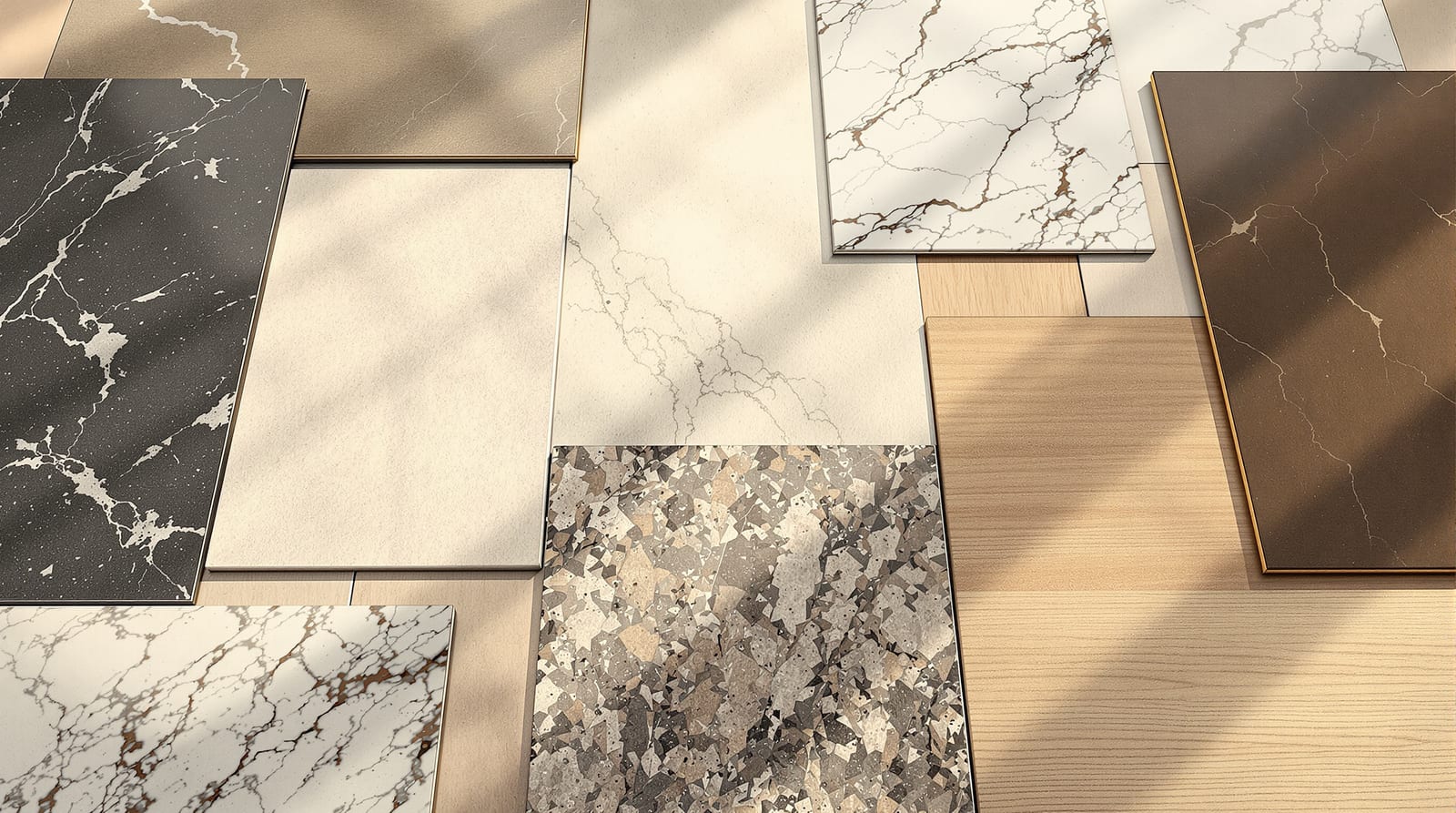
Flooring Materials Explained: Every Type for Indian Homes (2026)
One scannable reference to every flooring material family — tiles, natural stone, wood, resilient and seamless — with look, durability, water resistance, ₹/sq ft cost band and where each suits Indian homes.
Walk into any tile showroom in India and the choice is overwhelming: GVT, PGVT, double-charged, full-body, R10, full-vitrified, microcement. Every material is sold as "the best", and the jargon is designed to confuse. This page cuts through it. It is a single, scannable reference to every flooring material family used in Indian homes — what each one actually is, how it looks, how tough it is, how it behaves around water, what it costs per square foot, and where it belongs. When you want to go deep on one material, follow the links to its dedicated guide.
Think of flooring in five families: tiles, natural stone, wood and wood-look, resilient and seamless. Almost everything you will be shown sits in one of these. Get the families straight and the showroom stops being intimidating.
The master comparison table
Costs below are indicative material-only rates (2026, +18% GST), and vary by city, grade and vendor. Laying labour (₹15-60/sq ft), adhesive or cement-sand bed, grout, skirting and polishing are extra. Water resistance reflects the finished, correctly-laid floor.
| Material | Type | Cost ₹/sq ft (material) | Water / stain resistance | Best use in Indian homes |
|---|---|---|---|---|
| Ceramic tile | Tiles | 30-80 | Good (glazed); grout stains | Walls, low-traffic rooms, budget floors |
| Vitrified GVT/PGVT | Tiles | 40-150 | Excellent (<0.5% absorption) | Living, bedrooms, whole-home workhorse |
| Double-charged vitrified | Tiles | 45-90 | Excellent | High-traffic, joint-family homes, commercial |
| Porcelain tile | Tiles | 60-200 | Excellent | Premium look, outdoor (anti-skid), wet areas |
| Granite | Stone | 50-250 (premium 250-500) | Excellent (sealed) | Kitchens, stairs, high-traffic, durability |
| Indian marble | Stone | 80-350 | Fair (etches with acid) | Living rooms, pooja, cool underfoot |
| Italian marble | Stone | 250-1,500+ | Fair (needs sealing) | Luxury living rooms, statement floors |
| Kota / Tandur stone | Stone | 30-80 | Good (sealed) | Budget durable, verandahs, stairs, courtyards |
| Terrazzo / mosaic | Stone | 60-200 | Good | Retro-modern living, hardy seamless look |
| Solid hardwood | Wood | 250-1,500 | Poor (avoid wet/humid) | Bedrooms, hill-station homes, premium |
| Engineered wood | Wood | 180-700 | Fair | Bedrooms, living, real-wood look with stability |
| Laminate | Wood-look | 80-250 | Fair (swells if soaked) | Bedrooms, budget wood look, fast install |
| Bamboo | Wood | 150-450 | Fair | Eco-conscious bedrooms, living |
| Vinyl / LVT | Resilient | 40-350 | Excellent | Bedrooms, kids/elderly, rentals, quiet floors |
| SPC | Resilient | 90-250 | Excellent (waterproof core) | Whole-home wood look, wet-tolerant, click-fit |
| WPC | Resilient | 100-300 | Excellent | Comfortable warm wood look, bedrooms |
| Cork / rubber | Resilient | 200-500 | Fair-Good | Play areas, gyms, soft acoustic floors |
| Epoxy | Seamless | 80-300 | Excellent (seamless) | Modern interiors, garages, utility, balconies |
| Microcement | Seamless | 250-800 | Excellent (sealed) | Contemporary seamless living, walls + floor |
| IPS / polished concrete | Seamless | 100-400 | Good (sealed) | Industrial-modern, courtyards, budget durable |
For a live side-by-side filter, use the flooring material comparison tool or estimate spend with the flooring cost calculator. For the room-by-room and laying logic behind these choices, see the complete home flooring guide for India.
Tiles: the Indian default
Tiles cover the majority of Indian floors for good reason — they are durable, low-maintenance, water-tolerant and value-for-money. The confusion is all in the sub-types, governed by IS 15622, which classifies pressed tiles by water absorption. Vitrified tiles absorb under 0.5% (group BIa) — that low porosity is why they resist stains and water; ceramic tiles absorb more, which is why glazed ceramic is fine for walls and light-traffic rooms but vitrified rules the floor.
- Ceramic floor tile (30-80) — clay-bodied with a glazed top. Huge range of looks, easy on the budget. The glaze handles water, but a chip exposes a different-coloured body and grout lines stain over time. Best for walls and rooms that do not see heavy footfall. See ceramic tile flooring.
- Vitrified GVT/PGVT (40-150) — the everyday hero. The body is fired dense (vitrified) so the whole tile is hard and water-resistant. GVT (glazed vitrified) prints any design on a glazed surface; PGVT (polished glazed) adds a high-gloss polish for a marble-like mirror finish. Deep dives: vitrified tile flooring, GVT and PGVT.
- Double-charged vitrified (45-90) — pigment fed through the top 3-4 mm in two layers, so the pattern runs deep and survives years of scuffing. The go-to for showrooms, lobbies and high-traffic joint-family homes. See double-charged vitrified tiles.
- Porcelain tile (60-200) — the premium end of vitrified. Dense, frost- and stain-resistant, available in true anti-skid (R10-R11) finishes that make it excellent for balconies, terraces and coastal homes. See porcelain tile flooring.
Watch the size, too: ceramic comes in 300x300 and 300x600 mm; vitrified in 600x600, 800x800 and 600x1200; large-format runs to 800x1600 and 1200x1200. Bigger tiles mean fewer grout lines but need a perfectly flat bed and tile adhesive rather than a thick cement-sand mortar.
Natural stone: durable and Indian-grown
India is a stone country — granite, marble, kota and sandstone are quarried here, so natural stone is often more available and better-value than imported tile look-alikes. Stone is sold by the slab, laid on a cement bed, then ground and polished in place.
- Granite (50-250, premium 250-500) — the toughest mainstream floor. Near-impervious once sealed, scratch- and heat-resistant, ideal for kitchens, staircases and high-traffic zones. Governed by IS 14223 for polished building stone. See granite flooring.
- Marble (80-1,500+) — prized for being cool underfoot, a real advantage in hot Indian summers, and for its luxury veining. The catch: marble is calcareous, so it etches with acids (lemon, vinegar, toilet cleaners) and needs periodic sealing and polishing. Indian marbles — Makrana, Udaipur, Morwad, Banswara — run 80-350; Italian marbles like Carrara, Statuario and Botticino start around 250 and climb past 1,500. Compare Indian marble, Italian marble and the overview marble flooring.
- Kota and Tandur stone (30-80) — the unsung budget heroes. Dense limestones in green, blue and grey, extremely hard-wearing, great for verandahs, stairs, courtyards and back-of-house. Naturally matte and anti-skid when leather-finished. See kota stone flooring.
- Terrazzo / mosaic (60-200) — marble or granite chips set in cement (or modern resin) and ground smooth, governed by IS 1237. The retro Indian floor, now back in fashion as a hardy, seamless-look surface. See terrazzo flooring.
Two quick decision aids: marble vs granite flooring and granite vs vitrified tiles.
Wood and wood-look: warmth with caveats
Wood brings warmth no tile can match, but real wood and India's humidity are uneasy partners. The trick is choosing the right grade of "wood" for the room.
- Solid hardwood (250-1,500) — a single piece of timber, sandable and refinishable for decades. Beautiful, premium, but it expands and contracts with humidity and hates standing water — best reserved for dry bedrooms and hill-station homes. See solid hardwood flooring.
- Engineered wood (180-700) — a real-wood veneer over cross-bonded plywood layers, which makes it far more dimensionally stable in humid plains than solid wood, while still looking and feeling like timber. The sensible real-wood choice for most Indian homes. See engineered wood flooring and the comparison engineered vs solid wood.
- Laminate (80-250) — a photographic wood-look print under a tough wear layer on a fibreboard core. Scratch-resistant and quick to click-install, but the core swells if water sits, so keep it out of wet areas. See laminate flooring.
- Bamboo (150-450) — technically a grass, harder than many hardwoods and fast-renewing, for the eco-minded.
If you are torn between warmth and water-worry, wooden flooring vs tiles lays out the trade-offs. The honest rule: avoid genuine wood in bathrooms, kitchens and balconies — that is what the resilient family is for.
Resilient: the waterproof wood look
"Resilient" means the floor has give underfoot — quieter, warmer and softer than tile or stone. This family has exploded in India because it delivers a convincing wood or stone look that is genuinely waterproof and clicks together fast.
- Vinyl / LVT (40-350) — flexible PVC planks or tiles. Basic sheet vinyl is budget and rental-friendly; LVT (luxury vinyl tile) is thicker, more realistic and very water-resistant — kind on the joints of children and elders. See vinyl flooring and LVT.
- SPC (90-250) — Stone Plastic Composite. A rigid, dense mineral core makes it 100% waterproof and stable across temperature swings, with a click-lock fit over almost any subfloor. The current favourite for whole-home wood looks that tolerate the odd spill. See SPC flooring and the popular SPC vs laminate.
- WPC (100-300) — Wood Plastic Composite, with a foamed core that feels warmer and softer than SPC while staying waterproof. See WPC flooring.
- Cork and rubber (200-500) — soft, acoustic, cushioned floors for play areas, home gyms and quiet studies.
Here is a simple section showing why SPC and laminate behave so differently around water — the core material is the whole story.
Seamless: the joint-free modern floor
Seamless floors are poured or trowelled in place, so there are no tiles, no grout lines and nothing to lift. They suit contemporary, minimalist interiors and tough utility spaces alike.
- Epoxy (80-300) — a resin coat over a screed, fully seamless and chemical-resistant, available glossy or matte. A staple for garages, utility rooms, balconies and modern interiors. See epoxy flooring.
- Microcement (250-800) — a thin cement-polymer skin, 2-3 mm, that wraps floors, walls and even countertops in one continuous tone. The look of the moment for high-end contemporary homes; needs skilled application and good sealing. See microcement flooring.
- IPS / polished concrete (100-400) — Indian Patent Stone, the traditional in-situ cement floor, now embraced as industrial-modern when ground and polished. Red-oxide IPS is a heritage warm-floor finish still loved in Kerala and Tamil Nadu courtyards.
How the families stack up at a glance
When you strip away the marketing, the families differ on five things. This summary tells you which family to shortlist before you ever pick a colour.
| Family | Durability | Water tolerance | Comfort underfoot | Maintenance | Typical entry cost |
|---|---|---|---|---|---|
| Tiles | High | High | Cool, hard | Low | Low-medium |
| Natural stone | Very high | Medium-high (sealed) | Cool, hard | Medium (polish/seal) | Medium-high |
| Wood / wood-look | Medium | Low | Warm, soft | Medium | Medium-high |
| Resilient | Medium-high | High-waterproof | Warm, soft | Low | Low-medium |
| Seamless | High | High (sealed) | Hard | Medium | Medium |
A few India-specific rules cut across all of them. In wet areas, balconies and coastal homes, choose anti-skid (R10+) vitrified, porcelain, stone or waterproof resilient — never solid wood. For high-traffic joint-family homes, lean on granite, double-charged vitrified or SPC. For hot-climate comfort, marble and stone stay cool underfoot; for warmth and quiet, resilient and wood win. By Vastu tradition, lighter floors are favoured in the north-east and east and for main living areas, with marble and light stone preferred — framed practically, lighter floors also make rooms feel larger and brighter.
To turn this shortlist into a single decision for your home, read how to choose flooring for India or run the flooring material selector.
Frequently asked questions
What is the most popular flooring material in India?
Vitrified tiles, followed by granite. Together they cover the majority of Indian homes because both are durable, water-resistant, low-maintenance and good value. Vitrified GVT/PGVT dominates living rooms and bedrooms for its endless designs; granite rules kitchens, stairs and high-traffic zones for sheer toughness.
Which flooring material is best for bathrooms and balconies?
Anything anti-skid and water-tolerant: anti-skid vitrified or porcelain tiles (R10 or higher slip rating), kota stone with a leather finish, or epoxy. Avoid solid wood, laminate and glossy polished surfaces in any wet or outdoor area, especially in coastal and high-humidity homes.
What is the difference between ceramic and vitrified tiles?
It comes down to water absorption under IS 15622. Vitrified tiles are fired dense and absorb under 0.5%, so they resist stains and water and are hard right through the body — ideal for floors. Ceramic tiles absorb more and are typically glazed only on top, which makes them better suited to walls and light-traffic rooms. See ceramic vs porcelain tiles for the premium comparison.
Is real wood flooring practical in Indian homes?
In dry rooms, yes — but choose carefully. Engineered wood handles humid Indian plains far better than solid hardwood because its plywood core resists expansion. For wet-prone areas or a waterproof wood look, SPC and WPC give you timber aesthetics without the moisture risk.
How much should I budget per square foot?
Material alone ranges from about ₹30/sq ft for basic ceramic or kota stone to ₹1,500+ for Italian marble. Most Indian homes land in the ₹40-200/sq ft band with vitrified, granite or SPC. Always add laying labour (₹15-60/sq ft), adhesive or cement bed, grout, skirting and 18% GST. Use the flooring cost calculator for your exact area.
Export this guide
Related Guides — Deep-dive reading
Complete Home Flooring Guide for Indian Homes (2026)
The authoritative overview of every flooring family — tiles, stone, wood, vinyl and seamless — with India ₹/sq ft costs, room-by-room logic and laying basics.
Flooring & SurfacesHow to Choose Flooring for an Indian Home: A Step-by-Step Framework (2026)
A decision framework to pick the right floor for any room — weighing traffic, water, comfort, budget, maintenance, look, climate, durability and resale, with the key natural-stone vs tile vs wood vs resilient trade-offs.
Flooring & SurfacesBathroom Flooring Guide India: Anti-Skid Tiles, Stone, Vinyl & Epoxy Compared
Every bathroom floor material for Indian homes in one place — anti-skid ceramic and vitrified tiles, natural stone, mosaic, vinyl (SPC/LVT) and epoxy — with a full comparison table, slip ratings, ₹/sq ft costs and the safety and slope rules that keep a wet floor from becoming a hazard.
BathroomsRelated Tools — Try Free
Flooring Cost Calculator
Estimate the all-in cost of a floor — material, laying, wastage, skirting and GST — by area and material.
Flooring CalculatorMarble Flooring Cost Calculator
Estimate installed marble-floor cost — material, laying, grinding and polishing, sealing, wastage and GST.
Flooring CalculatorWooden Flooring Cost Calculator
Estimate installed wood or wood-look floor cost — solid, engineered, laminate or SPC — with underlay and skirting.
Flooring Calculator