
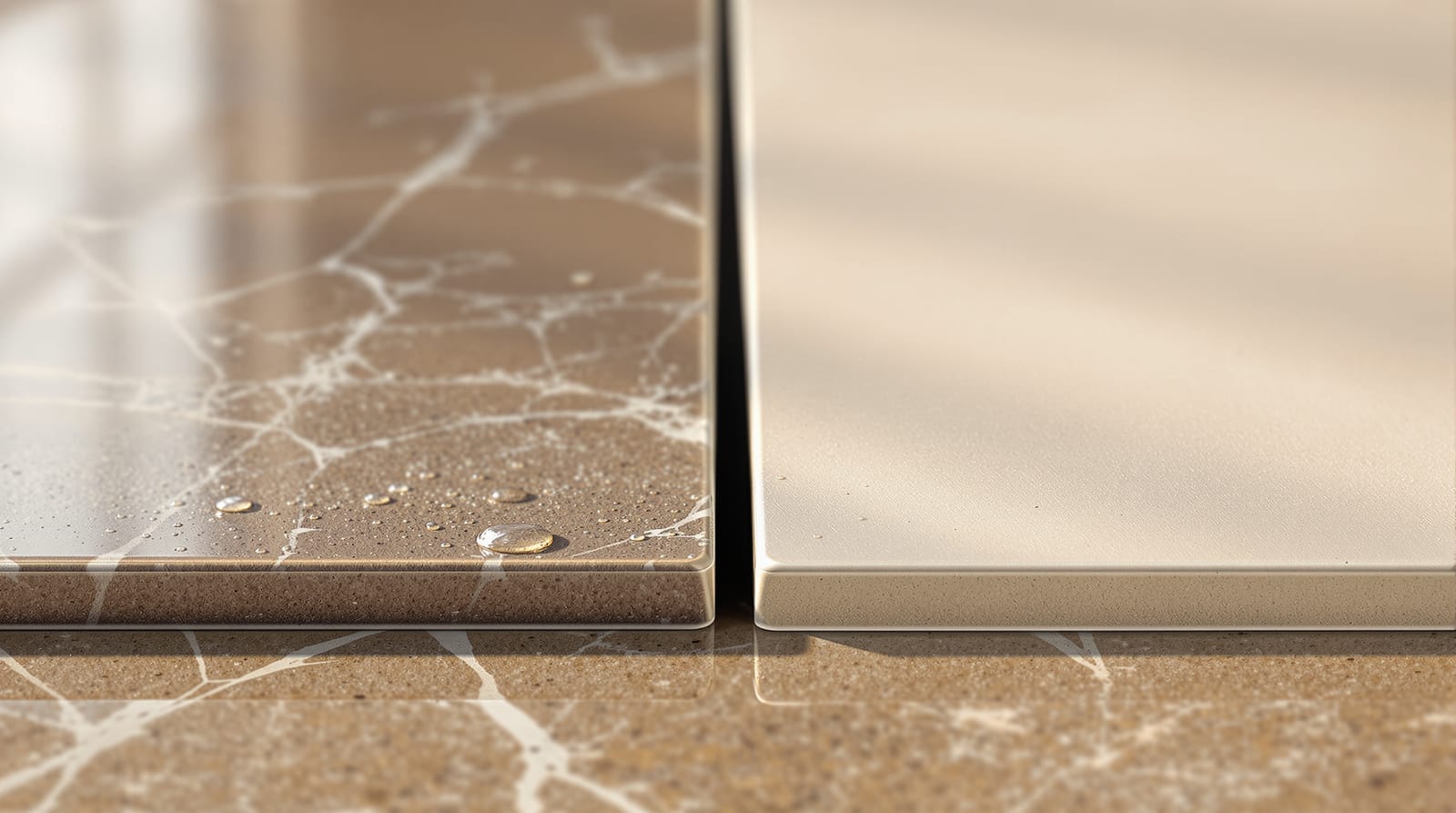
Ceramic vs Porcelain Tiles in India: The Real Difference, Use & Cost (2026)
A clear head-to-head — the one technical difference that matters (water absorption under IS 15622), density, hardness, slip ratings, cutting, the vitrified-equals-porcelain terminology muddle, ₹/sq ft, and a straight recommendation by room.
Walk into any tile showroom in India and you will be shown two families of pressed tile that look almost identical on the wall: ceramic and porcelain. They are not the same product, and choosing wrong is how you end up with a chipped, stained living-room floor or, just as wastefully, overpaying for heavy-duty porcelain on a wall that takes no traffic at all. Underneath all the marketing, the entire difference comes down to one measurable property — and once you understand it, the right choice for each room becomes obvious. This is the honest head-to-head.
The one difference that explains everything: water absorption
Ceramic and porcelain are both clay-based tiles, pressed into shape and fired in a kiln. The difference is how dense the fired body is — and that is captured by a single number, water absorption, defined and tested under IS 15622 (pressed ceramic tiles) using the method in IS 13630.
Porcelain is made from finer, more refined clays, pressed harder and fired hotter and longer. The body partly turns to glass — it vitrifies — so it barely drinks water. Under IS 15622 it sits in group BIa, water absorption below 0.5%. Ordinary ceramic is fired less aggressively from coarser clay, so its body stays more porous, typically absorbing 3% to 10% of its weight in water (groups BIIa, BIIb and above).
Almost every practical difference flows from that one fact:
- Lower absorption means a denser, harder, stronger body. Porcelain resists scratches, impact, stains and frost far better because there is simply less open pore structure to chip, soak or crack.
- Higher absorption is not "bad" — it is cheaper and lighter, which is exactly what you want on a wall.
If you remember nothing else, remember this: porcelain is the dense, low-absorption, tough tile; ceramic is the lighter, more porous, friendlier-to-cut, cheaper tile. Everything below is the consequence.
Ceramic vs porcelain — the head-to-head table
| Criterion | Ceramic (glazed) | Porcelain |
|---|---|---|
| Body | Coarser clay biscuit, porous | Refined clay, very dense, vitrified |
| Water absorption (IS 15622) | ~3-10% (BIIa/BIIb+) | < 0.5% (BIa) |
| Hardness / scratch resistance | Lower — softer surface | Very high |
| Strength / breaking load | Lower; chips and cracks more easily | Highest of the pressed tiles |
| Stain resistance | Moderate (porous edges) | Excellent |
| Frost / freeze-thaw | Poor — water in pores cracks it | Excellent — safe for hill stations |
| Best traffic level | Light to moderate | Heavy / commercial / joint-family |
| Wet & outdoor use | Only with anti-skid + small format | Yes (anti-skid grades), indoor-outdoor |
| Ease of cutting | Easier — score-and-snap, normal blade | Harder — needs diamond blade, slower |
| Weight | Lighter (good for walls) | Heavier |
| Cost (material, ₹/sq ft) | 30-80 | 60-200 |
| One-line verdict | Cheapest, perfect for walls | The toughest tile, for floors that work |
The India terminology muddle: is "vitrified" the same as porcelain?
This is where most Indian buyers get confused, so let us settle it. In India the shop word for dense, low-absorption tile is usually vitrified (VT), and you will see GVT, PGVT and double-charged on the price list. In the rest of the world the same dense BIa tile is called porcelain.
For practical purposes, vitrified and porcelain are the same family — both sit at water absorption below 0.5% under IS 15622, and the difference is mostly vocabulary and how the body is coloured (full-body vs a printed glaze on top). When an Indian salesperson says "porcelain", they often mean an imported or premium full-body tile; when they say "vitrified", they mean the everyday Indian dense tile. Do not let the word change your decision — ask for the water absorption figure and the IS 15622 group instead. If it says BIa / below 0.5%, you are buying porcelain-grade tile whatever the label calls it. Our vitrified tile flooring in India and porcelain tile flooring in India guides untangle this in full.
So the honest three-way picture is: ceramic = the soft porous family; vitrified and porcelain = the dense family (effectively the same thing in Indian usage).
Density, hardness and durability — what it means underfoot
Because porcelain is denser, it is harder and tougher. A dropped steel kadai is far more likely to chip a glazed ceramic floor tile than a full-body porcelain one — and where ceramic chips, the coarse biscuit shows as a pale scar, whereas full-body porcelain carries its colour right through, so a chip is far less visible. In a joint-family home with children, daily mopping and constant footfall, that durability gap is the whole argument for porcelain on the floor.
On walls, none of this matters. A wall takes no foot traffic and no dropped vessels, so ceramic's lower hardness is irrelevant — and its lighter weight actually helps it bond and stay up. Paying for porcelain on a bathroom wall is money you could have spent on a better floor.
A note on cutting and labour
Porcelain's density has a flip side on site: it is harder to cut. Ceramic can be scored and snapped with a basic manual tile cutter and drilled with ordinary bits. Porcelain — especially dense full-body and large-format slabs — needs a wet saw with a diamond blade, slower cutting, and a skilled mason, or you get chipped edges. Expect porcelain (and any large-format tile) to carry higher laying labour, typically toward the upper end of the ₹15-60/sq ft range, and budget more wastage on intricate layouts. This is a real cost difference, not a footnote.
Slip ratings and wet areas — read this before the bathroom
Neither material is automatically safe when wet — the surface finish decides grip, not whether it is ceramic or porcelain. A high-gloss tile of either kind is dangerous on a wet floor.
For any wet zone — bathroom, balcony, utility, outdoor — specify a matte or structured anti-skid finish and ask for a DIN 51130 R-rating: aim for R10 or higher for bathrooms and balconies, R11 to R13 for ramps and heavy outdoor splash. Smaller formats (like 300x300) with more grout lines drain and grip better than one big slab. The safety backdrop in India — NBC 2016 and the RPwD Harmonised Accessibility Guidelines 2021 — expects anti-slip, level floors with thresholds kept to about 12 mm, which matters for elderly-friendly bathrooms.
The material does change one thing: porcelain's near-zero absorption means it shrugs off standing water and won't degrade at chipped edges, so for constantly wet, outdoor, coastal-salt or freeze-prone areas, anti-skid porcelain is the safer body — ceramic there should be limited to small, well-sealed indoor wet-area floors. See our bathroom flooring in India guide for the full wet-area specification.
How they are built — a simple section view
The diagram below shows why absorption differs: ceramic carries a waterproof glaze over a porous biscuit, so any chip or cut edge exposes thirsty clay; full-body porcelain is dense and coloured right through.
Cost: what each really adds up to
Material-only ₹/sq ft figures (2026, indicative, +18% GST, before laying):
| Tile | Material ₹/sq ft | Plus laying / adhesive |
|---|---|---|
| Glazed ceramic floor tile | 30-80 | Labour ₹15-30; adhesive ₹12-30 or cement-sand bed |
| Glazed ceramic wall tile | 30-70 | Wall tiling labour |
| Vitrified (GVT/PGVT) | 40-150 | Labour ₹20-40; adhesive recommended |
| Double-charged vitrified | 45-90 | Labour ₹20-40 |
| Porcelain (full-body / imported) | 60-200 | Labour ₹25-60 (harder to cut, large-format) |
Two honest points. First, ceramic's lower material price is real, but the cheapest line-item is not always the cheapest floor — if a soft ceramic floor chips and is re-laid in five years, porcelain was the better value. Second, porcelain costs more not only in material but in labour and wastage because of cutting difficulty, so quote the installed price, not the box price. Use our flooring cost calculator, tile quantity calculator and tile adhesive calculator to model the all-in number, and see tile flooring cost in India for the full breakdown.
The straight recommendation — by use
Here is the call, room by room, with no hedging:
| Where | Choose | Why |
|---|---|---|
| Bathroom & kitchen walls | Ceramic | No traffic; lighter, cheaper, endless decors |
| Bathroom floors (small) | Ceramic (matte anti-skid) or porcelain | Small format + grout grips; ceramic fine if sealed |
| Living room, hall, main floors | Porcelain / vitrified | Daily traffic, chairs, dropped vessels demand hardness |
| Kitchen floor | Porcelain / vitrified | Spills, grease, heavy use, easy to clean |
| Balcony, utility, terrace | Anti-skid porcelain | Wet, sun, weather — near-zero absorption wins |
| Outdoor, coastal, hill stations | Porcelain (R11+) | Frost, salt and standing water; ceramic cracks |
| Light-traffic guest room, store, rental | Ceramic floor tile | Lowest spend for a clean finished floor |
| Joint-family high-traffic home | Porcelain / vitrified | Toughness pays back over years of footfall |
The shorthand most Indian homeowners can carry to the showroom: ceramic for walls and light, dry, indoor floors; porcelain (or vitrified) for every floor your family actually lives and works on, and for anything wet or outdoors. For the wider material picture see how to choose flooring in India, and for the room-by-room logic of any material, the complete home flooring guide for India.
Frequently asked questions
Is porcelain always better than ceramic?
No — it is tougher, but "better" depends on the job. On a wall or a low-traffic dry floor, ceramic does the same visual job for less money and is easier to cut. Porcelain only earns its premium where there is real traffic, water, weather or impact. Match the tile to the room, not to the price tag.
Are vitrified tiles the same as porcelain?
For practical purposes in India, yes. Both are dense BIa tiles with water absorption below 0.5% under IS 15622. "Vitrified" is the common Indian shop term; "porcelain" is the international term, often used for full-body or imported premium tiles. Ask for the absorption group rather than relying on the label.
How do I tell ceramic from porcelain in the shop?
Three quick checks. Look at the unglazed back and the cut edge — porcelain's body is dense and uniform, ceramic's biscuit is coarser and often reddish or pale. Ask for the IS 15622 water absorption group (BIa = porcelain). And lift two same-size tiles — porcelain is noticeably heavier.
Which is safer in a wet bathroom?
The finish matters more than the material. Use a matte or structured anti-skid tile of either type, ideally R10 or higher (DIN 51130), in a small format with grout lines for grip. For constantly wet, outdoor or coastal areas, anti-skid porcelain's near-zero absorption makes it the safer long-term body.
Is porcelain harder to install?
Yes. Its density means it must be cut with a wet diamond-blade saw rather than scored and snapped, so cutting is slower and needs a skilled mason — which is why porcelain (and large-format tiles) carry higher laying labour and wastage. Budget the installed cost, not just the box price.
Export this guide
Related Guides — Deep-dive reading
Ceramic Bathroom Tiles India: Water Absorption, Cost & Where They Suit (2026)
What ceramic tiles actually are (glazed earthenware), how water absorption groups under IS 13630 and IS 15622 decide where they belong, why they are the smart choice for bathroom walls and low-traffic floors, glazes, finishes, sizes, PEI ratings, rupee costs, and an honest comparison with porcelain and vitrified.
BathroomsBathroom Flooring Guide India: Anti-Skid Tiles, Stone, Vinyl & Epoxy Compared
Every bathroom floor material for Indian homes in one place — anti-skid ceramic and vitrified tiles, natural stone, mosaic, vinyl (SPC/LVT) and epoxy — with a full comparison table, slip ratings, ₹/sq ft costs and the safety and slope rules that keep a wet floor from becoming a hazard.
BathroomsRelated Tools — Try Free
Flooring Cost Calculator
Estimate the all-in cost of a floor — material, laying, wastage, skirting and GST — by area and material.
Flooring CalculatorTile Water Absorption Classifier
Classify a tile by its water-absorption percentage into its IS 15622 group and see where it can be used.
Flooring ToolChild & Elder Home-Safety Audit
Room-by-room safety audit for households with children or seniors — 10 categories, 70+ checkpoints tagged by audience.
Safety Audit