
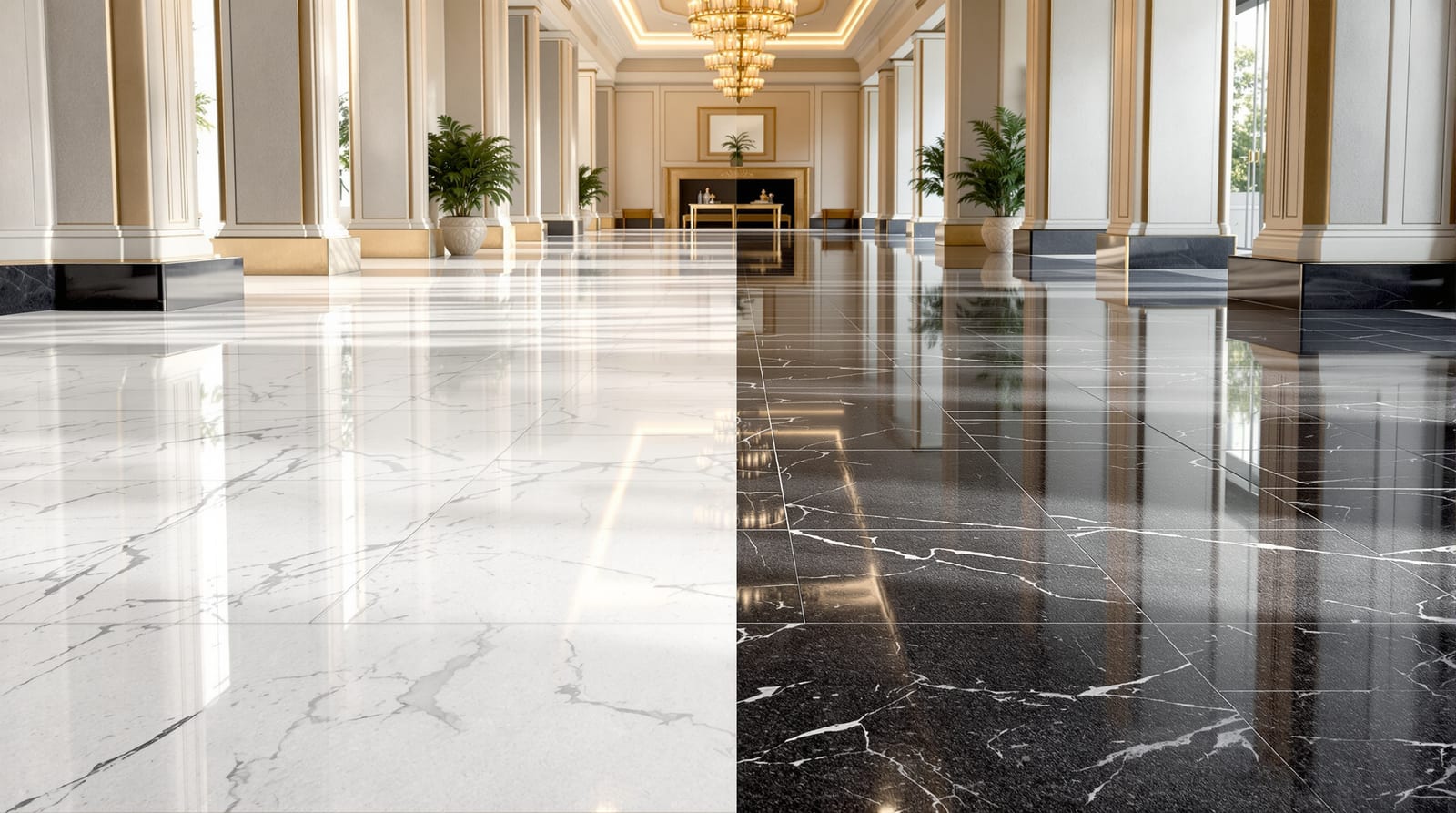
Marble vs Granite Flooring in India: Look, Durability, Cost & Where Each Wins (2026)
The classic Indian natural-stone decision, settled head-to-head: marble's veined luxury versus granite's near-indestructible strength, across look, hardness, maintenance, slip, cost and resale — with a clear recommendation by room and priority.
Marble or granite? It is the oldest question in Indian flooring — two premium natural stones, both cool underfoot, both quarried in India, and both promising a floor that outlives the building. Yet they behave like opposites. Marble buys you veined, luxurious softness that you must protect; granite buys you speckled, near-indestructible strength that asks almost nothing of you. Get the match wrong and you either scratch a fortune of stone in your kitchen or pay for a foyer that feels less special than it could. This guide settles the choice head-to-head, criterion by criterion, and tells you exactly where each one wins in an Indian home.
The one-line difference
Marble is a metamorphic limestone — relatively soft, with flowing veins, that takes a deep mirror polish but etches and stains when acids and water sit on it. Granite is an igneous stone — much harder, speckled or uniform in pattern, that shrugs off scratches, heat and stains with only a light seal. Marble is the showpiece you curate; granite is the workhorse you forget about. Almost everything below follows from that single contrast in hardness and porosity.
If you want the full single-material picture first, read the dedicated Studio Matrx guides on marble flooring in India and granite flooring in India. This page is the direct comparison.
Head-to-head: eight criteria
| Criterion | Marble | Granite |
|---|---|---|
| Look | Veined, luminous, luxurious — each slab unique | Speckled or uniform, deep and natural; very even |
| Hardness (Mohs) | Soft, ~3-5; scratches and etches | Hard, ~6-7; highly scratch-resistant |
| Stain / acid resistance | Low — lemon, curd, wine, cleaners etch and dull it | High when sealed; resists oil, acids, masala stains |
| Heat resistance | Good, but can discolour; treat with care | Excellent — kadhai-proof, ideal near cooking |
| Maintenance | High — seal regularly, periodic re-polish/crystallise | Low — damp-mop; seal every 1-3 years; rarely re-polished |
| Cool underfoot | Yes — excellent for hot climates | Yes — equally cool |
| Slip when wet (polished) | Slippery; use honed in wet zones | Slippery; use flamed/honed in wet/outdoor zones |
| Cost per sq ft (material) | Indian 80-350; Italian 250-1,500+ | 50-250; premium 250-500 |
Indicative material-only ranges, before 18% GST; laying, polishing, grout and skirting are extra and vary by city, variety and finish. Use the Studio Matrx flooring material comparison to weigh these side by side for your own shortlist.
Look: veins versus speckles
This is the heart of the decision, because both stones last for decades — so you are mostly choosing a face you will live with.
Marble reads as soft luxury. The flowing veins, the slight translucency, the way light seems to sink into a polished white marble floor — nothing else feels quite like it. Indian whites like Makrana, Udaipur and Morwad, and Italian stones like Statuario and Carrara, are the language of formal foyers and showpiece living rooms. Because every slab is unique, a marble floor can be book-matched and arranged for drama, but it also demands careful slab selection from one lot for consistency.
Granite reads as solid, grounded, modern. Patterns are speckled (Black Galaxy's gold flecks, Tan Brown's warm grain) or near-uniform (Absolute Black, Steel Grey). It is less "soft" than marble and more "strong" — confident rather than delicate. Light granites such as Kashmir White even mimic a marble look at a granite price and a fraction of the upkeep. If your aesthetic is contemporary, minimal or industrial, granite often suits it better than marble; if it is classical, palatial or boutique-hotel, marble wins.
Hardness and durability: granite, decisively
On the Mohs scale, granite sits around 6-7 and marble around 3-5 — and that gap shows up every day. Granite resists scratches from grit, furniture and pet claws; marble picks them up. Drop a steel vessel and granite is far likelier to survive unmarked.
The bigger issue for marble is etching and staining, not scratching. Marble is calcium-based, so anything acidic — lemon, tamarind, curd, tea, wine, vinegar, many household cleaners — reacts with the surface and leaves a dull, water-mark-like etch even if you wipe it instantly. Oil and turmeric can stain unsealed marble. Granite, being denser and chemically inert, takes acids and masala in its stride once sealed. This single fact decides kitchens and dining areas almost on its own.
Both stones handle heat well and both are genuinely cool underfoot — a real advantage in hot Indian summers — but granite's edge in everyday toughness is decisive for high-traffic and joint-family homes.
Maintenance: low-effort granite versus high-care marble
Granite is close to fit-and-forget. Dust-mop or sweep, damp-mop with a pH-neutral cleaner, re-apply a penetrating sealer every 1-3 years (lighter varieties more often), and an occasional buff restores shine. It almost never needs the full machine re-polish marble does.
Marble is a relationship. It should be sealed after laying and re-sealed periodically; it benefits from crystallisation or a diamond re-polish every few years to remove etch marks and traffic dulling; and it wants prompt wiping of every spill, coasters under glasses, and felt pads under furniture. In a busy household with children and daily Indian cooking, that discipline is hard to sustain — which is why so many marble floors look tired within five years while granite stays sharp. Factor the lifetime re-polishing cost into any marble budget.
Slip, wet areas and how each is laid
Polished versions of both stones are slippery when wet, so neither belongs glossy in a bathroom, open balcony or outdoor step. The fix differs slightly: marble can be honed (matte) for grip; granite can be honed or flamed (a rough, grippy texture that is the standard anti-skid surface for Indian porches, steps and terraces). NBC 2016 and the RPwD Harmonised Guidelines 2021 favour anti-slip, level floors with thresholds under about 12 mm, so specify the right finish for wet zones rather than carrying a mirror polish everywhere.
Both are typically laid as slabs (or large tiles) on a cement-sand bedding mortar with neat cement slurry, set to a true level, with marble usually ground and polished on site after curing while granite arrives factory-finished. The build-up is similar:
Cost: overlapping ranges, different ceilings
The headline ranges overlap, but the stories differ. Granite material runs roughly 50-250 per sq ft for common Indian varieties, with premium stones reaching 250-500. Indian marble runs 80-350 per sq ft; Italian marble starts around 250 and climbs to 1,500+ for prized whites. So a budget granite can be cheaper than budget marble, while top-end Italian marble is in a league of its own.
A laid floor — including bedding/adhesive, laying labour (₹15-60 per sq ft, more for stone and large slabs), grout, skirting and, for marble, on-site polishing — typically lands well above the material figure. The hidden lifetime cost is maintenance: granite's near-zero re-polishing versus marble's periodic re-polish and crystallisation. Over 25-40 years, granite is usually the better value per rupee of effort; marble is paying for irreplaceable looks. For numbers tied to your area and variety, use the marble flooring cost calculator, the granite flooring cost calculator or the broader flooring cost calculator.
Where each wins — by room and priority
Choose marble for spaces where aesthetics lead and abuse is low: formal living rooms, foyers and entrance lobbies, pooja rooms, master-bedroom suites and staircases you want to feel grand (in dry, lightly used homes). Marble rewards a household willing to maintain it.
Choose granite for spaces that take a beating: kitchens (acid, oil, heat, dropped vessels), high-traffic and joint-family living areas, staircases and treads, utility and entrance areas, and anything outdoor or wet when finished flamed/honed. Granite is the safe default whenever durability and low upkeep matter more than the last 10% of luxury.
Many Indian homes simply mix the two — granite in the kitchen, stairs and busy zones; marble in the formal living room or foyer for the wow factor. There is nothing wrong with that, and it is often the smartest spend.
On Vastu, lighter floors are traditionally favoured in the north-east and east; light marble suits main living areas and the NE, while darker granites are better avoided in the NE. Treat this as tradition layered with the practical point that lighter stone reads as more open — and in wet zones, anti-slip always overrides colour preference.
Resale and longevity
Both stones add resale appeal because Indian buyers read natural stone as premium and permanent. Marble — especially in a clean, well-kept foyer or living room — signals luxury and lifts perceived value, but only if it still looks pristine; an etched, dull marble floor can read as neglected. Granite signals quality and durability and, because it stays sharp with little care, almost always presents well at resale. For a property you will let or sell, granite's resilience is the lower-risk choice; for a forever home you will pamper, marble's character can be worth more.
The verdict
If you want one rule: granite for performance, marble for prestige. Pick granite when you need a natural stone floor that survives heavy use, kitchens, stairs and the outdoors with almost no upkeep. Pick marble when a softer, veined, luxurious look in a controlled, formal space is worth the sealing, the polishing and the careful living. When in doubt in a busy Indian home, granite is the safer bet — and reserving marble for the one or two showpiece rooms gives you both.
Go deeper with the Studio Matrx comparisons: marble vs vitrified tiles and granite vs vitrified tiles. For the full picture across every material, start with the complete home flooring guide for India and how to choose flooring in India.
Frequently asked questions
Which is better for flooring, marble or granite?
Neither is universally better — it depends on the room and your priorities. Granite is harder, more stain- and heat-resistant and far lower maintenance, so it wins for kitchens, stairs, high-traffic and outdoor areas. Marble is softer but more luxurious and veined, so it wins for formal living rooms, foyers and showpiece spaces in dry, lightly used homes.
Is granite cheaper than marble in India?
Often, yes, at the everyday level — common Indian granite runs about 50-250 per sq ft versus 80-350 for Indian marble, and granite also costs far less to maintain over its life. But premium Italian marble (Statuario, Carrara) reaches 1,500+ per sq ft, well above almost any granite. Compare laid-and-maintained cost, not just slab price.
Which is harder, marble or granite?
Granite, clearly. It sits around 6-7 on the Mohs scale versus marble's 3-5, so granite resists scratches, chipping and everyday wear much better. Marble is softer and also etches when acids like lemon, curd or cleaners touch it — a problem granite largely avoids once sealed.
Can I use marble in my kitchen instead of granite?
You can, but granite is the better kitchen floor. Cooking means acids, oil, heat and dropped vessels — exactly what etches and stains marble. Granite shrugs all of that off with a light seal. If you love the marble look in a kitchen, accept that it will need diligent wiping, sealing and periodic re-polishing to stay good.
Does marble or granite add more resale value?
Both help, because buyers value natural stone. Well-maintained marble in a formal area signals luxury and can lift perceived value most, but an etched or dull marble floor reads as neglected. Granite stays sharp with little care, so it almost always presents well — the lower-risk choice for a property you may sell or let.
Export this guide
Related Guides — Deep-dive reading
Tile Grouting Guide India: Cement vs Epoxy Grout, Joint Width, Mixing, Curing and Sealing
How to grout tile floors properly in Indian homes: choosing cement versus stain-proof epoxy grout, getting timing and joint width right, floating it in, clearing haze, curing and sealing.
Flooring & SurfacesGranite Floor Care in India: Keep a Near-Indestructible Floor Looking New
Why granite is the lowest-maintenance natural stone in Indian homes, the simple pH-neutral routine that keeps it gleaming, and how to seal lighter varieties, lift oil, rust and hard-water marks, and re-polish a dull floor.
Flooring & SurfacesHow to Choose Flooring for an Indian Home: A Step-by-Step Framework (2026)
A decision framework to pick the right floor for any room — weighing traffic, water, comfort, budget, maintenance, look, climate, durability and resale, with the key natural-stone vs tile vs wood vs resilient trade-offs.
Flooring & SurfacesRelated Tools — Try Free
Flooring Cost Calculator
Estimate the all-in cost of a floor — material, laying, wastage, skirting and GST — by area and material.
Flooring CalculatorGranite Flooring Cost Calculator
Estimate installed granite-floor cost — material, cutting, laying, polishing, sealing, wastage and GST.
Flooring CalculatorMarble Flooring Cost Calculator
Estimate installed marble-floor cost — material, laying, grinding and polishing, sealing, wastage and GST.
Flooring Calculator