
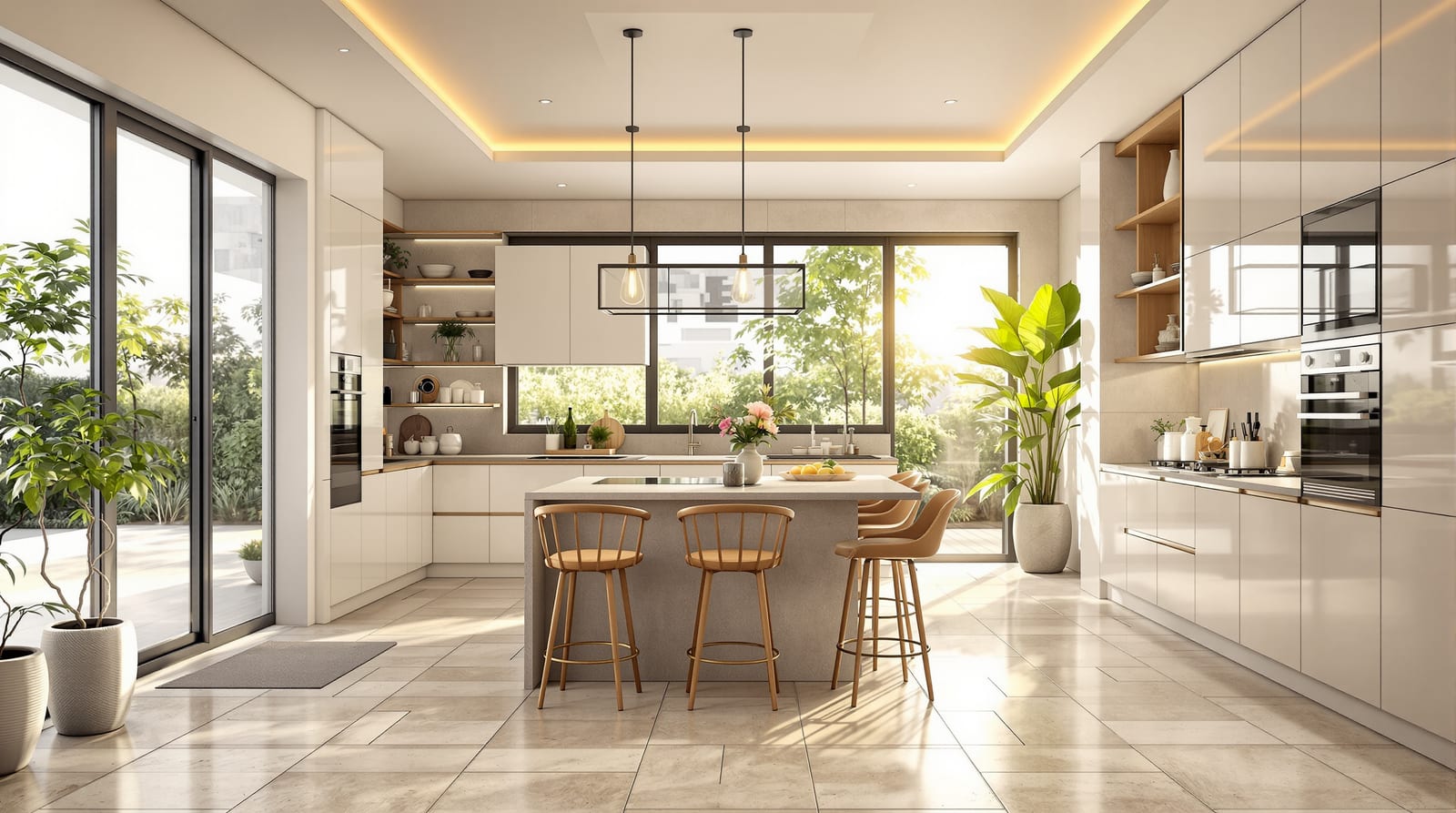
Porcelain Tile Flooring in India: Full-Body vs Glazed, Slabs, Anti-Skid & Cost (2026)
The densest, lowest-absorption tile money buys in India — full-body vs glazed porcelain, large-format porcelain slabs for floors and counters, frost and stain resistance, indoor-outdoor-wet-area use, and the porcelain-vs-vitrified terminology untangled, with sizes and ₹/sq ft.
Porcelain is the densest, hardest-wearing tile you can lay in an Indian home — fired hotter and pressed harder than ordinary ceramic, with water absorption so low that frost, monsoon damp, coastal salt and red-wine stains barely register. It is also the most misunderstood category in the Indian tile shop, because here the words "porcelain" and "vitrified" describe almost the same thing. This guide untangles the terminology, separates full-body porcelain from glazed porcelain, explains the new world of large-format porcelain slabs for floors and counters, and gives you honest ₹/sq ft numbers so you know when porcelain is worth the premium and when a good vitrified tile does the same job for less.
What actually makes a tile "porcelain"
Porcelain is a type of ceramic — but a special one. It is made from finer, whiter clays (often kaolin) blended with feldspar, quartz and silica, pressed at very high pressure and fired at roughly 1,200-1,300 degrees Celsius. That heat vitrifies the body: the raw materials partly melt and fuse into a dense, glass-like mass with almost no open pores.
The defining technical line is water absorption. Under IS 15622 (the Indian standard for pressed ceramic and vitrified tiles, harmonised with ISO 13006), the lowest absorption class is Group BIa, at less than 0.5%. Internationally, true porcelain is usually pegged at 0.5% or below, and many premium porcelains sit under 0.1%. Ordinary glazed ceramic, by contrast, absorbs 3-10% or more. That single number drives everything porcelain is good at — it is why porcelain resists frost (no trapped water to expand and crack), shrugs off stains, survives wet areas, and handles heavy traffic without the body soaking up grime.
So when a salesperson says a tile is "porcelain," they are really saying "a fully vitrified, very low-absorption ceramic tile." Which leads straight to India's biggest tile confusion.
"Porcelain" vs "vitrified" — the India terminology problem
In most of the world, porcelain is the standard retail word for a dense, low-absorption tile. In India, the word that dominates is vitrified — Glazed Vitrified Tiles (GVT), Polished Glazed Vitrified Tiles (PGVT), double-charged, full-body. These are all marketed as "vitrified tiles," and a good vitrified tile meets the same BIa less-than-0.5% absorption that defines porcelain.
In other words, most quality Indian vitrified tiles ARE porcelain by the technical definition. The two words overlap heavily. The differences you will actually notice are about marketing and positioning, not a hard scientific wall:
- Vitrified is the Indian mass-market label. It spans soluble-salt and nano tiles (which can absorb more than 0.5% and are arguably not true porcelain) right up to double-charged and full-body tiles that are pure porcelain by any test.
- Porcelain in an Indian showroom is usually used for imported or premium-positioned tiles, large-format porcelain slabs, and full-body or technical porcelain aimed at architects and high-spec projects.
Practical rule: do not buy on the word. Ask for the water absorption figure and the IS 15622 group. If it is BIa, under 0.5%, you have porcelain-grade tile regardless of whether the box says "vitrified" or "porcelain." We unpack this side by side in ceramic vs porcelain tiles in India, and the whole vitrified family is mapped in vitrified tile flooring in India.
Full-body vs glazed porcelain — the section that matters most
The single most useful distinction within porcelain is whether the colour and pattern run all the way through the tile (full-body) or sit only on a printed surface layer under a glaze (glazed). It decides how the tile ages when it chips and wears.
Full-body (homogeneous) porcelain has the same colour and composition top to bottom. Scratches, chips and decades of foot traffic do not expose a different shade underneath, so it ages gracefully. The trade-off is that the surface look is more uniform and matte (you cannot print a realistic marble vein through the full thickness), so it suits commercial floors, balconies, staircases, parking and high-traffic Indian joint-family homes more than it suits a marble-look living room.
Glazed porcelain is what most "GVT" and "PGVT" tiles are: a porcelain body topped with a digitally printed glaze that can mimic Carrara marble, travertine, concrete, wood or terrazzo with stunning realism. Polished Glazed Vitrified (PGVT) adds a mirror polish; matte GVT keeps a softer finish. The look is far richer than full-body, but a deep chip on a sharp edge can reveal the paler body beneath. For most Indian homes this is a non-issue indoors — but it is why you want full-body or a rugged matte for steps and outdoor zones. The glazed family is detailed in glazed vitrified tiles (GVT) and polished glazed vitrified tiles (PGVT), with the dense colour-through option covered in double-charged vitrified tiles.
Porcelain type x best use x cost
Use this to match the right porcelain to the right room and budget. Costs are material only, indicative and vary by city, brand and lot; add 18% GST, plus laying labour ₹15-60/sq ft, tile adhesive ₹12-30/sq ft, grout, skirting and polishing.
| Porcelain type | What it is | Best use in an Indian home | Finish | ₹/sq ft (material) |
|---|---|---|---|---|
| Glazed porcelain (GVT, matte) | Porcelain body, printed matte glaze | Living, dining, bedrooms; anti-skid grades for balcony/bath | Matte / textured | 60-140 |
| Polished glazed porcelain (PGVT) | Porcelain body, printed + mirror-polished | Living/dining where you want marble look with shine | High-gloss polished | 70-180 |
| Full-body / homogeneous porcelain | Colour through full thickness | High-traffic, stairs, parking, balconies, commercial | Matte / lappato | 90-200 |
| Double-charged porcelain | Two layers fused 3-4 mm deep | Heavy-traffic floors, lobbies, joint-family homes | Polished / matte | 60-120 |
| Anti-skid / structured porcelain (R10-R13) | Textured low-slip surface | Bathrooms, kitchens, balconies, terraces, pool decks | Textured matte | 60-160 |
| Large-format porcelain slab | 1.2 x 2.4 m or larger, 6-20 mm | Seamless floors, feature walls, countertops | Polished / matte | 150-600+ |
| Outdoor / 20 mm porcelain paver | Thick, frost- and load-rated | Terraces, driveways, garden paths (dry-lay or pedestal) | Structured anti-skid | 120-350 |
For context against neighbouring materials, see ceramic tile flooring, and for the broader money picture the cluster's cost guides cover flooring cost per square foot in India.
Why porcelain wins in Indian conditions
Porcelain's near-zero absorption is not a showroom abstraction — it solves real Indian problems:
- Monsoon and humidity. Water does not penetrate the body, so there is no swelling, no mustiness and no damp-driven failure. Unlike solid wood or laminate, porcelain is indifferent to coastal humidity in Mumbai, Chennai, Goa or Kochi.
- Coastal salt. Salt-laden air corrodes and crystallises in porous surfaces; vitrified porcelain gives it nothing to grip, making it a favourite for sea-facing balconies and terraces.
- Frost resistance. In hill stations (Shimla, Manali, Mussoorie, the Northeast), water trapped in a porous tile expands when it freezes and cracks the tile. Porcelain's less-than-0.5% absorption makes it genuinely frost-proof — the standard choice for outdoor surfaces at altitude.
- Stain resistance. Turmeric, oil, tea, red wine, beetroot — the classic Indian-kitchen stain panel — sit on the surface and wipe off. Glazed and polished porcelain are effectively non-staining; full-body is highly resistant.
- Hardness and traffic. Porcelain is harder than most natural stone on the surface, so it laughs off the grit a joint-family home tracks in daily. Unlike marble, it never needs re-polishing, sealing or acid-spill panic.
- Heat. Porcelain stays cooler underfoot than dark stone in summer and is unbothered by hot Indian afternoons; it pairs well with the cool-floor preference many homes have.
Where it loses: glossy polished porcelain is slippery when wet, so wet areas demand anti-skid grades (see below); large slabs are unforgiving to lay; and a hard porcelain floor is unforgiving to dropped glassware and tiring to stand on for long kitchen sessions versus a resilient floor.
Indoor, outdoor and wet areas — and the anti-skid rule
Porcelain is one of very few materials that does floors, walls, wet areas and outdoors with one family of products — but you must match the finish to the zone:
- Living, dining, bedrooms: polished PGVT or matte GVT for looks; any porcelain works because traffic is moderate and dry.
- Bathrooms and kitchens: use anti-skid / textured porcelain. Specify a slip rating — DIN 51130 R10 minimum for bathrooms, R11 for kitchen and shower floors. A small-format mosaic on a shower floor also adds grout-line grip.
- Balconies and terraces: anti-skid matte or structured porcelain, ideally R11-R12, frost-rated if you are at altitude. Coastal homes benefit from the salt resistance.
- Driveways, paths, pool decks: 20 mm structured porcelain pavers, R12-R13, which carry vehicle loads and can be dry-laid on sand or raised pedestals.
The legal and accessibility backdrop: NBC 2016 and the RPwD Harmonised Guidelines 2021 call for slip-resistant, level floors with thresholds of 12 mm or less — anti-skid porcelain meets this cleanly. For the full outdoor decision, including porcelain pavers versus natural stone, see outdoor flooring guide for India.
Large-format porcelain slabs — floors and countertops
The headline product of the last few years is the large-format porcelain slab: sheets typically 1.2 x 2.4 m, 1.2 x 2.8 m or 1.6 x 3.2 m, in thicknesses from a slim 6 mm (for walls and over-cladding) up to 12 mm and 20 mm (for floors, counters and outdoor). Because one slab covers a huge area, you get near-seamless floors with very few grout lines — the closest tile gets to the look of a single marble expanse.
These slabs do double duty as countertops. Porcelain slab counters are non-porous (no sealing, unlike marble or some granites), heat-resistant, scratch- and stain-resistant, and available in dramatic book-matched marble looks. They compete directly with quartz and natural stone in Indian modular kitchens; for that comparison the cluster touches on engineered surfaces, and you can weigh stone options in the countertop guides.
Handling and cutting are the catch. A 1.6 x 3.2 m, 12 mm slab is heavy, flexible and fragile until installed. It demands:
- a suction-frame lifting rig and 2-4 trained installers, never two labourers and rope;
- a perfectly flat, fully bonded substrate — large slabs telegraph any hump and crack over voids, so a full-coverage tile-adhesive bed (not the traditional cement-sand dab method) and back-buttering are essential;
- specialist cutting — a track-mounted score-and-snap rail for straight cuts and a water-fed bridge saw or CNC waterjet for sink cut-outs and notches, with relief drilling at internal corners to stop crack propagation;
- wider expansion and movement joints and careful levelling-clip systems for lippage-free joints.
This is genuinely skilled work. Insist on an installer with slab-specific tooling and references; a botched ₹600/sq ft slab floor is an expensive lesson. Budget extra labour — large-format laying runs at the top of the ₹15-60/sq ft range and often beyond.
Sizes, wastage and buying notes
Common Indian porcelain sizes (mm): 600x600 and 800x800 for general floors; 600x1200 and 800x1600 for a contemporary large-tile look; 1200x1200 large-format; and slabs at 1200x2400 and up. Smaller 300x300 / 300x600 anti-skid porcelain suits bathrooms and balconies.
Buying tips that save money and grief:
- Add 7-10% wastage for cuts (more — 12-15% — for diagonal or herringbone patterns or rooms with many cut edges).
- Buy one shade lot for the whole job; porcelain prints vary slightly batch to batch.
- Check the PEI / abrasion rating for glazed porcelain in high-traffic homes (PEI IV-V for living and entrance zones).
- Confirm absorption (BIa, less than 0.5%) in writing if "porcelain" matters to you for outdoor or wet use.
- Reputable Indian and global brands: Kajaria, Somany, Johnson, Nitco, Simpolo, Varmora and AGL for mainstream porcelain; imported and slab ranges from Italian and Spanish makers and Indian slab lines for premium projects.
For where porcelain sits against the rest of the cluster, start at the broader explainer in vitrified tile flooring in India and the wall-friendly budget option in ceramic tile flooring in India. You can price your exact area with the flooring cost calculator and work out boxes with the tile quantity calculator and tile adhesive calculator.
Frequently asked questions
Is porcelain tile the same as vitrified tile in India?
Largely, yes. "Vitrified" is the Indian retail word and "porcelain" is the global one, and a quality vitrified tile (double-charged, full-body, good GVT/PGVT) meets the same under-0.5% water absorption that defines porcelain. The grey area is cheaper soluble-salt and nano "vitrified" tiles that absorb more than 0.5% and are not true porcelain. Buy on the IS 15622 group and absorption figure, not the label.
Should I choose full-body or glazed porcelain?
Choose glazed (GVT/PGVT) for indoor living areas where you want a rich marble, wood or stone look — the printed surface is far more decorative. Choose full-body for stairs, balconies, parking and very high-traffic floors where a chip must not show a different colour underneath. Both share the same dense, low-absorption body.
Is porcelain too slippery for Indian bathrooms?
Polished porcelain is slippery when wet, so for bathrooms, kitchens and balconies use textured anti-skid grades — R10 minimum for bathrooms and R11 for shower and kitchen floors under DIN 51130. Smaller tiles or mosaics add grout-line grip on shower floors. Keep glossy PGVT for dry living areas.
Are large-format porcelain slabs worth the cost and trouble?
For a seamless, near-jointless floor or a non-porous marble-look countertop that never needs sealing, yes — but only with a skilled, slab-equipped installer. Slabs need suction-lift rigs, a perfectly flat fully-bonded bed and waterjet or bridge-saw cutting. A poor install on a ₹150-600/sq ft slab is costly to fix, so the installer matters as much as the material.
How much does porcelain flooring cost in India?
As a material, glazed porcelain runs roughly ₹60-180/sq ft, full-body ₹90-200/sq ft, and large-format slabs ₹150-600+/sq ft — indicative, varying by city, brand and lot, plus 18% GST. Add laying labour (₹15-60/sq ft, higher for slabs and large format), tile adhesive, grout and skirting. Use the flooring cost calculator for your specific area.
Export this guide
Related Guides — Deep-dive reading
Vitrified Tile Flooring in India: Types, Sizes, Cost & Buying Guide (2026)
India's most popular floor decoded — what vitrified really means, the four main types, sizes and finishes, ₹/sq ft costs, laying methods and how it stacks up against ceramic and stone.
Flooring & SurfacesAnti Slip Flooring for Bathroom and Wet Areas in India: R-Ratings, Finishes and Genuinely Safe Tile Choices
How to choose genuinely safe flooring for bathrooms, kitchens, balconies, pools, entrances and elderly- or child-friendly homes — the R-rating system, finishes that grip wet feet, anti-skid natural stone, slope to drains and the tiles to avoid.
Flooring & SurfacesHow to Buy Floor Tiles in India: The Complete Buyer's Playbook for Size, Spec, Grade, Quote & Delivery (2026)
From deciding size, finish, PEI and water-absorption group for each room to reading the box spec and ISI mark, matching calibre and lot, spotting seconds, and getting an honest all-in quote.
Flooring & SurfacesRelated Tools — Try Free
Flooring Cost Calculator
Estimate the all-in cost of a floor — material, laying, wastage, skirting and GST — by area and material.
Flooring CalculatorModular Kitchen Budget Calculator
Live breakdown by running feet, countertop area, material tier and city — with wastage, design fee, GST.
Kitchen CalculatorFull-Room BOQ — Living, Bedroom, Kitchen, Bath
Room-wise BOQ across living, bedrooms, kitchen, utility, and bathrooms with line-item pricing.
Full-Room BOQ