
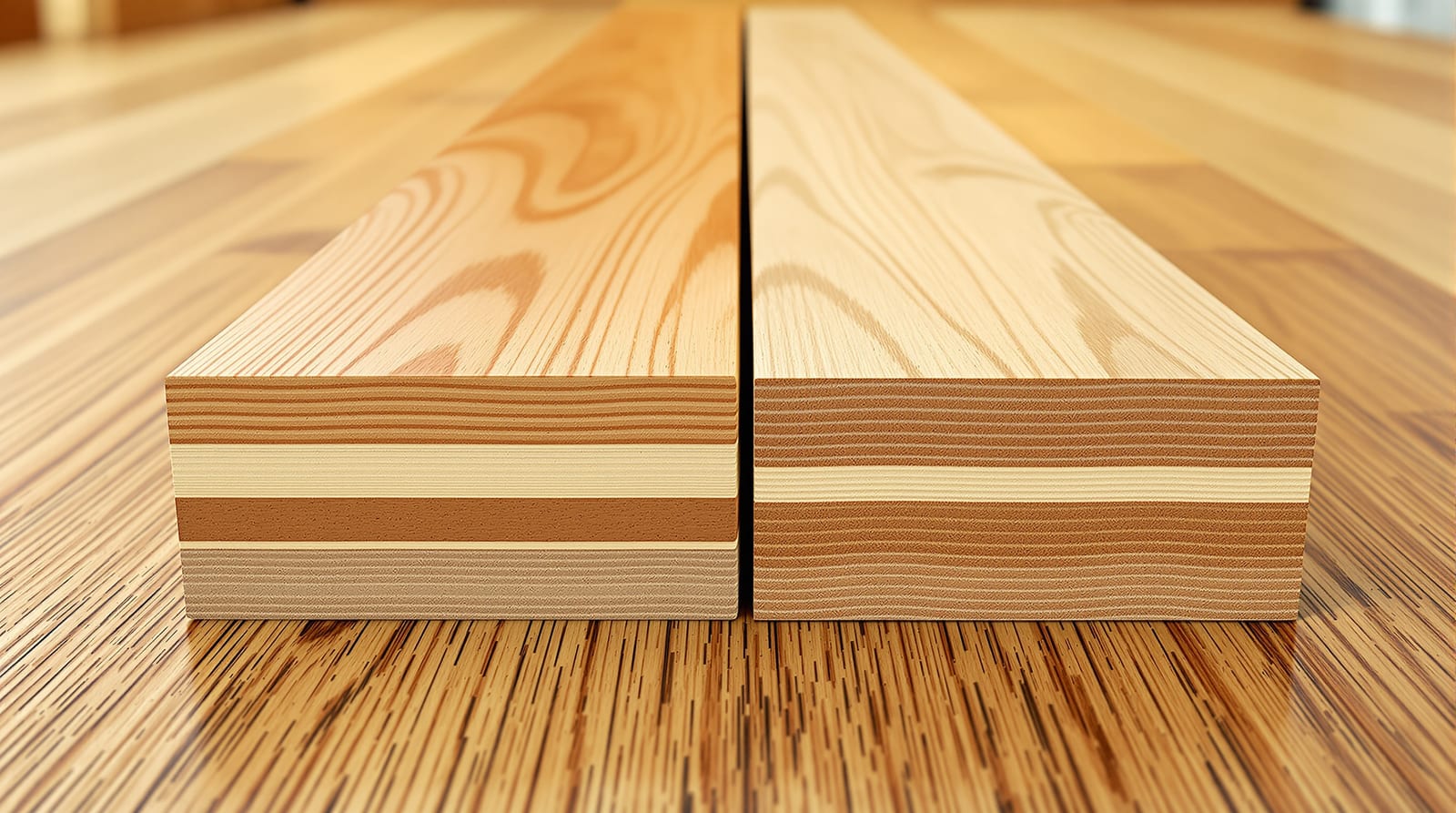
Engineered Wood vs Solid Wood Flooring in India: Which Wins?
A head-to-head on dimensional stability, refinishing, cost and lifespan to settle which real-wood floor suits Indian humidity, homes and budgets.
Both engineered wood and solid hardwood give you a genuine timber floor underfoot, the warmth, the grain, the soft acoustic. The difference is hidden below the surface, and in India that hidden difference decides almost everything. Solid wood is one piece of timber top to bottom; engineered wood is a thin slice of real hardwood bonded over a cross-layered plywood or HDF core. In a climate that swings from bone-dry summers to drenching monsoon, that construction gap is not a detail, it is the whole story.
This guide puts the two side by side on the things that actually matter, dimensional stability, refinishing, lifespan, installation and cost, and ends with a clear recommendation for Indian homes.
What "engineered" and "solid" really mean
A solid hardwood plank is milled from a single piece of timber, typically 18-20 mm thick, often oak, teak, walnut, merbau or maple. The wood you see is the wood all the way down. Because it is one continuous piece, it expands and contracts with moisture across its full thickness.
An engineered wood plank is a sandwich. The top is a real hardwood wear layer (a veneer), usually 2-6 mm thick, glued over a core of cross-bonded plywood or high-density fibreboard. The grain in each core ply runs at right angles to the next. That cross-lamination is what makes engineered wood fight back against swelling and shrinking, the layers physically restrain one another. Total thickness is usually 10-15 mm.
So both are "real wood" at the surface. The honest way to think about it: engineered wood is a stability technology wrapped around a real-wood top; solid wood is the pure material with all its beauty and all its temperament.
Dimensional stability, the decisive factor in India
This is where the comparison is won or lost, so it goes first.
Wood is hygroscopic, it absorbs moisture from humid air and releases it in dry air, swelling and shrinking as it does. In a solid plank, that movement is large and unrestrained. During a Mumbai or Kochi monsoon, relative humidity sits at 80-95% for weeks; in a Delhi or Jaipur summer it can drop below 25%. A solid wood floor lives through that swing every single year.
The visible results of that movement on solid wood in Indian conditions are well known to anyone who has fitted it badly:
- Cupping, the plank edges rise higher than the centre as the underside absorbs moisture (very common over damp concrete slabs and in coastal homes).
- Gapping, planks shrink in the dry season and open gaps you can slide a coin into.
- Crowning and buckling, in extreme moisture the floor lifts off the subfloor.
Engineered wood's cross-laminated core resists all of this. The opposing grain directions cancel out most of the expansion force, so a quality engineered floor stays far flatter through the same humidity swing. It is also the only real-wood floor you can sensibly lay directly over a concrete slab, the dominant subfloor in Indian apartments and villas, where rising slab moisture is the number-one killer of solid wood.
For the overwhelming majority of Indian homes, this single factor decides it. If you live anywhere coastal, anywhere with a heavy monsoon, or you are laying over concrete, engineered wood is dramatically more forgiving. Solid wood demands a stable, dry, well-acclimatised environment to perform, conditions most Indian homes simply do not offer year-round without active climate control.
Refinishing, where solid wood fights back
Solid wood's one decisive advantage is here. Because it is timber top to bottom, a solid floor can be sanded down and refinished many times over its life, typically 4-8 full sand-and-recoat cycles before you reach the tongue-and-groove. Scratched, dull, water-stained or just out of fashion, a solid floor can be brought back to bare wood and re-stained a completely different colour. This is why heritage homes still have their century-old teak floors, they have simply been sanded and oiled across generations.
Engineered wood can also be refinished, but only as far as its wear layer allows. The maths is simple, a light professional sand removes roughly 0.5-1 mm.
| Wear layer thickness | Realistic full refinish cycles | Practical position |
|---|---|---|
| 0.6-1.5 mm (entry-grade) | 0-1 (light buff only) | Treat as not refinishable; replace planks instead |
| 2-3 mm (mid-grade) | 1-2 | Refinish once, maybe twice |
| 4-6 mm (premium) | 2-4 | Approaches solid-wood longevity |
The lesson: a thick-veneer engineered floor (4 mm and up) closes much of the gap, while a cheap 1 mm veneer cannot survive a sanding at all, sand it and you go straight through to the plywood. If "refinish forever" matters to you, either buy solid wood or insist on a 4 mm+ wear layer.
Lifespan
A well-maintained solid hardwood floor, in the right environment, can last 40-100 years precisely because it can be refinished repeatedly. In the wrong environment, Indian humidity over a damp slab, it can be ruined in a few seasons by cupping and buckling.
A quality engineered floor lasts 20-40 years, and a premium thick-veneer one can rival solid wood. Entry-grade engineered floors with thin veneers and HDF cores are shorter-lived, 10-20 years, and are effectively replaced rather than restored. So the headline "solid lasts longer" is only true when the environment lets solid wood survive at all, which in much of India it does not.
Installation
Installation method shapes both cost and where each floor can go.
- Solid wood is almost always nailed or glued down to a stable subfloor, usually over plywood battens, never floated. It needs long acclimatisation on site (a week or more) and proper expansion gaps at the walls. Over concrete it requires a plywood sub-base and a serious moisture barrier, adding cost and height.
- Engineered wood can be floated (planks click together over an underlay, not fixed to the subfloor), glued, or nailed. Floating installation is fast, clean, lets the floor move as a unit, and works directly over a level concrete slab with a moisture membrane. This flexibility is a big practical advantage in Indian apartments.
| Aspect | Solid hardwood | Engineered wood |
|---|---|---|
| Typical methods | Nail-down, glue-down | Float (click), glue, nail |
| Over concrete slab | Needs ply sub-base + moisture barrier | Float directly over membrane |
| Acclimatisation | Long, critical | Shorter, still recommended |
| Underfloor heating | Generally not advised | Suitable (check rating) |
| Reuse if you move | Difficult | Floated floors can be lifted |
Cost per square foot in India
For the same look, engineered wood is usually the cheaper real-wood floor, because it uses far less premium hardwood. These are indicative 2026 material-only ranges; laying, underlay, skirting and 18% GST are extra.
| Floor type | Material ₹/sq ft | Installed ballpark ₹/sq ft |
|---|---|---|
| Engineered wood | 180-700 | 280-900 |
| Solid hardwood | 250-1,500 | 400-1,800 |
| Laminate (for reference) | 80-250 | 140-350 |
A few honest cost notes. Premium solid teak or walnut sits at the very top of the solid range and easily passes ₹1,000/sq ft. A thick-veneer (4 mm+) engineered floor in a desirable species can cost as much as mid-grade solid wood, you are paying for that refinishable wear layer. And solid wood's installation premium is real, the ply sub-base and moisture barrier needed over concrete add ₹60-150/sq ft before the wood even arrives. Use the wooden flooring cost calculator and the flooring cost calculator to price your exact area.
Construction at a glance
The diagram below shows why the two behave so differently, one continuous piece versus opposing layers that restrain each other.
Feel and authenticity
A fair worry: is engineered wood "the real thing"? Underfoot and to the eye, a quality engineered floor with a thick sawn veneer is indistinguishable from solid wood, same species, same grain, same warmth, same gentle give. The differences purists notice are at the edges: solid wood can be sanded to a perfectly seamless, finished-in-place surface, and some find its solidity sounds marginally more substantial underfoot. But cheap engineered floors with paper-thin rotary-peeled veneers can look flat and repetitive. The veneer quality, not the engineered construction itself, is what makes or breaks authenticity. Pay for a thick, sawn-cut wear layer and you sacrifice almost nothing in feel.
Where each one wins
Choose engineered wood if (and this is most Indian homes):
- You are laying over a concrete slab, the standard apartment and villa subfloor.
- You live coastal, in a heavy-monsoon city, or any humid region, the stability advantage is decisive.
- You want underfloor heating, faster floating installation, or the option to lift and reuse the floor.
- You want real wood at a more accessible price.
Choose solid hardwood if:
- You have a genuinely stable, dry, climate-controlled interior (year-round AC, hill-station home, or a naturally dry inland location).
- You value refinishing forever, restoring the same floor across decades and generations, above all else.
- You are matching or restoring a heritage home with existing solid timber.
- Budget is not the constraint and authenticity to the last detail matters to you.
For deeper dives, see our dedicated guides on engineered wood flooring in India and solid hardwood flooring in India, the wooden flooring overview, and, if humidity has you worried, the cheaper water-tolerant alternative in laminate flooring.
The verdict
For most Indian homes, engineered wood is the smarter real-wood floor. Its cross-laminated core handles our humidity swings, it lays straight over concrete, it costs less, and a 4 mm+ veneer version can be refinished enough to last decades. Reserve solid hardwood for stable, dry, climate-controlled interiors where you specifically want a floor you can sand and restore for the rest of your life, or for heritage homes that already speak that language. Pick engineered for resilience and value; pick solid for permanence in the right conditions.
Frequently asked questions
Is engineered wood less durable than solid wood?
No, not in everyday use. The wear comes from the surface finish and species hardness, which can be identical on both. Engineered wood is actually more durable in humid Indian conditions because it resists cupping and buckling. Solid wood only out-lasts it where the climate is stable enough for solid wood to survive and be refinished repeatedly.
Can engineered wood be refinished like solid wood?
Yes, but limited by the wear layer. A 4-6 mm premium veneer can take 2-4 sand-and-recoat cycles, close to solid wood. A thin 1 mm entry-grade veneer cannot be sanded at all without exposing the core, you replace it instead. If refinishing matters, insist on a thick sawn veneer.
Which is better for a coastal or monsoon-heavy city?
Engineered wood, clearly. The cross-laminated core resists the large humidity-driven swelling that wrecks solid wood in places like Mumbai, Chennai, Goa or Kochi. Pair it with a good moisture barrier over the slab and keep it out of bathrooms and uncovered balconies, no real-wood floor belongs in permanently wet areas.
Is engineered wood real wood or just a laminate?
It is genuinely real wood, the entire top wear layer is solid hardwood. That is the key difference from laminate, where the wood look is a printed photographic layer under melamine with no real timber at all. Engineered wood looks, feels and ages like wood because at the surface it is wood.
Does engineered wood cost less than solid wood in India?
Usually yes. Engineered wood runs roughly ₹180-700/sq ft in material versus ₹250-1,500/sq ft for solid hardwood, because it uses far less premium timber. Solid wood also carries a higher installation cost over concrete due to the plywood sub-base and moisture barrier it needs.
Export this guide
Related Guides — Deep-dive reading
Solid Hardwood Flooring in India: Species, Cost, Refinishing & the Humidity Caveats (2026)
Real solid timber planks of teak, oak, merbau or walnut give the deepest premium feel and can be sanded and refinished for decades — but in India's humidity they need acclimatisation, expansion gaps and the right rooms. Here is the honest homeowner's guide, with species, Janka hardness, ₹/sq ft and how it compares with engineered wood.
Flooring & SurfacesEngineered Wood Flooring in India: Layers, Wear Layer, Install & Cost (2026)
Engineered wood is a real-wood top veneer bonded over a cross-laminated plywood or HDF core, which makes it far more dimensionally stable than solid wood in Indian humidity — the practical way to get a genuine timber floor here. This guide covers the layer build-up, wear-layer thickness, click vs glue-down install, where it suits, ₹/sq ft, brands and maintenance.
Flooring & SurfacesLaminate Flooring in India: AC Ratings, Cost, Brands & the Honest Limits (2026)
The budget wood-look floor for Indian homes — an HDF core with a printed decor and tough melamine wear layer, click-lock floating install over underlay, DIY-friendly and fast, with the water and refinishing caveats made plain.
Flooring & SurfacesRelated Tools — Try Free
Wooden Flooring Cost Calculator
Estimate installed wood or wood-look floor cost — solid, engineered, laminate or SPC — with underlay and skirting.
Flooring CalculatorFlooring Cost Calculator
Estimate the all-in cost of a floor — material, laying, wastage, skirting and GST — by area and material.
Flooring CalculatorHome Building & Interior Cost Calculator — 20 Cities
Construction + interior costs for 20 Indian cities across kitchen, wardrobes, flooring, painting, ceiling.
Cost Calculator