
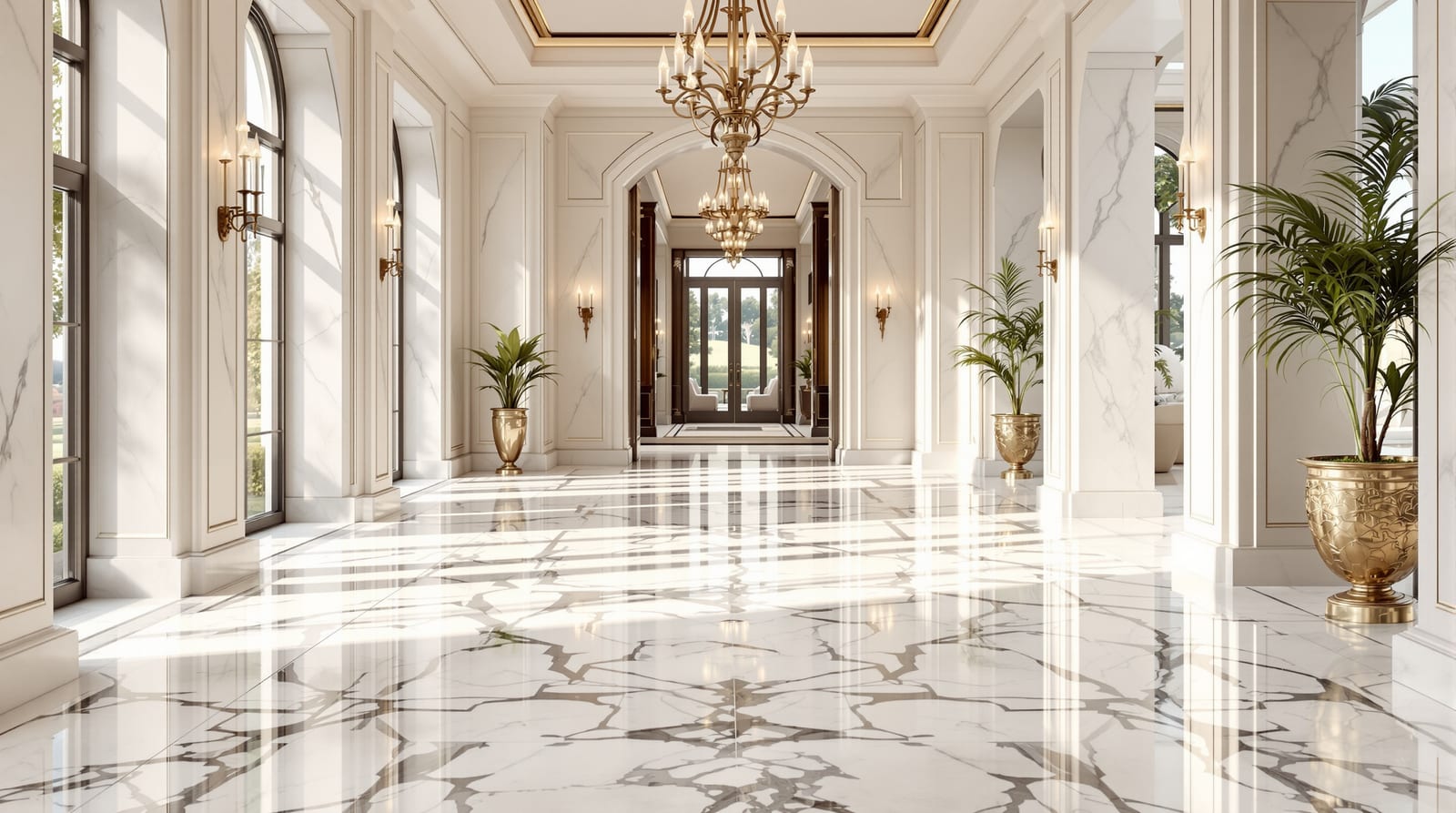
Italian Marble Flooring in India: Carrara, Statuario, Botticino, Cost & the High-Maintenance Reality (2026)
Imported Italian marble gives the most luxurious floor money can buy in India — here is the honest homeowner's guide to Carrara, Statuario, Botticino, Dyna Beige, Michelangelo and Onyx, book-matching, why it costs 250-1,500+ /sq ft, the real sealing and anti-etch upkeep, and whether it beats PGVT marble-look tiles.
Italian marble is the most aspirational floor an Indian home can have: a quarried-in-Italy white stone, sawn into large slabs, book-matched so its veins mirror across the room, polished to a deep glass-like glow. It is also the most demanding floor you can buy here. The same softness that makes Carrara and Statuario so beautiful means they etch when turmeric, lemon or floor cleaner touch them, scratch under grit, and need sealing, careful spill control and occasional professional re-polishing. This guide is the honest version: the famous imported marbles, why they cost 250 to 1,500+ /sq ft, how book-matching works, the real maintenance reality in Indian homes, where the spend makes sense, and whether you should just lay a PGVT marble-look tile instead.
What "Italian marble" actually means
"Italian marble" is a marketing umbrella for marble quarried in Italy (and a few other European sources sold under the same banner), as distinct from Indian marble like Makrana, Morwad or Banswara. It is prized for three things Indian marble usually cannot match at the same level: a very white, bright base; fine, controlled grey or gold veining; and large, consistent slabs cut and pre-polished in modern European or Indian processing plants. It arrives in India as gangsaw slabs, gets re-polished and laid here, and is covered under the same Indian Standard as other marble, IS 1130 (marble blocks, slabs and tiles).
It is important to be clear about one thing up front: Italian marble is a soft, calcareous stone. On the Mohs hardness scale it sits around 3 to 4 — far softer than granite (6 to 7) or a vitrified tile. That single fact drives everything below: the look, the price, and the upkeep.
The famous Italian marbles — look and cost
These are the varieties you will be shown at a premium stone yard or importer. Rates are indicative, material-only (polished slab before laying, plus 18% GST), and vary widely by lot, slab size, vein quality and importer.
| Italian marble | Look | Typical use | ₹/sq ft (material) |
|---|---|---|---|
| Carrara | Soft white-grey base with fine, feathery light-grey veining | Living rooms, large floors, the "everyday" Italian white | 250-500 |
| Statuario | Bright white with bold, dramatic dark-grey veins | Showpiece floors, foyers, feature walls — the premium white | 450-1,200+ |
| Calacatta | Warm white with thick, gold-and-grey dramatic veins | Luxury feature floors and statement areas | 600-1,500+ |
| Botticino | Warm beige/cream with subtle soft veining | Classic warm living and dining floors, very forgiving look | 250-450 |
| Dyna / Beige (Dyna Marble) | Light beige, even tone, gentle veining | Popular value Italian-look beige for large floors | 200-400 |
| Michelangelo | Off-white to light beige with soft linear veining | Soft modern luxury floors, lobbies | 300-600 |
| Onyx | Translucent, banded amber/green/white, can be backlit | Feature panels, bar fronts, accent floors (not high-traffic) | 800-2,500+ |
A few honest notes. Statuario and Calacatta are where the headline luxury (and headline price) lives — the whiter and more dramatic the vein, the rarer the block and the higher the rate. Botticino and Dyna Beige are the warm, forgiving, comparatively affordable end and are what many Indian homes actually lay when they want "Italian marble" without Statuario money. Onyx is a showpiece material, often backlit, and is too soft and brittle for a real walking floor — treat it as a feature, not a main floor.
Why it costs so much
Italian marble is expensive for stacked reasons, not one:
- Import. It is quarried and often processed abroad, then shipped to India — freight, customs and importer margin all add up before it reaches your stone yard.
- The look. A bright white base with clean, fine veining is geologically rarer than the greys and browns of common stone. You are paying for the specific block.
- Large, consistent slabs. Italian slabs come big and uniform, which is what makes book-matching and seamless floors possible — but big, flawless slabs cost more and waste more in cutting.
- Fine veining and selection. Premium grades are hand-selected for vein pattern; the importer rejects more to sell you the good blocks.
- Finishing. It is gangsawn, resin-treated, and mirror-polished to a standard most Indian marble does not reach off the shelf.
That is why the brief's range is so wide: a beige Dyna might land near 200-250 /sq ft material, while a top Statuario or Calacatta block runs past 1,200-1,500 /sq ft before you have paid for laying, polishing or GST.
Book-matching — the signature move
Book-matching is what makes an Italian marble floor look custom rather than just tiled. Two adjacent slabs are cut from the same block and one is flipped like opening a book, so the veins mirror each other across the joint and form a continuous, symmetrical pattern. Done across four slabs you get a "quad-match" with a central motif. It is the reason people lay Italian marble in big formal rooms — the pattern reads as one designed surface, not a grid of repeats.
Book-matching needs planning: you reserve slabs from one lot, the layer dry-lays and numbers them, and the floor is set out from the centre of the room so the mirror sits where the eye lands. It also drives wastage up (10 to 15%+), because you cannot freely swap pieces. The diagram below shows the idea.
The high-maintenance reality in Indian homes
This is the part most showrooms underplay. Italian marble is gorgeous and genuinely cool underfoot in hot Indian summers — but it is a soft, acid-sensitive stone, and an Indian kitchen and living routine is full of its enemies.
- It etches. Etching is a chemical dulling, not a stain: anything acidic — lemon, lime, tamarind, tomato, curd, vinegar, many floor cleaners and even hard-water residue over time — reacts with the calcium and leaves a dull mark or ring that no amount of mopping removes. This is the single biggest regret homeowners report.
- It stains. Oil, turmeric, coffee, wine and even a wet potted plant can soak into unsealed or under-sealed marble. Turmeric is notorious.
- It scratches. At 3 to 4 Mohs, grit dragged underfoot, furniture legs and a falling steel vessel can scratch the polish.
- It needs sealing. A penetrating sealer must be applied after laying and re-applied periodically (roughly every 1 to 2 years, sooner in kitchens and high-traffic zones) to slow staining. Sealing reduces staining; it does not stop etching.
- It needs professional re-polishing. Over the years the high gloss dulls and fine scratches accumulate; restoring it means diamond honing and re-polishing by a specialist crew — a real, recurring cost, not a one-time buy.
Practical rules that keep an Italian marble floor alive in India: wipe acidic and oily spills immediately (do not let lemon or curd sit), use only pH-neutral stone cleaners (never acidic, never harsh acids like the strong bathroom cleaners common in Indian homes), put felt pads under furniture, use doormats so grit stays at the entry, and keep it out of the heavy-cooking kitchen zone and the splash areas of bathrooms. If your household cannot commit to immediate spill control, Italian marble in a kitchen or dining floor will disappoint you.
Where Italian marble actually makes sense
Match the material to the room, and the upkeep becomes manageable:
- Formal living rooms and drawing rooms — the classic, correct home for Italian marble: high impact, lower spill risk than a kitchen, the room you want to look spectacular.
- Entrance foyers and double-height lobbies — a book-matched Statuario or Calacatta floor here is the showpiece statement most people buy it for.
- Premium villas and bungalows — where budget, scale and a design team to specify and maintain it all exist.
- Feature areas and accent floors — a single book-matched panel, a marble inlay, or a backlit onyx feature, rather than the whole house.
Where it usually does not make sense: heavy-use kitchens, children's and high-traffic family rooms, bathroom wet zones, balconies, terraces and any outdoor area (it is not for outdoors, and polished marble is slick when wet — a slip and NBC 2016 / accessibility concern). For those, granite, anti-skid vitrified or porcelain is the right call.
Thickness, backing and laying
Italian marble slabs are typically supplied around 16 to 20 mm thick. Because the stone is relatively soft and slabs are large, two practical issues come up:
- Backing / reinforcement. Thin or heavily-veined slabs are often resin-treated and may be fibre-mesh or fibreglass backed at the plant to hold them together during transport and laying — ask the importer what backing the slabs have.
- The bed. Italian marble is almost always laid on a full cement-sand mortar bed (not just thin tile adhesive), because a large soft slab needs continuous, void-free support — any hollow under it becomes a crack point under load. The bed must be perfectly level so the polished floor reads flat.
- Setting out and polishing. Slabs are dry-laid, numbered and book-matched first, then set; joints are kept very fine and filled with colour-matched epoxy/resin, and the whole floor is ground level and mirror-polished on site after laying.
This is skilled, slow work — the laying and polishing labour on Italian marble is higher than for tile or even ordinary stone, which is part of the all-in cost below.
What it actually costs (₹/sq ft, 2026, indicative — varies by city, lot and importer)
| Component | Indicative ₹/sq ft | Notes |
|---|---|---|
| Italian marble material (polished slab) | 250-1,500+ | Dyna/Botticino lower; Statuario/Calacatta/Onyx far higher |
| Cement-sand laying bed + labour | 40-90 | Higher than tile; book-matching and large slabs cost more |
| On-site grinding + mirror polishing | 30-80 | Multi-stage diamond polish after laying |
| Edge/skirting work, epoxy joint filler, sealer | extra | Plus 18% GST on material |
| Wastage allowance | 10-15%+ | More for book-matched and patterned layouts |
A realistic delivered-and-laid Italian marble floor in a value beige (Dyna/Botticino) often starts around 350-550 /sq ft all-in before GST; a Statuario or Calacatta book-matched floor can run 900-1,800+ /sq ft all-in. Treat every number as a benchmark and get importer quotes against your exact area and grade. For a budget tied to your variety, area and finish, use the Studio Matrx marble flooring cost calculator, and compare materials with the flooring cost calculator.
Is Italian marble worth it vs PGVT marble-look tiles?
This is the question that matters, because a good polished-glazed vitrified tile (PGVT) now prints Carrara and Statuario veining convincingly at a fraction of the cost and none of the etching.
| Italian marble | PGVT marble-look tile | |
|---|---|---|
| Look | The real thing — depth, translucency, unique veins, book-matching | Excellent printed mirror of marble; uniform, repeats across tiles |
| Hardness / scratch | Soft (3-4 Mohs), scratches | Hard, scratch-resistant |
| Etch / stain | Etches with acid, stains without care | Does not etch; near stain-proof (absorption <0.5%) |
| Maintenance | High — seal, anti-etch discipline, re-polish | Lowest — damp mop, no sealing |
| Cost ₹/sq ft (material) | 250-1,500+ | 40-150 |
| Slip when wet | Slick (polished) | Anti-skid grades available |
| Best for | Formal living/foyer in a maintained premium home | Anywhere you want the marble look with low upkeep |
The honest verdict: choose Italian marble when you genuinely want the real stone — the depth, the unique veining, the book-matched showpiece — and you have the budget plus a household willing to seal it, control spills and re-polish it every few years, in a formal room rather than a working kitchen. Choose PGVT marble-look tile when you want the marble aesthetic with near-zero maintenance, anti-skid options and a tenth of the cost — which is the right answer for most Indian homes, kitchens, bathrooms and high-traffic family floors. Many premium homes do both: real Italian marble in the formal living room and foyer, PGVT marble-look tiles everywhere else.
Go deeper in the Studio Matrx flooring library: the broader marble flooring guide for India, the Indian marble flooring guide (Makrana, Morwad and the value alternatives), the countertop-focused Italian marble vs quartz comparison, marble vs vitrified tiles, and the polished glazed vitrified tiles (PGVT) guide. For the full picture, start with the complete home flooring guide for India.
Frequently asked questions
Is Italian marble flooring worth it in India?
It is worth it for a formal living room, foyer or premium villa where you want the genuine luxury of real stone — the depth, unique veining and a book-matched showpiece — and you can commit to sealing, immediate spill control and occasional professional re-polishing. For kitchens, bathrooms, high-traffic family rooms or a low-maintenance home, a PGVT marble-look tile gives almost the same look for a tenth of the cost without etching, and is the wiser choice for most Indian homes.
Why is Italian marble so expensive?
Several costs stack: it is quarried and processed abroad and imported (freight, customs, margin); a bright white base with fine, clean veining is geologically rare; it comes in large, consistent slabs that enable book-matching but waste more; premium grades are hand-selected for vein quality; and it is finished to a mirror polish. Beige varieties like Dyna and Botticino start near 200-250 /sq ft, while Statuario and Calacatta can pass 1,200-1,500 /sq ft material, before laying, polishing and GST.
Does Italian marble stain and scratch easily?
Yes, more than most floors. It is soft (3-4 on the Mohs scale), so grit and dragged furniture can scratch the polish, and being a calcareous stone it etches — a chemical dulling from acids like lemon, curd, tamarind, vinegar and many cleaners — and stains from oil, turmeric and coffee if unsealed. Sealing slows staining but does not stop etching; the real defence is immediate spill wiping, pH-neutral cleaners and felt pads under furniture.
Italian marble vs Indian marble — what is the difference?
Italian marble (Carrara, Statuario, Botticino) is imported and prized for a whiter base, finer veining and larger, more consistent pre-polished slabs, at 250-1,500+ /sq ft. Indian marble (Makrana, Morwad, Banswara, Udaipur) is quarried here, costs far less (about 80-350 /sq ft) and includes the famous Makrana white of the Taj Mahal. Both are soft, both need sealing and care; Italian buys you a brighter, more uniform luxury look at a premium. See the Indian marble flooring guide.
How do I maintain an Italian marble floor?
Wipe acidic and oily spills immediately, clean only with pH-neutral stone cleaners (never acidic or harsh bathroom acids), use doormats to keep grit out and felt pads under furniture, re-seal every 1 to 2 years (sooner in busy areas), and budget for professional diamond re-polishing every few years to restore the gloss. Keep it out of heavy-cooking kitchens and bathroom wet zones, where etching and slip risk are worst.
Export this guide
Related Guides — Deep-dive reading
Marble Flooring in India: Indian vs Italian, Types, Cost & Care (2026)
Marble is India's aspirational natural-stone floor — cool underfoot, luxuriously veined and re-polishable. Here is the homeowner's honest guide to Makrana and the popular Indian types, Indian vs Italian marble, ₹/sq ft costs, the staining and etching downsides, where to use it and how it is laid and polished.
Flooring & SurfacesMarble Flooring Cost in India 2026: ₹/Sq Ft by Type + Installed Price Breakdown
What marble flooring really costs in India in 2026 — material ₹/sq ft for Indian (Makrana, Morwad, Banswara, green) and Italian (Carrara, Statuario, Botticino, Dyna) marble, PLUS the laying, grinding-and-polishing, sealing, wastage, skirting and 18% GST add-ons, with a fully worked living-room example and an honest real-marble-vs-PGVT comparison.
Flooring & SurfacesMarble Bathroom India: Countertops, Vanity Tops, Cladding & Floors — Beauty vs Maintenance
An honest, India-first guide to using marble in the bathroom — Makrana, Italian Carrara and Statuario on countertops, vanity tops, walls and floors. The luxury look, but also the real downsides: staining, etching, hard-water dulling, sealing regimes, honed vs polished, where to use it and where to avoid it, plus ₹ costs.
BathroomsRelated Tools — Try Free
Flooring Cost Calculator
Estimate the all-in cost of a floor — material, laying, wastage, skirting and GST — by area and material.
Flooring CalculatorMarble Flooring Cost Calculator
Estimate installed marble-floor cost — material, laying, grinding and polishing, sealing, wastage and GST.
Flooring CalculatorBefore vs After — Cost Reality Check
Compare what you expected to pay vs what you actually paid, category by category.
Reality Check