
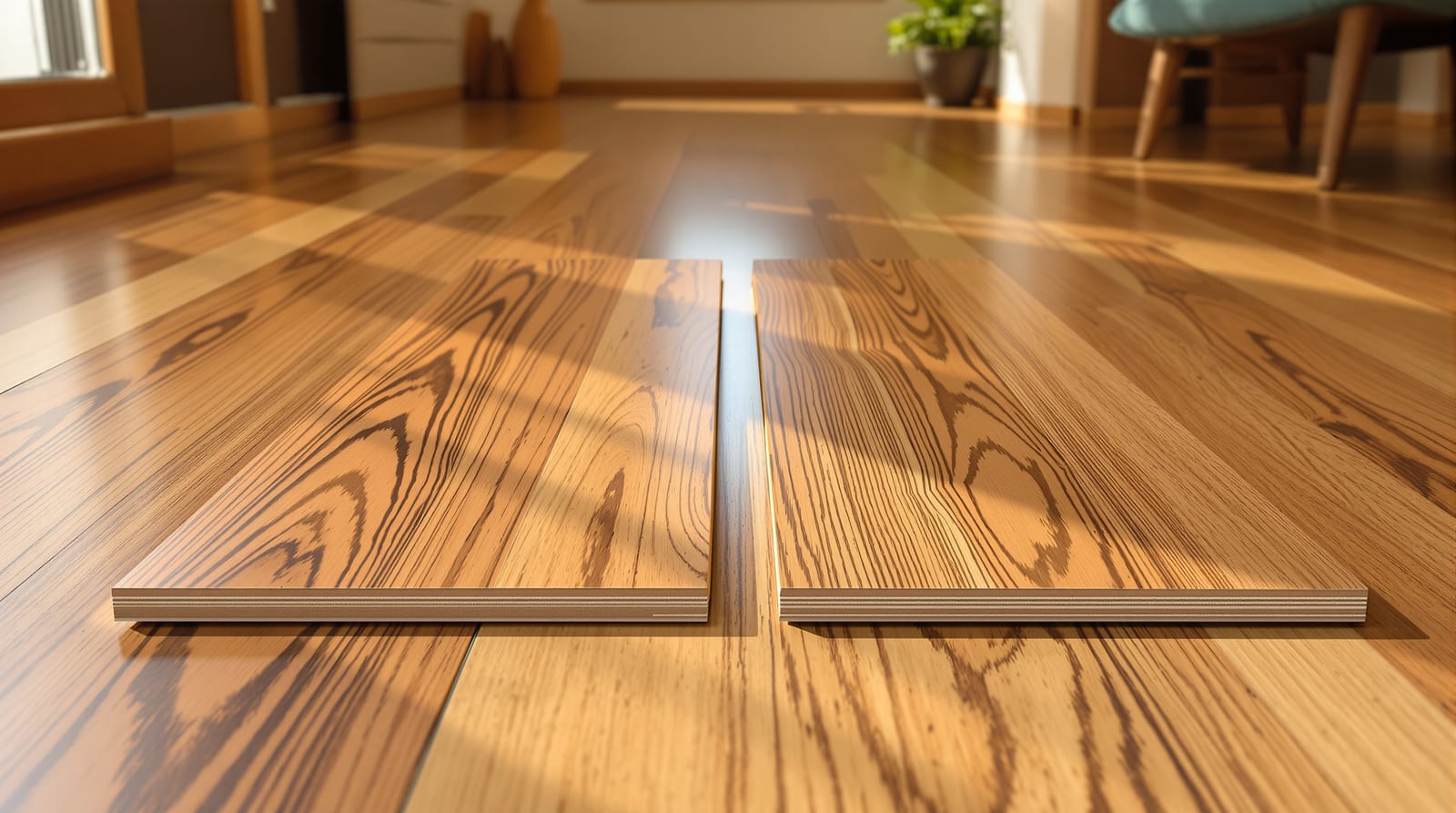
SPC vs Laminate Flooring in India: The Rigid Wood-Look Showdown (2026)
Two click-lock wood-look floors, one decisive difference — SPC's waterproof stone-plastic core versus laminate's water-sensitive HDF, and exactly which wins room by room in humid Indian homes.
SPC and laminate look like cousins in the showroom — both are wood-look click-lock planks that float over your existing floor, both go down without cement, both promise a hardwood feel for a fraction of the price. But under that printed wood grain they are built around two completely different cores, and that one difference decides whether your floor survives a Mumbai monsoon, a kitchen spill or a Chennai summer. This guide cuts past the marketing to give you the one comparison that actually settles the choice for an Indian home: SPC's waterproof stone-plastic core versus laminate's water-sensitive HDF, room by room, rupee by rupee.
The one difference that decides everything: the core
Strip away the identical-looking decor film and you are left with two very different boards.
A laminate plank is built on HDF — high-density fibreboard — which is wood fibre bonded with resin and compressed into a dense board. It is the same material family as MDF, just denser. HDF is strong and stable when dry, but it is still wood: soak it and it swells, and once swollen it does not shrink back. The decor and a tough melamine wear layer sit on top, and the click joints are cut into the HDF edges themselves.
An SPC plank is built on a stone-plastic composite core — roughly 60-70% finely ground limestone (calcium carbonate) blended with PVC resin and stabilisers, extruded into a rigid, dense board. There is no wood fibre anywhere in it. Water has nothing to swell because there is no organic material to absorb it.
That single material choice cascades into every other difference — water resistance, dent behaviour, sound, weight, feel and price. If you remember nothing else from this guide, remember this: laminate has a wood core that fears water; SPC has a stone-plastic core that ignores it. For a deeper single-material treatment, see our dedicated guides on SPC flooring and laminate flooring.
SPC vs laminate at a glance
| Criterion | SPC (stone-plastic composite) | Laminate (HDF core) |
|---|---|---|
| Core material | Limestone + PVC, rigid, mineral | High-density fibreboard (wood) |
| Water resistance | 100% waterproof (core + surface) | Surface water-resistant; joints/core swell if soaked |
| Best for wet/humid areas | Yes — kitchens, washes, coastal, monsoon | No — dry bedrooms, halls, drawing rooms |
| Dent resistance | High — hard rigid core | Very high surface hardness, but core can crush under point loads |
| Scratch resistance | Good (wear layer 0.3-0.55 mm) | Excellent (melamine wear layer, AC3-AC5) |
| Sound underfoot | Quieter — denser, usually attached IXPE underlay | Can sound hollow/clicky without good underlay |
| Comfort/warmth underfoot | Firm, slightly warmer than tile | Firm; warmer feel than SPC to some |
| Thickness (typical) | 4-7 mm | 8-12 mm |
| Install | Click-lock floating, DIY-friendly | Click-lock floating, DIY-friendly |
| Cost (material, ₹/sq ft) | 90-250 | 80-250 |
| Lifespan in Indian homes | 12-20+ years | 7-15 years (less in humidity) |
| Refinishable | No (replace planks) | No (replace planks) |
| Heat/sunlight stability | Stable; quality grades resist warping | Can edge-swell with humidity; less heat-tolerant |
Prices are indicative material-only rates for 2026 and vary by city, brand and grade; add 18% GST, plus underlay, skirting and laying labour (typically ₹15-40/sq ft for floating floors).
Water resistance: the decisive factor in humid India
This is where the comparison is won or lost. India is not a dry country for most of the year — coastal Mumbai, Chennai, Kochi and Goa sit at high humidity for months, the monsoon pushes moisture into every room, and kitchens and dining areas see daily spills.
SPC is genuinely waterproof. You can mop it, flood it, leave a glass sweating on it overnight — the core does not care because there is no wood to swell. A burst RO filter or an overflowing washing-machine inlet that would destroy a laminate floor will, at worst, need SPC planks lifted, the slab dried and the same planks clicked back. This is why SPC has become the default recommendation for kitchens, dining areas, ground floors prone to seepage, and any coastal home.
Laminate is water-resistant on the surface, not waterproof at the joints. A quick wipe of a spilled cup of tea is fine. But standing water that reaches the click joints wicks into the HDF, and the plank edges swell and crown — they puff up at the seams and never go back down. In a humid coastal flat, even ambient moisture over years can lift laminate edges. Modern "water-resistant" laminates with sealed or wax-treated joints buy you time (they survive a spill wiped within a few hours), but they are not waterproof, and no laminate warranty covers standing water or flooding.
The practical rule for India: if the room ever sees water — kitchen, near a bathroom door, an open balcony threshold, a coastal home — choose SPC. If the room stays reliably dry, laminate is on the table.
Durability: dents, scratches and daily traffic
This one splits, and it is worth understanding why.
Scratch resistance slightly favours laminate. Laminate's melamine wear layer is extremely hard and is rated by the AC scale — AC3 for normal homes, AC4 for busy homes and light commercial, AC5 for commercial. A good AC4 laminate shrugs off chair legs, kids and pet claws very well. SPC's wear layer is measured in thickness (0.3 mm for light use, 0.5 mm+ for heavy/commercial) and is good, but the very hardest laminate surfaces edge it on pure scratch resistance.
Dent and impact resistance favours SPC. The rigid stone-plastic core absorbs dropped pans, dragged furniture and the dropped pressure-cooker lid that is a real hazard in Indian kitchens. Laminate's HDF can crush under a heavy point load (a sofa leg, a stiletto heel) and chip at edges. SPC also bridges minor unevenness in your old tile floor; laminate needs a flatter base or it can flex and crack at joints.
For a joint-family or high-traffic home, SPC's all-round toughness and waterproofing usually make it the safer long-term bet, even though a premium laminate scratches marginally better.
Comfort, sound and feel underfoot
Walk on both and you will notice a difference.
Cheap laminate over a thin or skipped underlay sounds hollow and clicky — a tap-tap as you walk, and a slightly drum-like echo in an empty room. This is laminate's most common complaint in Indian homes, and it is almost always an underlay problem, not the plank. A proper 2-3 mm foam or rubber underlay (and a flat base) fixes most of it.
SPC is denser and usually ships with a factory-attached IXPE or EVA acoustic underlay, so it is quieter and feels more solid underfoot straight away. It is also less prone to the hollow sound because the rigid core does not flex.
On warmth, both are warmer than tile, marble or granite — a real plus in a cool hill-station bedroom or for anyone who dislikes cold floors in winter. Between the two, thicker laminate (10-12 mm) can feel marginally warmer and softer than thin SPC (4 mm), while SPC feels firmer and more stone-like. Neither is as soft as carpet or as cool as marble in summer.
Thickness, feel and the realism of the look
Laminate is usually thicker — 8-12 mm versus SPC's 4-7 mm. The extra HDF thickness gives laminate a deeper, more "real wood" plank feel and allows deeper surface embossing, so high-end laminate can have very convincing wood texture and grain that lines up with the print (called EIR, embossed-in-register).
SPC is thinner but rigid, which is an advantage when laying over an existing tile floor — less height to lose at doors. Modern SPC decor and embossing have caught up fast and look excellent, though at the very top end, premium laminate still arguably wins on the most realistic wood texture. For most buyers the look difference is negligible; the buying decision is about water and durability, not appearance.
If you want to compare both against real timber, see wooden flooring in India — these are the affordable wood-look alternatives to it.
Installation: both click, both DIY
Here the two are near-identical, which is part of why they are constantly compared.
Both are floating, click-lock floors: planks lock edge-to-edge and rest on the base without glue, nails or cement. Both need a clean, dry, level base (your old vitrified tile or a screed both work), both leave an expansion gap around the perimeter (5-10 mm, hidden by skirting), and both are genuinely DIY-able for a handy homeowner over a weekend in one room.
Two India-specific install notes:
- Base flatness: laminate is fussier about a flat base because flex stresses the HDF joints. SPC's rigidity tolerates minor undulation better — handy over older Indian tile floors.
- Expansion gap matters more here: India's temperature swings mean both floors expand and contract. Skip the gap and SPC can tent (lift at the middle) in summer heat; laminate can peak at joints. Quality SPC is more heat-stable, but neither forgives a missing gap near a sun-facing window.
A simple plank-and-joint section makes the shared install idea clear:
Cost in India: laminate often cheaper, SPC mid
The two overlap heavily, which surprises people who assume SPC is far pricier.
| Item | SPC | Laminate |
|---|---|---|
| Entry / budget grade (₹/sq ft) | 90-130 | 80-120 |
| Mid grade (₹/sq ft) | 130-180 | 120-180 |
| Premium grade (₹/sq ft) | 180-250 | 180-250 |
| Underlay | Usually pre-attached (included) | Often extra (₹10-25/sq ft) |
| Laying labour (floating) | ₹15-40/sq ft | ₹15-40/sq ft |
All figures are material-only and indicative for 2026; add 18% GST, plus skirting and edge trims. Note the hidden equaliser: laminate's lower plank price is partly offset because it more often needs a separate underlay bought and laid, while SPC usually has it attached. Run your own room numbers with the flooring cost calculator, and compare full material costs in flooring cost per square foot in India.
Bottom line on money: at the budget end laminate wins on sticker price; in the mid-to-premium range they are neck-and-neck, and SPC's included underlay plus longer humid-climate lifespan often make it the better value over 10-15 years.
Where each one wins (the India verdict)
Choose SPC if:
- The room sees water — kitchen, dining, near a bathroom, balcony threshold.
- You live in a coastal or high-humidity city (Mumbai, Chennai, Kochi, Goa, Kolkata).
- You want the longest life and least worry, especially on a ground floor with any seepage risk.
- You are laying over an existing uneven tile floor.
- It is a high-traffic joint-family home where dents and spills are constant.
Choose laminate if:
- The room is reliably dry — bedrooms, drawing rooms, study, first-floor halls.
- You want the lowest upfront cost for a wood look.
- You value the very best wood texture and a thicker, deeper plank feel.
- Scratch resistance from pets and chairs is your top concern (pick AC4/AC5).
For a whole-home plan that mixes surfaces room by room, start with how to choose flooring in India and the complete home flooring guide.
The clear recommendation
For most Indian homes, SPC is the safer all-round choice — its waterproof core removes the single biggest risk (water and humidity) that quietly ruins laminate floors here, and its price has fallen close enough to laminate that the gap rarely justifies the risk. Laminate remains an excellent, value-leading pick for dry bedrooms and living rooms where budget matters and water never reaches the floor, and where a premium AC4 board can look and feel superbly like real wood.
The honest one-line decision: water in the room? Buy SPC. Dry room, tight budget, best wood feel? Buy laminate. Both beat solid wood for cost and convenience; if you want a third waterproof option to weigh, read about vinyl flooring in India, which shares SPC's plastic DNA in a softer, flexible form.
Frequently asked questions
Is SPC really better than laminate for Indian homes?
For most Indian homes, yes — chiefly because SPC is 100% waterproof and laminate is not. India's humidity, monsoon and daily kitchen spills are exactly the conditions that swell laminate joints. In a guaranteed-dry bedroom on a tight budget, laminate is still a sound, cheaper choice; everywhere water is a risk, SPC wins.
Is laminate cheaper than SPC?
At the budget end, usually yes — entry laminate starts around ₹80/sq ft versus ₹90/sq ft for SPC. But the gap narrows in the mid and premium ranges, and laminate often needs a separate underlay (₹10-25/sq ft) that SPC includes. Over a 10-15 year life in humid conditions, SPC frequently works out as better value.
Does laminate flooring swell in humidity?
Laminate's HDF core can swell if water reaches the joints, and in very humid coastal homes even ambient moisture over years can lift the edges. Surface spills wiped quickly are fine, and "water-resistant" laminates resist longer, but no laminate is waterproof. SPC has no wood fibre to swell, so humidity does not affect it.
Which is quieter and warmer to walk on, SPC or laminate?
SPC is usually quieter because it is denser and ships with an attached acoustic underlay, avoiding laminate's common hollow, clicky sound. Both are warmer than tile or marble. Thicker laminate (10-12 mm) can feel marginally warmer and softer, while SPC feels firmer and more solid underfoot. A good underlay closes most of the gap for laminate.
Can I lay SPC or laminate over my existing tile floor?
Yes — both are floating click-lock floors designed to go over a clean, dry, level base, including old vitrified tile. SPC's rigid core tolerates minor unevenness in old Indian tile floors better than laminate, and its thinner profile loses less height at doors. Both need a 5-10 mm expansion gap at the walls, hidden by skirting.
Export this guide
Related Guides — Deep-dive reading
Cork Flooring in India: Warm, Quiet, Eco Floors for Bedrooms, Study & Kids' Rooms
Why cork is genuinely sustainable (bark is harvested while the tree lives on), the comfort and acoustic benefits, the natural look, ₹200-500/sq ft, click-floating vs glue-down tiles, sealing, and the dent, moisture and sun-fade caveats every Indian homeowner should know.
Flooring & SurfacesEngineered Wood Flooring in India: Layers, Wear Layer, Install & Cost (2026)
Engineered wood is a real-wood top veneer bonded over a cross-laminated plywood or HDF core, which makes it far more dimensionally stable than solid wood in Indian humidity — the practical way to get a genuine timber floor here. This guide covers the layer build-up, wear-layer thickness, click vs glue-down install, where it suits, ₹/sq ft, brands and maintenance.
Flooring & SurfacesLaminate Flooring in India: AC Ratings, Cost, Brands & the Honest Limits (2026)
The budget wood-look floor for Indian homes — an HDF core with a printed decor and tough melamine wear layer, click-lock floating install over underlay, DIY-friendly and fast, with the water and refinishing caveats made plain.
Flooring & SurfacesRelated Tools — Try Free
Flooring Cost Calculator
Estimate the all-in cost of a floor — material, laying, wastage, skirting and GST — by area and material.
Flooring CalculatorApartment Furniture Size Chart
Standard furniture dimensions for Indian apartments — sofas, beds, tables, dining, storage.
Reference ChartFull-Room BOQ — Living, Bedroom, Kitchen, Bath
Room-wise BOQ across living, bedrooms, kitchen, utility, and bathrooms with line-item pricing.
Full-Room BOQ