
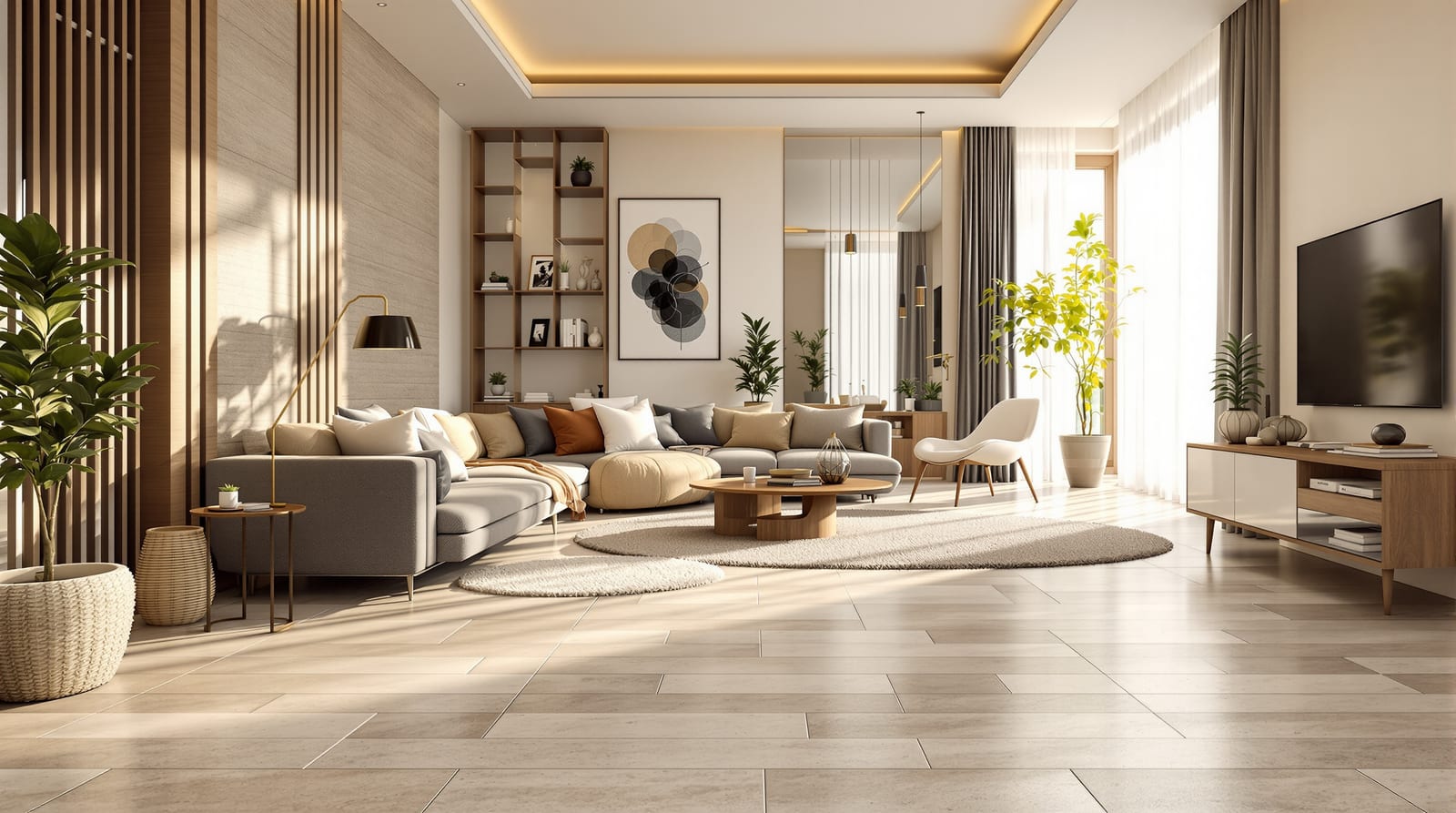
Luxury Vinyl Tile (LVT) Flooring in India: Wear Layer, Glue-Down vs Click, Waterproof & Cost (2026)
The premium flexible vinyl plank and tile that mimics wood and stone for a fraction of the price — how LVT differs from basic sheet vinyl and rigid SPC/WPC, why wear-layer thickness (mil) decides durability, the subfloor it demands, and honest ₹/sq ft for Indian homes, offices and retail.
Luxury vinyl tile — LVT for short — is the floor that lets an Indian home look like solid oak or Italian marble for a tenth of the price, without warping in the monsoon or staining like real wood. It is a flexible, multi-layer vinyl plank or tile with a photo-realistic printed decor and a thick clear wear layer on top, and it is 100% waterproof, quiet and warm underfoot. The catch is that "flexible" cuts both ways: LVT follows whatever is under it, so it demands a very smooth, level subfloor — which is exactly where it differs from the rigid SPC and WPC planks it is so often confused with. This guide explains what LVT really is, how it differs from basic sheet vinyl and from rigid composites, why wear-layer thickness in mils decides durability, what it costs per square foot in 2026, and how to lay it.
What luxury vinyl tile actually is
LVT is a premium grade of flexible PVC (vinyl) flooring, supplied as individual planks (LVP, the wood-look plank format) or square tiles (the stone-look format), rather than the big rolls of basic sheet vinyl. Each piece is built up from several bonded layers: a stabilising backing, a flexible PVC core, a high-resolution printed decor film, an embossed texture, and a clear wear layer sealed with a UV or polyurethane top coat. It is the printed decor plus the surface emboss — often "embossed in register" so the texture follows the grain you see — that makes good LVT genuinely hard to tell from real timber or stone at a glance.
The word "luxury" is doing real work here. It separates LVT from the thin, cheap roll-out vinyl most Indians picture when they hear "vinyl flooring". Basic sheet vinyl is a single continuous sheet, usually 1.5-3 mm thick, with a thin printed surface and a soft felt or foam back; it is fast and cheap but shows wear, dents and seams quickly. LVT is thicker (typically 2-5 mm), comes as individual rigid-edged tiles or planks, carries a far thicker and tougher wear layer, and looks and feels several leagues more convincing. See the wider vinyl flooring guide for how the whole vinyl family fits together.
The layer build-up
A good LVT plank is the sum of four or five thin layers, each with a job. The diagram below shows a typical section and how it sits on the subfloor.
- UV / PU top coat: a thin factory finish that resists scuffs, stains and sunlight fade — useful for Indian homes with big windows and strong daylight.
- Wear layer: a clear protective film measured in mils (thousandths of an inch). This is the single most important spec to check, and is covered in detail below.
- Decor film: a high-resolution printed image of timber or stone, usually embossed-in-register so the texture lines up with the visible grain.
- Flexible PVC core: the body of the plank. It bends — which is why LVT needs a very smooth base.
- Backing / stabiliser: a dimensionally stabilising under-layer; on glue-down LVT it also gives the adhesive a key.
LVT vs basic sheet vinyl, and vs rigid SPC/WPC
The two most common confusions are worth settling up front, because they decide whether LVT is even the right product for you.
LVT vs basic sheet vinyl. Sheet vinyl is one big roll with a thin print and a soft back — cheap, fast, fine for a low-budget rental or a utility room, but it dents, scuffs and looks plasticky. LVT is individual planks/tiles with a thick wear layer and convincing emboss — pricier, but it looks premium, resists wear, and a single damaged plank can be replaced rather than re-doing the whole floor.
LVT vs rigid SPC and WPC. This is the big one. SPC (stone-plastic composite) and WPC (wood-plastic composite) are also vinyl-based, but their cores are rigid — loaded with limestone or wood-flour so the plank stays dead flat. LVT's core is flexible. The practical consequences:
| LVT (flexible) | SPC (rigid) | WPC (rigid) | |
|---|---|---|---|
| Core | Flexible PVC | Limestone + PVC (hard, dense) | Wood-flour + PVC + foam (lighter) |
| Bridges an uneven base | No — follows every bump | Yes | Yes |
| Subfloor demand | Very smooth, dead-flat | Reasonably level | Reasonably level |
| Waterproof | Yes (100%) | Yes (100%) | Yes (100%) |
| Install options | Glue-down or click | Click, floating | Click, floating |
| Underfoot feel | Soft, warm, quiet | Firm, slightly cooler | Soft, warm, quiet |
| Dent resistance | Good (softer) | Best | Good |
| Cost ₹/sq ft (material) | 120-350 | 90-250 | 100-300 |
| Best for | Smooth/old-tile bases, glue-down, retail | High traffic, kitchens, uneven bases | Comfort and warmth |
The headline: if your base is already smooth (a sound screed, a good levelled floor, or a self-levelled skim), LVT gives you a softer, warmer, quieter floor with the widest choice of premium decors. If your base is uneven and you want to lay straight over old vitrified tiles without much prep, a rigid plank is the safer call — read the SPC flooring guide and WPC flooring guide for those. For a laminate comparison, see SPC vs laminate flooring.
Wear-layer thickness in mils — the number that matters most
The wear layer is the clear sacrificial film that takes the abrasion of footfall, furniture and grit, and it decides how long an LVT floor looks new. It is quoted in mils (1 mil = one-thousandth of an inch, about 0.025 mm) — do not confuse a mil with a millimetre. Match it to traffic, not to a salesperson's pitch.
| Wear layer | Approx. mm | Best for | India context |
|---|---|---|---|
| 6-8 mil | 0.15-0.20 mm | Light residential | Low-traffic bedrooms, guest rooms, budget rentals |
| 12 mil | 0.30 mm | Standard residential | Most homes — living rooms, bedrooms |
| 20 mil | 0.50 mm | Heavy residential / light commercial | High-traffic and joint-family homes, kitchens, home offices |
| 28-40 mil | 0.70-1.0 mm | Commercial / retail | Shops, showrooms, clinics, offices, hospitality |
For a normal Indian home, aim for at least 12 mil, and step up to 20 mil for living rooms, kitchens and joint-family traffic. For a shop, showroom or office floor, 28 mil or more is the sensible minimum. Total plank thickness (often 2-5 mm) affects feel and how forgiving the plank is, but it is the wear layer — not the overall thickness — that governs longevity. A thick plank with a thin 6-mil wear layer will wear through in a busy room long before a thinner plank with a 20-mil layer.
Why LVT suits Indian homes — and where it doesn't
Several LVT strengths line up with Indian conditions.
100% waterproof. Being all-vinyl, LVT does not absorb water, swell or delaminate. Spills, daily mopping and monsoon humidity do not harm the plank itself — a decisive advantage over laminate and solid wood in our climate.
Quiet and warm underfoot. Unlike tile, stone or rigid SPC, flexible LVT is soft and warm to walk on and absorbs footstep noise — a real comfort gain in bedrooms, kids' rooms and apartments where you do not want to hear the neighbours' floor.
A premium look on a budget. This is LVT's core promise: convincing oak, walnut, teak or marble decors at ₹120-350/sq ft, far below the ₹250-1,500 of real hardwood or Italian marble, with none of the staining, sealing and warping headaches.
Glue-down stability for retail and offices. Glue-down LVT is bonded flat to the subfloor, so it does not move, lift or telegraph — which is why offices, showrooms, retail and hospitality favour it for heavy rolling and foot traffic.
The honest limits. LVT's flexibility is its weakness as much as its strength: it needs a very smooth, level base, because any bump, ridge or grout line in the subfloor will eventually show (telegraph) through the soft plank. Skimping on subfloor prep is the number-one cause of disappointing LVT. Being softer than SPC, it dents more easily under sharp point loads (stiletto heels, heavy furniture legs without pads). And like all flexible vinyl, it can be affected by direct, harsh sun and is not for open terraces or wet-floor bathrooms where water stands — use anti-skid porcelain or stone there. For a balcony, see the relevant flooring guidance rather than laying LVT in the open.
Glue-down vs click LVT — how it goes down
LVT comes in two install systems, and the choice shapes both prep and cost.
Glue-down LVT is bonded to the subfloor with a pressure-sensitive or hard-set adhesive. It is the more stable, more commercial method: the floor cannot lift, shift or telegraph joints, and it handles heavy rolling loads. The subfloor must be smooth, clean, dry and dead-flat, because every imperfection will read through. Glue-down is the standard for retail, offices and large areas, and is fully repairable plank by plank. The trade-off is that prep and adhesive cost more, and lifting it later is messier.
Click (loose-lay or interlocking) LVT has a click joint or a high-grip back, so planks float over the base with no glue. It is faster, cleaner, renter-friendly and DIY-able, much like SPC — but because the planks are flexible, the base still has to be very level, and click LVT can be less stable over large areas or under heavy rolling loads than glue-down. For homes with a good smooth base, click LVT is a tidy choice.
A typical glue-down installation runs like this:
1. Prepare the base. Clean, dry and dead-flat is non-negotiable. Over old vitrified tiles, an uneven IPS screed or a rough floor, apply a self-levelling compound and let it cure — this is where most of the cost and quality difference sits with LVT.
2. Acclimatise. Leave the planks flat in the room for 24-48 hours so they reach room temperature before laying.
3. Set out and glue. Spread the specified adhesive, let it reach the right tack, and lay planks staggering end joints, working from a chalked centre line or a straight wall.
4. Roll the floor. Use a flooring roller to press out air and bed every plank fully into the adhesive — skip this and edges lift later.
5. Finish. Fit skirting or beading and transition strips at doorways. Glue-down floors usually need a short no-traffic period while the adhesive sets.
Click LVT skips the adhesive and roller and floats with a perimeter expansion gap, much like the floating-floor sequence described in the SPC flooring guide.
What LVT costs in India (2026)
Prices are indicative and vary by city, brand, decor and wear-layer grade; material only unless stated, plus 18% GST. The big swing in fitted cost is the subfloor prep — LVT lives and dies by a flat base.
| Item | Indicative cost (₹/sq ft) |
|---|---|
| LVT — entry (6-12 mil wear, thin) | 120-180 |
| LVT — standard home (20 mil wear) | 180-260 |
| LVT — commercial / 28-40 mil wear | 260-350 |
| Self-levelling underlayment (usually needed) | 25-60 |
| Adhesive (glue-down) | 15-35 |
| Glue-down install (labour) | 25-60 |
| Click / loose-lay install (labour) | 20-45 |
| Skirting / beading + transition strips | as per run |
That ₹120-350/sq ft material band sits a little above SPC, overlaps WPC, and is well below hardwood or Italian marble. For a typical home in standard 20-mil LVT, an all-in figure of roughly ₹220-380/sq ft fitted — material, self-levelling, adhesive, labour and sundries — is realistic, with the prep being the variable. Use the flooring cost calculator and the flooring material comparison to firm up a number for your floor and decide between glue-down and click.
Maintenance
LVT is one of the lowest-maintenance floors you can buy, which suits busy Indian households. Sweep or vacuum (hard-floor mode, no beater bar) to lift grit, which is what actually abrades the wear layer. Damp-mop with a pH-neutral cleaner — no harsh acids, no abrasive scourers, no steam mops, which can lift the decor and soften the adhesive over time. Put felt pads under furniture legs and use proper castor cups for chairs to prevent point-load dents, and place a doormat at entries to keep grit off. There is no polishing, sealing or re-coating as with marble or wood; if a single plank is damaged, a glued plank can be cut out and replaced, and a click plank simply swapped.
How to choose: LVT, SPC, WPC or something else
If you want the softest, warmest, quietest premium-look floor and your base is already smooth (or you will skim it flat), choose LVT — glue-down for retail, offices and large or heavy-traffic areas, click for homes with a good base. If your base is uneven and you want to lay over old tiles with minimal prep, or you want the hardest, most dent-resistant floor for kitchens and high traffic, choose rigid SPC instead. If you want rigid-core convenience but a softer, warmer feel, look at WPC. And if your budget is tight and the room stays dry, basic vinyl or laminate may be enough.
For the bigger picture across every floor type, start with the complete home flooring guide for India and the how to choose flooring guide, and read the family overview in the vinyl flooring guide.
Frequently asked questions
What is the difference between LVT and SPC flooring?
Both are vinyl, but LVT has a flexible PVC core while SPC has a rigid limestone-plastic core. The flexibility means LVT follows the subfloor, so it needs a very smooth, dead-flat base and shows any bumps; SPC's rigid core bridges minor unevenness and can lay over old tiles with less prep. LVT is softer, warmer and quieter underfoot; SPC is harder and more dent-resistant. Both are 100% waterproof.
What wear-layer thickness should I buy for LVT?
Aim for at least 12 mil for normal home use, and 20 mil for living rooms, kitchens and joint-family traffic. Shops, showrooms and offices should use 28-40 mil. Remember a mil is a thousandth of an inch, not a millimetre — and it is the wear layer, not the total plank thickness, that decides how long the floor keeps looking new.
Glue-down or click LVT — which is better?
Glue-down is more stable, handles heavy rolling and foot traffic, and is the standard for retail and offices, but needs more prep and adhesive. Click (loose-lay) LVT floats with no glue, installs faster, is renter-friendly and DIY-able, and suits homes with a good smooth base. Either way the subfloor must be very level, because flexible LVT telegraphs imperfections.
Is LVT waterproof and good for Indian climate?
Yes. Being all-vinyl, LVT is 100% waterproof and unaffected by mopping, spills and monsoon humidity, and it does not warp or stain like wood. It is well suited to Indian homes, with two caveats: it is not for open terraces or wet-floor bathrooms where water stands, and direct harsh sun can affect flexible vinyl, so use anti-skid porcelain or stone in those spots.
What does LVT flooring cost in India?
Expect roughly ₹120-350 per sq ft for the planks (material only, plus 18% GST), with standard 20-mil home ranges around ₹180-260. Add self-levelling (₹25-60), adhesive for glue-down (₹15-35) and labour (₹20-60/sq ft), so a fitted home floor often lands around ₹220-380/sq ft. The subfloor prep is the biggest variable — figures are indicative and vary by city, brand and grade.
Export this guide
Related Guides — Deep-dive reading
Cork Flooring in India: Warm, Quiet, Eco Floors for Bedrooms, Study & Kids' Rooms
Why cork is genuinely sustainable (bark is harvested while the tree lives on), the comfort and acoustic benefits, the natural look, ₹200-500/sq ft, click-floating vs glue-down tiles, sealing, and the dent, moisture and sun-fade caveats every Indian homeowner should know.
Flooring & SurfacesEngineered Wood Flooring in India: Layers, Wear Layer, Install & Cost (2026)
Engineered wood is a real-wood top veneer bonded over a cross-laminated plywood or HDF core, which makes it far more dimensionally stable than solid wood in Indian humidity — the practical way to get a genuine timber floor here. This guide covers the layer build-up, wear-layer thickness, click vs glue-down install, where it suits, ₹/sq ft, brands and maintenance.
Flooring & SurfacesLaminate Flooring in India: AC Ratings, Cost, Brands & the Honest Limits (2026)
The budget wood-look floor for Indian homes — an HDF core with a printed decor and tough melamine wear layer, click-lock floating install over underlay, DIY-friendly and fast, with the water and refinishing caveats made plain.
Flooring & SurfacesRelated Tools — Try Free
Flooring Cost Calculator
Estimate the all-in cost of a floor — material, laying, wastage, skirting and GST — by area and material.
Flooring CalculatorCross-Ventilation Analyzer
Estimate airflow and air changes per hour (ACH) from room size, window areas, layout, and local wind — with NBC 2016 Part 8 compliance check.
Ventilation CalculatorDoor Material Comparison Tool
Compare 2–4 door materials on cost, durability, maintenance, security and moisture resistance.
Comparison Tool