
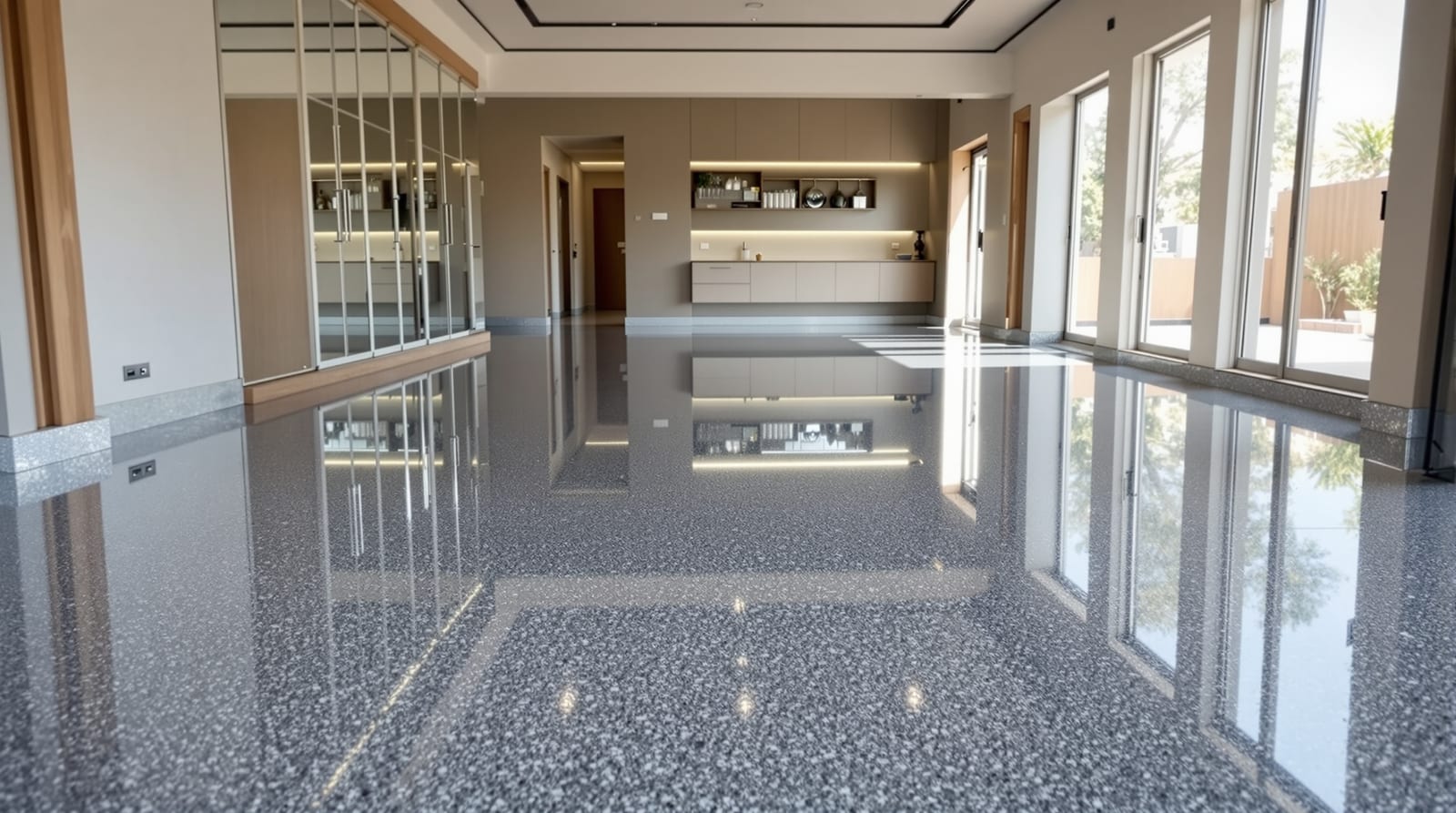
Epoxy Flooring in India: Seamless Resin Floors for Homes & Spaces
A seamless, jointless poured resin coating over concrete — types, costs, where it suits, and the realities of metallic and decorative epoxy in Indian homes.
Epoxy flooring is the seamless, mirror-smooth resin floor you have walked across in showrooms, hospital corridors, swanky garages and, increasingly, in Indian living rooms styled to look like poured liquid stone. It is not a tile or a plank — it is a fluid two-part resin troweled and poured directly over a concrete slab, where it self-levels and cures into a hard, jointless, waterproof skin bonded to the floor below. This guide explains the main epoxy types, why people choose it, where it genuinely suits an Indian home or workspace, what it honestly cannot do, and what it costs per square foot in 2026.
What epoxy flooring actually is
Epoxy is a thermosetting polymer made by mixing two liquids — a resin and a hardener — that react chemically and set into a rigid, glass-hard plastic. As a floor, that liquid is applied over a properly prepared concrete base in coats: a penetrating primer first, then one or more build coats, then a clear or pigmented topcoat. Because it goes down wet and flows, it forms a continuous surface with no joints, no grout lines and no gaps for water or dirt to hide in. The whole system is typically only 0.3 mm to 3 mm thick (decorative metallic) and up to 6-9 mm for heavy-duty mortar floors, but it bonds to and effectively becomes part of the slab.
This is the key mental shift: epoxy is a floor finish, not a floor covering. It does not sit loose on top like a tile or a click-plank; it is chemically married to the concrete. That is why the concrete underneath matters more than almost anything else, a point we return to below.
The coat build-up
A good epoxy floor is built in layers, each with a job. The diagram shows a typical decorative system in section.
- Primer: a penetrating coat that soaks into the concrete and gives the build coats something to grip. Skip or rush this and the floor will eventually peel.
- Build coat: the pigmented, self-levelling body of the floor that creates the colour, the flatness and most of the thickness.
- Decorative layer: where character is added — broadcast vinyl flakes, metallic pigments swirled for a marbled effect, or a printed image under clear resin for "3D" floors.
- Topcoat: a clear, hard finish that takes the wear, sets the sheen (high-gloss or matte), and can carry anti-skid grit and UV stabilisers.
The main types of epoxy flooring
Not all epoxy is the same. The system you choose depends on whether you want raw toughness, decoration, or both.
| Epoxy type | What it is | Typical use | Cost (₹/sq ft, applied) |
|---|---|---|---|
| Self-levelling epoxy | Flowable resin that settles into a smooth flat film, 1-3 mm | Living areas, showrooms, offices, smooth garages | 100-250 |
| Epoxy mortar (screed) | Resin + graded sand/aggregate, 4-9 mm, very tough | Factories, warehouses, heavy-impact workshops | 150-300 |
| Flake (chip) epoxy | Coloured vinyl flakes broadcast into the coat, then sealed | Garages, utility, balconies, anti-slip-friendly | 90-180 |
| Metallic epoxy | Metallic pigments swirled for a marbled, 3D-depth look | Statement living rooms, cafes, retail, lobbies | 200-300 |
| 3D epoxy | A printed image laid under clear self-levelling resin | Feature floors, kids rooms, themed spaces | 250-300+ |
| Anti-static (ESD) epoxy | Conductive epoxy that dissipates static charge | Electronics labs, server rooms, pharma, OTs | 150-300 |
| Epoxy floor paint (roller) | Thin 0.1-0.3 mm coating, simplest grade | Budget garages, utility refresh | 30-80 |
The cheapest "epoxy" you will be quoted is often just roll-on epoxy floor paint — a thin coat that looks the part for a year or two but wears through quickly. A true poured self-levelling or metallic system is a different, more durable animal at a different price.
Why people choose epoxy
Several epoxy strengths line up neatly with Indian conditions and modern tastes.
Seamless and jointless. With no grout lines or tile edges, there is nowhere for water, dust, oil or bacteria to lodge. This is why hospitals, labs, kitchens and pharma plants love it — and why it reads as so clean and minimal in a modern home.
Waterproof and chemical-resistant. A cured epoxy skin shrugs off water, oil, mild acids, solvents and detergents. It is genuinely useful in garages (engine oil, brake fluid), utility areas, and commercial kitchens. For wet domestic areas it works, but slip safety becomes the watch-out (below).
Abrasion- and impact-tough. Epoxy mortar floors take forklifts, dropped tools and heavy footfall that would chip tiles. Even residential self-levelling epoxy resists scuffing and the trolley-and-grit wear of a high-traffic, joint-family home.
Hygienic and easy to clean. A continuous non-porous surface mops clean in seconds — no grout to scrub, no joints harbouring grime.
Design freedom. This is the trend driver. Metallic epoxy produces swirling, marbled, almost molten-stone effects no tile can match; flakes give a flecked terrazzo-like look; 3D floors embed images; and you can pick any colour, high-gloss or matte. Decorative epoxy in living areas, cafes and boutiques is having a real moment in Indian metros.
Where epoxy suits in an Indian home and beyond
Epoxy earns its keep first in the utility end of a home: garages and car porches (oil-proof, easy to wash down), utility and wash areas, store rooms, terraces under cover, and stilt parking in apartments. In these spaces its toughness and wipe-clean nature are exactly right, and a flake finish adds grip.
In living spaces, decorative metallic or flake epoxy is the draw for owners chasing a seamless modern or industrial look — open-plan living-dining floors, home cafes, studios and home offices. Done well, it is striking. Kitchens are a natural fit for the seamless, oil-resistant surface, provided an anti-skid topcoat is used near the sink and hob.
Beyond the home, epoxy dominates commercial and industrial floors: showrooms, retail, restaurants, hospitals, laboratories, pharma cleanrooms, warehouses and factories. For Indian climates it is broadly suitable indoors, but two environmental notes matter: keep decorative epoxy out of direct, harsh sunlight (UV yellowing), and treat exposed terraces and open balconies with caution — epoxy is best under cover, with anti-skid porcelain or stone the safer call for open monsoon-exposed areas. For an outdoor floor comparison see the existing outdoor flooring guide for India.
The realities — what epoxy honestly cannot do
Epoxy is sold on its looks, so the limits deserve plain talk.
It is only as good as the concrete under it. Epoxy bonds to the slab; it does not fix it. The base must be sound, fully cured, dry (low moisture — rising damp or a green slab will cause blistering and peeling), clean and crack-stable. Surface preparation — grinding or shot-blasting the concrete to open the pores — is non-negotiable. Most epoxy failures in India trace back to skipped prep or a damp slab, not the resin.
It needs a skilled applicator. Self-levelling and metallic epoxy are unforgiving — mixing ratios, working time (pot life), temperature, humidity and timing between coats all matter. A poured floor shows every roller mark, bubble and lap. This is not a casual DIY job; use an experienced applicator with a system warranty.
It can yellow and chalk in UV. Standard epoxy ambers and loses gloss under sustained direct sunlight. For sun-flooded rooms or any outdoor use, a UV-stable polyurethane (PU) topcoat over the epoxy, or a full PU floor, is the right answer.
It is slippery when wet unless an anti-skid additive or textured topcoat is used. A high-gloss epoxy near a sink, in a bathroom, or at an entrance that catches monsoon rain is a fall risk. Specify an anti-slip topcoat (aluminium-oxide or polymer grit) for any wet or transitional zone — this aligns with NBC 2016 and accessibility guidance on slip-resistant floors.
Repair means recoat, and colour-matching is hard. A localised gouge or burn cannot be swapped out like a tile. You patch and recoat, and matching a metallic swirl or aged gloss exactly is difficult — repairs can show. It is also rigid and cold underfoot, and a hard surface to stand on for long periods.
Curing, maintenance and lifespan
Curing is the other thing people underestimate. After application, a typical epoxy floor is walkable in about 24 hours, ready for light furniture in 2-3 days, and fully chemically cured (full hardness and chemical resistance) in about 7 days. That down-time, plus prep, means a room is out of use for the better part of a week — plan around it.
Maintenance is light: sweep or dust-mop daily, damp-mop with a pH-neutral cleaner, wipe spills, and avoid harsh abrasive scrubbing that dulls the gloss. Use felt pads under furniture and avoid dragging heavy metal items. A well-laid residential epoxy floor lasts roughly 7-15 years before a refresh recoat; industrial mortar systems can run longer. A periodic clear recoat restores gloss and extends life cheaply.
What epoxy flooring costs in India (2026)
Prices are indicative and vary by city, applicator, system thickness and finish; figures are for the applied floor (including prep and labour) unless noted, plus 18% GST. The biggest swing is prep: a sound, level slab is cheap to coat; a poor slab needing grinding, crack repair and a levelling screed adds significantly.
| Item | Indicative cost (₹/sq ft) |
|---|---|
| Epoxy floor paint (thin roller coat) | 30-80 |
| Flake / chip epoxy system | 90-180 |
| Self-levelling epoxy (1-3 mm) | 100-250 |
| Metallic / 3D decorative epoxy | 200-300+ |
| Epoxy mortar / heavy-duty screed | 150-300 |
| Anti-static (ESD) epoxy | 150-300 |
| Surface prep extras (grinding, crack repair, levelling) | add 20-80 |
| Anti-skid topcoat / UV-stable PU topcoat | add 20-60 |
That ₹80-300/sq ft band puts a basic epoxy in tile territory and a decorative metallic floor up near a good microcement or premium stone floor. For a typical 300 sq ft garage in flake epoxy, budget roughly ₹30,000-55,000 all-in; a 400 sq ft living room in metallic epoxy can run ₹90,000-1,40,000+. Use the flooring cost calculator and the flooring material comparison to firm up a number for your floor.
Epoxy vs microcement vs polished concrete
These three seamless surfaces are often shortlisted together for a modern jointless look, but they behave differently.
| Feature | Epoxy | Microcement | Polished concrete |
|---|---|---|---|
| Material | Two-part resin (plastic) | Cement-polymer skim | The slab itself, ground and sealed |
| Look | Glossy/matte, metallic, flake, vivid colour | Soft matte cement, mineral | Industrial, mottled aggregate |
| Thickness | 0.3-3 mm (up to 9 mm) | 2-3 mm | The slab |
| Wall + floor continuity | Floor mainly | Floor and walls (great for wet areas) | Floor |
| UV stability | Yellows unless PU topcoat | Better | Good |
| Repair | Recoat (match tricky) | Patch and reseal | Re-polish |
| Cost ₹/sq ft | 80-300 | 250-800 | 100-400 |
In short: choose epoxy for the toughest, most chemical- and abrasion-resistant seamless floor and for metallic/flake decorative effects; choose microcement for a softer matte cement look that wraps up walls and around wet areas; and choose polished concrete when you want the honest slab itself. Read the full breakdowns in our microcement flooring guide, and for a seamless terrazzo alternative see the terrazzo flooring guide.
For the bigger picture across every floor type, start with the flooring materials explained guide, the complete home flooring guide for India and the how to choose flooring guide.
Frequently asked questions
Is epoxy flooring good for Indian homes?
For garages, utility areas, kitchens and modern living rooms, yes — it is seamless, waterproof, easy to clean and visually striking, especially in metallic or flake finishes. The caveats are real: it needs a sound, dry concrete base and a skilled applicator, it can yellow in direct sun (use a UV-stable PU topcoat), and it must carry an anti-skid topcoat anywhere it gets wet. It is less suited to open, sun-and-monsoon-exposed terraces, where anti-skid porcelain or stone is safer.
What does epoxy flooring cost per square foot in India?
Roughly ₹80-300 per sq ft applied (including prep and labour, plus 18% GST). Thin roller floor paint is ₹30-80, flake systems ₹90-180, self-levelling ₹100-250, and decorative metallic or 3D floors ₹200-300+. Poor concrete needing grinding, crack repair or a levelling screed adds ₹20-80/sq ft. Figures are indicative and vary by city, applicator and finish.
How long does epoxy flooring take to cure and last?
A typical epoxy floor is walkable in about 24 hours, takes light furniture in 2-3 days, and reaches full chemical cure in around 7 days — so plan for the room being out of use for most of a week. A well-laid residential epoxy floor lasts roughly 7-15 years before a refresh recoat, and a periodic clear recoat extends its life and restores gloss.
Is epoxy flooring slippery?
High-gloss epoxy is slippery when wet. For any wet or transitional zone — kitchens near the sink, bathrooms, entrances exposed to monsoon — specify an anti-skid topcoat with aluminium-oxide or polymer grit, which keeps grip without losing the seamless look. Flake finishes naturally add some texture, making them a good choice for garages and utility floors.
Can epoxy flooring be repaired?
Not like a tile — you cannot swap out one damaged area. A gouge, burn or worn patch is repaired by patching and recoating, and on metallic or aged-gloss floors an exact colour and pattern match is difficult, so repairs can be visible. The upside is that a full clear recoat over the whole floor is straightforward and restores the surface cheaply.
Export this guide
Related Guides — Deep-dive reading
Epoxy Floor Application in India: Substrate Prep, Coats and Curing Step-by-Step
How a resin epoxy floor is actually laid in India — moisture testing and mechanical grinding, crack repair, primer, self-leveling vs broadcast vs coating systems, mixing ratios, pot life, coats and a full 7-day cure.
Flooring & SurfacesEpoxy Grout vs Cement Grout for Tiles in India: Which to Specify (2026)
A plain-English guide to tile grouts for Indian homes: what grout does, how cementitious grout compares with epoxy grout on cost, stain and water resistance, hygiene and durability, and exactly where each one belongs - kitchens, bathrooms, pools, dry rooms and more.
Building MaterialsMicrocement Flooring in India: The Seamless 2-3 mm Concrete Look
A thin, hand-applied cement-polymer coating that gives a jointless concrete or stone surface over your existing floors, tiles and walls — no demolition.
Flooring & SurfacesRelated Tools — Try Free
Flooring Cost Calculator
Estimate the all-in cost of a floor — material, laying, wastage, skirting and GST — by area and material.
Flooring CalculatorCross-Ventilation Analyzer
Estimate airflow and air changes per hour (ACH) from room size, window areas, layout, and local wind — with NBC 2016 Part 8 compliance check.
Ventilation CalculatorAcoustic Privacy (STC) Visualizer
Indian healthcare acoustic visualizer — compare wall assemblies and noise sources, see received SPL after STC attenuation, and check FGI 2018 / IS 1950 / NABH speech-privacy compliance with live dual-canvas waveform.
Acoustic Tool