
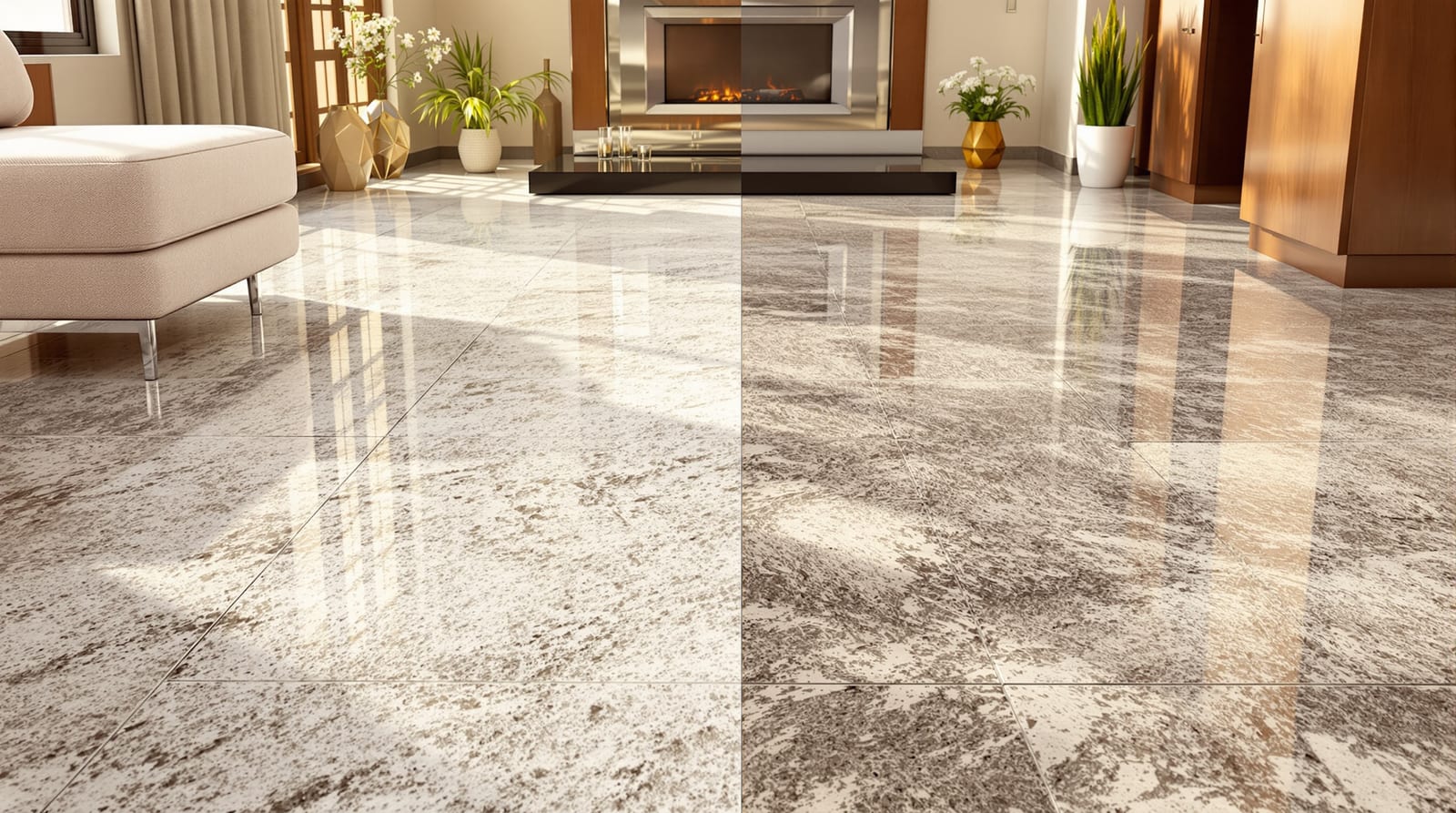
Granite vs Vitrified Tiles in India: Cost, Durability & Which to Choose (2026)
Natural stone or engineered tile? A head-to-head on looks, joints, durability, maintenance, ₹/sq ft cost, laying and resale value — so you can pick the right floor for an Indian home.
Stand in any tile showroom in India and you will eventually be asked the same question: "Granite ya vitrified?" It is the most common floor decision Indian homeowners actually face, because these two materials dominate our living rooms, kitchens and lobbies. One is natural stone quarried from Indian soil; the other is a high-fired engineered tile that mimics almost anything. Both are tough, both are low-maintenance, and their prices often overlap — which is exactly why the choice feels so hard. This guide puts them head to head on the things that matter: how they look, joints, durability, maintenance, real 2026 ₹/sq ft cost, laying and resale value, with a clear answer on where each one wins.
The fundamental difference
Granite is natural igneous stone — quartz, feldspar and mica fused by heat and pressure deep in the earth over millions of years, then cut into slabs and polished. India is one of the world's largest granite producers (think Black Galaxy from Andhra, Tan Brown and Steel Grey from the south), so good granite is genuinely a local material here. It is governed by IS 14223 for polished building stone.
Vitrified tile is a manufactured product. A blend of clay, feldspar, silica and quartz is pressed and fired at around 1200°C until it partly melts and fuses into a dense, glass-like body. The defining number is water absorption: under IS 15622, genuine vitrified tile sits in group BIa, absorbing 0.5% or less of water. Within "vitrified" there are several grades — glazed (GVT), polished glazed (PGVT), double-charged and full-body — and they behave very differently, which matters for this comparison.
So at heart this is natural stone vs engineered tile. Granite gives you a one-of-a-kind slab from the earth; vitrified gives you predictable, designed-to-spec uniformity. Almost every difference below flows from that one fact.
Look: unique stone vs designed variety
Granite's beauty is that no two slabs are identical. The crystalline grain, the flecks, the depth of a Black Galaxy or the warm movement of Tan Brown are real and impossible to fake exactly. For many Indian families this "natural premium" feeling is the whole point, especially in a formal living room or pooja area. The flip side: your colour palette is limited to what nature and quarries offer — mostly blacks, browns, greys, greens and speckled tones. Bright whites and pure pastels in granite are rare and expensive.
Vitrified tile wins decisively on design range. Modern PGVT uses digital inkjet printing, so a single tile can convincingly imitate Italian marble, Indian marble, travertine, wood planks, concrete, terrazzo or solid colours — in a finish from high gloss to matt to anti-skid. If you want a marble look without marble's stain risk, or a wood look without wood's water problems, vitrified is the only practical route. The caveat: cheaper vitrified prints repeat every few tiles, and on a large floor the eye spots the pattern. Better (and pricier) ranges carry many more "faces" per box to avoid this.
| Look factor | Granite | Vitrified tile |
|---|---|---|
| Natural / unique | Genuinely natural, every slab different | Engineered; printed designs can repeat |
| Colour & pattern range | Limited (blacks, browns, greys, greens) | Vast — marble, wood, concrete, plain, any colour |
| Finish options | Polished, honed, leather, flamed | Gloss, matt, sugar/anti-skid, carving |
| Premium feel | High — "real stone" status | High in PGVT/double-charged; lower in cheap GVT |
| Marble / wood look | No | Yes, convincingly |
Joints: big slabs vs the tile grid
This is one of granite's biggest practical advantages. Granite comes in large slabs (commonly up to roughly 2400 x 1200 mm or larger), so a living-room floor or staircase can be laid with very few joints — sometimes a near-seamless expanse with only thin slab lines. Fewer joints means fewer places for dirt and water to collect and a more monolithic, luxurious look.
Vitrified tile is sold in fixed module sizes — 600x600, 800x800, 600x1200, and large-format 1200x1200 or 800x1600 mm. However good the tile, you still get a regular grid of grout lines. Rectified (machine-cut) vitrified laid with tile adhesive can achieve very thin, near-seamless joints of 1.5-2 mm, which looks excellent — but it is never truly jointless like a single granite slab. Large-format vitrified (1200x1200 and above) narrows the gap by cutting the number of joints dramatically.
For seamlessness: granite slab > large-format rectified vitrified > standard 600x600 vitrified.
Durability: both very tough, different strengths
Here is the good news — both materials are extremely durable and easily outlast wood, laminate or vinyl in an Indian joint-family home. But their strengths differ.
Granite is harder than most flooring stone and is excellent against scratches and heat. You can drop a knife, drag a sofa, or set a hot kadhai down (on a counter) and granite shrugs it off — which is exactly why it is the default Indian kitchen countertop too. Its weakness: it is porous, so untreated granite can absorb oil, turmeric and acidic spills over time, and unsealed light granites can stain. Polished granite can also chip on a sharp impact at edges.
Vitrified tile (especially double-charged and full-body) is highly stain and water resistant because of that sub-0.5% absorption — turmeric, oil and chai wipe off rather than soak in. Good vitrified resists abrasion well. Its weaknesses: a heavy sharp impact can chip a tile, glaze on cheaper GVT can scratch and dull over years of grit, and the grout lines stain and need periodic cleaning. The PEI / abrasion rating and the tile type matter enormously — double-charged outlasts surface-glazed GVT in high traffic.
| Durability factor | Granite | Vitrified tile |
|---|---|---|
| Scratch resistance | Excellent | Good (double-charged best; cheap GVT scratches) |
| Heat resistance | Excellent | Good |
| Stain / water resistance | Needs sealing (porous) | Excellent (<0.5% absorption) |
| Chip / impact | Edges can chip | Tile can chip on hard impact |
| Lifespan (proper laying) | 30+ years | 15-30 years by grade |
| Weak point | Sealing / acid etch | Grout lines, glaze wear |
Maintenance: both low, one needs sealing
Both are mop-and-go floors — a huge reason they dominate Indian homes. The difference is in the extras.
Granite benefits from periodic sealing (a penetrating sealer every 2-4 years, more often for lighter or honed granite) to keep its pores from absorbing stains. Acidic spills (lemon, vinegar, some cleaners) can etch polished granite, so avoid harsh acids. A re-polish every several years restores deep gloss. Done right, maintenance is minimal.
Vitrified tile needs no sealing at all — the body itself is non-porous. Day-to-day it is the lowest-fuss floor going. The one ongoing chore is grout: light grout lines yellow and trap dirt, so an epoxy grout (instead of cement grout) or a darker grout colour and occasional grout cleaning keeps it looking fresh. Anti-skid (sugar/matt) vitrified surfaces hold a little more grime in their texture and want a slightly firmer mop.
Cost in India: often comparable, but laying differs
This is where most homeowners are surprised. Material costs overlap heavily. Standard commercial granite and mid-range vitrified land in similar ₹/sq ft territory; it is at the premium end and in the laying that they diverge. All figures below are 2026 indicative, material only, +18% GST, laying extra — and they vary by city and vendor.
| Item | Granite | Vitrified tile |
|---|---|---|
| Material ₹/sq ft | 50-250 (premium 250-500) | GVT/PGVT 40-150; double-charged 45-90; full-body higher |
| Typical home choice | Commercial granite ~80-180 | Double-charged / PGVT ~70-130 |
| Laying labour ₹/sq ft | 30-60 (heavy slabs, skilled) | 15-40 (more for large-format) |
| Bed / adhesive | Cement-sand bed or adhesive | Tile adhesive ₹12-30/sq ft (recommended) |
| Polishing | Post-lay grinding & polishing extra | Not needed (factory finish) |
| Wastage | Lower (cut to room) | Add 5-10% (more for diagonal) |
The headline: large granite slabs cost more to lay. They are heavy, need skilled masons to handle and level, and usually require post-laying grinding and polishing on site (an extra cost and a dusty, multi-day job). Vitrified arrives factory-finished and is set on tile adhesive — faster, cleaner, often cheaper to install even when material prices are similar. So compare delivered, laid and finished cost, not box price. Our flooring cost calculator and flooring material comparison tool help you model both side by side, and the granite flooring cost calculator covers slab-specific overheads.
Laying: slab craft vs tile system
Granite slabs are laid by experienced masons on a cement-sand bed (or adhesive), carefully levelled because each piece is large and heavy; joints are filled and the whole floor is then machine-ground and polished to a mirror finish on site. It is craft work — the result is seamless, but quality depends heavily on the mason and the polishing.
Vitrified is a system: rectified tiles set on notched-trowel tile adhesive over a sound, level screed, with tile spacers for consistent 1.5-2 mm joints, then grouted (epoxy grout in wet areas and kitchens is worth the extra). It is more forgiving and repeatable. For both, the subfloor must be level and cured — most "hollow tile" and lippage complaints come from a bad bed, not the material. See our existing flooring finishes specification guide for the spec-level detail.
Where each one wins
Choose granite when you want a seamless, monolithic premium look with the fewest joints — grand living rooms, lobbies, staircases (granite treads and risers are superb), and high-traffic commercial entrances. Granite is also the obvious pick if you are doing kitchen countertops in the same stone for a coordinated look, and where heat and scratch resistance top your list. It suits buyers who value real natural stone status and resale signalling.
Choose vitrified when you want design freedom and value — a marble look, a wood look, a specific colour, or a consistent finish across a large flat — with no sealing and the lowest fuss. It is ideal for bedrooms, modern apartments, rental and builder floors, and anywhere you want a premium look on a controlled budget. Anti-skid vitrified (R10+ / matt) is also the safer, easier pick for bathrooms, balconies and around wet areas, where you would otherwise need a flamed or leather granite finish.
For wet-area and balcony specifics, see bathroom flooring and balcony flooring; for room-by-room logic, living room flooring and kitchen flooring.
Resale value
In the Indian resale and rental market, both read as "good quality" floors to buyers — a clear step above ceramic, laminate or vinyl. Granite carries a slight edge in perceived premium, especially in larger or higher-end homes, where "Italian marble or granite flooring" is a selling line in listings. Vitrified, particularly double-charged or large-format PGVT in marble finish, presents almost as well to most buyers at lower cost and is unlikely to date. Neither will hurt resale; for pure budget-to-impression efficiency, premium vitrified is hard to beat, while granite signals enduring quality. For a Vastu-conscious buyer, lighter floors in the north-east and main living areas are traditionally preferred — easier to achieve with vitrified's range than with naturally dark granites.
The short answer
If you want natural stone, a near-seamless floor and maximum perceived premium (and you are okay with occasional sealing and higher laying cost), choose granite. If you want design variety, marble or wood looks, zero sealing and the best value-for-impression on a large or modern home, choose vitrified — double-charged or PGVT for living areas, anti-skid for wet zones. Many Indian homes sensibly do both: granite in the formal living room and on the staircase, premium vitrified through the bedrooms and utility areas.
Going deeper? Read the dedicated granite flooring guide and vitrified tile flooring guide, compare marble vs granite, and use the flooring material comparison tool.
Frequently asked questions
Is granite cheaper than vitrified tiles in India?
Material prices overlap — standard commercial granite (about ₹80-180/sq ft) and good double-charged or PGVT vitrified (about ₹70-130/sq ft) are broadly comparable. The real difference is laying: large granite slabs are heavier, need skilled masons and on-site grinding-and-polishing, so installed cost is usually higher than vitrified, which arrives factory-finished and goes down on adhesive. Always compare delivered-and-laid cost, not box price.
Which is more durable, granite or vitrified tiles?
Both are very durable and outlast wood or laminate. Granite is harder and better against scratches and heat but is porous and benefits from sealing. Vitrified (especially double-charged) is more stain- and water-resistant out of the box but its grout lines need cleaning and cheaper glazed GVT can scratch over years. For a joint-family, high-traffic home both work well — pick by look and budget, not durability fears.
Which has fewer joints, granite or vitrified?
Granite, clearly. It comes in large slabs, so a floor can be laid with very few seams — almost monolithic. Vitrified always has a regular grout grid, though rectified large-format tiles (1200x1200 mm and up) laid with thin 1.5-2 mm joints get close. If a seamless look is the priority, granite slab wins; if design variety matters more, choose vitrified.
Does granite need sealing and vitrified does not?
Correct. Granite is natural stone and slightly porous, so a penetrating sealer every 2-4 years (and avoiding acidic cleaners) keeps it stain-free. Vitrified tile absorbs under 0.5% water by IS 15622, so the tile body needs no sealing at all — only the grout benefits from epoxy grout or occasional cleaning.
Which is better for an Indian kitchen — granite or vitrified?
Granite is the traditional Indian kitchen choice because it shrugs off heat, knives and heavy use, and it pairs naturally with granite countertops. Vitrified is also excellent and easier to keep stain-free — choose an anti-skid (matt) finish near the cooking and washing zones for safety. Many homeowners use granite on the counter and vitrified or granite on the floor; both are sound.
Export this guide
Related Guides — Deep-dive reading
Porcelain, Ceramic & Sintered-Stone Facade Cladding in India: A Practical Guide
Thin large-format porcelain and sintered-stone slabs can clad a building with the look of marble, concrete or weathered steel at a fraction of stone's weight — but on a facade, the fixing system is a life-safety decision, not a finish choice.
Building FacadesEpoxy Grout vs Cement Grout for Tiles in India: Which to Specify (2026)
A plain-English guide to tile grouts for Indian homes: what grout does, how cementitious grout compares with epoxy grout on cost, stain and water resistance, hygiene and durability, and exactly where each one belongs - kitchens, bathrooms, pools, dry rooms and more.
Building MaterialsComplete Home Flooring Guide for Indian Homes (2026)
The authoritative overview of every flooring family — tiles, stone, wood, vinyl and seamless — with India ₹/sq ft costs, room-by-room logic and laying basics.
Flooring & SurfacesRelated Tools — Try Free
Flooring Cost Calculator
Estimate the all-in cost of a floor — material, laying, wastage, skirting and GST — by area and material.
Flooring CalculatorGranite Flooring Cost Calculator
Estimate installed granite-floor cost — material, cutting, laying, polishing, sealing, wastage and GST.
Flooring CalculatorMaterial Compare — Side by Side
Compare materials side-by-side: granite vs quartz vs marble, laminate vs acrylic vs PU, and more.
Comparison