
Bathroom Flooring Guide India: Anti-Skid Tiles, Stone, Vinyl & Epoxy Compared
Every bathroom floor material for Indian homes in one place — anti-skid ceramic and vitrified tiles, natural stone, mosaic, vinyl (SPC/LVT) and epoxy — with a full comparison table, slip ratings, ₹/sq ft costs and the safety and slope rules that keep a wet floor from becoming a hazard.
The bathroom floor is the hardest-working surface in an Indian home. It is wet for hours a day, sprayed by a health faucet, walked on with soapy feet, scrubbed with acidic cleaners and exposed to hard water that leaves scale on everything it touches. Choose the wrong material — or the right material laid flat with no fall — and you get either a slip hazard or a floor that stains, cracks and pools water within a couple of monsoons.
This is the flooring pillar for the Studio Matrx bathroom cluster. It walks through every realistic floor material for an Indian bathroom, gives you a single comparison table to shortlist from, and then spends real time on the two things that matter more than the material itself: anti-slip safety and slope to the drain. For how the floor fits into the whole room, read the Bathroom Design Guide (India), and for the broader picture across the house, the general Flooring guide.
Pick a bathroom floor in this order: first slip resistance, then how it drains, then water resistance, then looks and budget. A gorgeous polished floor that is slippery when wet has failed at its only real job.
The materials, one by one
There are five families worth considering. Each has a genuine place; the trick is matching it to the zone (wet vs dry) and the user (a young couple vs elderly parents).
1. Ceramic tiles
The default and cheapest choice. Ceramic floor tiles are clay-based with a glazed top. For bathrooms you want a matte or textured anti-skid glaze, never a glossy one. They handle water and hard-water cleaning well, come in every size and pattern, and are easy for any tiler to lay. The trade-off is lower strength and higher water absorption than vitrified — fine for a low-traffic family bathroom, less ideal for a heavy-use common toilet.
- Best for: budget bathrooms, walls-and-floor matching, rental and builder flats.
- Watch for: absorption above 3%; buy tiles rated for floors, not walls.
2. Vitrified tiles
The most popular mid-market floor in India today. Vitrified tiles are fired at high temperature so the body vitrifies (turns glassy), giving very low water absorption (under 0.5% for the best full-body types) and high strength. For bathrooms, use matte, carving/anti-skid or "wood-look" textured vitrified — not the mirror-polished GVT used in living rooms, which is dangerously slick when wet. Full-body vitrified hides chips because the colour runs through the tile.
- Best for: most modern Indian bathrooms, wet and dry zones alike.
- Watch for: polished finishes; insist on an anti-skid surface for the floor.
3. Natural stone
Granite, Kota, Tandur, slate and honed marble all appear on Indian bathroom floors. Stone is durable and repairable, and flamed or leather-finished granite and riven Kota are genuinely grippy underfoot. But most stone is porous and needs periodic sealing, and acidic bathroom cleaners etch marble and limestone. Kota and Tandur (leather/matte finish) are the workhorse Indian bathroom stones; polished marble looks luxurious but is slippery and stain-prone in a wet area. For the deep-dive, see Bathroom Stone Flooring (India).
- Best for: premium and traditional homes; grippy flamed granite or Kota in wet zones.
- Watch for: sealing schedule and acid etching; avoid polished marble on wet floors.
4. Mosaic
Small tiles — ceramic, glass, stone or terrazzo — on mesh sheets. Mosaic's superpower in a bathroom is the sheer density of grout lines, which makes it one of the grippiest surfaces available and lets it wrap curved shower floors and follow the slope to a drain without cuts. It shines in wet rooms and walk-in showers. The catch is grout: lots of joints means lots of cleaning and sealing.
- Best for: shower floors, wet rooms, curved or sloped areas.
- Watch for: grout maintenance; use epoxy grout in constant-wet zones.
5. Vinyl — SPC and LVT
Resilient sheet and plank flooring has arrived in India. SPC (stone-plastic composite) is a rigid, waterproof click plank; LVT (luxury vinyl tile) is a flexible glue-down. Both are 100% waterproof at the plank, warm and soft underfoot, quiet, and quick to install over a sound screed. The weak point is the joints and edges — water that gets under a floating floor has nowhere to go — so vinyl suits dry zones and powder rooms better than a jet-sprayed Indian wet area unless fully sealed. See Vinyl Bathroom Flooring (India).
- Best for: dry zones, powder rooms, renovations over old tile, warm underfoot.
- Watch for: edge sealing; not ideal for constantly flooded Indian-style wet bathrooms.
6. Epoxy
A seamless, poured resin floor. Epoxy is jointless (no grout lines to fail), fully waterproof, chemical-resistant and hygienic — which is why it suits luxury wet rooms and clinics. It must be laid over a sound, dry, well-prepared screed, needs a skilled applicator, and can be slippery unless an anti-slip aggregate is broadcast into the topcoat. See Epoxy Bathroom Flooring (India).
- Best for: seamless wet rooms, spa bathrooms, hygiene-critical spaces.
- Watch for: slip resistance (add grit) and skilled application; costlier.
The comparison table
Slip ratings below use two common scales: the R-rating (R9 least grip to R13 most, ramp test) and the DIN 51097 A/B/C barefoot wet-area class. Aim for at least R10 / Class B on a bathroom floor, and R11+ / Class C on shower and elderly-use floors.
| Material | Slip grip (R / barefoot) | Water resistance | ₹ / sq ft (material) | Durability | Best for |
|---|---|---|---|---|---|
| Anti-skid ceramic | R10, Class B | Good (absorption 3–6%) | ₹40–90 | 10–15 yrs | Budget & builder bathrooms |
| Anti-skid vitrified | R10–R11, Class B/C | Excellent (under 0.5%) | ₹60–160 | 20+ yrs | Most modern bathrooms |
| Kota / flamed granite | R11, Class C | Good, needs sealing | ₹70–200 | 25+ yrs | Wet zones, traditional homes |
| Honed / polished marble | R9, Class A | Fair, etches, seal often | ₹150–500+ | 20+ yrs | Dry-zone luxury only |
| Mosaic (glass/stone) | R11–R13, Class C | Excellent (epoxy grout) | ₹120–400 | 15–20 yrs | Shower floors, wet rooms |
| Vinyl SPC / LVT | R10 (embossed) | Plank waterproof, edges weak | ₹90–250 | 10–15 yrs | Dry zones, powder rooms |
| Epoxy (with grit) | R10–R11 with aggregate | Excellent, seamless | ₹150–400 | 10–20 yrs | Seamless wet rooms, spas |
Prices are indicative material-only ranges for 2026; add ₹35–70/sq ft for laying, adhesive and skirting, and more for stone or epoxy. Sizes: floor tiles commonly come in 300×300, 600×600 and 800×800 mm; smaller tiles (300×300 or mosaic) give more grout lines and better grip on wet and sloped floors.
Anti-slip: the safety rule that overrides everything
Falls on wet bathroom floors are the single most common home injury, and they are worst for children and the elderly. Slip resistance is not a nice-to-have; it is the primary spec.
- Read the rating, not the marketing. "Anti-skid" is a claim; R10/R11 (ramp) or DIN 51097 Class B/C (barefoot wet) is a measurement. Tiles are slip-tested to IS 13630. Ask the dealer for the class.
- Texture beats gloss. A matte, structured or lappato surface grips; a mirror-polished one does not, however premium it looks. Reserve polished tiles and marble for the dry basin/WC area, never the shower.
- Smaller tiles grip better. More grout lines per square metre mean more edges for the foot to catch and better drainage of the water film. This is why mosaic wins in showers.
- Grade up for elderly users. For an elderly-friendly bathroom, specify R11+ and add grab bars — the floor and the bar work together.
- Beware hard-water scale. Indian hard water leaves a mineral film that makes any floor slicker over time. A textured surface keeps some grip even when scaled; a polished one turns treacherous.
Slope to drain: the rule that keeps the floor dry
A bathroom floor must never be laid dead level. Water has to run to the drain by gravity, or it pools, breeds mould at the grout and eventually finds a way through the waterproofing.
- Fall required: a floor gradient of roughly 1 in 80 to 1 in 100 — about 10–12 mm per metre — toward the floor trap. Shower zones can be a touch steeper (up to 1 in 50) so water clears fast.
- Direction: slope the whole floor toward the trap, and give the shower/wet zone its own local fall so water never travels across the dry zone to reach the drain.
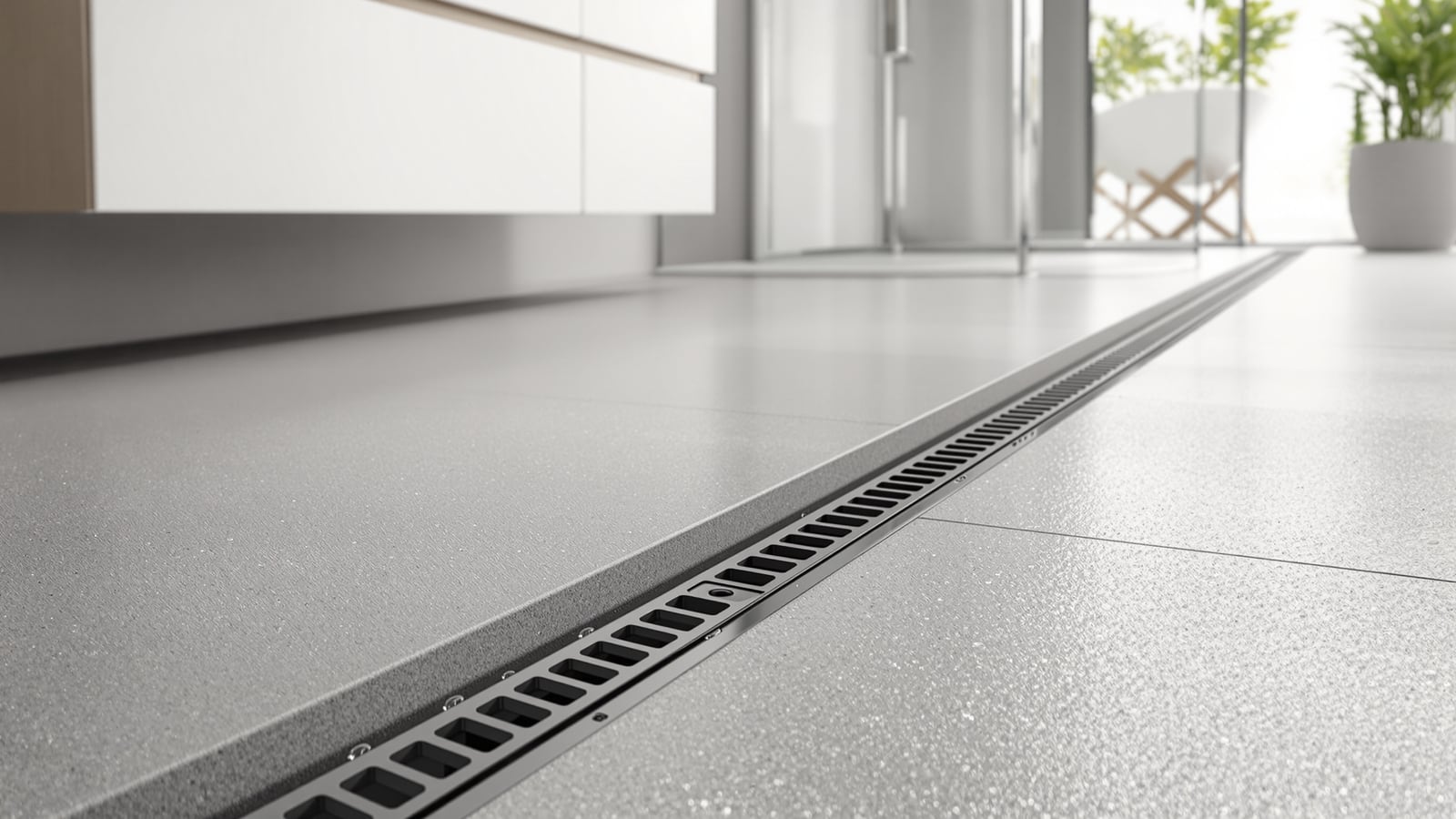
- Trap and grating: use a good floor trap or a linear channel drain at the wet-zone edge; linear drains let you slope in a single plane, which is easier with large tiles.
- Threshold: keep a small kerb or a gentle counter-slope at the door so water stays inside the wet area. In a barrier-free wet room, rely on a strong fall to a linear drain instead of a step.
- Set slope before tiling, in the screed. The fall is built into the sloped screed under the tiles, tied into the waterproofing. Trying to "correct" a flat screed with tile adhesive alone never works.
Matching floor to room type
- Master / ensuite: anti-skid vitrified across the floor, mosaic or flamed granite in the shower. See the Bathroom Design Guide.
- Common / family bathroom: durable anti-skid vitrified everywhere; it takes the most abuse.
- Powder room (dry): here you can indulge — vinyl LVT, honed marble or a patterned matte tile, since there is no shower.
- Wet room: epoxy or mosaic laid to a strong fall toward a linear drain.
Installation and maintenance essentials
- Adhesive, not just mortar. Fix floor tiles with a cementitious tile adhesive over the waterproofed, sloped screed for a void-free bed that will not trap water.
- Grout matters. Use epoxy grout in wet zones — it does not absorb water, resists hard-water staining and stops mould at the joints far better than cement grout.
- Seal stone. Kota, granite, marble and slate need a penetrating sealer on install and re-sealing every 1–2 years in a wet bathroom.
- Clean gently. Skip strong acids on stone and epoxy; use a pH-neutral cleaner to protect the surface and preserve slip texture.
Get these four right — an anti-skid material, a proper fall to the drain, epoxy grout and sound waterproofing — and the floor will outlast almost everything else in the bathroom.
References
- National Building Code of India (NBC) 2016, Part 9 (Plumbing Services) — floor drainage, slopes and wet-area detailing.
- IS 15622: Pressed Ceramic Tiles — Specification — classification and water-absorption groups for floor tiles.
- IS 13630: Ceramic Tiles — Methods of Test — including slip resistance and abrasion testing.
- IS 1237: Cement Concrete Flooring Tiles — for terrazzo/mosaic and cement tile specifications.
- IS 1443: Code of Practice for Laying and Finishing of Cement Concrete Flooring Tiles — bedding and slope guidance.
- DIN 51097 / DIN 51130 — international barefoot (A/B/C) and shod (R9–R13) slip-resistance classifications referenced by tile makers.
Export this guide
Related Guides — Deep-dive reading
Anti Slip Flooring for Bathroom and Wet Areas in India: R-Ratings, Finishes and Genuinely Safe Tile Choices
How to choose genuinely safe flooring for bathrooms, kitchens, balconies, pools, entrances and elderly- or child-friendly homes — the R-rating system, finishes that grip wet feet, anti-skid natural stone, slope to drains and the tiles to avoid.
Flooring & SurfacesEpoxy Grout vs Cement Grout for Tiles in India: Which to Specify (2026)
A plain-English guide to tile grouts for Indian homes: what grout does, how cementitious grout compares with epoxy grout on cost, stain and water resistance, hygiene and durability, and exactly where each one belongs - kitchens, bathrooms, pools, dry rooms and more.
Building MaterialsFlooring Materials Explained: Every Type for Indian Homes (2026)
One scannable reference to every flooring material family — tiles, natural stone, wood, resilient and seamless — with look, durability, water resistance, ₹/sq ft cost band and where each suits Indian homes.
Flooring & SurfacesRelated Tools — Try Free
Child & Elder Home-Safety Audit
Room-by-room safety audit for households with children or seniors — 10 categories, 70+ checkpoints tagged by audience.
Safety AuditFlooring Cost Calculator
Estimate the all-in cost of a floor — material, laying, wastage, skirting and GST — by area and material.
Flooring CalculatorMonsoon-Readiness Checklist
Pre-rain home audit across 9 categories — terrace, drains, waterproofing, electrical, HVAC, pest, vehicles, documents.
Seasonal Audit