
Vitrified Tile Flooring in India: Types, Sizes, Cost & Buying Guide (2026)
India's most popular floor decoded — what vitrified really means, the four main types, sizes and finishes, ₹/sq ft costs, laying methods and how it stacks up against ceramic and stone.
Walk into almost any new flat, villa or builder floor in India and the chances are you are standing on vitrified tile. It has quietly become the default floor of the country — and for good reason. It looks like polished stone, costs a fraction of marble, resists water and stains, survives a joint-family's worth of foot traffic, and wipes clean with a mop. But "vitrified tile" is not one product. It is a whole family with very different price tags, durability and finishes hiding behind the same word, and choosing badly is how people end up with a dull, scratched floor in three years. This guide decodes what vitrified actually means, the four main types and where each belongs, sizes and finishes, real 2026 ₹/sq ft costs, how it is laid, and how it compares to ceramic and stone.
What "vitrified" actually means
Vitrification is a manufacturing process, not a look. The tile body — a blend of clay, feldspar, silica and quartz — is pressed and then fired at very high temperature (around 1200°C). The silica and feldspar partially melt and fuse into a dense, glass-like (vitreous) mass. The result is a tile that is far less porous than ordinary ceramic.
The number that matters is water absorption. Under IS 15622 (the Indian Standard for pressed ceramic and vitrified tiles), tiles are sorted into groups by how much water they soak up. Genuine vitrified tile sits in group BIa — water absorption of 0.5% or less. Ceramic floor tile absorbs much more (typically 3-10%). That single property drives almost everything good about vitrified tile:
- Stain and water resistance — liquids sit on the surface instead of soaking in, so coffee, turmeric, oil and spills wipe away.
- Strength and low wear — the dense body resists chipping and the surface resists abrasion under heavy traffic.
- Dimensional accuracy — fired hard and rectified (machine-cut to exact size), so tiles can be laid with very thin, near-seamless joints.
- Frost and weather tolerance — low absorption means it copes with balconies and semi-covered areas better than ceramic.
So the rule of thumb: if a salesman says "vitrified," ask to see the water absorption figure on the box or test certificate. Under 0.5% is the real thing.
The four main types of vitrified tile
This is where most buyers get confused, because the price gap between the cheapest and the best vitrified tile is huge. Here are the four families you will be shown, from entry-level to premium, with links to the deeper guides on each.
1. Soluble salt / nano vitrified. The design and colour are printed onto the surface with soluble salts that penetrate only a thin top layer, then the tile is fired and polished (the "nano" version gets an extra surface treatment for shine and stain resistance). Cheapest and most common in budget projects. The catch: the pattern is shallow, so deep scratches or heavy polishing over the years can expose the lighter body beneath. Best for low-to-medium traffic rooms.
2. Double-charged vitrified. Two layers of pigment are fed into the press together, so the design penetrates roughly 3-4 mm into the body. Because the colour goes deep, minor surface wear does not reveal a different shade underneath — making it the workhorse choice for high-traffic Indian homes, lobbies, showrooms and joint families. Patterns are simpler (no fine photographic detail), but durability is excellent. See the deep dive: double-charged vitrified tiles.
3. Glazed vitrified (GVT) and polished glazed vitrified (PGVT). A digitally printed glaze layer is fused onto a vitrified body. This is the type that can mimic Italian marble, wood planks, concrete or fabric with stunning, photo-realistic detail — because the print is digital, design freedom is almost unlimited. GVT usually refers to the matte/textured-glaze versions; PGVT is the polished, mirror-gloss version. The trade-off is that the decorative layer is a glaze on top, so it is less scratch-tolerant than double-charged over decades — but the looks are unbeatable. Read more: GVT tiles, PGVT tiles, and the head-to-head GVT vs PGVT.
4. Full-body vitrified. The colour and composition run uniformly through the entire thickness — top to bottom is the same material. Chips and scratches are virtually invisible because there is no different layer to expose. This makes full-body the most durable (and usually the most expensive) option, favoured for commercial floors, industrial spaces and very heavy-traffic areas. Patterns are limited to solid and speckled looks.
Types at a glance — cost and feature comparison
Costs below are indicative material-only ₹/sq ft (2026, +18% GST; laying, adhesive, grout and skirting extra; varies by city and vendor). Use the tile quantity calculator to convert your room area into boxes and the flooring cost calculator for a full budget.
| Type | How the design sits | Design depth | Pattern range | Scratch tolerance | Best use | ₹/sq ft (material) |
|---|---|---|---|---|---|---|
| Soluble salt / nano | Printed thin surface layer | Shallow (top layer) | Limited | Low-medium | Bedrooms, low-traffic rooms, budget builds | 40-70 |
| Double-charged | Pigment pressed ~3-4 mm deep | Deep (into body) | Simple geometrics/speckle | High | Living rooms, lobbies, joint-family high traffic | 45-90 |
| GVT (matte/textured glaze) | Digital print under fused glaze | Surface glaze | Very wide (marble, wood, stone) | Medium | Living/bedrooms, accent floors, walls | 50-120 |
| PGVT (polished glaze) | Digital print, polished glaze | Surface glaze | Very wide, high-gloss | Medium | Living rooms, formal spaces wanting marble look | 60-150 |
| Full-body | Colour runs full thickness | Through-body | Solid/speckle only | Very high | Commercial, industrial, heaviest traffic | 80-200+ |
Sizes, finishes and where to use them
Sizes (mm). The Indian default is 600x600 (24x24 inch) — economical, fast to lay, suits most rooms. 800x800 has become the aspirational standard for living rooms and larger flats because fewer joints read as more premium and seamless. 600x1200 rectangles and large-format 800x1600 / 1200x1200 slabs deliver a true marble-slab look but need a perfectly flat screed, an experienced layer and tile adhesive (not a sand-cement bed) to avoid hollowness and lippage. Always order 5-10% extra for wastage (more for diagonal layouts).
Finishes.
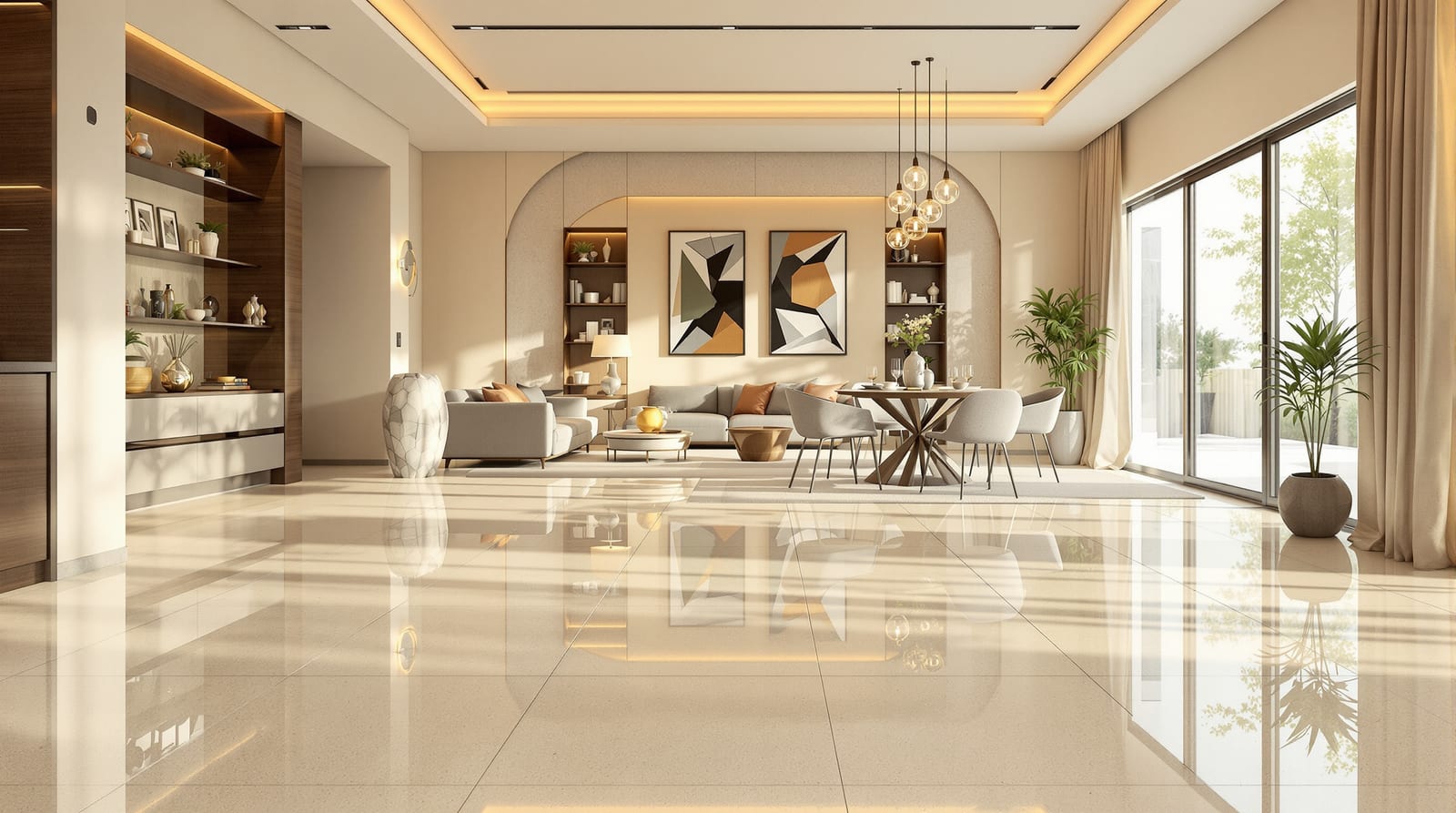
- Glossy / polished (PGVT): reflective, makes rooms feel bigger and brighter — the marble-look favourite. Shows scratches and footprints more, and is slippery when wet.
- Matte (GVT): soft, contemporary, hides smudges and minor scratches; safer underfoot than gloss.
- Anti-skid / textured: a deliberately rough or structured surface for grip. Essential for bathrooms, balconies, terraces, kitchens and coastal/wet areas. Look for slip ratings — R10 or higher (DIN 51130), R11+ for outdoor and bathrooms. This is a safety issue, not a style one, in joint families with children and elders.
Where to use what: glossy PGVT for the living room and formal areas; matte GVT or double-charged for bedrooms and passages; anti-skid (vitrified or porcelain) for every wet area, balcony and terrace; full-body or double-charged for any space that takes a beating. For room-by-room logic see living room flooring, bedroom flooring, kitchen flooring, bathroom flooring and balcony flooring.
Laying: adhesive vs cement-sand
How vitrified tile is fixed matters as much as the tile itself — most "hollow," cracking or popping tile complaints are laying failures, not tile failures.
Traditional cement-sand bed. Tiles are laid on a thick (20-40 mm) mortar bed of cement and sand, often with a slurry/neat-cement coat. It is cheaper on materials and still common, but for large-format and rectified vitrified tiles it risks hollow spots and lippage if the bed is uneven, because big dense tiles do not key well into thick mortar.
Tile adhesive (thin-bed). A polymer-modified adhesive is combed onto a level screed at 3-4 mm and the tile pressed in. It gives full contact (no hollows), stronger bond, faster work and is essential for 800x800 and larger formats and for tile-on-tile renovation. It costs more (₹12-30/sq ft of adhesive vs a sand-cement bed) but is the right call for any premium or large-format vitrified floor. A 20 kg adhesive bag covers roughly 30-40 sq ft at 3-4 mm — estimate yours with the tile adhesive calculator, and size your joint filler with the grout quantity calculator.
Indicative laying add-ons (₹/sq ft): labour 15-60 (more for large-format/diagonal); adhesive 12-30; plus grout, skirting and polishing extra. Budget the full installed cost, not just the box price.
Vitrified vs ceramic vs stone
Vitrified vs ceramic. Vitrified is denser, stronger and far less porous (BIa <=0.5% vs ceramic's higher absorption), so it wins for floors, wet zones and heavy traffic; ceramic is cheaper (₹30-80/sq ft) and fine for walls and low-traffic rooms but can crack or stain underfoot over time. Full comparison: ceramic tile flooring.
Vitrified vs granite. Granite (₹50-250/sq ft, premium higher) is natural, immensely hard and prized for kitchen platforms and stairs; vitrified offers more designs, easier large-format laying and a consistent finish with no natural variation or sealing. For the full trade-off — durability, joints, cost and resale — read granite vs vitrified tiles.
Vitrified vs marble. Marble (Indian ₹80-350, Italian ₹250-1,500+) is cool underfoot — a real advantage in India's hot months — and luxurious, but it stains, etches with acids and needs periodic polishing and sealing. PGVT marble-look vitrified delivers 80-90% of the look at a fraction of the cost and none of the upkeep. See marble vs vitrified tiles.
Quick verdict: for most Indian homes wanting low maintenance, durability and value, vitrified is the sensible default; reserve natural stone for where its character, coolness or hardness genuinely earns its cost and care.
Pros, cons and the brands to know
Pros: very low water absorption (stain/water resistant), high strength and abrasion resistance, huge design range (especially GVT/PGVT), consistent colour and size, easy mop-clean maintenance with no sealing, frost/weather tolerance for semi-open areas, and strong value per square foot.
Cons: glossy finishes are slippery when wet (always specify anti-skid for wet areas) and show scratches; large formats demand a flat screed, adhesive and skilled labour; soluble-salt grades can wear through their thin design layer; tiles can crack if laid hollow or over flexing subfloors; and a cold, hard surface underfoot in hill-station winters.
Brands. India's established names — Kajaria, Somany, Johnson (H&R Johnson), Nitco and Asian (Asian Granito) — all offer the full vitrified range from double-charged to GVT/PGVT and large-format slabs, with published IS 15622 conformity. Buy from a current dealer batch, insist on one batch / one shade lot for the whole order, and check the box for water absorption (BIa), size group and slip rating before you sign off.
Frequently asked questions
Is vitrified tile better than ceramic for flooring?
For floors, yes. Vitrified tile absorbs 0.5% water or less (IS 15622 group BIa) versus ceramic's higher porosity, so it is stronger, more stain- and water-resistant and better for heavy traffic and wet zones. Ceramic is cheaper and well suited to walls and low-traffic rooms.
Which type of vitrified tile is most durable?
Full-body vitrified is the most durable because the colour runs through the entire thickness, so chips and scratches barely show. For homes, double-charged is the practical durability champion — its design penetrates 3-4 mm, ideal for high-traffic, joint-family living. GVT/PGVT trade a little scratch tolerance for far richer designs.
Should vitrified tiles be laid with adhesive or cement-sand?
Use polymer-modified tile adhesive (thin-bed) for 800x800 and larger formats, polished tiles and tile-on-tile renovation — it gives full contact with no hollow spots. A traditional cement-sand bed costs less and is acceptable for smaller 600x600 tiles laid by skilled masons, but adhesive is the safer choice for premium floors.
Are glossy vitrified tiles slippery?
Yes, polished and PGVT tiles are slippery when wet, so they should not go in bathrooms, balconies or kitchens. For those areas choose anti-skid or matte (GVT) tiles with a slip rating of R10 or higher (R11+ outdoors). Reserve high-gloss for dry living and formal areas.
What is the cost of vitrified tile flooring in India?
As a 2026 indication, material-only ₹/sq ft runs roughly: soluble-salt/nano 40-70, double-charged 45-90, GVT/PGVT 50-150 and full-body 80-200+. Add 18% GST plus laying labour (₹15-60), adhesive (₹12-30), grout and skirting. Estimate your total with the Studio Matrx flooring cost and tile quantity calculators.
Export this guide
Related Guides — Deep-dive reading
Glazed Vitrified Tiles (GVT) for Indian Homes: HD Designs, Finishes & Cost (2026)
How GVT puts an HD printed glaze on a vitrified body to deliver marble, wood, stone and concrete looks double-charged tiles can't — with matte vs glossy, the wear-layer limit, sizes and ₹/sq ft.
Flooring & SurfacesCeramic Bathroom Tiles India: Water Absorption, Cost & Where They Suit (2026)
What ceramic tiles actually are (glazed earthenware), how water absorption groups under IS 13630 and IS 15622 decide where they belong, why they are the smart choice for bathroom walls and low-traffic floors, glazes, finishes, sizes, PEI ratings, rupee costs, and an honest comparison with porcelain and vitrified.
BathroomsEpoxy Grout vs Cement Grout for Tiles in India: Which to Specify (2026)
A plain-English guide to tile grouts for Indian homes: what grout does, how cementitious grout compares with epoxy grout on cost, stain and water resistance, hygiene and durability, and exactly where each one belongs - kitchens, bathrooms, pools, dry rooms and more.
Building MaterialsRelated Tools — Try Free
Flooring Cost Calculator
Estimate the all-in cost of a floor — material, laying, wastage, skirting and GST — by area and material.
Flooring CalculatorChild & Elder Home-Safety Audit
Room-by-room safety audit for households with children or seniors — 10 categories, 70+ checkpoints tagged by audience.
Safety AuditFull-Room BOQ — Living, Bedroom, Kitchen, Bath
Room-wise BOQ across living, bedrooms, kitchen, utility, and bathrooms with line-item pricing.
Full-Room BOQ