
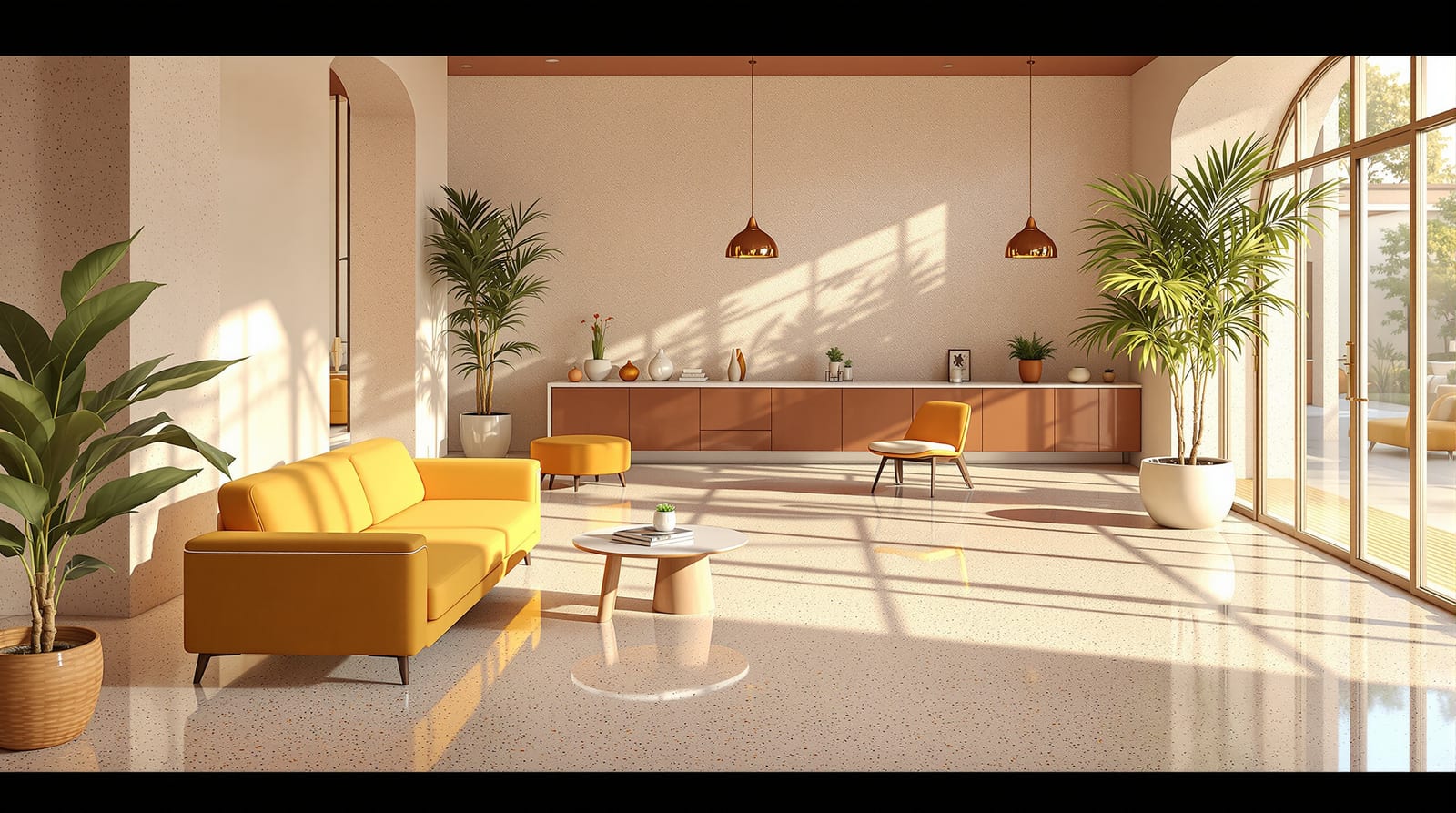
Terrazzo Flooring in India: In-Situ, Precast Tiles & the Modern Revival
The speckled chip-in-cement floor — from traditional poured mosaic and IS 1237 tiles to large-format terrazzo-look GVT and epoxy terrazzo.
Terrazzo is the floor your grandparents called "mosaic" or "chips flooring" — marble and granite chips scattered through a cement (or resin) matrix, then ground and polished until it gleams like a starlit slab. For decades it carpeted Indian schools, hospitals and middle-class homes because it was cheap, seamless and nearly indestructible. Then vitrified tiles arrived and terrazzo quietly disappeared. Now it is back: designers love its hand-made speckle and seamless freedom, and the market answers with everything from traditional poured floors to large-format terrazzo-look GVT. This guide untangles all of it for Indian homes.
What terrazzo actually is
At its heart terrazzo is a composite: a binder filled with stone chips. The binder is traditionally grey or white cement; the modern premium version uses epoxy resin. The chips are usually marble, but also granite, quartz, mother-of-pearl, recycled glass or coloured aggregate. Once the surface cures, it is mechanically ground flat to expose the chip faces, then progressively polished to a matte, satin or mirror finish.
That single idea produces wildly different products depending on how it is made:
- In-situ (poured / cast-in-place) terrazzo — mixed and laid wet on site over a screed, divided into panels by brass, aluminium or glass strips, cured, then ground and polished in place. Truly seamless, fully custom, the original "mosaic floor."
- Precast terrazzo / mosaic tiles — factory-made tiles to IS 1237 (cement concrete flooring tiles, including the terrazzo/chip variety). Laid like any tile, with grout joints. The 25 mm thick double-layer tiles you saw in old houses are this.
- Terrazzo-look GVT / PGVT — porcelain vitrified tiles digitally printed to imitate the speckle, then glazed or polished. Not real terrazzo at all — it is a tile pretending to be one. Cheap, fast, water-resistant.
- Epoxy terrazzo — chips set in pigmented epoxy resin, poured thin (6-12 mm) and seamless. Lightweight, vivid colours, very low porosity. The contemporary commercial and high-design choice.
Understanding which of these you are buying is the single most important decision, because they share a look but not a price, a process or a lifespan.
The look: speckled, seamless, endlessly customisable
Terrazzo's signature is the speckle — a controlled randomness no printed tile fully matches. Chip size sets the personality: fine chips (2-6 mm) read almost as a solid stone from across the room; large chips (10-25 mm, sometimes called "Venetian" or "palladiana" when broken marble offcuts are used) read as bold, chunky and architectural.
Because in-situ and epoxy terrazzo are poured, the design freedom is enormous:
- Seamless fields — no grout lines across a whole room, ideal for open-plan living and a calm, expansive feel.
- Brass / glass divider strips — thin metal strips set into the wet mix control cracking, divide colours and double as decoration. A brass strip framing a deep-green terrazzo panel is a hallmark of the modern revival.
- Colour zoning and inlays — borders, logos, room outlines and even custom motifs can be poured in different colours within the same continuous floor.
- Chip and base colour — white-cement bases with pastel chips for a soft Scandinavian look; charcoal bases with bright chips for drama.
This is where terrazzo beats almost everything: it is one of the very few floors you genuinely design rather than select from a catalogue.
Durability and the killer feature: re-polishability
A well-made cement terrazzo floor is one of the longest-lasting surfaces you can install — Italian terrazzo floors routinely survive a century. Because the chips are bedded deep through the wear layer (the full thickness in precast tiles, several millimetres in in-situ), there is no thin printed film to wear through. It is hard, dense, fire-resistant and, being monolithic, has no grout lines to crack or stain in in-situ form.
The standout advantage is re-polishability. When a terrazzo floor dulls, scratches or stains after years of use, you do not replace it — you grind off a wafer-thin layer and re-polish, and it looks new again. A real terrazzo floor can be refreshed several times over its life. No printed tile, laminate or vinyl can do this; in this respect terrazzo behaves like marble or granite.
The trade-offs to respect:
- Cement terrazzo is porous. It absorbs water and stains (oil, turmeric, wine, acids) unless sealed, and it etches with acidic spills like marble. Periodic sealing matters, especially in kitchens.
- It is hard and cold — pleasant in hot Indian summers (cool underfoot, like marble) but unforgiving to dropped crockery and to standing for long periods.
- In-situ floors can hairline-crack if the substrate moves or panels are too large — which is exactly why divider strips exist.
- Epoxy terrazzo flips the porosity problem: the resin matrix is near-impervious and highly stain-resistant, but it is softer than cement and can be scratched or scuffed; it is best indoors away from harsh UV.
For India's joint families and high-traffic homes, a sealed cement terrazzo or precast IS 1237 tile is genuinely heirloom-grade.
Where terrazzo suits an Indian home
| Space | Suitability | Notes |
|---|---|---|
| Living / dining | Excellent | Seamless in-situ or large precast tiles; cool, premium, design-forward |
| Bedrooms | Good | Cool underfoot; some prefer warmer wood-look here |
| Kitchen | Good if sealed | Seal against oil/turmeric; choose honed (anti-skid) finish |
| Bathrooms | Good (epoxy best) | Use anti-skid finish; epoxy terrazzo handles wet areas best; seal cement type |
| Balcony / verandah | Moderate | Use textured/honed cement terrazzo or precast; avoid high-gloss (slippery when wet) |
| Open terrace | Avoid epoxy | Cement terrazzo / IS 1237 tiles tolerate weather; epoxy degrades in UV |
| Staircases / passages | Excellent | Classic terrazzo stair treads; extremely durable, easy to keep clean |
| Coastal homes | Good | Salt-tolerant; seal well; pick anti-skid for humidity |
Terrazzo is at its best in main living areas where its seamless, designed look pays off, and in high-traffic circulation where durability and re-polishability earn their keep. For wet areas, lean on epoxy terrazzo or a honed anti-skid finish, and remember that NBC 2016 and the RPwD Harmonised Guidelines call for level, anti-slip surfaces and thresholds under about 12 mm — easy to meet with a seamless poured floor.
A Vastu note, framed as tradition plus practice: lighter terrazzo with white-cement bases and pale chips suits the north-east and east; reserve darker mixes for south and west zones. Practically, lighter floors also hide cement dust and brighten Indian interiors.
Cost: ₹ per square foot by terrazzo type
Costs below are indicative material rates, vary by city and vendor, and exclude 18% GST. In-situ and epoxy are installed systems, so their rates bundle labour, grinding and polishing; tile rates are material only (laying, adhesive/cement-sand bed, grout and skirting are extra).
| Terrazzo type | What you get | Typical look | Indicative ₹/sq ft |
|---|---|---|---|
| Precast terrazzo / mosaic tiles (IS 1237) | Factory tiles, laid like any tile | Classic chip, repeating | 60-200 (laid: + ₹30-80) |
| Terrazzo-look GVT / PGVT | Porcelain tile, printed speckle | Imitation, very uniform | 40-200 (per vitrified rates) |
| In-situ cement terrazzo | Poured, ground & polished on site | Truly seamless, custom | Highly variable; commonly ₹150-450+ installed |
| Epoxy terrazzo | Chips in resin, poured seamless | Vivid colour, fine speckle | Premium; commonly ₹300-900+ installed |
A few buyer notes:
- Precast IS 1237 tiles are the value sweet spot — real terrazzo durability at ₹60-200/sq ft plus laying, far below in-situ.
- In-situ terrazzo is labour-heavy. The grinding and multi-stage polishing dominate the cost and there is little of it left as a trade in many cities, so quotes swing widely; always get the full installed rate, not a "material" figure.
- Terrazzo-look GVT is the cheapest entry to the aesthetic — but it is a vitrified tile, not terrazzo, with no re-polishability. See our polished glazed vitrified tiles (PGVT) guide for what you actually get.
- For room totals, run numbers through the flooring cost calculator and tile quantity calculator, adding 5-10% wastage.
How it is laid, cured and ground (in-situ)
Knowing the sequence helps you supervise the work and judge a contractor.
1. Substrate and screed. A sound, level RCC slab gets a cement-sand levelling screed. Cleanliness and a true level here decide the final floor.
2. Divider strips. Brass, aluminium, glass or PVC strips are fixed in a grid (typically 0.6-1.2 m panels). They control shrinkage cracking and let you change colours.
3. Topping. A cement-and-marble-chip mix is poured into each panel, compacted and trowelled slightly proud of the strips. Pigment is added for coloured terrazzo. Modern systems may use a thinner high-strength topping.
4. Curing. The topping is kept damp and cured for several days — rushing this is the commonest cause of weak, dusting floors. Cement terrazzo needs patience that tile does not.
5. Grinding. Once hard, heavy floor grinders with progressively finer diamond pads cut the surface flat and expose the chip faces. The first pass reveals the speckle; later passes refine it.
6. Grouting voids & re-grind. Tiny pinholes exposed by grinding are filled with matching slurry, cured, and ground again for a dense, flawless face.
7. Polishing and sealing. Final fine pads bring the chosen sheen (matte/honed, satin or mirror), then a penetrating sealer protects the porous cement. This is the step that makes cement terrazzo stain-resistant.
The whole process spans one to two weeks of site time, which is why in-situ is reserved for projects that want the seamless, bespoke result. Precast tiles skip steps 3-7 — they arrive pre-ground and pre-polished and are simply laid, levelled and grouted.
Care and maintenance
Terrazzo is low-maintenance, not no-maintenance:
- Daily: dry dust-mop or soft broom, then damp-mop with a pH-neutral cleaner. Grit is the enemy of any polished floor.
- Avoid acids and harsh chemicals on cement terrazzo — no vinegar, no acidic toilet cleaners, no strong descalers. They etch the cement and dull the chips, exactly as they do on marble.
- Wipe spills fast — oil, turmeric, wine and citrus stain porous cement. Sealing buys you time but is not a force field.
- Re-seal cement terrazzo every 1-3 years (more often in kitchens) with a penetrating stone/cement sealer.
- Periodic buffing restores shine; a full re-grind-and-polish every decade or two makes a tired floor look brand new — terrazzo's superpower.
- Epoxy terrazzo needs no sealing and shrugs off stains, but avoid abrasive pads and very hot pans directly on the surface.
For more on how terrazzo sits among the alternatives, compare it with marble flooring (terrazzo is essentially marble's hard-wearing, seamless cousin) and the seamless resin look of microcement flooring. To see where the revival fits the wider market, read flooring trends in India for 2026.
Frequently asked questions
Is terrazzo the same as old "mosaic" or "chips" flooring?
Yes — what was sold for decades in India as mosaic or chips flooring is terrazzo: marble/granite chips in a cement matrix, ground and polished. The precast tile version is covered by IS 1237. The "modern terrazzo revival" is the same material reimagined with designer colours, brass dividers and epoxy or large-format alternatives.
Is terrazzo cheaper than marble?
The precast tile and terrazzo-look GVT versions are much cheaper than marble (₹60-200 and ₹40-200/sq ft respectively, material). In-situ and epoxy terrazzo are labour-intensive and can cost as much as or more than mid-range marble once installed. You are paying for the seamless, custom, re-polishable result rather than for a single natural stone slab.
Does terrazzo crack?
In-situ cement terrazzo can develop hairline cracks if the slab beneath moves or panels are too large — which is precisely why divider strips are laid in a grid to absorb shrinkage. A sound substrate, proper curing and correct panel sizes keep it stable for generations. Precast tiles and epoxy terrazzo rarely crack in normal use.
Is terrazzo slippery, and is it good for bathrooms?
Polished (high-gloss) terrazzo can be slippery when wet, so choose a honed or matte anti-skid finish for bathrooms, balconies and wet areas. Epoxy terrazzo is the best terrazzo choice for bathrooms because its resin matrix resists water and stains; seal cement terrazzo well if you use it in wet zones.
Can an old terrazzo floor be restored?
Almost always — and this is terrazzo's biggest advantage. A dull, scratched or stained cement terrazzo floor can be machine re-ground to remove a thin layer, then re-polished and re-sealed to look new. The same floor can be refreshed several times across its life, which is why genuine terrazzo lasts for decades.
Export this guide
Related Guides — Deep-dive reading
Flooring Materials Explained: Every Type for Indian Homes (2026)
One scannable reference to every flooring material family — tiles, natural stone, wood, resilient and seamless — with look, durability, water resistance, ₹/sq ft cost band and where each suits Indian homes.
Flooring & SurfacesHow to Choose Flooring for an Indian Home: A Step-by-Step Framework (2026)
A decision framework to pick the right floor for any room — weighing traffic, water, comfort, budget, maintenance, look, climate, durability and resale, with the key natural-stone vs tile vs wood vs resilient trade-offs.
Flooring & SurfacesComplete Home Flooring Guide for Indian Homes (2026)
The authoritative overview of every flooring family — tiles, stone, wood, vinyl and seamless — with India ₹/sq ft costs, room-by-room logic and laying basics.
Flooring & SurfacesRelated Tools — Try Free
Flooring Cost Calculator
Estimate the all-in cost of a floor — material, laying, wastage, skirting and GST — by area and material.
Flooring CalculatorFull-Room BOQ — Living, Bedroom, Kitchen, Bath
Room-wise BOQ across living, bedrooms, kitchen, utility, and bathrooms with line-item pricing.
Full-Room BOQHome Building & Interior Cost Calculator — 20 Cities
Construction + interior costs for 20 Indian cities across kitchen, wardrobes, flooring, painting, ceiling.
Cost Calculator