
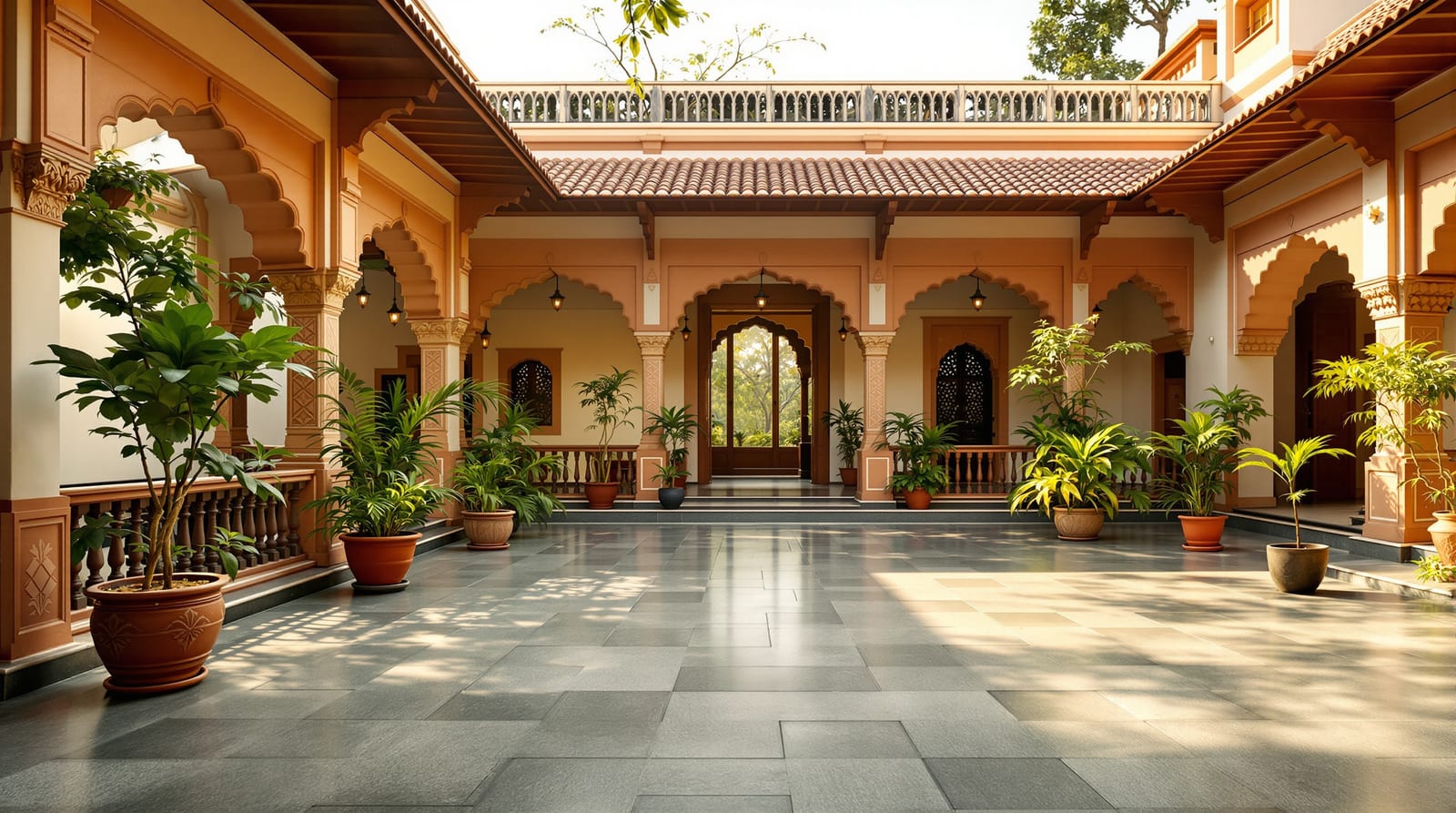
Kota Stone Flooring in India: Cost, Finishes, Laying & Maintenance
Why Rajasthan's tough, cool, anti-slip limestone is India's quiet workhorse floor — for kitchens, balconies, stairs, parking and courtyards.
If you have ever walked barefoot across a school verandah, a temple courtyard, a bank lobby or your grandmother's kitchen in India and felt a cool, dark, slightly matte stone underfoot, you have almost certainly met Kota stone. Quarried near Kota in Rajasthan, this fine-grained limestone is the country's quiet workhorse floor: very tough, naturally cool, anti-slip when honed, forgiving of dirt, and astonishingly cheap at roughly ₹30-70 per sq ft. It will never look as glamorous as Italian marble, but in the places that take a beating — kitchens, balconies, stairs, parking, courtyards and commercial floors — it often outlasts and out-earns its showier cousins.
What Kota stone actually is
Kota stone is a hard, fine-grained sedimentary limestone mined in the Kota and Jhalawar districts of Rajasthan. It is sold mostly as large tiles or slabs and is graded loosely by colour. The famous greenish-grey "Kota green" is the most common and the most popular; "Kota blue" (a deeper blue-grey) and "Kota brown" (warmer, less common) round out the family. Because it is a natural stone it carries subtle tonal variation, faint veining and the occasional shell or fossil mark — part of its honest, understated character rather than a defect.
What makes it a workhorse is the combination of properties you rarely get at this price:
- Very durable and hard-wearing — it shrugs off heavy foot traffic, dragged furniture and the chaos of a joint-family household.
- Anti-slip when honed — a honed (matte) finish gives genuine grip, which is why it dominates stairs, balconies, parking ramps and wet-prone zones.
- Cool underfoot — like most dense natural stone, it stays pleasantly cool through hot Indian summers.
- Hides dirt — the dark green/blue tones and matte surface mask everyday grime, scuffs and the inevitable foot marks far better than light marble or glossy vitrified.
- Genuinely cheap — material at ₹30-70 per sq ft makes it one of the lowest-cost natural stone floors available in India.
It is governed loosely under building-stone practice; for any natural dimension stone, look for IS 14223-style quality expectations (sound, dense, free of cracks) and ask your supplier for consistent thickness and machine-cut edges.
Where Kota stone earns its keep
Kota stone is not trying to be a drawing-room showpiece. Its sweet spot is the hard-use, value-driven, slightly utilitarian floor:
- Kitchens — tough, cool, hides spills and grime, and far cheaper than granite for a large floor (see our kitchen flooring guide at /guides/kitchen-flooring-india).
- Balconies and verandahs — honed Kota is anti-slip and weather-tolerant, a classic balcony pick (more options at /guides/balcony-flooring-india).
- Stairs — the grip of a honed finish plus the toughness of the stone make it a default for staircases; mirror-polished Kota on treads, by contrast, can be slippery, so reserve gloss for risers or low-traffic flights.
- Parking and driveways — rough or honed Kota handles vehicle loads and outdoor exposure where you would never put marble or wood.
- Courtyards and traditional homes — the matte green sits beautifully with red-oxide, IPS and old-world Indian architecture.
- Commercial floors — schools, offices, hospitals, banks and warehouses rely on it for cheap, repairable, low-maintenance flooring at scale.
It is one of the budget-durable natural stones (alongside Tandur) that Indian builders reach for when a floor has to be cheap and indestructible rather than luxurious.
Finishes: from rough to mirror
The single biggest decision with Kota stone is the finish, because it changes both the look and the slip behaviour completely.
| Finish | Look | Slip behaviour | Typical material ₹/sq ft | Best use |
|---|---|---|---|---|
| Rough / natural | Coarse, raw, fully matte | Very high grip | 30-40 | Parking, ramps, outdoor utility, driveways |
| Honed (matte) | Smooth but non-reflective, natural green/blue | High grip even when damp | 35-55 | Kitchens, balconies, stairs, courtyards, high-traffic |
| Polished | Soft sheen, deeper colour | Moderate grip dry, slippery wet | 45-65 | Living/passage areas, indoor dry zones |
| Mirror-polished | High gloss, reflective, richest colour | Low grip, slippery when wet | 55-70 | Indoor showpiece dry areas only; avoid wet zones and stairs |
The look therefore splits into two camps. Matte natural (rough/honed) reads as honest, earthy, traditional, and is what most people picture as "Kota floor" — it is also the safe, anti-slip, low-maintenance choice. Polished/mirror brings out a darker, richer green with a reflective sheen that can pass for a budget granite-like floor, but it shows scratches and water marks more readily and loses grip. For most Indian homes, honed is the intelligent default; save mirror polish for dry, indoor, low-traffic spaces where you want a bit of shine.
What it costs in India (2026)
Kota stone is one of the cheapest natural-stone floors you can lay. Indicative 2026 material rates, varying by city, vendor, colour, thickness and grade:
| Item | Indicative cost | Notes |
|---|---|---|
| Kota stone (material) | ₹30-70 / sq ft | Lower for rough/standard green; higher for select blue, thicker slabs, mirror polish |
| Laying labour | ₹25-60 / sq ft | More than tiles — stone is heavy, needs a thicker bed and careful levelling |
| Cement-sand bed | included in laying | Traditional thick-bed method is standard for stone |
| Grinding & polishing (site) | ₹20-50 / sq ft | If you buy rough and polish in place after laying |
| Sealing | ₹8-20 / sq ft | Penetrating sealer to cut porosity; optional but recommended |
| GST | +18% | On material and works as applicable |
All figures are indicative and vary by city and vendor. A fully laid, honed and sealed Kota floor commonly lands around ₹80-140 per sq ft installed — still well below most granite or quality vitrified installations. For a quick project estimate you can use our flooring cost calculator at /utilities/flooring-cost-calculator, and compare materials side by side with the flooring material comparison tool at /utilities/flooring-material-comparison.
How Kota stone is laid
Because Kota is a heavy natural stone, the traditional cement-sand thick bed is the norm rather than thin-set tile adhesive. A simplified section looks like this:
Practical pointers:
- Buy slightly oversized and consistent thickness — slabs vary, so insist on machine-cut, calibrated stone if you want fine, even joints.
- Lay tight, fine joints. Kota looks best with thin grout lines filled with cement or a matching slurry, not wide gaps.
- Decide polish timing. Many installers lay rough/sawn Kota and then grind and polish on site to a honed or polished finish, which gives a flat, seamless floor. Pre-polished slabs are faster but show lippage if levelling is sloppy.
- Plan slopes in wet zones. In balconies, bathrooms and courtyards, build a slight fall toward the drain.
- Allow wastage — add about 5-10% for cutting, edges and breakage; heavy slabs do crack if mishandled.
Sealing and porosity
The one real weakness of Kota stone is porosity. Being a limestone, it can absorb water, oil and stains if left bare, and acidic spills (lime, citrus, harsh acidic cleaners) can etch or dull the surface. This is why sealing matters more here than with vitrified tile.
- Apply a penetrating (impregnating) sealer after laying and polishing, and re-seal every 1-3 years depending on traffic and exposure. This dramatically reduces absorption of water and oil.
- In kitchens and outdoor areas, sealing is strongly recommended; a sealed honed floor resists kitchen grease and monsoon moisture far better.
- Avoid acidic cleaners. Never use acid-based or harsh bathroom cleaners on Kota; they etch the stone. Stick to a pH-neutral cleaner.
- Polishing recharges the look. A periodic machine polish restores sheen and removes scratches — one of Kota's best traits is that it is repairable, unlike a chipped tile.
Day-to-day maintenance
Kota is genuinely low-effort once sealed:
- Daily: sweep or dry mop to remove grit, then damp mop with a mild, pH-neutral cleaner.
- Wipe spills promptly, especially oil, wine, lime and citrus, to prevent staining or etching.
- Use felt pads under furniture and avoid dragging heavy items.
- Re-seal periodically; re-polish every few years to refresh dark green/blue floors that have gone slightly grey or scuffed.
- Its dark, matte tones forgive missed cleaning days far better than light marble or glossy floors — a real advantage in busy, high-traffic homes.
Kota vs granite vs Tandur
Buyers usually weigh Kota against two rivals: granite (the premium tough stone) and Tandur (its closest budget-stone cousin, a limestone quarried near Tandur in Telangana).
| Factor | Kota stone | Granite | Tandur stone |
|---|---|---|---|
| Material ₹/sq ft | 30-70 | 50-250 (premium 250-500) | 35-80 |
| Type | Limestone | Igneous, very hard | Limestone |
| Hardness / durability | High | Highest | High |
| Stain / acid resistance | Lower (needs sealing) | High | Lower (needs sealing) |
| Slip resistance | Excellent when honed | Good honed, slippery polished | Excellent when honed |
| Colours | Green, blue, brown | Wide range | Grey, blue, yellow tones |
| Look | Matte, earthy, utilitarian | Premium, speckled/veined | Similar to Kota, slightly varied |
| Best for | Kitchens, balconies, stairs, parking, commercial | Showpiece kitchens, high-end durable floors | Same niche as Kota; budget durable |
In short: granite wins on prestige, stain resistance and the sheer range of premium colours, and it is the choice when you want a tough floor that also looks rich — at a higher price. Deep-dive at /guides/granite-flooring-india and weigh it against tile in our granite-versus-vitrified comparison. Tandur is Kota's near-twin — another budget limestone with very similar economics and the same need for sealing; the choice often comes down to local availability and colour preference. Kota itself remains the default when you want maximum toughness and grip for minimum money, and you are happy with a matte, honest look.
For the bigger picture, see how Kota sits among all the options in our flooring materials explainer at /guides/flooring-materials-explained-india, and how it compares to the polished alternative most families consider for the same rooms in our marble flooring guide at /guides/marble-flooring-india.
Frequently asked questions
Is Kota stone good for kitchen flooring?
Yes — honed Kota is one of the best value kitchen floors in India. It is tough, cool, anti-slip and hides everyday grime, and it costs a fraction of granite for a large floor. Just seal it to resist oil and grease, and avoid acidic cleaners that can etch the surface.
Is polished or honed Kota better?
For most homes, honed (matte) is better. It gives genuine grip even when damp, hides scratches, and suits kitchens, balconies and stairs. Mirror-polished Kota looks richer and darker but becomes slippery when wet and shows scratches, so keep gloss to dry, indoor, low-traffic areas.
Does Kota stone need sealing?
Yes. Kota is a limestone and naturally porous, so it can absorb water, oil and stains. A penetrating sealer applied after laying and re-applied every one to three years sharply reduces porosity and staining, which is why sealing matters far more for Kota than for non-porous vitrified tile.
How much does Kota stone flooring cost in India?
Material is roughly ₹30-70 per sq ft in 2026, with laying labour around ₹25-60 per sq ft plus optional polishing and sealing. A fully laid, honed and sealed Kota floor commonly lands around ₹80-140 per sq ft installed — still well below most granite or quality vitrified floors. Figures are indicative and vary by city and vendor.
Kota stone or granite — which should I choose?
Choose granite if you want a premium look, the widest colour range and high stain resistance, and your budget allows ₹50-250 per sq ft or more. Choose Kota if you want maximum durability and anti-slip grip for minimum cost in hard-use areas like kitchens, balconies, stairs and parking, and you are happy with a matte, earthy finish.
Export this guide
Related Guides — Deep-dive reading
Limestone Flooring India: Honed Matte Stone, Colours, Cost and Care
The soft sedimentary stone family — beige, grey, blue and cream limestone with an elegant honed matte look, cool underfoot — plus its porosity, sealing needs, ₹/sq ft cost and where it suits Indian homes.
Flooring & SurfacesEpoxy Grout vs Cement Grout for Tiles in India: Which to Specify (2026)
A plain-English guide to tile grouts for Indian homes: what grout does, how cementitious grout compares with epoxy grout on cost, stain and water resistance, hygiene and durability, and exactly where each one belongs - kitchens, bathrooms, pools, dry rooms and more.
Building MaterialsVitrified Tile Maintenance: How to Care for Vitrified & PGVT Floors in India
Vitrified and PGVT tiles are India's most common, near maintenance-free floor; the real weak point is the cement grout, not the tile, so this guide shows the simple routine, post-construction haze and stain removal, and how to keep the gloss.
Flooring & SurfacesRelated Tools — Try Free
Flooring Cost Calculator
Estimate the all-in cost of a floor — material, laying, wastage, skirting and GST — by area and material.
Flooring CalculatorMarble Flooring Cost Calculator
Estimate installed marble-floor cost — material, laying, grinding and polishing, sealing, wastage and GST.
Flooring CalculatorApartment Furniture Size Chart
Standard furniture dimensions for Indian apartments — sofas, beds, tables, dining, storage.
Reference Chart