
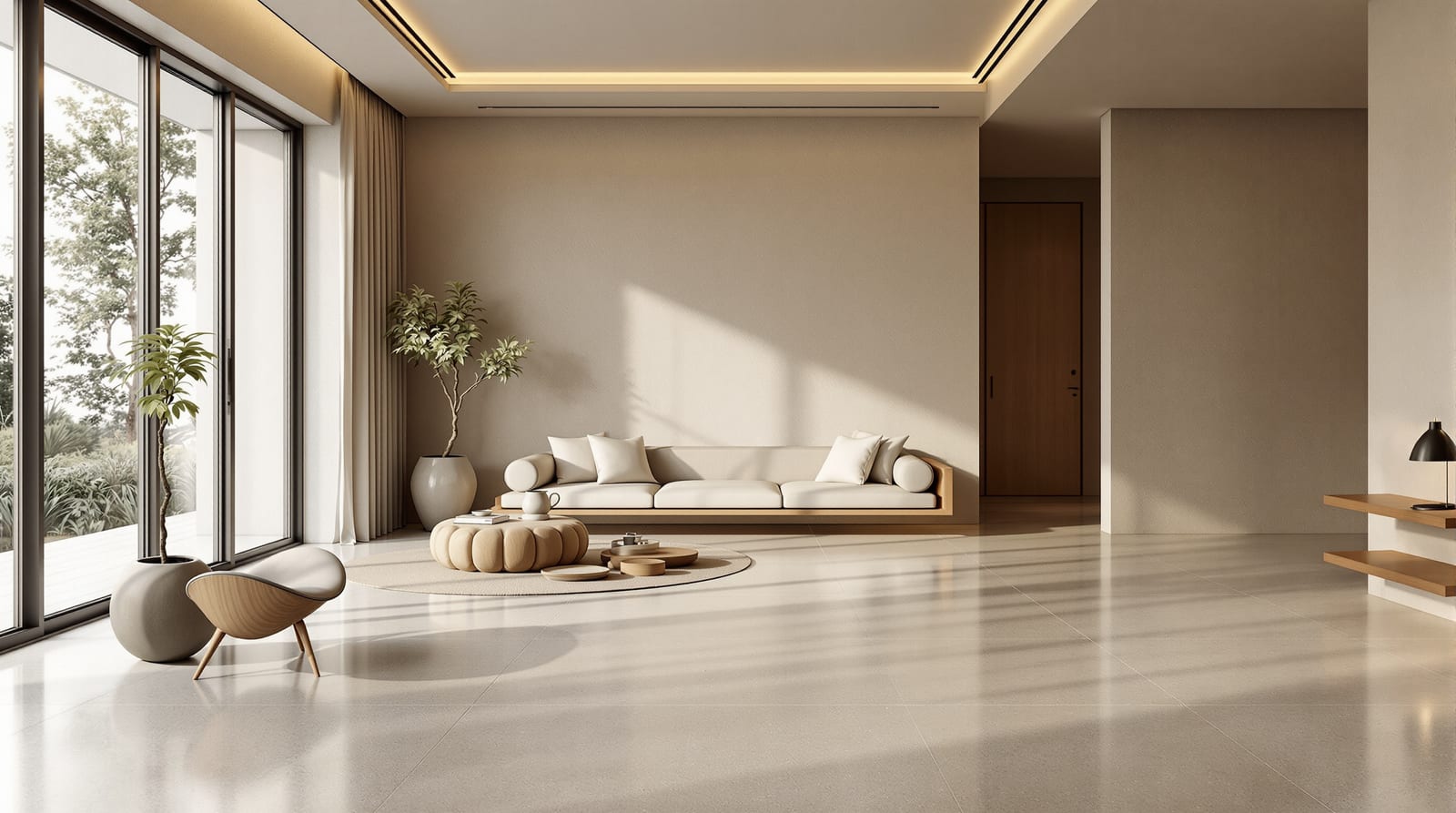
Microcement Flooring in India: The Seamless 2-3 mm Concrete Look
A thin, hand-applied cement-polymer coating that gives a jointless concrete or stone surface over your existing floors, tiles and walls — no demolition.
Microcement is the floor that arrived with India's love of minimalist, "quiet luxury" interiors: a seamless, joint-free surface with the warm grey, putty and earth tones of polished concrete, but only 2-3 mm thick and applied by hand like a plaster. Its real magic is that it can go straight over your existing tiles, marble, screed — even up the walls — with no demolition, no rubble and no raising of floor levels. That promise is genuine, but microcement is also one of the most applicator-dependent surfaces you can buy. This guide explains how it works, what it costs in India, where it shines, and the realities nobody mentions until the second coat.
What microcement actually is
Microcement (also sold as micro-concrete, microtopping, micro-screed or by brand names) is a factory-formulated blend of fine cement, graded mineral aggregates, mineral pigments and polymer resins. It is not poured concrete and it is not epoxy. It is a thin cementitious coating trowelled on in several wafer-thin layers over a prepared substrate, then sealed.
A few defining characteristics:
- Thin — total finished thickness is typically 2-3 mm across the whole build-up, so it adds almost nothing to floor level and rarely needs doors to be re-hung.
- Seamless — there are no grout joints. A whole room, and the skirting, and the wall, can read as one continuous surface.
- Polymer-modified — the acrylic or epoxy polymers give it flexibility and adhesion that plain cement render does not have, which is why it can bond to tiles and not simply pop off.
- Hand-finished — the cloudy, mottled, "troweled" character comes from the applicator's hand. No two floors are identical, which is part of the appeal and part of the risk.
Crucially, microcement is a finish, not a structure. It borrows all its strength and stability from the substrate underneath. If the floor below moves or cracks, the microcement on top will telegraph it.
The trend: why India wants seamless concrete
Microcement rides three waves at once. First, the global shift to minimalist, monolithic interiors — single-material rooms, hidden joints, warm neutral palettes — where a busy tile grid feels dated. Second, the wabi-sabi and "concrete chic" aesthetic that reads as understated and expensive. Third, and most Indian, the renovation reality: millions of homes already have perfectly sound but tired vitrified or ceramic tiles, and the idea of a contemporary makeover without breaking the floor is enormously attractive.
The colour story suits the moment too. Microcement comes in muted greys, taupes, putty, sand, terracotta and off-white earth tones that flatter wood, brass, linen and indoor plants — the staples of current Indian interiors. Because it flows seamlessly from floor to wall to a vanity or a kitchen counter face, designers use it to make small apartments feel larger and calmer.
Why people choose it (the genuine advantages)
- Goes over the old floor — over sound ceramic/vitrified tiles, marble, kota, terrazzo or a cement screed, no demolition. This saves the cost, dust, rubble disposal and three-week disruption of a tear-out. For occupied flats and rentals-turned-owned, this is the headline reason.
- No level rise — at 2-3 mm it does not create thresholds, does not bury skirting and almost never needs doors trimmed, unlike a new tile-on-tile bed (12-15 mm) or a fresh screed.
- Truly seamless — no joints to collect dirt, no grout to discolour. Easy to keep visually clean and a calm, expansive look.
- Waterproof when sealed — properly primed and sealed, microcement resists water, which is why it is used in walk-in showers, vanity walls and around basins. The seal is doing the waterproofing; the surface itself is not inherently impervious.
- Works on floors and walls — the same system wraps floors, walls, steps, niches and counters, giving the monolithic effect that tiles cannot.
- Design freedom — bespoke pigment colours, matte to satin sheen, and a hand-troweled texture you cannot get from a printed tile.
The realities (read this before you commit)
Microcement is a premium, labour-intensive, skill-dependent finish. The honest cautions:
- A skilled applicator is everything. This is not a tile-mason job. Layer thickness, trowel technique, drying time between coats and sealing all decide whether you get a gallery floor or a patchy, peeling disappointment. Insist on a trained installer with a portfolio and a sample.
- Hairline cracks are possible. Because it is a thin coating bonded to whatever is below, any movement in the substrate — a flexing tile, an expansion joint, a structural crack — can show through as a fine line. A reinforcing fibreglass mesh in the base coats reduces but does not eliminate this risk.
- It needs sealing — and re-sealing. The protective sealer (polyurethane or similar) is wearable. High-traffic floors typically want re-sealing every few years; the finish itself can last 10-15+ years if the seal is maintained. Skip maintenance and you get staining and wear.
- Not bulletproof. It resists everyday wear well, but it can scratch under grit and dragged furniture, and acidic spills (lemon, vinegar, harsh cleaners) can etch or dull a worn seal. Use felt pads and pH-neutral cleaners.
- Premium price for the labour, not the material. The bag of microcement is a fraction of the cost; you are paying for many hours of skilled, multi-coat handwork.
- Repairs are visible-ish. A damaged patch can be re-coated and blended, but because the finish is hand-mottled, a perfect invisible repair is hard. Plan to re-seal a whole area rather than spot-fix.
How it is applied (the layer build-up)
A typical microcement floor is built in roughly five stages over one to two weeks, including cure time:
1. Substrate prep. The existing tile/marble/screed is cleaned, degreased and de-glossed (sanding or mechanical abrasion) so the primer can grip. Loose tiles are fixed; major cracks and expansion joints are addressed first.
2. Primer. A bonding primer keyed to the substrate (different primers for absorbent screed vs glossy tile) is rolled on. This is the make-or-break adhesion layer.
3. Base coats with mesh. Two structural base coats are trowelled on, with a fibreglass reinforcing mesh embedded in the first to bridge micro-movement and tile joints. These build flatness and crack resistance, not the final look.
4. Finish coats. Two thin top coats deliver the colour, sheen and hand-troweled texture, sanded between coats for smoothness.
5. Sealing. After full cure, two to three coats of a penetrating + protective sealer (matte, satin or gloss) lock the surface, deliver the waterproofing and set the maintenance behaviour. Light foot traffic usually after 24-48 hours; heavy use and water exposure after the sealer fully cures (often ~7 days).
Microcement vs epoxy vs polished concrete
These three get confused because they all deliver a seamless, modern, hard surface — but they are very different products.
| Factor | Microcement | Epoxy floor | Polished concrete |
|---|---|---|---|
| What it is | Thin cement-polymer coating (2-3 mm) | Resin coating poured over concrete | The actual concrete slab/screed, ground & polished |
| Goes over old tiles? | Yes (over sound, prepped tiles/marble) | Possible with prep, less common in homes | No — needs a real slab |
| Thickness added | ~2-3 mm (no level rise) | ~1-3 mm typically | None (it is the slab) |
| Look | Warm, mottled, hand-troweled stone/concrete | Glossy, uniform, can be high-build/coloured | Industrial, aggregate exposed, polished |
| Walls too? | Yes (floors + walls + counters) | Floors mainly | No |
| Water/wet areas | Waterproof when sealed; good for baths | Excellent, very impervious | Needs sealing; porous if not |
| Feel | Matte, soft, "natural" | Plasticky/clinical gloss (matte options exist) | Hard, cool, raw |
| Crack risk | Hairline via substrate movement | Can chip/yellow under UV | Slab cracks, control joints visible |
| Cost (material) | High; labour-heavy | Mid-high | Mid (if slab exists) |
| Best for | Renovations, seamless modern homes, feature walls, baths | Garages, kitchens, commercial, wet utility | New builds, lofts, where the slab is the finish |
The short version: choose microcement when you want a warm, hand-made seamless look over an existing floor without demolition; epoxy when you want a tough, glossy, chemical-resistant industrial floor (see /guides/epoxy-flooring-india); and polished concrete when you have a real slab you want to expose. Microcement and terrazzo (/guides/terrazzo-flooring-india) both prize seamlessness, but terrazzo is chip-and-binder and far thicker.
What it costs in India (₹/sq ft)
Microcement is a premium finish and pricing is driven by labour and the brand system, not the bag of material. Treat these as indicative, varying by city, applicator skill and the system used; +18% GST typically applies.
| Item | Indicative ₹/sq ft | Notes |
|---|---|---|
| Microcement floor, supply + apply (basic system) | 250-450 | Standard colours, satin/matte seal |
| Premium / imported system, designer finish | 450-800 | Bespoke colour, multi-tone, walls, branded systems |
| Walls / vertical microcement | 250-600 | Often priced with floors as a package |
| Re-sealing (maintenance, later) | 30-90 | Every few years on busy floors |
| Substrate prep / crack repair | varies | If the existing floor needs fixing first |
For context against the wider market: ceramic tile sits at ₹30-80/sq ft material, vitrified ₹40-150, epoxy ₹80-300 and polished concrete ₹100-400 — so microcement at ₹250-800 (installed) is a genuine premium choice. You can estimate a project on the Studio Matrx /utilities/flooring-cost-calculator and compare options side by side with /utilities/flooring-material-comparison. For a fuller picture of the whole market, see /guides/flooring-materials-explained-india and the current /guides/flooring-trends-india-2026.
Where microcement suits Indian homes (and where it doesn't)
Good fits
- Modern, minimalist apartments and villas where a seamless monolithic look is the design goal.
- Renovations over sound tiles — the no-demolition makeover is microcement's strongest case in India's vast resale and second-hand-flat market.
- Feature areas — a TV/accent wall, a niche, a vanity, a kitchen island face, or one statement room rather than the whole house.
- Bathrooms and showers — popular and viable, but only with meticulous priming, mesh and high-quality sealing, ideally over a properly waterproofed and sloped substrate. Specify anti-slip texture/sealer for wet zones.
Be cautious or avoid
- Floors with active cracks or flexing tiles — fix the substrate or expect telegraphing.
- Very high-grit, very high-traffic commercial-style use — porcelain, granite or epoxy may wear better and cost less.
- DIY ambitions — this is not a weekend job; an unskilled hand shows immediately.
- Buyers who want zero maintenance and zero risk — granite or vitrified tiles are the lower-drama choice (see /guides/granite-flooring-india and /guides/vitrified-tile-flooring-india via the cluster).
Climate notes for India: microcement is dimensionally stable in heat and humidity (it is cement-based, not wood), which suits most of the country far better than solid timber. In coastal and heavy-monsoon homes the sealer must be in good condition to keep water and salt out; re-seal on schedule. For wet balconies and terraces exposed to sun and rain, a dedicated external system and anti-slip finish are essential — discuss exposure with your applicator.
Maintenance: keeping a microcement floor good
- Daily: sweep or dust-mop grit (grit is the main scratch risk), then damp-mop with a pH-neutral cleaner. No acids, no harsh chemicals, no abrasive scourers.
- Protect: felt pads under furniture, doormats at entries to trap grit, lift rather than drag heavy items.
- Spills: wipe promptly, especially acidic ones (lemon, vinegar, descalers, wine) which can etch a worn seal.
- Re-seal: the single most important task. Watch high-traffic paths for dulling and re-seal before the surface itself starts to wear — typically every few years on floors, less often on walls.
- Repairs: small chips and scratches can be re-coated and blended by the original applicator; plan to feather and re-seal a zone rather than spot-patch for an even look.
Done well and re-sealed on time, a microcement floor comfortably lasts 10-15 years or more. Done by an unskilled hand and neglected, it can disappoint within a couple of years — which is exactly why applicator choice matters more here than for almost any other floor.
Frequently asked questions
Can microcement really go over my existing tiles without breaking the floor?
Yes — that is its signature use in India. The existing tiles must be sound (no loose or hollow pieces), thoroughly cleaned and de-glossed, and primed with the correct bonding primer. A reinforcing mesh is embedded in the base coats so tile joints and minor movement do not telegraph through. If tiles are loose or the floor is cracking, those problems are fixed first.
Is microcement waterproof enough for an Indian bathroom?
It is water-resistant to waterproof when correctly primed, reinforced and sealed, which is why it is used in walk-in showers and on vanity walls. The sealer does the waterproofing, so quality of application and sealing is everything; ideally it goes over a properly waterproofed, sloped substrate, with an anti-slip finish in the shower zone. Re-seal on schedule to keep it watertight.
How much does microcement flooring cost in India?
Indicatively ₹250-450/sq ft installed for a standard system and ₹450-800/sq ft for premium or designer finishes and walls, plus 18% GST and any substrate repair. The cost is mostly skilled, multi-coat labour rather than material. Compare it on the Studio Matrx /utilities/flooring-cost-calculator against tiles, epoxy and stone.
Will it crack?
Hairline cracks are the main risk because microcement is a thin coating that depends entirely on the substrate. A stable, prepared base plus a fibreglass mesh in the base coats greatly reduces it, but no thin cement finish can guarantee zero hairlines if the floor below moves. Choosing a skilled applicator and fixing the substrate first are the best insurance.
Microcement or epoxy — which should I pick?
Pick microcement for a warm, matte, hand-troweled seamless look over an existing floor, including walls and feature areas, without demolition. Pick epoxy for a tougher, glossier, more chemical-resistant industrial floor in garages, utility kitchens or commercial spaces. See /guides/epoxy-flooring-india for the epoxy side, and /guides/flooring-materials-explained-india to weigh both against tiles and stone.
Export this guide
Related Guides — Deep-dive reading
Epoxy Grout vs Cement Grout for Tiles in India: Which to Specify (2026)
A plain-English guide to tile grouts for Indian homes: what grout does, how cementitious grout compares with epoxy grout on cost, stain and water resistance, hygiene and durability, and exactly where each one belongs - kitchens, bathrooms, pools, dry rooms and more.
Building MaterialsMicrocement Walls: The Complete Guide for Indian Homes
The thin, seamless cement skin that goes over almost anything — what microcement is, where it works including wet rooms, how it's applied by hand, the look and colours, and how it compares with tile.
Wall FinishesQuartz Bathroom Countertop India: Engineered Quartz Vanity Tops, Cost & vs Granite/Marble
A practical, India-first guide to engineered quartz vanity tops for bathrooms — why the non-porous, no-seal surface beats granite and marble on a wet counter, plus thickness, seams, heat caution, brand quality and honest ₹ per sq ft costs.
BathroomsRelated Tools — Try Free
Flooring Cost Calculator
Estimate the all-in cost of a floor — material, laying, wastage, skirting and GST — by area and material.
Flooring CalculatorBathroom Renovation Cost Calculator
Cost to renovate an existing bathroom with a replace-vs-keep model — demolition, re-waterproofing, tiles, fittings and the money saved by keeping items.
Bathroom CalculatorBathroom Waterproofing Calculator
Work out waterproofing material (kg/L) and cost for a bathroom by area, wall band, system type and coats — cementitious, acrylic, PU or SBR.
Bathroom Calculator