
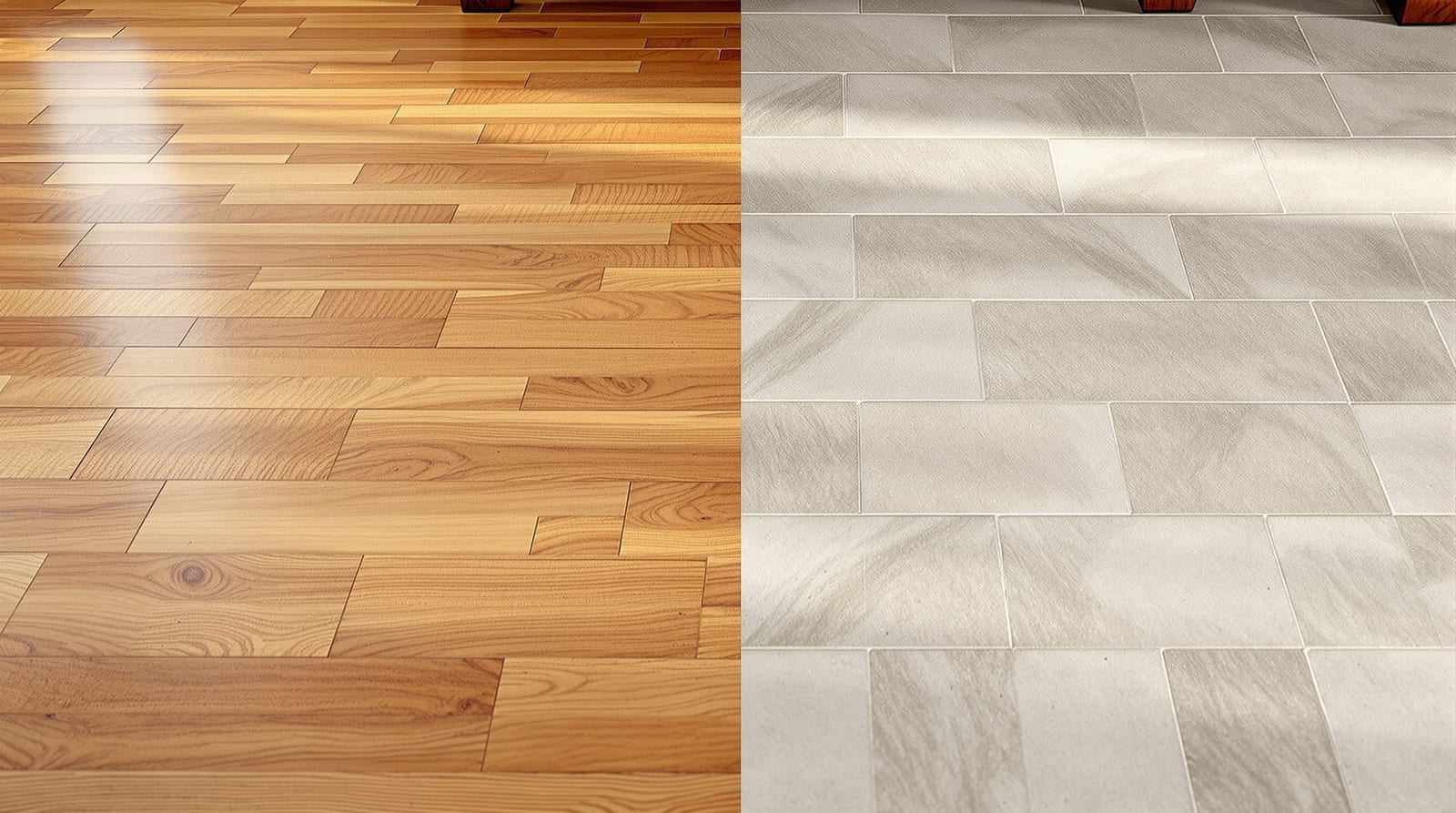
Wooden Flooring vs Tiles in India: Which Should You Choose?
Warmth and comfort against durability and water resistance — how to pick the right floor room by room for Indian homes, plus the wood-look-tile middle ground.
It is one of the first big decisions in any Indian home: the warm, cosy, premium feel of wood underfoot, or the cool, tough, wipe-clean practicality of tiles. Both are excellent floors — but they win in different rooms, different climates and different budgets. This guide settles the wooden flooring vs tiles question the way an experienced designer would: not "which is better" in the abstract, but which is right for each space in your home, and why the modern wood-look tile has quietly become the answer for many families.
The short version
If you want comfort, warmth and a high-end look, wood feels unbeatable underfoot — but it is fussy about water, humidity and rough use. If you want durability, water resistance and near-zero maintenance, tiles are the dependable Indian workhorse, especially given our monsoons, hard summers and joint-family traffic. And if you cannot decide, wood-look tiles (GVT/PGVT) and SPC planks give you the timber look with tile-grade toughness — the single most popular compromise in Indian homes in 2026.
There is no universally "correct" choice. The right floor depends on the room, your climate (coastal humidity behaves very differently from dry inland heat), how many people use the space, and how much upkeep you are willing to do.
Warmth, comfort and look
This is where wood wins emotionally. Real wood — whether solid hardwood or engineered wood — is naturally warm to the touch, soft and quiet underfoot, and reads as premium in any room. In bedrooms especially, stepping onto wood on a winter morning feels far nicer than stepping onto cold tile. Wood also flatters traditional and contemporary interiors alike, adding grain, depth and a sense of crafted quality that flat tile rarely matches.
Tiles, by contrast, feel cool and hard. In much of India that coolness is a feature, not a flaw — a polished vitrified or marble floor that stays cool through a 42 degC summer afternoon is genuinely pleasant. But the same floor is unforgiving on the feet over long hours, louder, and can feel clinical in a bedroom. Glossy tiles bounce light and feel spacious; matt and wood-look tiles soften that hardness visually, though not underfoot.
The honest summary: wood feels better; tiles look clean and stay cool. Which matters more depends on the room.
Durability and water — where tiles pull ahead
This is the heart of the Indian decision. Our climate is hard on floors: a four-month monsoon, coastal salt air, swing humidity, and homes where shoes, water and heavy use are constant.
- Tiles shrug off water. Vitrified tiles absorb under 0.5% water (IS 15622, group BIa), so they do not swell, warp or stain from spills, mopping or humidity. Porcelain and glazed vitrified tiles are equally indifferent to monsoon damp.
- Real wood fears water. Solid wood swells, cups and warps if it gets wet or sits in high humidity; engineered wood is more stable but still not for genuinely wet areas. Standing water near a kitchen sink or a bathroom doorway is the classic way to ruin a wood floor.
- Tiles resist scratches and dents. Drop a steel vessel and tile usually survives; wood dents and scratches, and a dragged sofa or pet claws will leave marks.
- High-traffic and joint families. For homes with kids, elders, daily visitors and constant footfall, tiles (and SPC) take the abuse far better.
Tiles do have a weakness — grout lines stain and need occasional cleaning, and gloss tiles can be slippery when wet, so always specify anti-skid (R10 or higher under DIN 51130) in bathrooms, balconies and coastal homes. But on the core question of surviving Indian conditions, tiles win decisively.
Maintenance and upkeep
Tiles are about as low-maintenance as flooring gets: sweep, mop, done. No sealing, no polishing, no special cleaners, no fear of water. A vitrified floor laid today will look the same in fifteen years with nothing more than routine cleaning.
Wood asks for more. It should be cleaned with a barely-damp mop (never wet), kept away from standing water, protected with felt pads under furniture, and re-coated or refinished periodically — solid wood can be sanded and re-polished several times over its life, while laminate and most engineered boards cannot be sanded and are simply replaced when worn. In humid and coastal cities, wood needs even more vigilance.
If "fit and forget" is your priority, tiles. If you are happy to baby a beautiful floor, wood rewards the care.
Comfort underfoot and sound
Two quieter factors that matter day to day:
- Underfoot comfort: wood, laminate and resilient floors like vinyl/SPC are softer and warmer than ceramic or stone, easier on the legs over long standing periods, and gentler if a child or elder falls.
- Sound: wood and resilient planks absorb sound and feel quieter; hard tile and stone reflect noise, so rooms can echo. Wood-look planks with a good underlay are the quietest of the lot.
Cost: wood vs tiles vs wood-look
Prices are material-only (add 18% GST, plus laying, adhesive/cement bed, grout and skirting), and are indicative — they vary by city, brand and grade.
| Criterion | Wooden flooring (real wood) | Tiles (vitrified/ceramic) | Wood-look tile / SPC (the middle ground) |
|---|---|---|---|
| Material cost (Rs/sq ft) | Engineered 180-700; laminate 80-250; solid hardwood 250-1,500 | Ceramic 30-80; vitrified GVT/PGVT 40-150 | Wood-look GVT 60-150; SPC plank 90-250 |
| Look and feel | Warmest, most premium, real grain | Clean, cool, modern; vast range | Convincing wood look, cool/hard like tile |
| Water resistance | Poor (solid) to fair (engineered) | Excellent (vitrified <0.5% absorption) | Excellent — tile is waterproof; SPC is water-resistant |
| Scratch / dent resistance | Low-moderate; dents and scratches | High | High |
| Maintenance | Higher — no wet mopping, periodic re-coat | Lowest — sweep and mop | Low — like tile (SPC slightly more care at joints) |
| Comfort underfoot | Soft, warm, quiet | Hard, cool, can echo | Hard like tile; SPC is warmer/quieter than tile |
| Indian climate fit | Best inland/dry, hill stations; risky coastal | Excellent everywhere, ideal wet/humid | Excellent everywhere — wood look without the worry |
| Best rooms | Bedrooms, living, study | Kitchen, bath, balcony, living, high-traffic | Anywhere you want wood look + durability |
| Lifespan | Solid 25+ yrs (refinishable); laminate 8-15 | 20-30+ yrs | Wood-look tile 20-30 yrs; SPC 15-25 yrs |
The takeaway: real wood costs the most and asks the most, tiles are the value-and-durability champion, and wood-look options bridge the two — wood aesthetics at tile-like robustness and often tile-like prices.
The modern middle ground: wood-look tiles and SPC
For a decade, families wanted the wood look but feared the wood. The market answered with two products that now dominate that demand:
- Wood-look vitrified tiles (GVT/PGVT): large planks (typically ~1200 x 190 mm) printed with realistic timber grain on a vitrified body. You get a genuine wood appearance with full tile benefits — waterproof, scratch-resistant, zero refinishing, laid with tile adhesive. The trade-off is that they still feel cool and hard underfoot like any tile.
- SPC flooring (Stone Plastic Composite): rigid click-lock planks with a wood-look top layer over a dense waterproof core. SPC is water-resistant, dimensionally stable in heat, warmer and quieter than tile, scratch-resistant and DIY-friendly. It is the closest thing to "wood that does not mind water," which is why it has become hugely popular for Indian bedrooms and living rooms.
If you love wood but live on the coast, have a busy household, or simply do not want maintenance, one of these two is almost certainly your answer.
How the three layers compare in section
A quick mental picture of what you are actually walking on:
The clear recommendation, room by room
Here is how a designer actually allocates floors across an Indian home:
| Room | Best pick | Why |
|---|---|---|
| Master and kids' bedrooms | Wood or SPC | Comfort, warmth, quiet; low water exposure. See bedroom flooring. |
| Living and dining | Vitrified / wood-look tile | Durability and easy cleaning for the busiest room; tiles or wood-look tiles for the premium feel. |
| Kitchen | Vitrified / anti-skid tile | Water, oil and heat demand a waterproof, wipe-clean, hard floor — never solid wood. |
| Bathrooms and balconies | Anti-skid vitrified / porcelain | Constant water; specify R10+ slip resistance for safety. |
| Study / home office | Wood or SPC | Warm, quiet, comfortable for long hours. |
| High-traffic / joint-family halls | Vitrified / granite / SPC | Maximum durability under heavy use. |
Coastal and high-humidity homes: lean towards tiles or SPC over real wood everywhere; salt air and damp are unkind to timber.
Hill stations and dry inland homes: real wood is at its happiest here, and is well worth it in bedrooms and living spaces.
For a whole-home plan that ties all these surfaces together, see the complete home flooring guide for India and how to choose flooring. To put rupee figures against your own area, the flooring cost calculator and wooden flooring cost calculator help quickly.
Frequently asked questions
Is wooden flooring or tiles better for Indian homes?
For most Indian homes, tiles (or wood-look tiles/SPC) are the more practical all-rounder because they handle the monsoon, humidity, water and heavy use that real wood struggles with. But real wood is wonderful in bedrooms and living rooms in dry or cooler climates where you value comfort over carefree maintenance. The smartest approach is to mix: wood or SPC in bedrooms, tiles in wet and high-traffic areas.
Is wooden flooring a bad idea in a humid or coastal city?
Solid wood is risky in genuinely humid or coastal conditions — it can swell, cup and warp. Engineered wood is more stable, and SPC is water-resistant and dimensionally steady, so if you want the wood look in such climates, choose SPC or wood-look vitrified tiles rather than solid timber.
Are wood-look tiles as good as real wood?
They look remarkably close and are far tougher — waterproof, scratch-resistant and maintenance-free. The one thing they cannot replicate is the warm, soft feel of real wood underfoot, since a tile body is always cool and hard. SPC sits in between: it looks like wood and feels warmer and quieter than tile while still resisting water.
Which is cheaper, wood or tiles?
Tiles are generally cheaper and far more durable rupee-for-rupee: ceramic from about Rs 30/sq ft and vitrified from about Rs 40/sq ft (material), versus laminate from about Rs 80, engineered wood from about Rs 180, and solid hardwood from Rs 250 upward. Wood-look tiles deliver the timber look at tile prices, which is a big part of their appeal.
Can I use real wood in the kitchen or bathroom?
It is not recommended. Kitchens and bathrooms have constant water, spills and humidity that ruin real wood. Use anti-skid vitrified or porcelain tiles in these rooms, and keep wood or SPC for bedrooms, living rooms and studies where water exposure is low.
Export this guide
Related Guides — Deep-dive reading
Best Bedroom Flooring in India: Warm, Quiet, Comfortable Choices
Bedrooms reward comfort over toughness — here is how to choose warm-underfoot, soft and quiet flooring for Indian homes, room by room, with 2026 costs and a Vastu note.
Flooring & SurfacesHow to Choose Flooring for an Indian Home: A Step-by-Step Framework (2026)
A decision framework to pick the right floor for any room — weighing traffic, water, comfort, budget, maintenance, look, climate, durability and resale, with the key natural-stone vs tile vs wood vs resilient trade-offs.
Flooring & SurfacesComplete Home Flooring Guide for Indian Homes (2026)
The authoritative overview of every flooring family — tiles, stone, wood, vinyl and seamless — with India ₹/sq ft costs, room-by-room logic and laying basics.
Flooring & SurfacesRelated Tools — Try Free
Flooring Cost Calculator
Estimate the all-in cost of a floor — material, laying, wastage, skirting and GST — by area and material.
Flooring CalculatorApartment Furniture Size Chart
Standard furniture dimensions for Indian apartments — sofas, beds, tables, dining, storage.
Reference ChartWooden Flooring Cost Calculator
Estimate installed wood or wood-look floor cost — solid, engineered, laminate or SPC — with underlay and skirting.
Flooring Calculator