
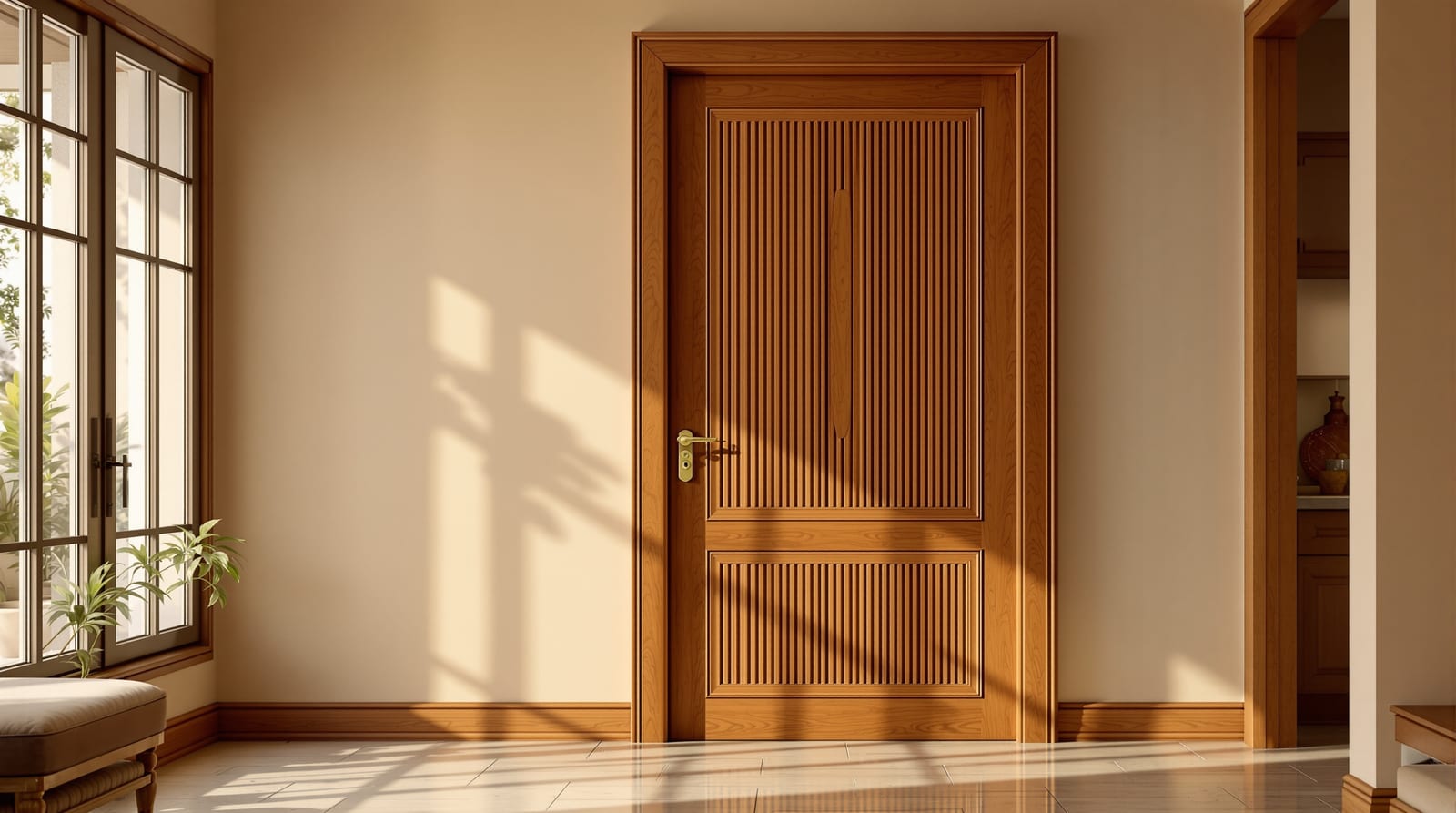
Wooden Door Designs for Indian Homes (2026): Styles, Patterns, Finishes & Costs
A design gallery of wooden door styles for Indian homes — traditional carved and panelled, classic 4/6-panel, modern flush wood, vertical-plank and slat, fluted, framed-glass, grooved CNC and minimalist — with grain-showing finishes, proportion tips and rough cost bands.
Wood is the material Indian homeowners trust most for a door — but the difference between a door that looks ordinary and one that makes visitors pause is almost never the timber. It is the design: the panel layout, the proportion of the leaf, the depth of the grooves, the way the grain runs and the finish that either hides the wood or celebrates it. This guide is a style gallery, not a material primer. If you still need to choose your timber, sealer or species, read wooden doors in India and teak wood doors first — here we assume you have the wood and want the design.
We will walk through ten wooden door design languages, where each one suits a main door versus an internal door, the finishes that show (or deliberately hide) the grain, and a few proportion rules that separate a designed door from a default one. Costs are indicative 2026 ranges for the leaf only — fitting, frame and hardware are extra and GST (18%) usually applies.
How to think about a wooden door design
Before the style, fix three decisions, because they shape everything that follows:
1. Where it sits — a main door carries the first impression and Vastu weight, so it can be heavier, taller and more ornamented. An internal door (bedroom, study, pooja) should feel quieter and read as part of the wall, not compete with the entrance.
2. Solid wood, engineered or veneered flush — a carved or deep-panelled look needs real timber or a thick engineered core; a clean flat look is cheaper and more stable as a flush door with a wood veneer. The design vocabulary overlaps but the construction differs (see panel doors).
3. Show the grain or paint over it — melamine, PU, oil and open-pore finishes keep the wood visible; a Duco (PU spray paint) or laminate finish hides it for a colour-led, modern look. Choose the design and finish together.
A simple proportion rule helps every style read well: most Indian main doors look best around 3.5 ft × 7 ft (1050 × 2100 mm), a leaf ratio close to 2:1 portrait. Internal doors at 3 ft × 7 ft read taller and more elegant than the older 6.5 ft height. Keep stiles (vertical edges) and the bottom rail visually heavier than the top rail — a door that is uniform all round looks flat.
Traditional carved and panelled wooden doors
The classic Indian heavy door: deep-relief carving on solid teak or sal, often with a temple-like crest, brass studs or a carved panel band. It signals heritage, craftsmanship and arrival, and pairs naturally with traditional Indian door detailing and Vastu thresholds (dehleez).
- Best for: main doors of bungalows, villas, ancestral homes, pooja entries.
- Finish: matte PU or oil over teak to keep the carving crisp; melamine for a softer sheen. Avoid high-gloss — it flattens deep carving.
- Proportion tip: keep carving to the upper two-thirds and a wide solid bottom rail; a fully carved leaf reads busy and is harder to clean of dust in the grooves.
This is a main door design statement and the most expensive route — full carved teak main doors run from roughly ₹25,000 well into ₹1,50,000+ depending on relief depth and species.
Classic 4-panel and 6-panel wooden doors
The most versatile wooden design in India: a frame of stiles and rails enclosing raised or recessed timber panels. A 4-panel reads formal and balanced; a 6-panel reads taller and more traditional; a 2-panel reads modern. Even panel counts are considered auspicious in Vastu for the main door — frame it as tradition plus a clean symmetry.
- Best for: both main and internal doors; the safe, timeless default.
- Finish: veneer-and-melamine for warmth, or Duco paint for a crisp colonial/cottage white.
- Proportion tip: make the two lower panels shorter and the upper panels taller for a "lift"; equal panels look static.
Panel doors in engineered or solid wood typically run ₹4,000-12,000 per shutter — see panel doors in India for construction detail.
Modern flush wooden doors
A flat, seamless leaf faced with wood veneer over a flush core — the design lives entirely in the grain and the finish, not in panels. This is the dominant look in modern apartments because it is stable, affordable and pairs with minimalist interiors.
- Best for: bedroom, study and most internal doors; budget main doors when faced with a tough veneer.
- Finish: book-matched veneer in melamine or PU; run the grain vertically for height. A continuous grain across a double leaf is a designer touch.
- Proportion tip: add one slim vertical groove or an inlay strip to break the blankness — a totally plain flush door can read like a cupboard shutter.
Vertical-plank and slat wooden doors
Narrow vertical boards or applied slats give a warm, architectural, resort-style look that has become very popular for 2026 Indian interiors. Slats can be tight (cladding feel) or spaced over a backing for rhythm and a hint of texture.
- Best for: main doors of contemporary homes, study/home-office doors, home office entries; pairs with stone and concrete facades.
- Finish: open-pore PU or oil to feel natural and matte; teak, walnut or thermally-treated ash veneers suit it.
- Proportion tip: keep slat width consistent and align the top/bottom plank reveal — uneven end slats look unfinished.
Fluted and reeded wooden doors
Half-round (reeded) or U-grooved (fluted) vertical profiles carved or applied across the leaf. It is the trend-led cousin of the plank door — softer, more tactile, and it catches light beautifully in a foyer.
- Best for: statement main doors, wardrobe and feature internal doors.
- Finish: PU matte in a single tone so the shadows do the work; fluting is wasted under high-gloss.
- Proportion tip: stop the fluting short of the lock stile to leave a clean band for the handle and hardware.
Framed-glass and half-glass wooden doors
A wooden frame holding a glass panel — full-height for glass-panel door designs or a top half-glass over a solid lower panel. It borrows light between rooms while keeping the warmth of a wood frame.
- Best for: balcony/balcony door, pooja and living-dining partitions, study doors; half-glass for front-room internal doors.
- Finish: match the frame finish to your other wooden doors; frosted, fluted or ribbed glass keeps privacy.
- Proportion tip: keep the glass within the upper two-thirds and a solid kick-panel below — glass to the floor scuffs and feels less private.
Grooved and CNC-patterned wooden doors
Geometric grooves, lattice (jali-style) cut-outs or CNC-routed patterns turn a flush leaf into art. A jali door lets air and filtered light through; a solid grooved pattern is purely decorative. This is how a modern wooden door gets personality without traditional carving.
- Best for: main doors of designer homes, pooja-room doors (jali for ventilation), feature internal doors.
- Finish: veneer with PU; two-tone (a two-tone groove in a contrast laminate) reads very current.
- Proportion tip: keep one dominant pattern; mixing several CNC motifs on one leaf looks cluttered.
Cottage, farmhouse and contemporary minimalist wood
Two ends of the same calm spectrum. Cottage/farmhouse uses Z-brace or board-and-batten boards, often painted (Duco) in muted greens, off-whites or charcoal for a relaxed, door colour-led look. Contemporary minimalist strips ornament to a tall, grain-led flush leaf with concealed hinges and a recessed pull — see minimalist door designs.
- Best for: farmhouses, hill homes and balcony doors (cottage); apartments and luxury interiors (minimalist).
- Finish: Duco paint for cottage colour; open-pore matte veneer for minimalist warmth.
- Proportion tip: in minimalist doors, go floor-to-near-ceiling and skip the architrave so the door reads as a plane in the wall.
Wooden door design styles compared
| Design style | The look | Best suited for | Rough leaf cost band (₹, indicative) |
|---|---|---|---|
| Traditional carved/panelled | Heritage, ornate, heavy | Villa/bungalow main door, pooja | 25,000 – 1,50,000+ |
| Classic 4/6-panel | Formal, timeless, symmetric | Any main or internal door | 4,000 – 12,000 |
| Modern flush (veneered) | Seamless, grain-led, calm | Bedroom/study, budget main | 4,000 – 9,000 |
| Vertical-plank / slat | Warm, resort, architectural | Contemporary main, study | 8,000 – 20,000 |
| Fluted / reeded | Tactile, light-catching | Statement main, feature internal | 9,000 – 22,000 |
| Framed-glass / half-glass | Light-sharing, airy | Balcony, living-dining, study | 5,000 – 15,000 |
| Grooved / CNC / jali | Geometric, designer | Designer main, pooja, feature | 8,000 – 25,000 |
| Cottage / farmhouse | Relaxed, painted, rustic | Farmhouse, hill home, balcony | 4,000 – 12,000 |
| Contemporary minimalist | Tall, frameless, hidden hardware | Apartment, luxury internal | 6,000 – 18,000 |
Costs are leaf-only and vary widely with species, veneer grade, carving depth and city; fitting (₹800-3,000/door), frame (chowkat) and hardware (₹1,500-8,000) are extra, plus ~18% GST. For a full breakdown see door cost in India 2026 and teak door cost.
Finishes that show (or hide) the grain
The same panel door looks completely different across finishes. Pick the finish for the effect you want on the grain:
| Finish | Grain | Sheen | Where it shines | Note |
|---|---|---|---|---|
| Melamine | Shows | Matte–satin | Veneered internal doors, budget | Economical, decent durability indoors |
| PU (polyurethane) | Shows | Matte to gloss | Main doors, premium veneer | Tougher, better for high-traffic & some weather |
| Oil / open-pore | Shows strongly | Very matte | Slat, fluted, natural teak | Feels raw and warm; needs periodic re-oiling |
| Duco (PU spray paint) | Hides | Matte–gloss colour | Cottage, two-tone, coloured doors | Colour-led; great for door colour ideas |
| Laminate | Hides (printed grain) | Varies | Budget flush doors | Cheapest; prints can mimic wood, see door laminate designs |
For Indian conditions, favour PU or a good exterior-grade finish on the main door (monsoon swelling, sun and, on the coast, salt are unforgiving), and keep delicate oil finishes for protected internal doors. A door that swells in the monsoon is usually a sealing/finish problem as much as a timber one.
A panelled wooden door elevation
The diagram below shows a classic 6-panel wooden main door drawn in portrait proportion (a ~2.1:1 leaf), with the parts named — useful when you brief a carpenter or factory.
Notice the bottom rail is the widest and the lower panels are shorter than the middle ones — that small asymmetry is what makes a panel door look intentional rather than gridded.
Matching the design to main door versus internal doors
A coherent home rarely uses the same wooden door everywhere. A common, well-resolved combination:
- Main door: the statement — carved, fluted, vertical-plank or grooved/CNC, in solid teak or a thick engineered leaf with PU. This is where budget concentrates (main door design).
- Bedroom and study: quieter flush veneer or a 2/4-panel, grain matched to the main door's tone.
- Pooja room: a jali/grooved wooden door for ventilation and ritual significance — see pooja room door.
- Bathroom/utility: wood look but moisture-resistant construction; many homes switch to WPC or FRP here while keeping a matching wood-grain finish.
Keep one or two timber tones across the home rather than five — a unified veneer family reads far more luxurious than a mix.
Frequently asked questions
Which wooden door design is best for the main door of an Indian home?
For most homes a carved/panelled, fluted or vertical-plank design in solid teak or a thick engineered leaf with a PU finish gives the best mix of impact and durability. Choose carving for traditional homes, fluting or planks for contemporary ones. Keep an even number of panels and a generous threshold for Vastu — see Vastu for the main door.
Solid wood or veneered flush — which design route is cheaper?
Veneered flush doors are cheaper and more dimensionally stable, and they suit modern flush, fluted-applique and grooved designs well. Deep carving and raised-panel looks really need solid or thick engineered timber, which costs more. Many homeowners use a veneered flush leaf internally and reserve solid wood for the main door.
What finish shows the wood grain best?
Open-pore oil and matte PU show the grain most naturally; melamine shows it with a slight sheen. Duco (spray paint) and laminate hide the grain entirely for a colour-led look. For main doors exposed to monsoon and sun, prefer a tough PU or exterior-grade finish over delicate oil.
Are wooden door designs more expensive than flush or WPC?
Generally yes for solid-wood and carved designs, which start around ₹10,000 and can exceed ₹1,00,000 for teak carving. Veneered flush wooden designs overlap with ordinary flush doors (₹4,000-9,000). WPC doors are cheaper still but offer a wood-look rather than real grain. Compare options in types of doors.
How do I keep a wooden door design from looking dated?
Favour clean proportions — a tall 7 ft leaf, a heavier bottom rail, and one dominant motif rather than many. Vertical planks, fluting and a single restrained tone age better than ornate gloss-finished carving in modern interiors. For the current direction, see door design trends 2026 and modern door designs.
Export this guide
Related Guides — Deep-dive reading
Minimalist Door Designs in India (2026): Flush, Frameless & Concealed-Frame Doors
The clean-line, no-architrave, hidden-hardware door language behind modern Indian apartments and designer interiors — flush-to-wall doors, concealed hinges, recessed pulls, tall leaves and what the look really costs.
Home Doors & EntrancesModern Door Design for Indian Homes: 9 Contemporary Looks That Still Work in the Monsoon
Minimalist flush-and-groove leaves, vertical and horizontal slats, flush-with-frame reveals, handle-less pulls, glass accents and statement pivots - the contemporary door styles that look right in a 2026 Indian home, and what each one costs and demands.
Home Doors & EntrancesMain Door Design Ideas for Indian Homes 2026: Styles, Proportions, Materials and Vastu
From traditional carved teak to modern minimalist and pivot statement entrances - how to design a main door that reads as grand, ages well in the Indian climate, and respects Vastu, with real 2026 costs.
Home Doors & EntrancesRelated Tools — Try Free
Door Cost Calculator
Estimate the all-in cost of a door — leaf, frame, hardware, fitting and GST — by type, material and size.
Door CalculatorCross-Ventilation Analyzer
Estimate airflow and air changes per hour (ACH) from room size, window areas, layout, and local wind — with NBC 2016 Part 8 compliance check.
Ventilation CalculatorDoor Laminate Finish Selector
Answer a few questions and get a recommended door laminate finish family — woodgrain, solid, textured, gloss or matte.
Design Selector