
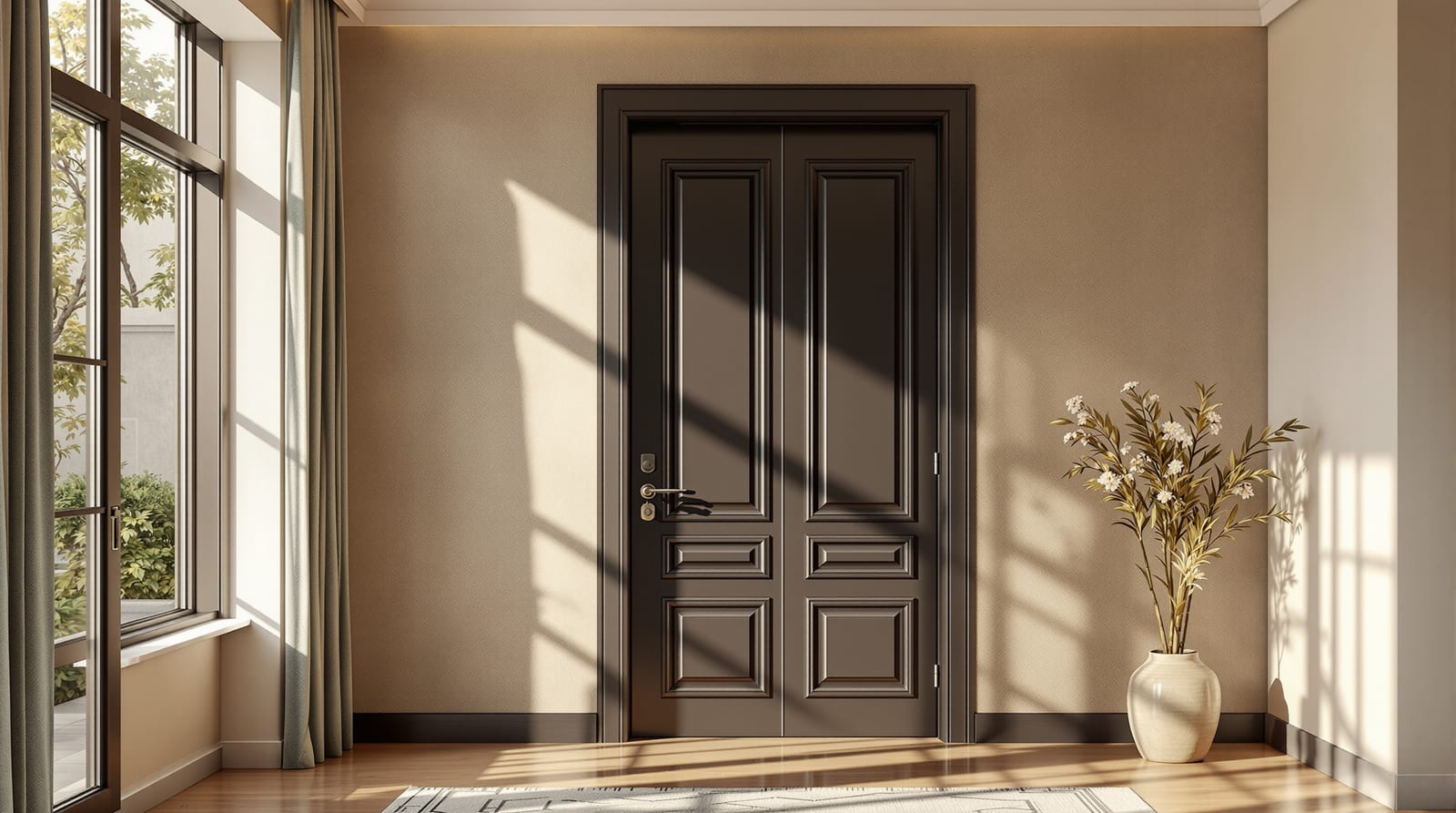
Door Design Trends 2026 in India: 13 Looks Reshaping Indian Homes
From floor-to-ceiling and concealed-frame doors to fluted surfaces, pivot entries, smart locks and biophilic jali screens — the door trends defining Indian homes in 2026, with costs and where to use each.
Doors have quietly become the most-photographed surface in the Indian home. In 2026 they are no longer the afterthought a builder fits last — they are statement pieces, sustainability signals and security gadgets all at once. Walk through any new Bengaluru apartment tower, a Pune villa or a renovated Chennai flat and you will see the same handful of moves repeating: taller leaves, flatter surfaces, moodier colours, hidden frames and hardware you can unlock from your phone. This guide rounds up the thirteen door trends genuinely defining Indian homes this year — what each one is, why it is rising here specifically, a rough cost implication, and exactly where to use it.
These are spokes off the bigger picture. For the foundations — sizes, materials, frames, fitting — start with the complete guide to home doors; this page is the trend-spotting layer on top.
The 2026 trends at a glance
The table below is the quick scan. Costs are indicative add-ons or finished-door ranges (material plus make; frame, hardware and ~18% GST extra) and vary by city, vendor and timber grade.
| # | Trend | The look | Cost impact (indicative) | Best placement |
|---|---|---|---|---|
| 1 | Floor-to-ceiling doors | Tall leaf 2.4-3.0 m, frame to slab | +30-60% over 7 ft (taller leaf, stiffer frame) | Main entry, living-to-balcony, master suite |
| 2 | Concealed-frame "invisible" doors | Flush-to-wall, no visible chowkat | ₹12,000-30,000+ per door (concealed system) | Living-room walls, study, plush bedrooms |
| 3 | Vertical fluting / reeded surfaces | Ribbed/grooved leaf, light-catching | +₹150-400/sq ft over plain | Main door, wardrobe-wall doors, bedroom |
| 4 | Statement pivot main doors | Wide oversized leaf on pivot hinge | ₹40,000-1,50,000+ finished | Main entrance only |
| 5 | Fluted / reeded glass | Textured privacy glass panels | +₹400-900/sq ft of glass | Study, pooja, balcony, bath (with frame) |
| 6 | Matte black & brushed-brass hardware | Black or warm-brass handles, hinges | ₹2,000-12,000 per set | Every door; brass on mains, black on internals |
| 7 | Deep moody colours | Forest green, charcoal, terracotta | +₹120-300/sq ft (PU/duco or membrane) | Main door, bedroom, study accents |
| 8 | Natural woodgrains | Recon teak/walnut veneer, warm tones | Veneer ₹4,000-9,000/shutter | Main door, living, bedrooms |
| 9 | Two-tone & mixed-material | Wood + metal, paint + veneer, stone inlay | +20-40% over single finish | Main door, feature internal doors |
| 10 | Smart locks as standard | Biometric/PIN/app lock on main door | ₹5,000-30,000 per lock | Main door, lock-up store, rental units |
| 11 | Biophilic jali / screen doors | CNC or carved perforated screens | ₹8,000-40,000+ per panel | Entry foyer, pooja, balcony, partitions |
| 12 | Sustainable materials | WPC, recon veneer, FSC-certified wood | WPC ~₹75-150/sq ft; FSC small premium | Wet areas (WPC), mains (FSC), all internals |
| 13 | Minimalist concealed handles | Edge-pull, push-to-open, recessed grip | ₹1,500-6,000 per door | Flush bedroom, wardrobe-wall, store doors |
The rest of this guide takes each one in turn.
1. Floor-to-ceiling doors
The single biggest shift in upper-segment Indian homes. Instead of a 7 ft (2100 mm) leaf with a wall and a transom panel above, the door runs the full slab-to-slab height — typically 2.4 m to 3.0 m. It reads as architecture, not joinery, and makes even a compact flat feel taller.
Why it is rising in India: floor heights in premium apartments and villas are creeping up to 3.0-3.3 m, and homeowners want the door to match rather than leaving a stubby panel above the frame. It pairs perfectly with the minimalist, gallery-wall aesthetic dominating Pinterest-driven 2026 interiors.
Cost implication: expect 30-60% more than a standard 7 ft door. A taller leaf needs a stiffer core (to resist warping over its length), heavier-duty hinges or a pivot, and a custom frame — this is not an off-the-shelf size. Engineered cores resist sag better than solid timber at this height.
Where to use: the main entrance, living-to-balcony openings, and master-suite doors. Avoid in low-ceiling builder flats where it just shrinks the room. See door size standards before committing to a non-standard height.
2. Concealed-frame "invisible" doors
A flush-to-wall door with a hidden aluminium frame and concealed hinges, so when closed and painted the same shade as the wall it nearly disappears. No visible chowkat, no architrave. The handle is often a minimal edge-pull or push-latch.
Why it is rising: the clean, seamless wall is the defining 2026 interior look, and concealed doors deliver it for studies, walk-in wardrobes and powder rooms. They also let a small room read as larger because the eye is not interrupted by a frame.
Cost implication: ₹12,000-30,000 and up per door for the concealed-frame system plus a flush shutter and finishing — meaningfully dearer than a conventional flush door because the aluminium kit, magnetic latch and skilled fitting carry the cost. Wall plaster and paint must be done after fitting.
Where to use: feature living-room walls, studies, dressing rooms and discreet utility access. Not ideal for high-traffic or wet doors. They pair naturally with minimalist door designs.
3. Vertical fluting and reeded surfaces
Fluting — closely spaced vertical grooves or half-round ribs across the leaf — is everywhere in 2026, on main doors, wardrobe-wall doors and feature internals. It catches light, adds quiet texture without colour, and photographs beautifully.
Why it is rising: it bridges minimalism and warmth — a flush door can feel flat, but fluting gives it depth while staying restrained. Indian factories now offer it in WPC, MDF and veneer, so it is no longer a bespoke carpentry job. CNC routing has made consistent fluting affordable.
Cost implication: roughly ₹150-400/sq ft over a plain finish, depending on whether it is routed MDF/WPC, applied PVC-membrane fluting or solid reeded timber. Membrane-pressed fluting on MDF is the budget route; solid teak reeding is the premium one.
Where to use: main doors, the run of doors on a wardrobe wall (for rhythm), bedrooms. In bathrooms use moisture-stable WPC fluting, not MDF.
4. Statement pivot main doors
A wide, often oversized leaf that rotates on a floor-and-ceiling pivot instead of side hinges. It feels grand, opens with a smooth swing, and is the headline move for villa and bungalow entrances in 2026.
Why it is rising: the pivot lets the leaf be much wider and heavier than a hinged door, which suits the tall, monolithic main door homeowners now want. It signals a designed home the moment a guest arrives.
Cost implication: ₹40,000 to ₹1,50,000+ finished, driven by the pivot mechanism (a quality concealed pivot hinge is a serious component), the oversized leaf and the premium finish — solid teak, fluted veneer or a metal-clad face. Floor-recessed pivots need to be set during flooring.
Where to use: the main entrance only — pivots are not for internal rooms. Get the swing arc and clearance right; our pivot doors guide covers the mechanism, and you can model clearance with the door swing planner. Note the Vastu preference for the main door to open inward and clockwise — flag this to your fabricator, and see Vastu for the main door.
5. Fluted and reeded glass
Textured glass — vertical fluting, reeding or ribbed patterns cast into the pane — is the 2026 alternative to plain frosted glass. It diffuses light and gives privacy while looking far richer than a sandblasted finish.
Why it is rising: it solves the Indian privacy-versus-light tension elegantly, especially in studies, pooja rooms and balcony doors where you want daylight but not a clear view. It coordinates with the same fluting motif appearing on solid doors.
Cost implication: roughly ₹400-900/sq ft of glass over plain float, depending on whether it is patterned rolled glass or toughened reeded glass (toughened to IS 2553 is wise for full-height panels and any door a child might run into).
Where to use: study and home-office doors, pooja-room shutters, balcony and partition doors. Pair with slim aluminium or wood frames. See glass doors and glass panel door designs.
6. Matte black and brushed-brass hardware
Hardware finishes have moved decisively away from shiny chrome. In 2026 the two dominant looks are matte black (graphite, satin black) and warm brushed brass / antique gold. Often a home will mix both — brass on the main door, black on internals.
Why it is rising: chrome reads dated against moody colours and natural woodgrains; black and brass complement them. Brass also nods to traditional Indian metalwork, so it bridges modern and heritage interiors.
Cost implication: a quality handle-and-hinge set runs ₹2,000-12,000 per door depending on brand and finish; PVD-coated black and lacquered brass cost a little more than plain chrome but resist tarnishing better. In coastal/humid cities insist on a proper coating or stainless base, or the finish pits. See the door hardware guide.
Where to use: brass mortise handles on the main door for warmth; matte-black levers and edge-pulls on internal and minimalist doors.
7. Deep, moody door colours
Forest green, charcoal/graphite, deep teal, oxblood and terracotta are the breakout door colours of 2026, replacing the safe browns and whites of the past decade. A single richly coloured door becomes the room's focal point.
Why it is rising: Indian homeowners are more confident with colour, and a painted main door is the lowest-risk way to make a bold statement — far cheaper than repainting a room. Terracotta and earthy greens also tie into the biophilic, natural mood dominating interiors.
Cost implication: a durable coloured finish — PU/duco paint or a coloured PVC membrane — adds roughly ₹120-300/sq ft over a clear finish. PU/duco gives the richest depth but needs skilled spraying; membrane is cheaper and more uniform on flat or fluted MDF/WPC.
Where to use: the main door (highest impact), a single bedroom door, study doors. Test the colour in your actual daylight first. For a full palette walk-through see door colour ideas.
8. Natural woodgrains making a comeback
Alongside the moody paints, real and recon woodgrain finishes are strongly back — warm walnut, smoked oak and teak tones, but now usually as reconstituted (recon) veneer rather than scarce solid timber.
Why it is rising: woodgrain brings the warmth that flat minimalism can lack, and recon veneer gives a consistent, sustainable grain at a fraction of solid-teak cost. It is the natural-materials half of the biophilic trend.
Cost implication: a veneered designer shutter runs ₹4,000-9,000; recon veneer is more uniform and often cheaper than natural veneer. Solid teak remains the luxury option at ₹800-1,500+/sq ft. See veneer doors and teak wood doors.
Where to use: main doors, living-room and bedroom doors. Pair a woodgrain main door with brass hardware for the signature 2026 entrance.
9. Two-tone and mixed-material doors
Single-finish doors are giving way to combinations: wood paired with black metal frames or inlays, a painted panel with a veneer band, or stone and brass accents set into a timber leaf. The two-tone main door — often dark wood with a contrasting vertical band — is a 2026 signature.
Why it is rising: mixing materials lets a door feel custom and layered without carving or ornament, which suits modern Indian taste. It also lets designers tie the door to the home's metal and stone palette.
Cost implication: typically 20-40% over a single-finish door, because of the extra fabrication, the metal/stone elements and more careful jointing. Mixed materials must expand and contract compatibly — a good fabricator detail isolates timber from metal to avoid splitting in the monsoon.
Where to use: the main door and one or two feature internal doors. Resist using it everywhere — its impact comes from being the exception. See two-tone door designs.
10. Smart locks as standard on main doors
What was a gadget two years ago is now a default spec on new main doors. Fingerprint, PIN, RFID-card and app/Bluetooth unlocking — often all in one lock — are increasingly chosen over a plain mortise lock for the primary entrance.
Why it is rising: rising security awareness, the convenience for joint families and frequent guests (no key copies to manage), and remote access for tenants, domestic help and delivery are all driving adoption. Indian brands and local availability (Godrej, Yale, Qubo, Hafele, Lavna) have matured.
Cost implication: budget ₹5,000-9,000, mid-range ₹10,000-17,000, premium ₹15,000-30,000. Factor door thickness and material — most smart locks suit solid or engineered leaves; check fitment on flush or glass doors. A mechanical key override and a backup power option matter in India.
Where to use: the main door first, then a lock-up store room or a rental unit's entry. Full detail in smart door locks; estimate with the smart-lock cost calculator.
11. Biophilic jali and screen doors
Perforated jali screens — CNC-cut or carved geometric and floral patterns — are surging as room dividers, foyer screens, pooja-room shutters and balcony doors. They filter light and air, throw beautiful shadow patterns, and connect to India's deep jali tradition.
Why it is rising: biophilic design (bringing nature, light and ventilation indoors) is the defining wellness trend of 2026, and the jali is its most authentically Indian expression. CNC routing has made intricate, repeatable patterns affordable in MDF, WPC and metal.
Cost implication: ₹8,000-40,000+ per panel depending on material, pattern density and whether it is CNC MDF/WPC, solid carved timber or laser-cut metal. Dense carving and solid teak push the top of the range.
Where to use: foyer and partition screens, pooja-room doors (a culturally resonant choice — see pooja room doors), balcony and ventilated utility doors. Full coverage in jali doors.
12. Sustainable materials going mainstream
Sustainability has shifted from a niche ask to a mainstream filter. The three materials defining the eco-conscious door in 2026 are WPC (wood-plastic composite, often partly recycled and termite/water-proof), reconstituted veneer (engineered from fast-growing wood to mimic scarce species), and FSC-certified solid wood from responsibly managed forests.
Why it is rising: awareness of deforestation and termite/monsoon failures of cheap timber, plus genuinely better-performing engineered products. WPC in particular has won Indian bathrooms and utilities outright because it shrugs off water and termites where MDF and ply fail.
Cost implication: WPC flush doors are economical at ~₹75-150/sq ft (≈ ₹2,000-4,500 per standard shutter). Recon veneer is comparable to or cheaper than natural veneer. FSC-certified solid wood carries a modest premium over uncertified timber but buys provenance. See WPC doors, engineered wood doors and the door materials comparison.
Where to use: WPC for all wet and humid areas (bath, utility, balcony), recon veneer and FSC wood for mains and bedrooms, engineered cores wherever you need stability at height.
13. Minimalist concealed handles
Bulky knobs and big lever handles are being replaced by edge-pulls, recessed finger grips and push-to-open (touch-latch) mechanisms. The leaf surface stays clean and uninterrupted.
Why it is rising: it completes the flush, seamless look that drives both concealed doors and the gallery-wall aesthetic. With smart locks handling the main door, internal doors no longer need a prominent handle at all.
Cost implication: ₹1,500-6,000 per door for quality edge-pulls or push-latch hardware. Push-to-open is convenient but needs a reliable mechanism — a cheap touch-latch that sticks is a daily annoyance, so buy a known brand.
Where to use: flush bedroom doors, wardrobe-wall door runs, store and utility doors. Keep a graspable handle (not just push-to-open) on at least one accessible route — see accessible doors for clear-width and operable-hardware guidance.
How to use these trends without overdoing it
Trends date fastest when stacked. A practical 2026 approach for an Indian home: pick one hero door — usually the main entry — and load it with two or three trends (say, a tall fluted pivot in forest green with brushed-brass hardware and a smart lock). Keep internal doors quiet and consistent (flush, woodgrain or one accent colour, minimalist handles) so the hero stands out. Match material to climate — WPC for wet areas, stable engineered cores at full height, proper hardware coatings in coastal cities — and you get a home that looks current and still performs through the monsoon. For the underlying decisions, lean on how to choose doors and modern door designs.
Frequently asked questions
Which 2026 door trend gives the biggest impact for the least money?
A bold colour on the main door. A durable PU/duco or membrane finish in forest green, charcoal or terracotta costs roughly ₹120-300/sq ft over a plain finish but completely transforms the entrance. Swapping shiny chrome hardware for matte black or brushed brass is the cheap second move.
Are floor-to-ceiling and pivot doors practical in a regular apartment?
A pivot main door needs space for its swing arc and a floor-recessed pivot, so it suits villas and larger flats more than compact builder units. Floor-to-ceiling doors only work where the ceiling is genuinely tall (3 m+); in a low-ceiling flat they shrink the room. Use the door swing planner and check size standards first.
Is WPC really good enough to be the "sustainable, trendy" choice?
For wet and humid areas, yes — WPC is water-proof and termite-proof, which solves the most common Indian door failure, and it takes fluting, colour and membrane finishes well. For the main door, many homeowners still prefer FSC-certified solid wood or recon veneer for warmth and gravitas. See WPC doors.
Will a smart lock work on my existing door?
Most smart locks fit solid and engineered leaves of standard thickness with a mortise cut-out; flush hollow-core and glass doors may need reinforcement or a specific model. Always confirm fitment, mechanical key override and battery-backup behaviour before buying. Detail in smart door locks.
How long will these trends stay current?
The structural moves — taller doors, concealed frames, sustainable materials and smart locks — are durable, function-led shifts likely to stay for years. The more decorative layers (specific colours, heavy fluting) move faster, so apply those where they are cheapest to change. Costs and product availability shift; treat the figures here as indicative and re-check with local vendors.
Export this guide
Related Guides — Deep-dive reading
Minimalist Door Designs in India (2026): Flush, Frameless & Concealed-Frame Doors
The clean-line, no-architrave, hidden-hardware door language behind modern Indian apartments and designer interiors — flush-to-wall doors, concealed hinges, recessed pulls, tall leaves and what the look really costs.
Home Doors & EntrancesWooden Door Designs for Indian Homes (2026): Styles, Patterns, Finishes & Costs
A design gallery of wooden door styles for Indian homes — traditional carved and panelled, classic 4/6-panel, modern flush wood, vertical-plank and slat, fluted, framed-glass, grooved CNC and minimalist — with grain-showing finishes, proportion tips and rough cost bands.
Home Doors & EntrancesGuest Room Door in India: Privacy, Quiet and Smart Picks Without Overspending (2026)
How to choose a guest bedroom door for an Indian home - privacy and acoustics so visitors feel comfortable, but budget-sensible for a room used only now and then: solid-core flush for quiet, panel or laminate for looks, the right privacy lock, simple soundproofing, and a finish that matches the rest of your doors - with picks ranked and indicative rupee costs.
Home Doors & EntrancesRelated Tools — Try Free
Cross-Ventilation Analyzer
Estimate airflow and air changes per hour (ACH) from room size, window areas, layout, and local wind — with NBC 2016 Part 8 compliance check.
Ventilation CalculatorDoor Cost Calculator
Estimate the all-in cost of a door — leaf, frame, hardware, fitting and GST — by type, material and size.
Door CalculatorDoor Material Comparison Tool
Compare 2–4 door materials on cost, durability, maintenance, security and moisture resistance.
Comparison Tool