
Door Laminate Designs for Indian Homes (2026): Finishes, Combinations & Room Ideas
A design-led guide to laminate door finishes — woodgrain, solid colour, textured, high-gloss, matte and stone-look — plus how to combine them room by room with 2026 trends.
A laminate door is the most common internal door in Indian homes — but two doors with identical plywood cores can look worlds apart depending on the laminate you specify. The finish is the design. This guide is purely about that design decision: which laminate finish families look best, how to combine them, and what to choose room by room. For what HPL laminate actually is — thickness, durability, edge-banding, cost per shutter and how it compares to veneer or membrane — read our companion guide on laminate doors in India. Here we assume you have already chosen laminate; now let us make it look good.
The six laminate finish families
Nearly every laminate catalogue in India — Greenlam, Merino, Century, Royale Touche, Sleek, Stylam, Advance — sorts into six visual families. Picking the right family for each room matters more than picking a brand.
| Laminate design family | The look | Best room(s) | Watch-outs |
|---|---|---|---|
| Natural woodgrain (teak, walnut, oak, wenge) | Warm, timeless, "real wood" feel | Main door face, living, bedroom, study | Cheap prints look flat; pick "synchronised" grain |
| Solid colours (white, greige, charcoal, olive, navy) | Clean, modern, architectural | Bedroom, kids' room, kitchen, accent doors | Plain colours show scuffs; matte hides better |
| Textured / synchronised | Grain you can feel (registered emboss) | Living, bedroom, premium internal doors | Costs more; needs matching edge-band |
| High-gloss (acrylic-look, mirror finish) | Glossy, luxe, reflective | Wardrobe-adjacent, modern living, kitchen | Shows fingerprints, dust, fine scratches |
| Matte / suede / soft-touch | Velvety, fingerprint-resistant, premium | Bedroom, master suite, minimalist homes | Slightly pricier; some grades mark with grease |
| Stone / marble / metal / fabric look | Statement, contemporary, designer | Pooja, main door insert, feature wall door | Use sparingly — too much reads "showroom" |
A useful rule for Indian interiors: woodgrain for warmth, solid colour for calm, gloss for drama, matte for luxury, stone-look for a single hero door. Most homes do best with one warm woodgrain family running through the public areas and a calmer solid or matte in the bedrooms.
Natural woodgrain — the safe default that still wins
Teak, walnut, oak and wenge prints remain the most-specified laminates in India because wood reads as both traditional and modern. The quality tell is synchronised (registered) embossing: the printed grain and the physical texture line up, so it feels like timber, not a photo. A 1 mm synchronised oak laminate on a flush door beats a thicker but flat-printed teak every time. For a genuine wood face instead of a print, our veneer doors guide explains when veneer is worth the premium — laminate gives you the look at a fraction of the cost and far better wipe-clean durability.
Solid colours — modern, but choose the sheen
Solid-colour laminates have overtaken loud woodgrains in newer Indian flats. Greige, putty, sage-olive and charcoal are the 2026 favourites; crisp white still rules wardrobe-adjacent and kitchen-side doors. The trap is sheen: a plain-colour high-gloss door looks stunning in the showroom and shows every fingerprint at home, while the same colour in matte/suede hides marks and feels more expensive. For a full palette discussion across paint, PU and laminate, see our door colour ideas for Indian homes.
How to combine laminates (where design actually happens)
A single flat laminate sheet is the budget option. The doors that look "designed" almost always combine two finishes or add a profile.
- Door face vs frame (chowkat). The simplest upgrade: a light woodgrain or solid-colour leaf against a dark frame, or vice versa. A white leaf in a wenge frame is a classic, low-cost contemporary look.
- Two-tone leaf. Split the leaf horizontally (lower third in a darker tone) or vertically, with a thin groove or PU strip as the divider line. This is the cleanest way to add interest without carving. See dedicated layouts in our two-tone door designs guide.
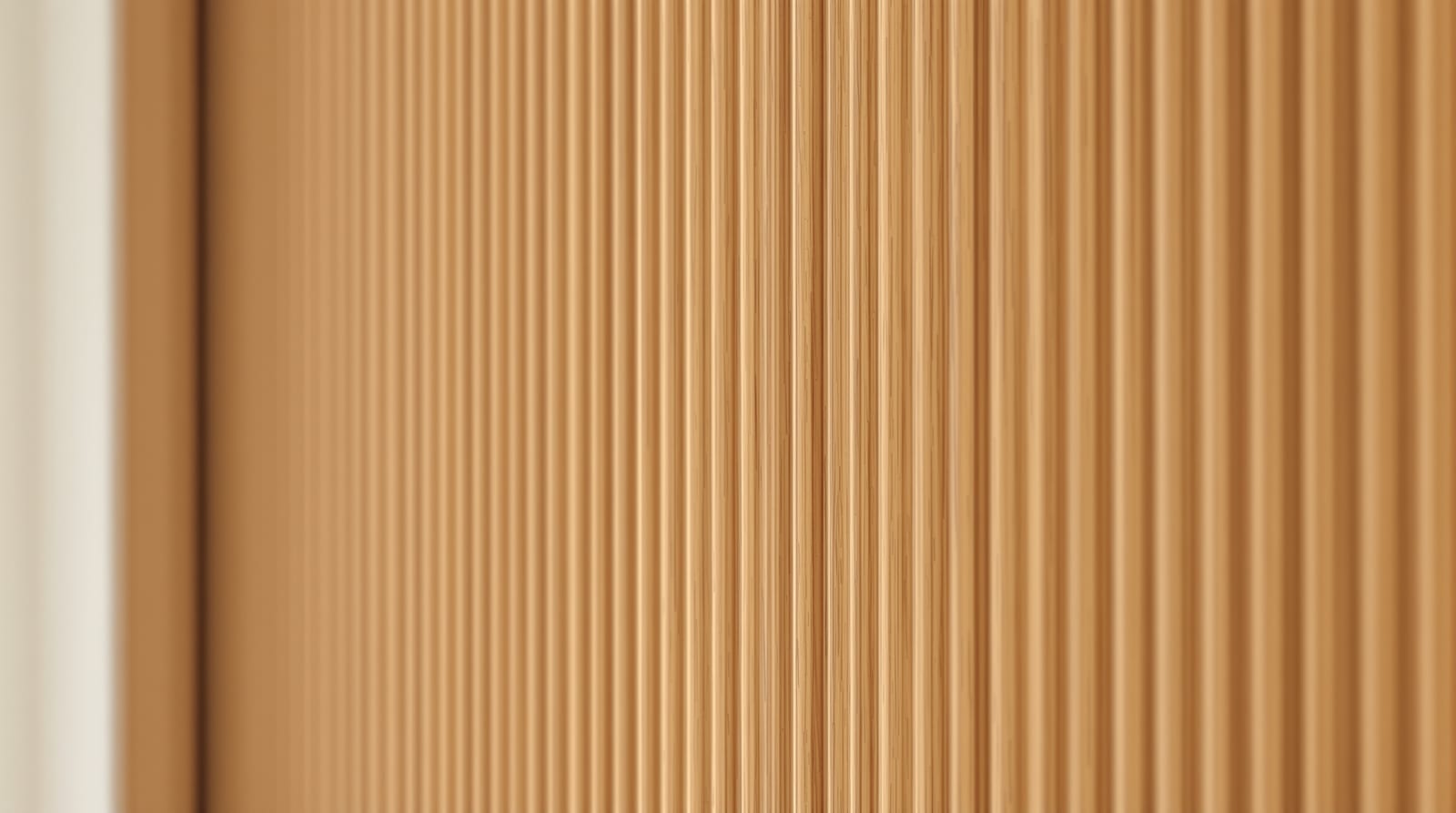
- Fluted / vertical-groove laminate. Routed grooves or factory-fluted panels faced in laminate give a ribbed, premium look that is very current — covered below in the SVG.
- Laminate + veneer/PU strip mix. A central woodgrain panel framed by a slim matte solid-colour border (or a brushed-metal PU strip) reads as a designer door at laminate cost.
- Inlay lines. A 6–12 mm metal or contrasting laminate inlay run vertically down the leaf is a quiet, modern detail that suits minimalist door designs and modern door designs.
When you combine finishes, the edge-banding must match the face — a 2 mm PVC lipping in the same décor (or a deliberate contrast band) is what separates factory-finished doors from a carpenter's mismatched edge. Always specify edge-band décor along with the face laminate.
A fluted laminate door face (portrait)
The fluted look — vertical grooves running the height of the leaf, faced in a single woodgrain or matte laminate — is one of the strongest 2026 internal-door designs in India. The diagram shows a typical groove rhythm on a 900 × 2100 mm leaf.
Fluting can be genuine routed grooves on the substrate or factory pre-fluted MDF/WPC panels faced in laminate. Keep groove spacing even (typically 18–25 mm) and run them full-height; partial flutes look unfinished. A matte or suede laminate over flutes reads more premium than gloss, which can over-shine in the grooves.
Choosing laminate design by room
Different rooms ask different things of a finish — durability, mood and cleanability all shift.
| Room | Recommended finish family | Why |
|---|---|---|
| Living / passage | Warm woodgrain or fluted matte | Sets the home's tone; hides daily traffic marks |
| Master bedroom | Matte / suede solid colour or soft woodgrain | Calm, luxurious, fingerprint-resistant |
| Kids' room | Solid colour matte (durable, washable) | Survives scuffs; cheerful without being loud |
| Kitchen-side door | High-gloss or solid laminate (wipe-clean) | Resists grease and steam; easy to clean |
| Bathroom | Solid colour laminate on WPC/FRP core | Avoid woodgrain prints near water; pair a moisture-proof core |
| Pooja room | Woodgrain or stone-look with a thin metal inlay | Warm and reverent; see the pooja-door design notes |
- Living and passage doors carry the most footfall and visual weight — make these your hero. A warm woodgrain or a fluted matte leaf here lifts the whole corridor.
- Bedrooms should feel restful: matte and suede laminates in muted solids or a soft oak read as luxury and hide fingerprints far better than gloss.
- Kitchen and bathroom doors are about cleanability and moisture, not just looks. Keep the leaf wipe-clean (gloss or a smooth solid), and if it is a bathroom, the laminate matters less than the core — pair the finish with a WPC or FRP substrate so swelling never undoes a pretty face.
For a fuller room-by-room walk-through across all door types, see our interior doors by room hub.
2026 design trends for laminate doors in India
- Fluted and reeded faces in matte woodgrain — the strongest single trend; works in both modern and transitional homes.
- Greige, putty and sage solids replacing high-contrast white-and-wenge; quieter, more European.
- Soft-touch / suede matte overtaking high-gloss in bedrooms for its fingerprint resistance and tactile feel.
- Slim brushed-metal or black inlay lines as a single vertical accent — a low-cost designer cue suited to modern door designs.
- Stone and travertine-look laminates on one feature or pooja door, not throughout.
- Frame-and-leaf contrast, e.g. a charcoal frame with a light-oak leaf, as a budget alternative to two-tone routing.
Whatever the trend, keep the whole-home story coherent: one warm family in the public spaces, calmer matte solids in the private rooms, and at most one statement door. For where laminate sits among veneer, paint, glass and carved options, see our modern door designs guide.
Frequently asked questions
Which laminate finish is best for an Indian bedroom door?
A matte or suede solid colour, or a soft woodgrain. Matte finishes resist fingerprints and feel more premium and restful than high-gloss, which shows every smudge in a low-light bedroom.
Is high-gloss laminate a good idea for doors?
It looks luxe and is easy to wipe, so it suits kitchen-side and modern living doors. The downside is that it shows fingerprints, dust and fine scratches clearly, so it is a poor choice for high-touch bedroom and kids' doors. Matte hides marks far better.
Should the laminate be the same on both faces of the door?
For internal doors that face two differently styled rooms, you can use different décors on each face — for example a passage-side woodgrain and a bedroom-side solid colour. This "double-side" approach costs little extra and lets each room keep its palette. Just confirm the carpenter matches the correct edge-band to each face.
Does the edge-banding really need to match the laminate?
Yes — mismatched edges are the single biggest giveaway of a budget job. Specify a 2 mm PVC edge-band in the same décor as the face (or a deliberate contrast band as a design choice). Factory-pressed doors come edge-banded; if a local carpenter laminates on site, insist on proper lipping, not exposed plywood edges.
Can I get a fluted or carved look in laminate, or do I need veneer or solid wood?
You can. Fluting is created with routed grooves or pre-fluted panels faced in laminate, and carving-style relief can be achieved with profiled MDF substrates. Laminate gives you the look at a fraction of veneer or solid-wood cost, with better wipe-clean durability — though for a true carved heirloom main door, solid timber still wins. See our carved door designs for that route.
Export this guide
Related Guides — Deep-dive reading
Two-Tone Door Designs in India (2026): Dual-Finish Doors, Combinations & How to Choose
The trending dual-finish look — how to combine two colours, materials or finishes on one door, the best Indian combinations, split rules and how to execute it in laminate, veneer or PU.
Home Doors & EntrancesModern Door Design for Indian Homes: 9 Contemporary Looks That Still Work in the Monsoon
Minimalist flush-and-groove leaves, vertical and horizontal slats, flush-with-frame reveals, handle-less pulls, glass accents and statement pivots - the contemporary door styles that look right in a 2026 Indian home, and what each one costs and demands.
Home Doors & EntrancesWooden Door Designs for Indian Homes (2026): Styles, Patterns, Finishes & Costs
A design gallery of wooden door styles for Indian homes — traditional carved and panelled, classic 4/6-panel, modern flush wood, vertical-plank and slat, fluted, framed-glass, grooved CNC and minimalist — with grain-showing finishes, proportion tips and rough cost bands.
Home Doors & EntrancesRelated Tools — Try Free
Door Laminate Finish Selector
Answer a few questions and get a recommended door laminate finish family — woodgrain, solid, textured, gloss or matte.
Design SelectorFull-Room BOQ — Living, Bedroom, Kitchen, Bath
Room-wise BOQ across living, bedrooms, kitchen, utility, and bathrooms with line-item pricing.
Full-Room BOQHome Colour Studio
Colour every room — living, bedroom, dining, kitchen, bathroom — surface by surface in any HEX/RGB/CMYK colour, or from 80+ curated Indian shades.
Colour Studio