
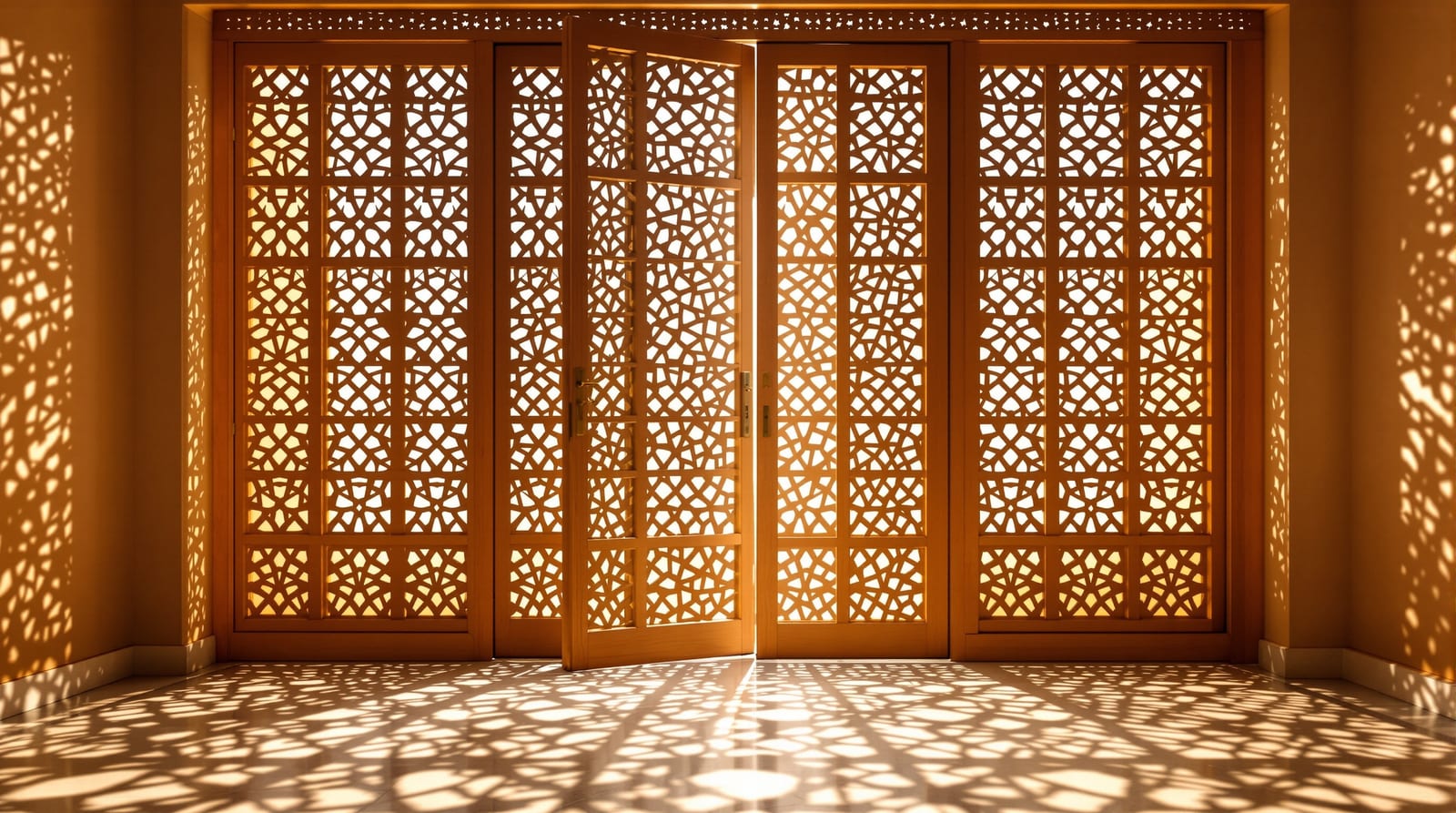
Jali Doors for Indian Homes (2026): Lattice Screens for Privacy, Airflow & Pattern
What jali doors are, their Rajasthan-Mughal heritage roots, modern CNC/laser/carved execution, where they suit (main-door screen, pooja room, partition, balcony), pattern styles, maintenance and cost drivers.
A jali (or jaali) is a perforated lattice screen, and a jali door is simply that lattice turned into a working door or door-screen. It is one of the few ideas in Indian building that does four things at once: it gives privacy, lets air move, throws filtered light, and adds pattern, all without a single moving part beyond the hinge. That is why jali keeps coming back, from the carved sandstone of a Rajasthan haveli to a CNC-cut MDF pooja-room shutter in a 2026 Bengaluru flat.
This guide is about jali as a door element specifically. For broad heritage door design see the traditional Indian doors guide; for relief carving see carved door designs in India. Here we go deep on the screen itself: what it is, where it came from, how it is made today, where it belongs in your home, and what it costs.
What a jali door actually is (and is not)
A jali door is a door whose leaf is wholly or partly a pierced lattice, so you can see and breathe through the pattern rather than a solid panel. It is not the same as a safety-grill door, which is an engineered MS/SS security barrier, nor a louvered door, whose slats angle airflow. Jali sits between decoration and function: the holes are ornamental first, but they genuinely ventilate and screen.
In Indian homes a jali door usually appears in one of these forms:
- A secondary screen door behind a solid main door, kept shut for cross-ventilation while the heavy leaf stays open.
- A pooja-room shutter, where the lattice keeps the space airy and visible yet set apart (see the pooja room door guide).
- A room partition or sliding screen between living and dining, or hall and passage.
- A jali insert inside an otherwise solid panel door, a single carved or CNC band as a decorative vent.
- A balcony or utility screen door that keeps pets and privacy in while letting the breeze through.
The defining trade-off is honest: more open area means more air and light but less privacy and less security. Designers tune the "porosity" (open percentage) and the eye-level density to balance this, often making the pattern denser at standing-eye height and more open above and below.
Heritage: from stone jaali to door screen
Jali is ancient Indian and Indo-Islamic craft. The carved stone jaali reached its peak in Rajasthan and Mughal architecture, where masons pierced sandstone and marble into geometric and floral webs. The screens at Fatehpur Sikri, the marble jaalis around Mughal tombs, and the famous lattice facades of Jaisalmer and Jaipur havelis (Hawa Mahal is the best-known) were climate machines as much as ornament: the small openings accelerate breeze (a venturi effect), cut harsh sun glare to a soft dapple, and shield the women's quarters (zenana) from outside view while letting occupants look out. That privacy-plus-ventilation logic is exactly what a modern jali door inherits.
What changed is the material and the scale. Hand-carving a marble jaali took weeks; today the same visual language is cut in minutes by CNC routers and lasers into sheet materials, which is why jali has moved from palace facades into ordinary flat doors and partitions. The pattern vocabulary, though, is still drawn from that heritage: interlacing stars, hexagons, the eight-pointed Mughal motif, jaal (net) florals, and trellis weaves.
How jali doors are made today
Modern jali doors are essentially a pattern cut into, or built into, a panel. The five mainstream methods in India:
- CNC-routed MDF/HDF/WPC: A digital pattern is routed into a sheet. Most affordable and popular for interior and pooja-room jali doors; the cut sheet is then laminated, PU-painted, or PVC-membrane finished. WPC and HDHMR resist moisture better than plain MDF.
- Laser-cut metal (MS, stainless steel, brass): A laser cuts crisp, fine patterns into sheet metal. MS is powder-coated; stainless and brass are left bright or PVD-coated. Best for durability, security-leaning screens, and a contemporary metallic look.
- Hand-carved or machine-carved wood: Solid teak, sheesham, or mango wood pierced into traditional lattice. The most premium and heritage-true, also the heaviest and costliest, prone to seasonal movement.
- Jali insert in a panel door: A solid panel or flush door with one cut-out band of jali (often backed by frosted glass or mesh), giving ventilation without a fully open leaf.
- Cast or readymade jali panels: Pre-made GRC, resin, or aluminium-composite jali panels fixed into a door frame, useful for repeatable patterns and balconies.
Choosing among these is mostly a material question, so it pairs with the door materials comparison and, for weather exposure, the best door material guide.
Jali material and method compared
Costs below are indicative for the jali leaf/screen only (make + material), exclusive of frame, hardware and fitting, and typically +18% GST. They vary by city, vendor, pattern density and finish.
| Jali type / method | Look & feel | Indicative cost | Durability & best use |
|---|---|---|---|
| CNC MDF/HDF (laminate or PU finish) | Clean, crisp modern pattern; painted colour | ₹300-700 / sq ft | Moderate; interiors, pooja room, partitions; keep dry |
| CNC WPC / HDHMR | Same look, water- and termite-resistant | ₹400-900 / sq ft | Good; balcony, utility, damp-prone interiors |
| Laser-cut MS (powder-coated) | Fine crisp metallic lattice; secure feel | ₹450-1,000 / sq ft | High; main-door screen, balcony, safety-leaning |
| Laser-cut stainless steel | Bright/matte premium metal | ₹700-1,400 / sq ft | Very high; coastal, exterior, low-maintenance |
| Laser-cut brass / PVD | Warm gold heritage-luxe | ₹1,200-3,000+ / sq ft | High; pooja room, statement main-door panel |
| Carved solid wood (teak/sheesham) | Authentic heritage, deep relief | ₹1,200-3,500+ / sq ft | High but moves seasonally; heritage main/pooja door |
| Jali insert in panel door | Subtle, mostly solid with vent band | adds ₹1,500-6,000 to a door | Versatile; bedroom, study, modest budgets |
Pattern density drives cost as much as material: a fine, intricate lattice means more cutting path (longer machine time) and more fragile thin "webs", so a delicate Mughal jaal costs more than a bold geometric grid in the same sheet.
A geometric jali pattern, drawn
The repeating eight-point star-and-cross is the workhorse of Indian jali. Below is a simplified single-tile of that geometry, the kind a CNC router would tile across a leaf. (This is a decorative panel, shown square, not a door elevation.)
The lighter shapes are the holes the breeze and light pass through; the dark web is the solid material that stays. Tile this across a leaf, vary the open percentage, and you have a jali door.
Where jali doors suit (and where they do not)
Jali earns its place where you want air and softened light but not a fully open or fully solid door. The strongest cases:
- Main-door secondary screen: A jali screen behind the main door lets you keep the heavy leaf open through the day for cross-ventilation while staying screened. Pair it with a mosquito-mesh layer in monsoon zones.
- Pooja room: The classic modern use. The lattice keeps the shrine airy and visible yet quietly separated; brass or carved-wood jali reads as devotional luxe. See the pooja room door guide.
- Partitions and sliding screens: Between living and dining, or to veil a passage, a sliding jali screen divides space without blocking light or breeze.
- Balcony, utility and store: WPC or metal jali screens give ventilation and a privacy veil to service zones.
Where to be careful: jali is a poor choice as a sole external security door (the openings are grippable and sightlines are open, so back it with a security door or grill), as a bathroom door (no privacy or moisture control), or as a bedroom door if you need real acoustic and visual privacy, in which case a solid bedroom door is better, perhaps with a small jali vent insert.
Pattern styles
The pattern is most of the design decision:
- Geometric: stars, hexagons, chevrons, grids. Reads contemporary; cheaper to cut; the safest all-rounder.
- Mughal / Indo-Islamic: eight-point stars, interlacing arabesque, the jaal net. Heritage-rich; ideal for pooja and traditional interiors.
- Floral / nature: vines, lotus, peacock, leaf motifs. Soft and ornamental; popular in carved wood and brass.
- Contemporary abstract: parametric waves, irregular voids, brand or monogram motifs. Statement modern doors.
Match density to purpose: a denser pattern (lower open area) for privacy-first screens, a more open pattern for ventilation-first ones.
Maintenance and the practical caveats
Jali's one real drawback is upkeep: dust settles in every perforation, and the more intricate the pattern, the harder it is to wipe. Plan for it:
- Dust regularly with a soft dry brush or a vacuum brush head; a blower clears deep webs fast.
- For metal jali, an occasional damp microfibre wipe; brass may need polish unless PVD-coated.
- For wood jali, keep it dry, re-coat the finish every few years; in coastal or monsoon-heavy zones prefer WPC or stainless over MDF or untreated wood (the best door material guide covers climate matching).
- Backing options: frosted or laminated glass behind the jali adds privacy and stops dust passing through; insect mesh behind it keeps mosquitoes out while preserving airflow.
Structurally, a fully pierced leaf is weaker than a solid one, so thin delicate webs can crack if knocked, especially in MDF. For a working door, choose a robust pattern and a sturdier sheet (WPC, HDHMR, or metal) rather than the finest possible lace.
Cost drivers, summarised
Five things move the price of a jali door: the base material (MDF cheapest, brass/teak dearest), pattern complexity (more cutting path and finer webs cost more), the finish (PU-paint and laminate are cheaper than PVD or hand-polish), size, and whether it is a full jali leaf or just an insert. As a rough planning anchor, a CNC MDF/WPC interior jali door commonly lands around ₹4,000-12,000 made-up before frame, hardware and fitting, while metal and carved-wood statement screens run well above that. For benchmarking against solid doors, use the door cost guide for 2026 and the door cost calculator; also add frame and fitting labour (commonly ₹800-3,000 per door) when you budget.
Frequently asked questions
Are jali doors secure enough for a main door?
Not on their own. The open lattice gives sightlines and grip, so jali works best as a secondary screen behind a solid main door, or as a decorative insert in a security door. For real protection, pair it with a safety grill or a graded lock from the door security guide.
Do jali doors actually help with ventilation in Indian summers?
Yes, that is their original purpose. The small openings let cross-breeze through and even accelerate it slightly, while cutting glare to filtered light. They were the climate-control device of Rajasthan and Mughal architecture before fans existed; a jali screen behind an open main door is a genuinely effective passive-cooling move.
Are jali doors good for a pooja room?
They are one of the most popular pooja-room choices in India. The lattice keeps the shrine airy and gently visible yet set apart; carved wood or brass jali reads as devotional and elegant. See the pooja room door guide for sizing, Vastu placement and finishes.
How do I stop dust collecting in the jali pattern?
Accept that some upkeep comes with the look. Choose a slightly bolder pattern over the very finest lace, dust with a soft brush, vacuum-brush or blower, and consider a frosted-glass or mesh backing that stops dust passing through and is easy to wipe.
MDF, WPC or metal jali, which should I pick?
For dry interiors and tight budgets, CNC MDF or HDHMR. For damp, balcony or utility use, WPC. For exterior, coastal, security-leaning or premium statement screens, laser-cut metal (stainless or brass). Carved teak is the heritage-true premium option but moves seasonally and costs the most. The door materials comparison lays out the full trade-offs.
Export this guide
Related Guides — Deep-dive reading
Jaali & Traditional Indian Façades: India's Original Climate-Smart Screen
Guide to the jaali and traditional Indian façades: history from Mughal and Rajasthani stone screens to Hawa Mahal and Sidi Saiyyed, the building physics of daylight, heat, privacy and breeze, materials from sandstone to GRC and metal, the parametric revival at Pearl Academy Jaipur, and how a homeowner can use a jaali.
Building FacadesWooden Door Designs for Indian Homes (2026): Styles, Patterns, Finishes & Costs
A design gallery of wooden door styles for Indian homes — traditional carved and panelled, classic 4/6-panel, modern flush wood, vertical-plank and slat, fluted, framed-glass, grooved CNC and minimalist — with grain-showing finishes, proportion tips and rough cost bands.
Home Doors & EntrancesCarved Door Designs in India (2026): Motifs, Regional Styles, Hand vs CNC & Costs
A design-led guide to ornamental carved wooden doors for Indian homes — regional traditions, motifs, hand-carving vs machine carving, wood choice, where they belong and what they cost.
Home Doors & EntrancesRelated Tools — Try Free
Jaali Generator
Design a parametric jaali / perforated screen, see its open-area (daylight vs privacy), and download a print-ready SVG for CNC/laser fabrication.
Parametric ToolDoor Cost Calculator
Estimate the all-in cost of a door — leaf, frame, hardware, fitting and GST — by type, material and size.
Door CalculatorBrise-Soleil Visualizer
Interactive horizontal-louvre cut-off angle calculator — sun altitude, louvre depth, and spacing inputs with a live shadow preview. Computes θ = arctan(spacing/depth) for façade shading, ECBC envelope compliance, hospital daylight design, and tropical sun-control detailing.
Sun Shading Tool