
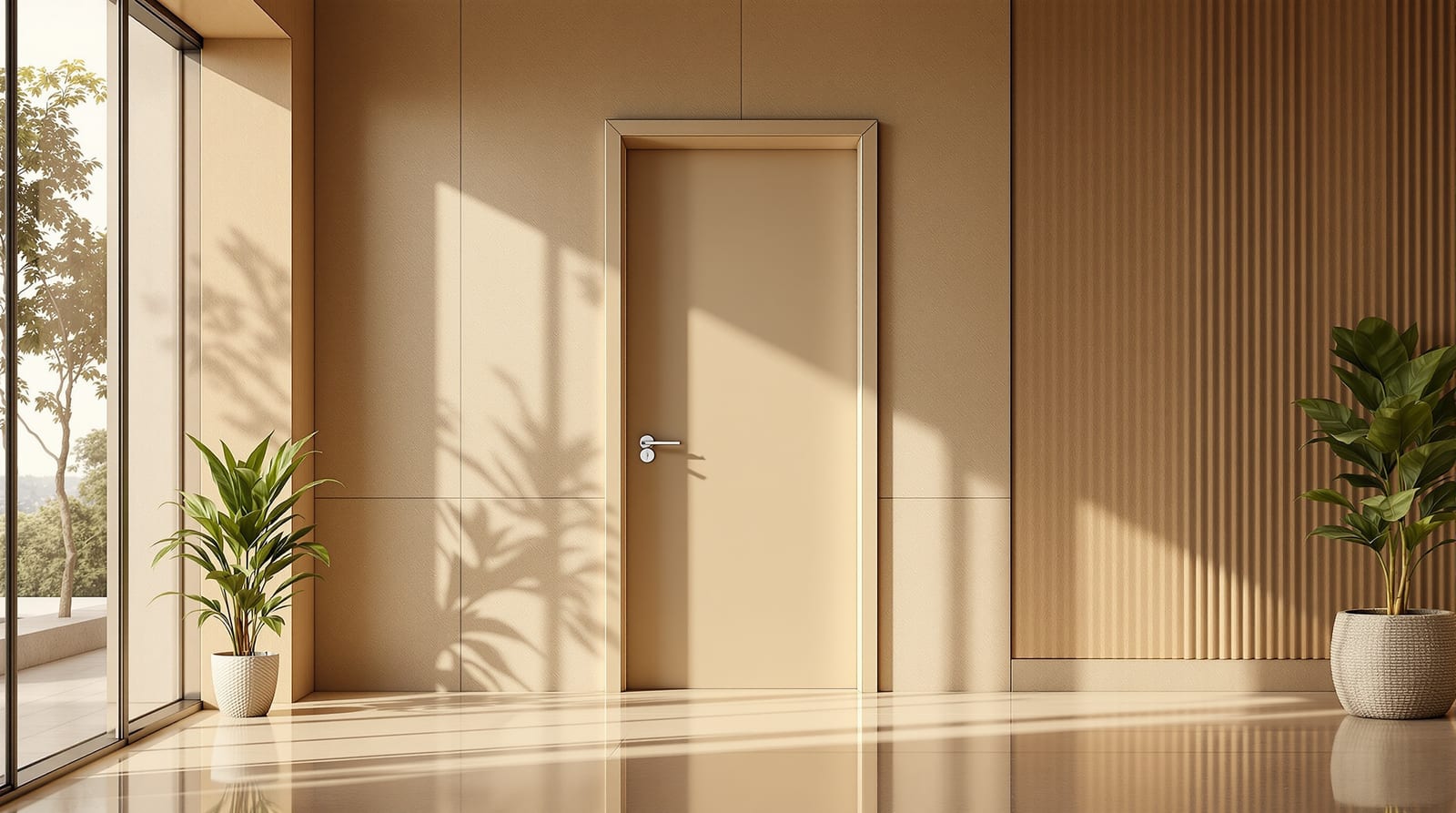
Minimalist Door Designs in India (2026): Flush, Frameless & Concealed-Frame Doors
The clean-line, no-architrave, hidden-hardware door language behind modern Indian apartments and designer interiors — flush-to-wall doors, concealed hinges, recessed pulls, tall leaves and what the look really costs.
A minimalist door is defined by what you take away, not what you add. No carved panels, no fluted architraves wrapping the frame, no shiny lever handle screwed to the stile — just a single clean flush leaf that reads almost as a continuation of the wall. It is the quiet, expensive-looking language behind most well-designed Indian flats and studio interiors today, and getting it right is far more about detailing the edges, the frame and the hardware than about choosing a "design".
This guide breaks down the minimalist door vocabulary item by item — flush faces, concealed frames, hidden hinges, recessed pulls, monochrome finishes, tall leaves and the much-hyped "invisible door" — then tells you honestly where it suits an Indian home, where it does not, and what each move adds to the bill. It complements our broader modern door designs guide; read that first for the full sweep, then use this for the tighter minimalist craft. For costs see the door cost benchmark and for the substrate the flush doors guide.
What makes a door "minimalist"
Minimalism in doors is a discipline of reduction. Every element that draws the eye on a traditional door is either removed or hidden:
- The face is flush and unbroken — a smooth flat plane, no raised panels, no glazing bars, no carving.
- The frame disappears — instead of a chunky teak chowkat with an architrave moulding, the frame is slim, recessed, or fully concealed in the wall.
- The architrave is gone — no cover moulding around the opening; the plaster or finish meets the frame in a clean shadow line or flush joint.
- The hardware is suppressed — hinges are concealed, and the visible knob or lever is replaced by a recessed pull, an edge pull or a push-to-open mechanism.
- The finish is restrained — a single matte colour, one continuous woodgrain, or at most a subtle vertical texture; nothing busy.
The result is a door that recedes. In a minimalist scheme you are not meant to notice the doors at all — they let the room, the light and one or two deliberate materials do the talking. This is the opposite of the traditional carved Indian door, where the door itself is the event.
The minimalist door vocabulary, decoded
Each "look" below is really a construction or hardware decision. Here is what each term actually means on site.
Clean flush faces
The starting point is a true flush door to IS 2202 — a solid-core block-board, plywood or WPC shutter with a perfectly flat face. For minimalism the face matters more than usual: any telegraphing of the internal frame, any wavy laminate, any visible edge-band line will spoil the effect. Specify a solid (not hollow) core for a quality feel, a genuine 1 mm laminate or veneer, and matching edge-banding on all four sides so there is no contrast line. See the laminate doors guide for finish and edge-band detail.
Flush-to-wall and concealed-frame doors
This is the signature minimalist move. A normal door sits proud of the wall inside a visible frame. A flush-to-wall door sits in a frame that is recessed into the wall thickness so the closed leaf finishes level with the plaster on at least one face. The frame — usually an aluminium or steel concealed casing built into the masonry before plastering — has a built-in shadow gap or a plaster-stop bead, so the wall finish runs right up to the leaf with no architrave.
These are sold as systems (Eclisse, Argenta, FritsJurgens-hinged sets, and Indian-assembled equivalents). The key point for buyers: a concealed frame is built in at the masonry/plaster stage, not retrofitted. You must decide on it during civil works, not after the walls are painted.
Hidden and concealed hinges
A standard butt hinge or a visible 3D hinge is a small but real interruption. Minimalist doors use concealed hinges (3-way adjustable invisible hinges such as Argenta Invisible, Hafele, Hettich or Tectus-style) that are mortised into the leaf and frame edge so nothing shows when the door is closed. They allow the door to open ~180 degrees and are adjustable in three planes, which matters because a flush-to-wall door needs a perfectly even reveal to look right. They cost several times more than ordinary hinges. Pair this guide with the door hardware guide.
No visible architraves and skirting-aligned reveals
Removing the architrave exposes the junction between wall and frame, so that junction has to be detailed deliberately — typically a 6-10 mm shadow reveal (a recessed shadow line) or a flush plaster joint with a separation bead. The most refined version aligns the door's reveal and any horizontal break with the room's skirting line, so the door, the skirting and the wall read as one coordinated system. This is a finishing-trade decision (the carpenter, the POP/plaster contractor and the painter all have to cooperate) and is the single most common place the look goes wrong on Indian sites.
Recessed pulls, edge pulls and concealed handles
Instead of a knob or lever, minimalist doors use:
- Recessed/inset pulls — a finger-pull machined into the face or stile, flush with the surface.
- Edge pulls — a pull on the vertical edge of the leaf, invisible from the front.
- Push-to-open / touch latch — no handle at all; you push and the door pops open on a sprung catch.
For doors needing a lock (bathrooms, bedrooms) a slim concealed-mortise or a discreet matte-black/brushed-steel privacy thumb-turn keeps the language clean. Avoid bright chrome rose plates.
Monochrome and single-woodgrain finishes
Minimalism is single-material, single-tone. Choose either one matte solid colour (off-white, greige, charcoal, deep green) or one continuous, low-contrast woodgrain — and carry it across the whole leaf with no contrasting beads or borders. Super-matte and textured-matte laminates are the 2026 default because they hide fingerprints and slipper scuffs in a busy Indian household far better than high-gloss. For palettes see door colour ideas.
Restrained vertical fluting
Fluting (slim vertical grooves) is the one texture that fits minimalism, provided it is restrained: fine, evenly spaced grooves in the same tone as the rest of the door, not a busy decorative panel. Used as a whole-leaf texture in a single colour it adds tactility and a play of light without breaking the rule of simplicity.
Floor-to-ceiling tall doors
Pushing the leaf height from the standard 2100 mm (7 ft) up to 2400-3000 mm — ideally to the ceiling or to a continuous head line — instantly makes a door feel architectural and modern. Tall leaves need a stiffer core, concealed adjustable hinges (a 7+ ft door is heavy and will sag on cheap hardware), and often a floor pivot. They cost meaningfully more because of the extra material, the heavier hardware and the precision fitting.
The "invisible door" trend
The logical endpoint of all of the above is the invisible door — a flush-to-wall, concealed-frame leaf finished in exactly the same paint, plaster or panelling as the surrounding wall, with a push-to-open catch and concealed hinges, so when closed it is genuinely hard to spot. It is used to hide a powder room off a living room, a store, a home-office or a service door, keeping a wall visually unbroken.
It is the most demanding minimalist detail to execute well in India: the wall finish has to wrap onto the leaf seamlessly, the reveal must be dead even all round, and the whole thing depends on the concealed frame being installed true during civil works. Done badly it looks like a mistake; done well it is the most impressive door in the house. Treat it as a designer-and-fabricator job, not a local-carpenter job.
How minimalist features map to cost
Here is the honest trade-off. Each minimalist move buys a cleaner look but adds cost or constraint. Figures are indicative and vary by city, vendor and brand; add ~18% GST and fitting labour.
| Minimalist feature | Visual effect | Cost / practical impact |
|---|---|---|
| Plain flush leaf (solid core, 1 mm laminate) | Clean unbroken face | Baseline: ~₹4,000-9,000 per shutter (designer laminate/veneer) |
| Matching 4-side edge-banding | No contrast line at edges | Small extra; specify explicitly or carpenters skip it |
| Concealed / flush-to-wall frame system | Door sits level with wall, no architrave | Adds ~₹8,000-25,000+ per opening; must be built in at civil stage |
| Concealed adjustable hinges | No visible hinge knuckles | ~₹2,500-7,000 per pair vs ₹200-600 for ordinary hinges |
| Recessed / edge pull (no knob) | No protruding handle | ₹1,000-5,000; push-to-open catch adds more |
| Push-to-open / touch latch | Truly handle-free | Adds ₹1,500-5,000 per door |
| Monochrome super-matte laminate / PU | Single restrained tone | Designer laminate ₹4,000-9,000/shutter; PU lacquer dearer |
| Restrained vertical fluting | Tactile single-tone texture | Adds ~₹2,000-6,000 per leaf (machining + finishing) |
| Floor-to-ceiling tall leaf (2.4-3.0 m) | Architectural, modern proportion | 30-80%+ over a 7 ft door; heavier hardware, often a pivot |
| Invisible (wall-finish) door | Door disappears into wall | Premium designer job; concealed frame + bespoke finish + push catch |
The pattern is clear: the leaf stays affordable, but the frame, hardware and tall sizing are where minimalism gets expensive — because you are paying to hide things, and hiding things well takes engineered systems and precise labour.
A flush-to-wall door with a recessed pull (section concept)
The diagram shows the closed leaf finishing flush with the wall plaster on the face side, the concealed frame recessed into the masonry, a fine shadow reveal in place of an architrave, and a recessed finger-pull machined into the leaf — the four moves that together create the minimalist look. Drawn as a portrait door elevation.
Where minimalist doors suit an Indian home — and where they do not
Good fit:
- Modern apartments and designer interiors, especially open-plan living-dining where you want walls to read as continuous planes.
- Bedrooms, dressing rooms, home offices and powder rooms where the door is internal, dry and low-abuse.
- Wardrobe and storage fronts — the same handle-free, monochrome language extends naturally to joinery.
Be careful:
- Main / external doors. A flush-to-wall main door fights against the Indian reality of grills, multi-point security, video door systems and weather, and it works against Vastu for the main door, where a prominent, ideally largest, threshold door is valued. Keep minimalism for the inside; treat the entrance on its own terms — see the main door design guide.
- Bathrooms and kitchens. Damp and grease are the enemy of seamless flush finishes. Use a WPC or FRP-cored leaf and accept that the look is slightly less pure than a designer dry-area door.
- Heavy joint-family traffic and small children. Push-to-open catches and seamless wall-doors get scuffed, leaned on and slammed; super-matte textured laminate survives this far better than gloss or delicate PU.
- Coastal and high-humidity homes. Concealed steel frames can corrode; specify aluminium or galvanised/SS frames and stainless hardware near the sea.
Specifying minimalism on an Indian site: a short checklist
1. Decide concealed frames during civil works, not after painting — the casing is built into the masonry before plaster.
2. Insist on solid-core leaves to IS 2202 and matching 4-side edge-banding; a hollow door spoils the premium feel.
3. Budget the hardware properly — concealed adjustable hinges and recessed/push pulls are the bulk of the upcharge, not the leaf.
4. Coordinate the reveal with skirting and wall finish as one detail; get carpenter, plaster contractor and painter aligned early.
5. For tall doors, confirm the hinge/pivot rating and frame fixing for the extra weight, or the door will sag.
6. Choose super-matte or textured-matte finishes for fingerprint and scuff resistance in real Indian use.
For trend context across the whole category, see door design trends 2026. To estimate your budget, the door cost calculator and door material comparison tool help quickly.
Frequently asked questions
Are minimalist flush-to-wall doors much more expensive than normal doors?
The leaf is not — a plain designer flush shutter is ₹4,000-9,000. The cost is in the system around it: a concealed flush-to-wall frame can add ₹8,000-25,000+ per opening, concealed hinges add a few thousand, and tall floor-to-ceiling leaves add 30-80%+. So a minimalist door costs more because of the frame, hardware and sizing, not the door face. All figures are indicative and vary by city and vendor.
Can a local carpenter build a flush-to-wall or invisible door?
A skilled carpenter can make and finish the flush leaf beautifully, but the concealed/flush-to-wall frame and the seamless wall-finish junction are precision jobs usually done with proprietary frame systems and tight coordination between trades. For a true invisible door, treat it as a designer-plus-fabricator project and have the frame built in during civil works — not retrofitted.
Do minimalist doors work with Vastu?
For internal doors, minimalism and Vastu rarely conflict — Vastu guidance focuses mainly on the main entrance. For the main door, Vastu tradition values a prominent, often the largest, well-defined threshold door, which sits awkwardly with a flush-to-wall "disappearing" look. The common solution is to keep minimalism inside the home and give the entrance its own treatment. See main door Vastu and entrance Vastu.
Are handle-free push-to-open doors practical for Indian households?
They look superb and suit low-traffic doors (powder rooms, home offices, wardrobes). In high-traffic, kids-and-joint-family situations the sprung catches wear and the leaf gets smudged where hands push. A recessed or edge pull is a more durable middle ground that keeps the clean look while giving a defined place to grip. Choose super-matte textured finishes so fingerprints do not show.
What finish should I pick for a minimalist door in India?
A single super-matte or textured-matte laminate (or PU lacquer for the highest budget) in one restrained tone — off-white, greige, charcoal, deep green, or one continuous low-contrast woodgrain. Matte hides the daily scuffs of Indian use; high-gloss shows every smudge and swirl. Carry the same finish across the whole leaf with matching edge-banding and no contrasting borders.
Export this guide
Related Guides — Deep-dive reading
Bedroom Door Design in India: Materials, Sizes, Finishes, Privacy and Cost (2026)
How to choose and design a bedroom door for Indian homes — privacy, light-noise control, finishes that match the room, the right 900x2100 internal door, locks and ₹ budget.
Home Doors & EntrancesGuest Room Door in India: Privacy, Quiet and Smart Picks Without Overspending (2026)
How to choose a guest bedroom door for an Indian home - privacy and acoustics so visitors feel comfortable, but budget-sensible for a room used only now and then: solid-core flush for quiet, panel or laminate for looks, the right privacy lock, simple soundproofing, and a finish that matches the rest of your doors - with picks ranked and indicative rupee costs.
Home Doors & EntrancesThe Complete Home Door Guide for Indian Homes (2026): Types, Materials, Cost, Security & Vastu
Everything an Indian homeowner needs to specify the right door for every opening — from main entrance to bathroom — with real 2026 prices, IS/NBC standards and Vastu sense.
Home Doors & EntrancesRelated Tools — Try Free
Door Material Comparison Tool
Compare 2–4 door materials on cost, durability, maintenance, security and moisture resistance.
Comparison ToolDoor Cost Calculator
Estimate the all-in cost of a door — leaf, frame, hardware, fitting and GST — by type, material and size.
Door CalculatorBefore vs After — Cost Reality Check
Compare what you expected to pay vs what you actually paid, category by category.
Reality Check