
Glass-Panel Door Designs for Indian Homes (2026): Glass Types, Panel Layouts & Privacy Ideas
A design-led guide to doors with glass inserts and panels — clear, frosted, fluted, lacquered and stained glass, half-glass and grid layouts, and where to use each for light without losing privacy.
A glass-panel door does one quiet, valuable thing in an Indian home: it moves daylight from a bright room into a dark one without opening up the wall. The trick is choosing the right glass and the right layout, because the same door can either flood a passage with morning sun or hand your neighbours a clear view of your dining table. This guide is design-led — it assumes you already know whether you want a full glass door, and instead helps you decide which glass, which panel arrangement and where, so the door reads as a deliberate design move rather than a builder default.
If you are still deciding between a fully glazed door and a solid one, read glass doors in India first — that is the type guide. For French-style multi-pane leaves, see French doors. Here we stay on the design choices: glass type, panel layout, framing and where each combination belongs.
Why glass panels, not full glass
A full glass door is honest about being a glass door — it suits balconies, gardens and large openings where you want the view. But inside the home, between rooms, a glass panel set into a framed timber, aluminium or uPVC leaf usually reads better. It keeps the solidity and acoustic mass of a real door at hand height, gives you a frame to match your other joinery, and lets you tune exactly how much you see through the glass.
The two questions every glass-panel door has to answer are light and privacy, and they pull in opposite directions. Clear glass gives maximum light and zero privacy; a solid leaf gives full privacy and no borrowed light. Almost every good design lives in between — frosted glass on a bathroom door, a fluted strip on a study, a small clear vision panel on a swing door so nobody gets hit on the other side. Get the glass family right and the layout almost designs itself.
Glass types by privacy and look
This is the heart of the decision. Indian glass processors and laminate-and-glazing dealers stock all of these; the names vary by region, so describe the effect when you ask.
| Glass type | Privacy | Light passed | Look / feel | Best use |
|---|---|---|---|---|
| Clear (float) | None | Maximum | Invisible, frameless feel | Balcony, garden, internal where view is wanted |
| Frosted / sandblasted | High | High (diffused) | Soft milky-white, hides shapes | Bathroom, study, bedroom, office cabin |
| Etched / acid-etched | High | High | Smoother frost, premium matte | Pooja room, designer interior doors |
| Fluted / reeded | Medium-high | High (distorted) | Vertical ribs, on-trend texture | Living-kitchen, wardrobe, partition |
| Lacquered / back-painted | Full (opaque) | None through glass | Glossy solid colour, mirror-like | Accent panel, kitchen, modern flat doors |
| Tinted (bronze/grey/green) | Low-medium | Reduced | Coloured, cuts glare | West-facing, balcony, sun control |
| Stained / leaded | Medium | Coloured | Decorative, traditional | Pooja room, heritage main-door sidelight |
| Wired / Georgian wired | Low | High | Mesh embedded, dated but tough | Old utility doors, fire-rated legacy |
| Laminated | Per inner film | Varies | Safety-first, holds on breaking | Any large or low pane, child-safe |
| Toughened (tempered) | Per surface finish | Varies | 4-5x stronger, breaks into granules | Any low/large pane — see safety below |
A few practical notes from Indian sites. Frosted is the workhorse for privacy because it is cheap, washable and forgiving; fingerprints show less than on clear. Fluted/reeded glass is the fashionable choice in 2026 — the vertical ribs blur the view while still letting bright light through, and it photographs beautifully, which is why you see it on so many living-kitchen partitions. Lacquered (back-painted) glass is technically opaque, so it is really a coloured finish, not a see-through panel — use it where you want a slab of glossy colour, not light transfer. Tinted glass is about glare and heat on a west or south face, not privacy.
For deeper material trade-offs (toughened vs laminated, cost of processing) the glass doors guide and the door materials comparison go further; here, pick by the privacy-and-light column above.
Panel layouts — how the glass is arranged
The same frosted glass looks entirely different as a full sheet versus a colonial grid. Layout is where your door gets its character.
- Full glass panel — one large pane filling most of the leaf, with a slim frame. Maximum light; choose the glass type for privacy. Best between living and kitchen, or a study.
- Half-glass (top-glazed) — solid lower half (kick-proof, hides clutter), glazed upper half. The most practical interior choice: privacy where you stand, light where it counts. Classic for kitchens and utility doors.
- Vision strip / vision panel — a narrow vertical or porthole pane in an otherwise solid leaf. Its real job is safety on a swing door so two people do not collide; it also looks crisp and minimal.
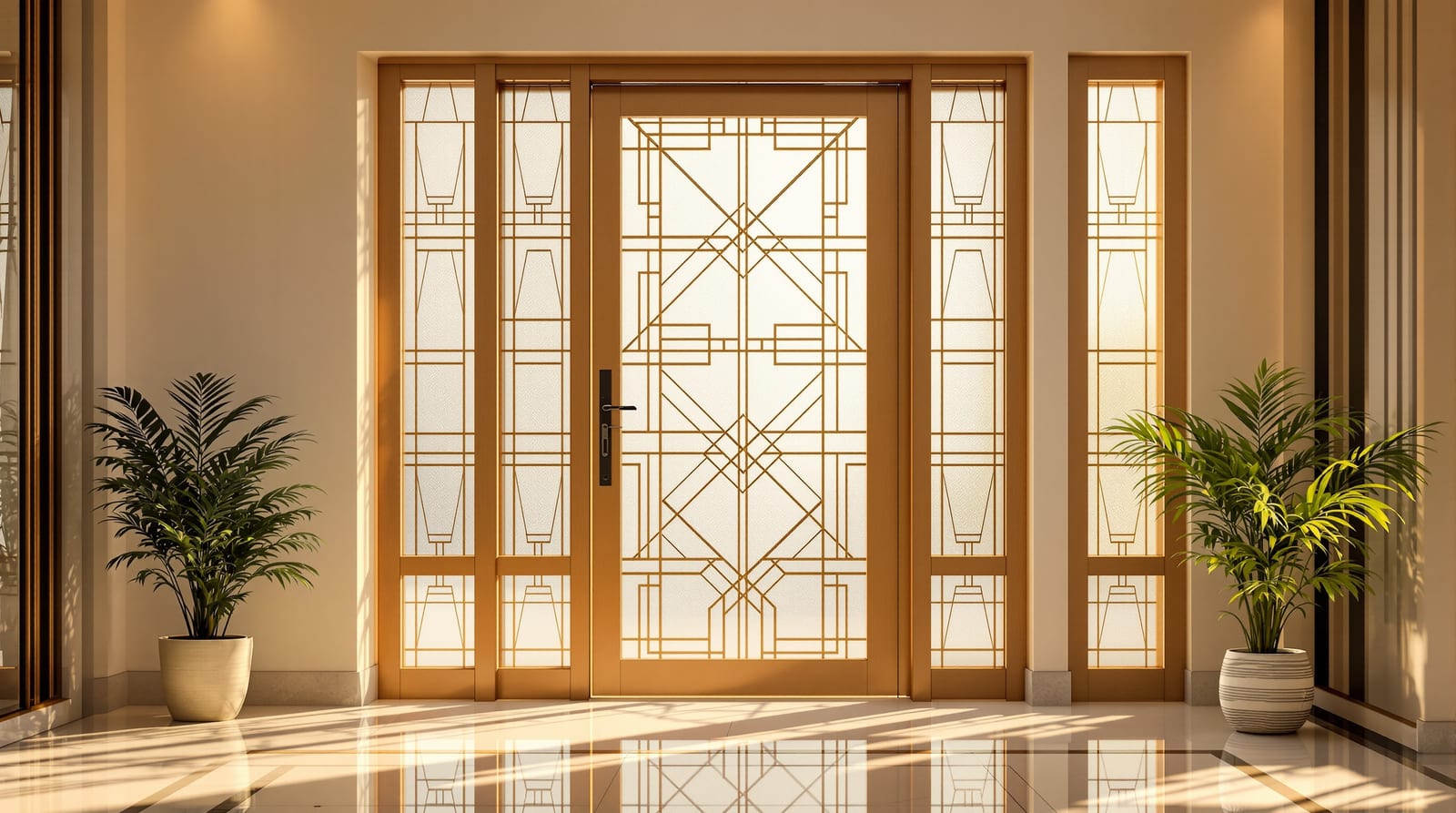
- Grid / colonial bars (French-style) — the pane divided by glazing bars into squares or a 2x3, 3x4 grid. Reads traditional or cottage; pairs with French doors and traditional Indian doors.
- Multi-pane / Crittall-style — slim black metal frames dividing many small panes; the strong 2026 trend for partitions and home-office doors.
- Sidelight — a fixed glazed panel beside the main door leaf (or a top fanlight above). Lights up a dark foyer without weakening the main door itself; popular as a main-door treatment with stained or etched glass.
Mix the type and the layout to taste: a half-glass kitchen door with fluted glass; a full-panel study door in frosted; a colonial-grid pooja door in stained glass; a slim vision strip in clear toughened on a busy swing door.
Where to use glass-panel doors in an Indian home
- Between living and kitchen — the single best use. A half-glass or fluted-glass door keeps cooking smells and noise out while borrowing the kitchen's window light into the living room and vice versa. See kitchen doors for the full kitchen-door picture.
- Pooja room — etched or stained glass on a colonial grid gives a sense of openness and reverence while keeping a clear threshold. Keep the design restrained; the pooja room door guide covers Vastu and motifs.
- Study / home office — frosted or fluted full-glass borrows light so the room never feels like a box, while blurring screens from view. A Crittall-style multi-pane door is the design-forward pick.
- Room partitions — sliding or fixed glass-panel partitions separate a hall and dining or a bedroom and dressing area without darkening either.
- Main-door sidelight / fanlight — a stained or etched glass sidelight lights a dark foyer; the leaf itself stays solid timber for security. Pair with main door design.
- Balcony / terrace — here you usually want clear or lightly tinted glass for the view; this drifts toward a full glass door rather than a panel.
For a clean, restrained look across all of these, the modern door designs guide shows how slim frames and large single panes carry a contemporary interior.
Safety: toughened and laminated glass
This is non-negotiable, not a style choice. Any glass in a door is at risk of being walked into, slammed or hit by a child or a heavy bag. Indian practice and good sense call for toughened (tempered) glass to IS 2553 in door panels, especially for large panes and any glass that reaches low (below ~900 mm, where children and trips happen). Toughened glass is roughly four to five times stronger and breaks into small blunt granules instead of dangerous shards.
For very large panels, sidelights at floor level, or homes with small children, laminated glass (or laminated-toughened) is better still — the inner film holds the broken glass together so it cannot fall out. Glazing workmanship should follow IS 3548, and panel thickness is typically 5-8 mm for interior doors, more for large or external panes. Tell your fabricator the use and ask for a toughening-marked pane; the small extra cost is the cheapest insurance in the door.
Framing the glass — wood, aluminium, uPVC
The frame around the glass sets the whole tone:
| Frame material | Look | Notes |
|---|---|---|
| Solid wood / teak | Warm, traditional, premium | Best for colonial-grid, pooja, main-door sidelight; can swell in monsoon if unseasoned |
| Engineered / flush leaf with glass cut-out | Clean, budget-friendly | Factory IS 2202 flush leaf with a glazed aperture; common and economical |
| Aluminium (slim/Crittall) | Modern, minimal, dark | Slim sightlines for the multi-pane trend; sections to IS 733/1285; rust-free |
| uPVC | Low-maintenance, sealed | Good for utility/balcony glass doors; uniform white or laminated finishes |
A timber or veneered frame ties a glass-panel door into wooden joinery; a slim black aluminium frame makes it a feature. uPVC suits wet or external locations where you want a sealed, low-maintenance frame.
What it costs and how it is priced
Glass-panel doors are priced as the leaf plus the glass plus processing, so two figures combine. As a rough Indian benchmark (indicative, varies by city and vendor; add ~18% GST and fitting):
- A factory flush/engineered leaf with a glazed aperture runs broadly ₹4,000-12,000 per shutter depending on size and finish.
- Glass processing adds on top: plain frosting or toughening is modest; fluted, lacquered, etched and especially stained glass cost progressively more.
- Framed aluminium/uPVC glazed doors are often quoted by opening area at roughly ₹450-1,200 per sq ft.
- Fitting labour is typically ₹800-3,000 per door, with the hardware set extra.
For a like-for-like budget on fully glazed doors, see glass door cost in India, and for the master benchmark across all door types, door cost in India 2026. You can sanity-check a quote with the door cost calculator.
Frequently asked questions
Which glass gives privacy but still lets in light?
Frosted (sandblasted), etched and fluted/reeded glass all block the view while passing bright, diffused daylight. Frosted is the cheapest and most washable; fluted is the most fashionable; etched is the most premium. Lacquered glass is fully opaque, so it gives privacy but no light through the pane.
Is glass in a door safe with children at home?
Yes, if you specify the right glass. Use toughened (tempered) glass to IS 2553 in any door panel, and laminated glass for large or low panes — it holds together if broken. Half-glass layouts with a solid lower half also keep glass above kick height.
Can I put a glass-panel door between my living room and kitchen?
This is the best use of one. A half-glass or fluted-glass door keeps cooking smells and noise contained while letting the two rooms share daylight. Choose toughened glass and a wipe-clean frame, and see our kitchen door guide.
What glass suits a pooja room door?
Etched or stained glass on a colonial grid is the traditional choice — it feels open and reverent while keeping a clear threshold. Keep motifs restrained and follow the Vastu notes in the pooja room door guide.
Does glass make a door more expensive than a plain one?
Yes, modestly. You pay for the leaf plus the glass plus processing, and decorative glass (fluted, lacquered, etched, stained) costs more than plain frosted or clear toughened. Compare options in glass door cost in India.
Export this guide
Related Guides — Deep-dive reading
Dining Room Door in India: Best Partition & Opening Choices (2026)
How to choose the right door for the dining area of an Indian home - kitchen-dining partitions that trap cooking smells and smoke while keeping flow, plus open dining-to-living and dining-to-garden options - ranked picks, drivers and indicative costs.
Home Doors & EntrancesBedroom Door Design in India: Materials, Sizes, Finishes, Privacy and Cost (2026)
How to choose and design a bedroom door for Indian homes — privacy, light-noise control, finishes that match the room, the right 900x2100 internal door, locks and ₹ budget.
Home Doors & EntrancesFrench Doors for Indian Homes: Glazing, Security, Cost & Monsoon Sealing
The double-leaf glazed door that opens a living room to a balcony or garden - where it works, how to specify the glass, frame and seals, what it costs, and how it stacks up against sliding and bi-fold.
Home Doors & EntrancesRelated Tools — Try Free
Window Cost Calculator
Estimate window price plus installation by type, frame material, size, glass and quantity.
Window CalculatorAcoustic Window Calculator
Estimate how much outside noise a window blocks and the resulting indoor dB level and comfort.
Window ToolDoor Cost Calculator
Estimate the all-in cost of a door — leaf, frame, hardware, fitting and GST — by type, material and size.
Door Calculator