
FRP Doors in India (2026): IS 14856 Waterproof Bathroom, Balcony & Terrace Doors
Why fibre-reinforced plastic doors win in wet, coastal and service areas — construction, costs, sizes, brands and where wood still beats them.
Ask any Indian carpenter what really kills a bathroom door and the answer is always the same: water. The bottom 150 mm swells, the laminate peels, the core rots, and within three or four monsoons you are replacing a "lifetime" flush door. FRP doors — fibre-reinforced plastic, sometimes called fibreglass-reinforced plastic — exist precisely to break that cycle. They are a moulded plastic skin over a foam core with zero exposed timber, which is why they have quietly become the default for bathrooms, balconies, terraces and servant-quarter doors across the country. This guide covers how they are built, where they genuinely shine, where wood still beats them, and what a set actually costs in 2026.
For the wider material decision, pair this with our door materials comparison and the best door material for India guide; for the room itself see the bathroom door guide.
What an FRP door actually is
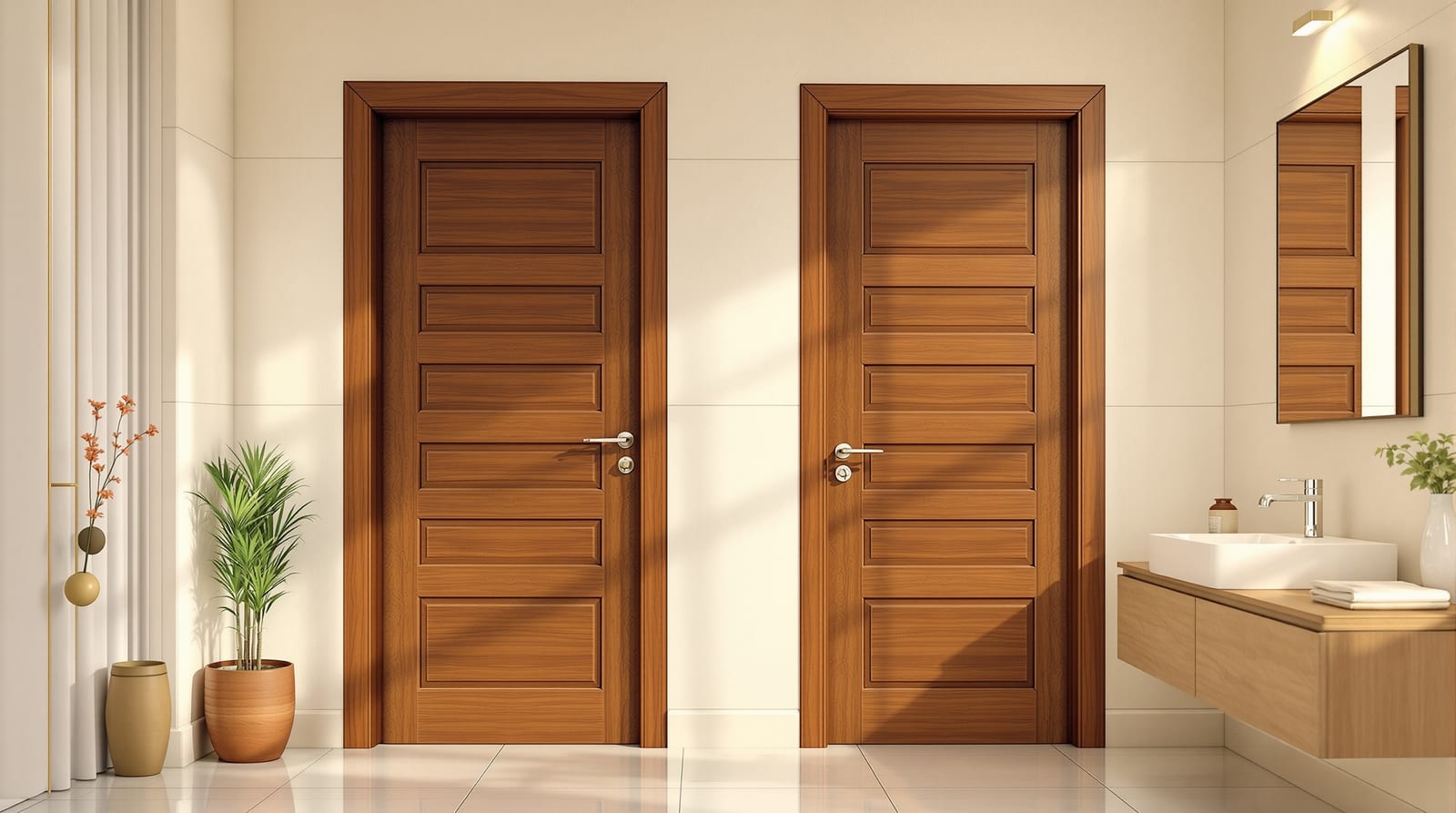
FRP stands for fibre-reinforced plastic — a thermoset resin (usually polyester) reinforced with chopped glass fibre, the same family of material used for boat hulls, water tanks and cooling towers. In a door, two moulded FRP skins are bonded over a lightweight core, almost always rigid polyurethane (PU) foam, sometimes a polymer or honeycomb core. The skin is typically 2-3 mm thick and can be moulded with a panel or "six-panel" relief so it mimics a traditional panelled door rather than looking like a flat slab.
The whole assembly is, by design, a sealed plastic envelope. There is no MDF, no plywood, no solid timber edge to drink water — which is the single property that defines everything good (and a couple of things annoying) about FRP. In India these shutters and frames are governed by IS 14856 (Glass Fibre Reinforced Plastic — GRP / FRP — panel type door shutters and frames), which sets requirements for skin thickness, glass content, water absorption, slamming endurance and screw-holding. When buying, ask explicitly whether the shutter is "IS 14856 marked" — it separates a proper moulded door from a thin spray-coated import.
Why FRP wins in wet and exposed areas
The strengths all flow from that sealed plastic shell:
- 100% waterproof. Water absorption under IS 14856 is negligible. You can hose an FRP bathroom door, leave it standing in a flooded balcony, or fit it where the shower spray hits it directly. It will not swell, delaminate or rot. This is the headline reason it has displaced wood and flush doors in Indian toilets.
- Termite-, borer- and pest-proof. There is no cellulose for termites or powder-post beetles to eat — a serious advantage in humid, termite-heavy regions where even teak frames get attacked at the floor.
- Rust-free and coastal-friendly. Unlike steel doors, FRP does not corrode in salty coastal air (Goa, Kerala, Chennai, Mumbai), making it a strong pick for sea-facing balconies and terrace doors.
- Fire-retardant grades available. Standard FRP is combustible, but fire-retardant (FR) resin grades exist for service and utility areas; ask for the FR specification if that matters. For rated fire doors proper, see steel/timber fire-check shutters to IS 3614, not standard FRP.
- Low maintenance. No polishing, no repainting, no annual sealing. A wipe with a damp cloth is the entire maintenance routine. Colour is moulded/coated through, so minor scratches do not expose a raw core.
- Light and easy to fit. The foam core makes the shutter light, so hinges and frames take less load and a single carpenter can hang it. Many sets ship as a matched FRP shutter + FRP frame, eliminating the timber chowkat entirely.
- Moulded panel looks. Good FRP doors are moulded with a panelled face and a wood-grain or solid colour finish, so they read as a decent panelled door from a few feet away rather than an obvious plastic slab.
Where FRP shines — and where it doesn't
FRP is a specialist, not an all-rounder. It is brilliant in exactly the places wood fails:
- Bathrooms and WCs — its home ground; pair with our bathroom door guide.
- Balconies and terraces — sun, rain and standing water; see the balcony door and terrace door guides.
- Coastal homes — salt air that rusts steel and warps wood.
- Utility, wash, store and servant-quarter doors — see utility door and store-room door — and industrial / quarters / factory washrooms where toughness and zero maintenance matter more than looks.
Where it does not belong is the showpiece front of the house. The honest limits:
- Looks and feel versus real wood. Up close, moulded FRP feels and sounds plastic. For a main entrance, pooja room or a designer bedroom, it cannot match teak, veneer or a solid wooden door. Keep FRP to the wet and back-of-house openings.
- Fade over years of harsh sun. Cheaper FRP on a west-facing terrace can chalk or fade. UV-stabilised grades hold colour far better — worth specifying for fully exposed positions.
- Mid-level security. A foam-core FRP leaf is not a security door. It is fine for internal and service openings, but for the main door choose a steel or solid-core leaf with proper door security.
- Hollow sound and lower mass. Light weight means less acoustic privacy than a solid leaf; for a quiet bedroom or study, see soundproof doors.
FRP vs WPC vs PVC vs flush — the wet/external decision
These four get cross-shopped constantly for bathrooms and service areas. Here is how they stack up. (Costs are per standard shutter, material + make; frame, hardware, fitting and ~18% GST extra; indicative, varies by city and vendor.)
| Factor | FRP | WPC | PVC | Flush (ply) |
|---|---|---|---|---|
| Waterproof | Excellent (sealed shell) | Very good | Good (light-duty) | Poor unless edge-sealed |
| Termite-proof | Yes | Yes | Yes | No (timber core) |
| Look / feel | Moulded panel, plastic feel | Wood-like, paintable | Basic, plasticky | Best with veneer/laminate |
| Strength / mass | Medium, light | High, rigid | Low (often hollow) | Medium-high |
| Best use | Bathroom, balcony, terrace, coastal, quarters | Bathroom, kitchen, main internal | Cheap bathroom/utility only | Bedrooms, dry internal |
| Security | Mid | Mid-high | Low | Mid |
| Indicative cost / shutter | ₹1,500-4,000 (bath); sets ₹6,000-20,000 | ₹2,000-4,500 | ₹1,000-2,500 | ₹1,200-4,000 |
| Relevant IS | IS 14856 | (proprietary; no single IS) | — | IS 2202 |
Quick rule of thumb: PVC is the cheap throwaway bathroom door; FRP is the rugged 100%-waterproof workhorse for wet and exposed positions; WPC is the wood-look upgrade that also handles main-internal openings; flush stays in the dry bedrooms. Compare each in detail via PVC doors, composite doors and fibreglass doors (FRP is the fibreglass family — those guides go deeper on resin and skin).
Standard sizes
FRP shutters and frames are moulded to standard Indian openings, so they drop straight into typical masonry:
| Opening | Typical leaf size | Notes |
|---|---|---|
| Bathroom / WC | 700-750 mm x 2000-2100 mm | Most common FRP application |
| Bedroom / internal | 750-900 mm x 2100 mm | Where a wet-area or low-maintenance leaf is wanted |
| Utility / store | 800-900 mm x 2100 mm | Service openings |
| Balcony / terrace | 750-900 mm x 2100 mm | UV-stabilised grade preferred |
Standard height is 2100 mm (7 ft); the frame adds roughly 50-75 mm. Many FRP sets come as a matched shutter + FRP frame, which removes the swelling timber chowkat — a real advantage in wet zones. For the full opening logic see door size standards.
What FRP doors cost in India (2026)
Costs are indicative and move with city, vendor, skin thickness, finish and whether you buy a bare shutter or a shutter + frame set. Add roughly 18% GST and fitting labour.
| Item | Indicative cost |
|---|---|
| FRP bathroom shutter (bare) | ₹1,500-4,000 per shutter |
| FRP shutter + matched FRP frame (set) | ₹6,000-20,000 per set |
| FRP frame only (chowkat) | ₹1,500-4,000 |
| Hardware (hinges, lock, handle) | ₹1,500-8,000 per door |
| Fitting / installation labour | ₹800-3,000 per door |
A realistic all-in bathroom door in FRP — bare shutter, modest hardware and fitting — lands around ₹4,000-9,000 fitted; a full shutter-plus-frame set for a balcony or terrace runs ₹8,000-20,000+ depending on size, UV grade and finish. For benchmarking against every other material, use the master door cost guide and the door cost calculator.
Brands and buying tips
Common FRP door makers and suppliers in the Indian market include Sintex (well known for FRP/GRP products), Rashmi, Greenply (in its WPC/FRP range), regional FRP moulders, and a wide spread of unbranded local fabricators — quality varies enormously between a proper moulded IS 14856 shutter and a thin spray job. When buying:
- Insist on IS 14856 marking and ask the skin thickness (2-3 mm is healthy; very thin skins dent and fade).
- Specify a UV-stabilised grade for any balcony, terrace or sun-exposed position.
- Ask for a fire-retardant (FR) grade for service and utility runs if your building requires it.
- Prefer a matched FRP frame in genuinely wet zones so no timber touches water.
- Check the moulded panel finish in person — a good wood-grain reads convincingly; a flat glossy slab will look cheap.
- Confirm screw-holding at hinge and lock points; foam-core leaves need proper edge reinforcement there.
Frequently asked questions
Are FRP doors really 100% waterproof?
Yes — the leaf is a sealed plastic shell over foam with no exposed timber, and IS 14856 caps water absorption to a negligible level. It will not swell or rot even with direct shower spray or standing water, which is why it has become the default Indian bathroom and balcony door.
FRP or WPC for a bathroom?
Both are termite-proof and handle water well. Choose FRP when you want the toughest, fully sealed, lowest-maintenance leaf, including for exposed balconies and coastal/terrace positions. Choose WPC when you want a more wood-like, paintable look that can also serve main-internal openings. PVC is the cheaper, lighter, less durable alternative for budget bathrooms only.
Can I use an FRP door as my main entrance?
Not recommended. FRP is mid-security and feels plastic up close, so it suits bathrooms, balconies, terraces and service openings — not the showpiece main door. For the entrance, choose teak/solid wood for looks or a steel door for security, and read door security.
Do FRP doors fade in the sun?
Cheaper grades can chalk or fade on a fully exposed west-facing terrace. Specify a UV-stabilised FRP grade for any sun-hit position and the colour holds for many years; interior bathroom doors rarely fade at all.
What is IS 14856?
It is the Indian Standard for glass-fibre-reinforced-plastic (GRP/FRP) panel-type door shutters and frames, setting requirements for skin thickness, glass content, water absorption, slamming endurance and screw-holding. Buying an IS 14856-marked shutter is the simplest way to separate a genuine moulded FRP door from a thin import. See the wider best door material guide and the home doors complete guide to place FRP in context.
Export this guide
Related Guides — Deep-dive reading
WPC Doors for Indian Homes: 100% Waterproof, Termite-Proof, and Where They Belong
Wood-plastic composite doors and frames promise zero swelling, zero termites and a low price - here is what that really means, where the screw-holding catch bites, and how WPC compares with wood and flush doors in 2026.
Home Doors & EntrancesThe Complete Home Door Guide for Indian Homes (2026): Types, Materials, Cost, Security & Vastu
Everything an Indian homeowner needs to specify the right door for every opening — from main entrance to bathroom — with real 2026 prices, IS/NBC standards and Vastu sense.
Home Doors & EntrancesBedroom Door Design in India: Materials, Sizes, Finishes, Privacy and Cost (2026)
How to choose and design a bedroom door for Indian homes — privacy, light-noise control, finishes that match the room, the right 900x2100 internal door, locks and ₹ budget.
Home Doors & EntrancesRelated Tools — Try Free
Door Cost Calculator
Estimate the all-in cost of a door — leaf, frame, hardware, fitting and GST — by type, material and size.
Door CalculatorDoor Material Comparison Tool
Compare 2–4 door materials on cost, durability, maintenance, security and moisture resistance.
Comparison ToolDoor Security Rating Calculator
Score your main door out of 100 across leaf, frame, lock and hardware — and see the top upgrades.
Security Tool