
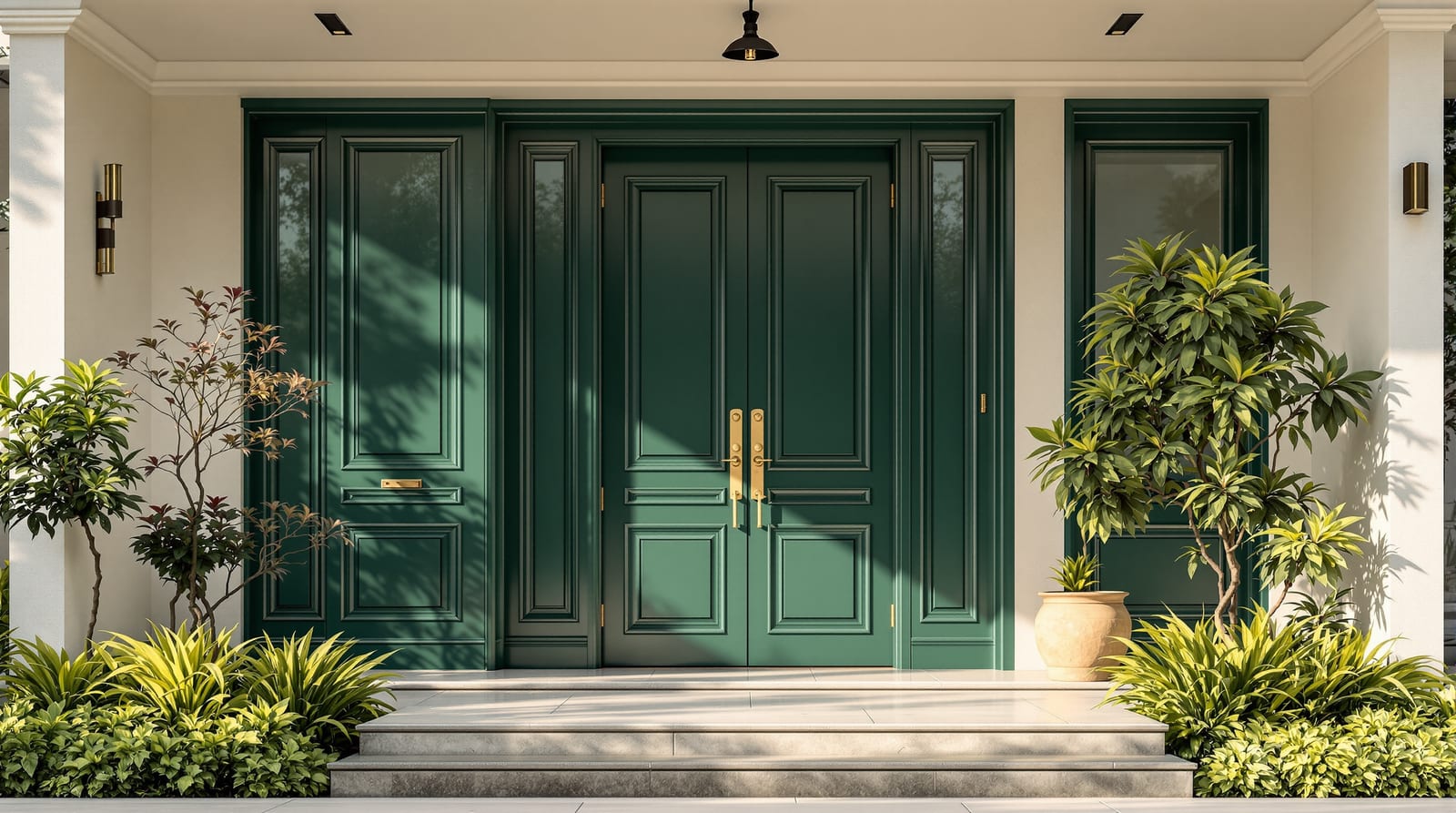
Door Colour Ideas for Indian Homes (2026): Main Door + Internal Doors
Main-door colour psychology, Vastu-by-direction guidance, 2026 palettes, sun-fade reality, and how to match doors to your wall, elevation and flooring.
Door colour is the cheapest, highest-impact decision in a whole house. A ₹6,000 main door in the right deep green reads more expensive than a ₹40,000 carved door in a tired off-white. Yet most Indian homes default to "wood-finish brown" or builder white by accident, not choice. This guide gives you a practical colour system for the main door and every internal door — grounded in Indian light, Vastu tradition, climate and the finishes that actually hold their colour.
We will keep two ideas separate throughout: the main door, which is a public, symbolic, weather-exposed object, and internal doors, which are a quiet backdrop you live with daily. They follow different colour rules.
How to think about main-door colour
Your main door is seen three ways: from the street (against your elevation), at the threshold (up close, in shade), and from inside (against your hall wall). A colour that sings on a swatch can disappear against grey stone cladding or fight a red oxide floor. So choose the colour in place, not in a shop.
Three reliable strategies work for Indian elevations:
- Earthy and grounded — natural teak, walnut, terracotta, oxblood, deep brown. Reads warm, traditional, safe. Pairs with stone, brick, and most Indian flooring.
- Bold accent — deep green, navy, charcoal, indigo, deep maroon. The door becomes the elevation's focal point against neutral plaster or white. This is the strongest 2026 look.
- Quiet and architectural — black, graphite, off-white, dove grey, natural oak. The door recedes; the hardware, jali or panelling does the talking. Suits minimalist elevations.
For the design language behind these, see main door design and modern door designs. For the carved/teak tradition, see traditional Indian doors.
Colour psychology: what each main-door colour signals
| Colour | Mood / signal | Best placement (Vastu + practical) | Watch-outs |
|---|---|---|---|
| Natural teak / wood-brown | Rootedness, prosperity, "established home" | Excellent all directions; classic for N/E/NE | Needs annual oiling/melamine to stay rich; greys if neglected |
| Deep / forest green | Growth, calm, nature; very on-trend | N, E, NE (associated with growth/wealth) | Cheap greens look municipal — go deep and muted, not bright |
| Navy / indigo | Trust, depth, quiet confidence | N, NW; fine for shaded entries | On a south/west sun-baked door it fades faster (see below) |
| Charcoal / graphite | Modern, premium, architectural | N, W, NW; pairs with grey stone | Reads cold without a warm threshold lamp or brass handle |
| Terracotta / rust | Warmth, earth, Indian-modern | S, SW, SE (earth/fire quadrants) | Can clash with red-oxide or rust-toned tiles nearby |
| Deep maroon / oxblood | Auspicious, festive, traditional | S, SE (fire); common for pooja-adjacent entries | Very dark in low light; pair with brass and a bright lamp |
| Mustard / ochre | Welcoming, sunny, vernacular | E, SE | Hard to match to cool-toned grey elevations |
| Off-white / dove | Clean, airy, lets door carving show | Universal; good when wall is dark | Shows dust, grime and monsoon splash fast on exteriors |
| Black | Bold, luxe, high-contrast | W, NW, SW; not traditional for the main door | See Vastu note below — many families avoid pure black |
Treat "mood" as a starting point, not a rule. The same navy reads luxe in a shaded NRI-style portico and gloomy in a dark north hall.
Vastu colour guidance by direction (belief + reasoning)
In Vastu, the direction your main door faces is considered far more important than its colour, and the broader prescriptions — main door largest, opening inward and clockwise, an even number of panels, a dehleez (threshold) — are covered in Vastu for the main door and entrance Vastu. This section only adds the colour layer; please read those for the full directional logic and don't treat colour as a substitute for placement.
The traditional colour-by-direction associations, with the reasoning many practitioners give:
| Door faces | Element / association | Favoured colours (tradition) | Reasoning given |
|---|---|---|---|
| North | Water, wealth (Kubera) | Green, blue, white, wood | Cool tones said to support flow of opportunity |
| East | Air, new beginnings (sunrise) | Wood-brown, light green, white | Warm dawn light; avoid heavy dark tones |
| Northeast (Ishan) | Most auspicious zone | Wood, cream, light yellow, pale green | Kept light and clean to "not block" the zone |
| South | Fire, fame | Red, maroon, terracotta, orange | Earth/fire tones reinforce the quadrant |
| West | Earth/Saturn | Blue, grey, white, wood | Calming, grounded tones |
| Southwest | Earth, stability | Brown, beige, terracotta, yellow | Heavier earth tones for the "stability" corner |
On black: a widely held belief discourages a pure-black main door, the reasoning being that black is associated with Saturn/Rahu, absorbs rather than welcomes energy, and (practically) absorbs heat and shows dust. If you love the look, most practitioners are comfortable with very-dark charcoal, deep graphite or near-black brown as a softer compromise — and a brass nameplate, toran and threshold lamp restore warmth and auspiciousness regardless of colour. Frame all of this as tradition plus reasoning, then decide with your family; there is no structural requirement here, only belief and aesthetics. Plan placement with the door Vastu planner.
Trending 2026 palettes
The 2026 mood in Indian door colour is deep, muted and earthy, moving away from glossy primaries and orange-toned "teak laminate" toward sophisticated naturals:
- Deep forest / bottle green — the breakout main-door colour, especially in PU or matte Duco against white or grey plaster.
- Charcoal & graphite — pairs with the grey-stone, exposed-concrete and metal-louvre elevations dominating new builds.
- Terracotta & rust — the warm counter-trend; "Indian modern", great with lime-plaster and cane.
- Navy & deep indigo — quietly premium; reads well with brass and warm wood handles.
- Natural / matte wood — open-pore, low-sheen teak and oak veneers; the un-glossy, honest-wood look (see veneer doors and laminate door designs).
- Two-tone — a darker outer face (statement) with a calmer inner face, or a wood-grain leaf with a contrast frame/architrave. This is the single most flexible 2026 idea; the full playbook is in two-tone door designs.
A simple swatch strip for the five most-asked-for 2026 main-door colours:
How Indian sun and climate change your colour choice
This is the rule most homeowners learn the hard way: darker, exposed doors fade and heat up faster. A south- or west-facing main door takes brutal afternoon sun across much of India. On such a door:
- Dark colours fade visibly within 2-4 years — navy, deep maroon and black lose depth and go chalky/patchy, especially in cheaper paints and PVC laminates.
- Surface heat builds up. A black or charcoal leaf in direct sun can get uncomfortably hot to touch and stresses adhesives on laminate/membrane finishes, sometimes causing edge lifting.
- Monsoon + UV cycling is the real killer — repeated wet-dry-bake cycles crack ordinary enamel and lift skins.
Practical responses: on a sun-baked, unshaded main door, prefer PU (polyurethane) coatings or factory Duco (both far more UV- and weather-stable than ordinary enamel), choose mid-tones over deepest darks, or shift the dark colour to the inner face and keep the weather-side lighter. A deep porch/chajja overhang changes everything — a shaded door can wear almost any colour. For exposure-driven material choices generally, see best door material for India.
Matching the door to wall, elevation and flooring
A door colour is never judged alone; it is judged against three big surfaces.
- Against the wall/elevation: for a statement, go opposite — dark door on light plaster, or a warm wood door on cool grey stone. For calm, stay tonal — a charcoal door on grey cladding, dressed up with brass hardware.
- Against the flooring (inside): warm floors (red oxide, terracotta, teak, beige Kota) love warm doors (wood, terracotta, ochre). Cool floors (grey vitrified, marble, black granite) carry charcoal, navy and white better. A clash here is what makes a hall feel "off" even when each element is nice.
- Hardware is part of the colour scheme: brass/antique-gold warms a dark door; matte black or stainless reads modern on green and charcoal. Decide hardware tone with the door colour, not after — see the door hardware guide.
Rule of thumb: pick one of {wall, floor, door} to be the bold one. If your elevation is already busy (stone + louvres + colour), let the door be quiet wood or charcoal.
Finishes that actually hold colour
Colour longevity is 80% about the finish system, not the shade. Here is how the common options behave on Indian doors.
| Finish | How colour is achieved | Colour-hold / durability | Indicative cost | Best for |
|---|---|---|---|---|
| PU (polyurethane) coating | Tinted/clear over wood or primer | Excellent; UV- and scratch-resistant, retains depth | Premium (₹/sq ft on top of door) | Statement main doors, exposed doors |
| Duco / PU spray (factory) | Sprayed automotive-style paint | Excellent, even, repairable; can re-coat later | Premium | Solid colour modern doors (green, charcoal) |
| Laminate (1 mm) | Pre-coloured decorative sheet | Very good indoors; cheaper grades sun-fade outdoors | ₹600-2,500 per 8x4 sheet | Internal doors, shaded main doors |
| PVC membrane (on MDF) | Heat-pressed coloured/woodgrain film | Good indoors; poor in direct sun/heat (can lift) | ~₹120-300/sq ft | Internal, bedroom, wardrobe doors |
| Veneer + melamine/PU | Natural wood + clear topcoat | Good; needs periodic re-coat; richest "real wood" look | ₹1,500-6,000 per veneer sheet | Premium natural-wood look |
| Enamel paint | Brushed/rolled colour | Fair; cheapest, easiest to refresh, but chalks/cracks outdoors | Lowest | Budget, repaintable, traditional |
(Costs indicative, vary by city/vendor; add ~18% GST and fitting.) The headline: for a bold exterior colour that lasts, spend on PU or Duco; for internal colour, laminate and veneer give you the widest palette at the lowest risk. Compare laminate options in door laminate designs.
Internal-door colour strategy
Internal doors are a backdrop, not a focal point. Two strategies dominate Indian homes:
1. Neutral and consistent (recommended for most): one calm finish on every internal door — usually a white/off-white laminate or a single woodgrain (oak, walnut, teak) laminate. The doors visually "disappear," the rooms feel larger and more cohesive, and resale-friendly. White suits modern, light interiors; matched woodgrain suits warm, traditional ones.
2. Accent doors, deliberately: a single bold internal door — study, child's room, or a pooja room door — in deep green, navy or a contrast colour, while every other door stays neutral. One accent reads designed; five accents read chaotic.
Room-specific notes: keep bathroom doors light and moisture-friendly (white laminate, WPC, FRP); a kitchen door in a warm woodgrain hides scuffs; bedroom doors can carry a quiet woodgrain or a soft muted accent. Match the door tone to your wardrobe/shutter laminate for a built-in look. Plan room by room with interior doors by room.
A safe default that almost never looks wrong: internal doors in one woodgrain laminate that matches your main interior wood (wardrobes, TV unit), with white architraves — calm, cohesive, and timeless.
Frequently asked questions
What is the best colour for a main door in an Indian home?
There is no single best — but the safest high-impact choices in 2026 are a deep, muted colour (forest green, charcoal, navy) on a light elevation, or a rich natural wood/teak for a traditional look. Match it to your elevation and floor, keep it Vastu-appropriate for your door's direction, and use a PU/Duco finish if it faces the sun.
Is a black main door bad as per Vastu?
Traditionally, pure black is discouraged for the main door (associated with Saturn/Rahu, and practically it absorbs heat and shows dust). This is belief, not a rule — many people use very-dark charcoal or near-black brown as a softer compromise, and a brass nameplate, toran and threshold lamp restore warmth. See Vastu for the main door; decide with your family.
Will a dark door colour fade in the sun?
Yes, on exposed south/west doors. Dark shades (navy, maroon, black) fade fastest, and cheap laminates/membranes can lift in heat. If the door is unshaded, choose PU or factory Duco, lean to mid-tones, or put the dark colour on the inner face and keep the weather side lighter. A good chajja/porch overhang largely solves it.
Should all my internal doors be the same colour?
For most homes, yes — one neutral finish (white or a single woodgrain laminate) on every internal door looks calmest, makes rooms feel larger, and is resale-friendly. Add one deliberate accent door (study or pooja room) if you want personality, not five.
What's an easy two-tone door idea?
Use a darker, bolder colour on the outer/public face of the main door and a calmer tone (or wood) on the inner face, or pair a woodgrain leaf with a contrasting frame/architrave. It's the most flexible 2026 look — the full playbook is in two-tone door designs.
For the full picture across types, materials and costs, start from the complete home doors guide.
Export this guide
Related Guides — Deep-dive reading
Two-Tone Door Designs in India (2026): Dual-Finish Doors, Combinations & How to Choose
The trending dual-finish look — how to combine two colours, materials or finishes on one door, the best Indian combinations, split rules and how to execute it in laminate, veneer or PU.
Home Doors & EntrancesMinimalist Door Designs in India (2026): Flush, Frameless & Concealed-Frame Doors
The clean-line, no-architrave, hidden-hardware door language behind modern Indian apartments and designer interiors — flush-to-wall doors, concealed hinges, recessed pulls, tall leaves and what the look really costs.
Home Doors & EntrancesDoor Design Trends 2026 in India: 13 Looks Reshaping Indian Homes
From floor-to-ceiling and concealed-frame doors to fluted surfaces, pivot entries, smart locks and biophilic jali screens — the door trends defining Indian homes in 2026, with costs and where to use each.
Home Doors & EntrancesRelated Tools — Try Free
Cross-Ventilation Analyzer
Estimate airflow and air changes per hour (ACH) from room size, window areas, layout, and local wind — with NBC 2016 Part 8 compliance check.
Ventilation CalculatorDoor Laminate Finish Selector
Answer a few questions and get a recommended door laminate finish family — woodgrain, solid, textured, gloss or matte.
Design SelectorVastu Window Planner
Vastu guidance for window placement and size by wall direction and room — rating and remedies.
Vastu