
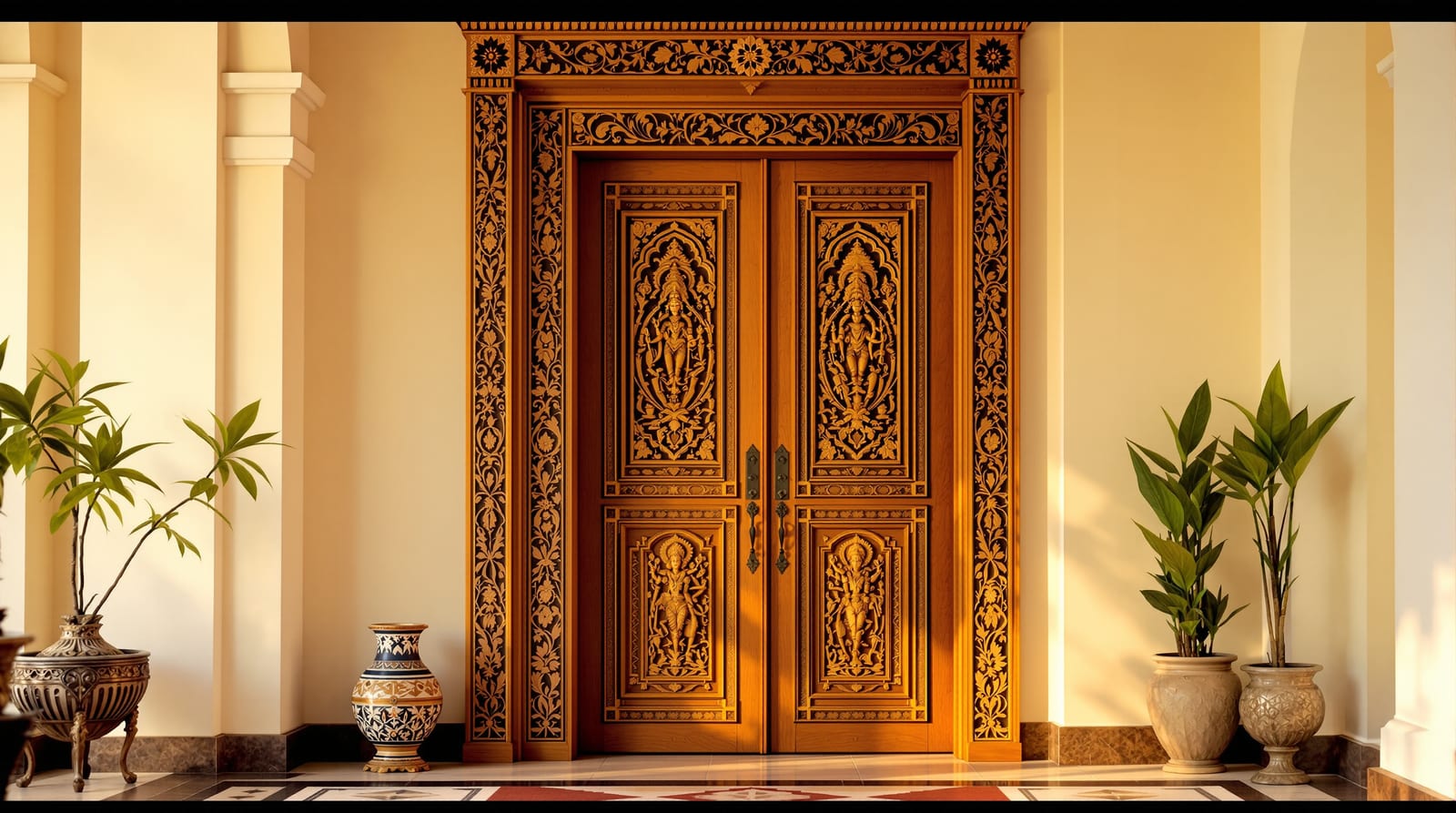
Carved Door Designs in India (2026): Motifs, Regional Styles, Hand vs CNC & Costs
A design-led guide to ornamental carved wooden doors for Indian homes — regional traditions, motifs, hand-carving vs machine carving, wood choice, where they belong and what they cost.
A carved door is the one element of an Indian home that still speaks in the old language of the chisel. Long before laminates and CNC routers, a carved entrance announced the family inside — its region, its faith, its prosperity — through depth of relief, the choice of motif and the patience of the hands that cut it. This guide is about the DESIGN and craft of carved doors: the regional traditions, the motifs and what they mean, how hand-carving differs from machine carving, which woods take a carving and where in your home an ornamental door truly belongs. For broad door-buying logic see the complete guide, and for the wider ornamental tradition pair this with traditional Indian doors.
What "carved" actually means
Carving is the removal of material to create relief — a raised or recessed pattern cut into a solid timber panel or stile. It is fundamentally different from a moulded, routed or pressed design (covered in door moulding designs), where a profile is run along an edge rather than a picture cut into a face. Three things define a carved door:
- Depth of relief — shallow (3-6 mm, decorative outline), medium (8-15 mm, the common range for residential florals) or deep/high relief (15-30 mm+, almost sculptural, used on heritage and temple-style doors). Depth is the single biggest driver of both labour and price.
- The motif — the subject cut into the wood, from abstract geometry to figurative gods and animals.
- The execution — hand chisel work, machine (CNC) routing, or a hybrid where a machine roughs out and a craftsman finishes.
Because carving needs solid wood of some thickness to cut into, a genuinely carved door is almost always a solid wood door, not a hollow flush door. That alone places carved doors at the premium end of the market — see designer door price for where they sit overall.
Regional carving traditions of India
India does not have "one" carved-door style; it has many, each shaped by local timber, climate, faith and patronage.
| Tradition / region | Signature look | Typical motifs | Common wood | Hand or machine today |
|---|---|---|---|---|
| Rajasthan (Jodhpur, Shekhawati, Udaipur) | Dense all-over relief, brass studs, jharokha framing | Floral vines, peacocks, elephants, lattice borders | Sheesham, mango, reclaimed teak | Mostly hand; antique-reclaimed common |
| Gujarat / Kutch | Deep figurative panels, mirror and bone inlay accents | Florals, parrots, deities, geometric bands | Teak, sheesham | Hand-led, some hybrid |
| Kerala (Nettipattam / temple style) | Heavy, dark, high-relief with brass fittings | Lotus, kalasam, deities, lamp motifs | Local teak, jackwood (anjili), rosewood | Hand |
| Chettinad (Tamil Nadu) | Tall double doors, carved columns and lintels, fine borders | Lakshmi, lotus, yali, geometric pillars | Burma teak, satinwood | Hand; restored antiques prized |
| Saharanpur (Uttar Pradesh) | Crisp shallow-to-medium relief, jaali fretwork | Floral arabesque, grapevine, leaf scrolls | Sheesham (Indian rosewood), mango | Both — the CNC hub of India |
| Karnataka / Chennapatna belt | Geometric and floral, lighter relief | Lotus, vine, rosette | Honne, teak | Mixed |
Saharanpur deserves a special mention: it is the country's largest wood-carving cluster and the place where a great deal of "Rajasthani" and "antique" carved furniture and doors are actually produced today, both by hand and increasingly by CNC. When you buy a carved door in Bengaluru or Mumbai, there is a fair chance the leaf travelled from Saharanpur or Jodhpur.
Common motifs and what they mean
Motif choice is rarely arbitrary in an Indian home — it is tied to the room and to belief.
- Floral vines and creepers (bel / lata): the everyday workhorse motif, suiting almost any door. Continuous, rhythmic, easy to scale up or down in relief.
- Lotus (kamal): purity and auspiciousness; very common on pooja room doors and main doors.
- Peacocks and parrots: beauty, love, prosperity; popular in Rajasthani and Gujarati work, usually mirrored as a pair.
- Elephants (gaja): strength, royalty, good fortune; flanking a main door like guardians.
- Ganesha: the remover of obstacles, carved as a central panel or lintel motif on main entrances — the single most-requested figurative carving in India.
- Ashtalakshmi / Lakshmi panels: the eight forms of Lakshmi or a single Lakshmi, the classic theme for a pooja room door; a carved Ashtalakshmi pooja door is a category of its own.
- Geometric and jaali (lattice): diamonds, rosettes and pierced fretwork — the carved cousin of the jali door, letting filtered light and air through while staying ornamental.
- Kalasam, diya and bell motifs: ritual symbols reserved for pooja and prayer spaces.
A practical Vastu note that homeowners often raise: gods are traditionally carved so the deity faces a person entering, and figurative pooja-door carving is treated with the same reverence as an idol. Frame these choices as tradition and personal belief, and for door placement and direction cross-link Vastu for the main door rather than re-deciding it here.
A carved panel, in outline
The diagram below shows how a single carved panel is built up — a recessed field, a carved central motif in medium relief, and a framing border. It is the basic unit a craftsman repeats across a door leaf.
A full door leaf is usually a grid of such panels (often an even number, which tradition considers auspicious), sometimes with a continuous carved border running around the whole leaf and a heavier carved lintel or top rail.
Hand carving vs CNC / machine carving
This is the decision that most affects authenticity, detail and cost.
| Aspect | Hand carving | CNC / machine carving |
|---|---|---|
| How it is made | Mallet and chisels by a karigar, freehand or to a drawn pattern | Router bit driven by a programmed file cutting a repeated pattern |
| Detail and depth | Undercuts, varied depth, sculptural high relief, figurative work | Limited undercut, uniform depth, best for repeatable 2.5D relief |
| Character | Each piece slightly unique; tool marks read as "alive" | Perfectly identical, crisp, can look mechanical on close view |
| Speed | Slow — days to weeks per door | Fast — hours per leaf once programmed |
| Cost | High (labour-hours dominate) | Lower per unit, especially at volume |
| Best for | Heritage main doors, deep figurative gods, restoration, one-offs | Mid-range decorative doors, repeated florals/jaali, budget carved looks |
Honest guidance: a good CNC floral or jaali door at medium relief looks excellent and costs a fraction of hand work — it is the right choice for most homeowners who want an ornamental door without a heritage budget. Hand carving earns its premium where it shows: deep relief, figurative deities, undercut sculpture, and the slight irregularity that machines cannot fake. A common hybrid — machine roughing followed by hand finishing — gives much of the hand "feel" at a lower price, and many "hand-carved" doors sold today are exactly this.
Wood choice for carving
A carving is only as good as the timber it is cut into. The wood must be close-grained, stable and hard enough to hold a crisp edge without chipping. See wooden doors and teak wood doors for the broader material picture.
- Teak (Burma / CP / plantation): the benchmark — stable, oily, termite- and moisture-resistant, takes deep relief and polish beautifully. The default for a premium carved main door. Cross-link teak wood doors.
- Rosewood (sheesham / Indian rosewood): dense, dark, very fine grain that holds sharp detail; the staple of Saharanpur carving. Heavier and pricier than mango, superb for fine floral and jaali work.
- Mango wood: affordable, carves cleanly, good for medium-relief decorative doors; less durable outdoors, better for interior and pooja doors.
- Reclaimed / antique timber: old teak and sheesham salvaged from havelis — prized for character and stability, common in "vintage" carved doors.
Avoid expecting real carving on MDF, plywood or WPC doors — any "carving" there is moulded or pressed, not cut, and reads flatter. That is a legitimate budget look, just not the same craft.
Where carved doors belong in an Indian home
Ornamental carving is high-impact but should be used with restraint — not every door wants it.
- Main entrance: the classic home for a carved door — a single or grand double door with a Ganesha or floral lintel, deep relief and a carved frame. This is where a carved door earns its keep visually and culturally.
- Pooja room: the second most common — Ashtalakshmi, Lakshmi, lotus or kalasam panels, often a smaller double-leaf door with jaali for ventilation.
- Heritage, villa and farmhouse interiors: carved doors as feature partitions, study doors or statement internal doors suit traditional, Indian-contemporary and villa schemes.
- Where to avoid: bathrooms (carving traps moisture and dust), high-traffic utility doors, and minimalist or modern interiors where a carved leaf fights the language — see minimalist door designs and modern door designs for those rooms instead.
Maintenance — the real cost of ornament
Carving's beauty is also its upkeep. The recessed field and undercuts collect dust, which is the most common complaint.
- Dusting: use a soft dry brush (a clean paintbrush or shaving brush) to reach into the relief weekly; a vacuum brush attachment helps. Avoid wet wiping into deep carving — water sits in the recesses.
- Polish: re-oil or re-polish (melamine, PU or traditional wax/lacquer) every 1-3 years depending on exposure; teak takes oiling well. A carved main door facing rain or coastal salt needs a protective coat and an overhang.
- Climate: in monsoon-heavy and coastal India, ensure the door is well seasoned and the frame (chowkat) sealed, or fine carving can crack as the timber moves. Termite treatment matters for sheesham and mango.
What carved doors cost in 2026 (indicative, varies by city, vendor and depth)
Costs are for the carved leaf (material plus carving labour); frame, hardware, fitting and +18% GST are extra. Carving labour-hours, depth of relief and wood are the big drivers.
| Door type | Method | Wood | Indicative price (leaf) |
|---|---|---|---|
| Light decorative carved interior door | CNC / machine | Mango / plywood-core with solid rails | ₹6,000 - 12,000 |
| Medium-relief floral / jaali door | CNC or hybrid | Sheesham / mango | ₹12,000 - 30,000 |
| Carved pooja-room door (Lakshmi / lotus, double leaf) | Hand or hybrid | Sheesham / teak | ₹20,000 - 60,000 |
| Carved teak main door, medium-deep relief | Hand-led | Teak | ₹40,000 - 1,00,000 |
| Heritage / deep figurative main door (Ganesha, high relief) | Full hand | Premium / reclaimed teak, rosewood | ₹1,00,000 - 3,00,000+ |
| Antique / reclaimed haveli door (restored) | Hand (vintage) | Old teak / sheesham | Highly variable; ₹40,000 - 2,00,000+ |
For where these sit against other premium doors see designer door price and the door cost benchmark; estimate your own with the door cost calculator. Remember a heavy carved door also needs robust hinges and a strong frame — budget for hardware accordingly, and read door hardware.
Frequently asked questions
Is a CNC carved door "fake"?
No — it is a different, legitimate technique. CNC routing cuts a real recessed pattern into solid wood and looks excellent at medium relief. What it cannot do is deep undercuts, sculptural figurative work and the subtle hand irregularity of a karigar's chisel. For most homeowners a CNC or hybrid floral door is the sensible, affordable choice; reserve full hand carving for heritage main doors and deep figurative panels.
Which wood is best for a carved door?
Teak for a premium, durable carved main door — stable, weather- and termite-resistant, takes deep relief and polish. Sheesham (Indian rosewood) for fine, crisp detail at lower cost, which is why Saharanpur carving favours it. Mango is the budget option for medium-relief interior and pooja doors. Carving on MDF, plywood or WPC is moulded, not truly cut.
Are carved doors hard to maintain?
The carving collects dust, so plan on a weekly soft-brush dusting and re-oiling or re-polishing every one to three years. Keep carved doors away from constant moisture — bathrooms are a poor fit — and give an external carved main door an overhang and a protective coat against monsoon and coastal salt.
Can I have a carved door in a modern home?
Yes, but use it as a deliberate accent — a single carved feature door or pooja door against otherwise clean interiors — rather than carving every leaf. A heavily carved door in an all-minimalist scheme can clash; if you want texture without ornament, look at two-tone, fluted or panelled looks in modern door designs instead.
How much does a carved main door cost in India in 2026?
Indicatively, a medium-relief CNC floral door runs about ₹12,000-30,000, a hand-led carved teak main door roughly ₹40,000-1,00,000, and a deep figurative heritage door (Ganesha, high relief) ₹1,00,000-3,00,000 or more — leaf only, before frame, hardware, fitting and 18% GST. Depth of relief and carving labour-hours move the price more than anything else.
Export this guide
Related Guides — Deep-dive reading
Kerala Traditional Doors: The Nalukettu Padippura & Carved Main Door Explained (2026)
The heritage door style of the Kerala tharavadu, from the padippura gateway to the carved teak and aanjili main door, its motifs, brass studs and panel proportions, and how it is revived in modern Kerala homes.
Home Doors & EntrancesDouble Doors in India (2026): Two-Leaf Entrances, Proportions, Hardware & Cost
When a double-leaf door makes sense for Indian main entrances, pooja rooms and master suites, plus active/inactive leaf hardware, the Vastu note on even panels, security at the meeting stile and the rupee premium over a single door.
Home Doors & EntrancesTraditional Indian Door Designs: Kerala, Chettinad, Rajasthani & Temple-Style Heritage Doors
A heritage tour of India's great door traditions - Kerala nalukettu teak, Chettinad mansions, Rajasthani haveli carving, South-Indian temple doors, brass cladding and nakshi work, thresholds and toranas - and how to bring reclaimed and revival traditional doors into a modern home.
Home Doors & EntrancesRelated Tools — Try Free
Door Cost Calculator
Estimate the all-in cost of a door — leaf, frame, hardware, fitting and GST — by type, material and size.
Door CalculatorDouble Door Planner
Decide single vs double from your opening width and get leaf sizes, hardware and a Vastu even-leaf note.
Door PlannerCross-Ventilation Analyzer
Estimate airflow and air changes per hour (ACH) from room size, window areas, layout, and local wind — with NBC 2016 Part 8 compliance check.
Ventilation Calculator