
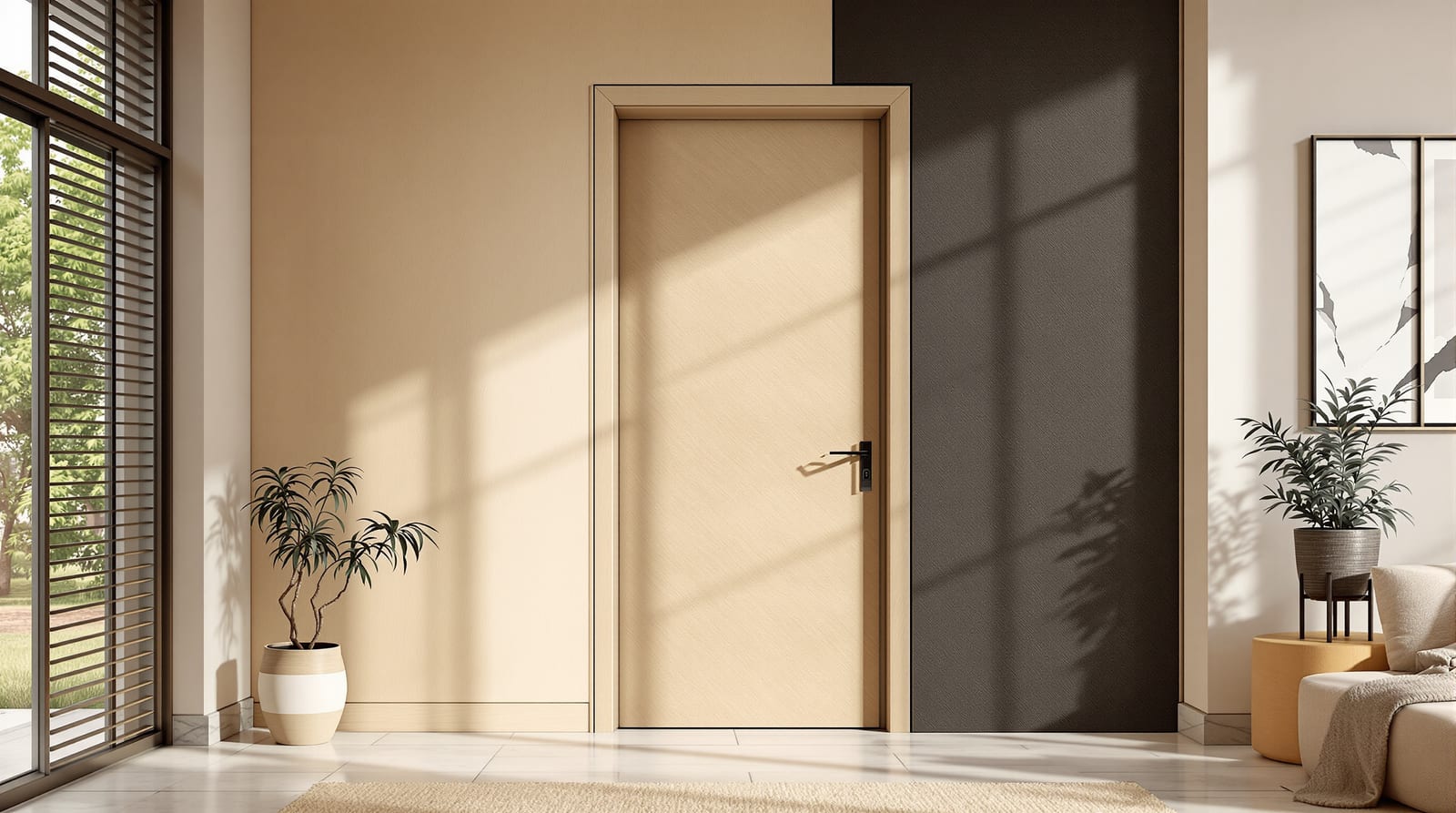
Two-Tone Door Designs in India (2026): Dual-Finish Doors, Combinations & How to Choose
The trending dual-finish look — how to combine two colours, materials or finishes on one door, the best Indian combinations, split rules and how to execute it in laminate, veneer or PU.
Walk through any new flat showroom or designer home in India in 2026 and you will notice the doors are no longer one flat colour. A pale oak leaf carries a slim charcoal band down its hinge edge; a white-framed door wraps a deep walnut panel; a fluted teak strip splits a matte grey shutter in two. This is the two-tone door — the single cheapest design trick to make an ordinary flush shutter look custom and current. Done with restraint it adds depth and a clean modern edge; overdone it turns into a clash of finishes that dates fast.
This guide explains exactly what two-tone means, the combinations that actually work in Indian homes, how to decide which colour faces which room, the finish-pairing rules that keep it from looking busy, and how to execute it in laminate, veneer or PU. For the wider colour and finish picture, pair this with our door colour ideas guide and the laminate designs guide; for the trend context see modern door designs and minimalist door designs.
What "two-tone" actually means
A two-tone (or dual-finish) door simply combines two distinct colours, materials or finishes on one door instead of a single uniform face. The contrast can be created several ways:
- Two colours on the same leaf — for example a light body with a dark accent band.
- Two materials — a woodgrain laminate paired with a solid PU colour, or a veneer leaf in a painted frame.
- Two finishes of the same family — matte and gloss of the same colour, or smooth and fluted texture.
- Door versus frame — a dark leaf set in a light chowkat (frame), or vice versa.
- Inside versus outside — the leaf finished one colour facing one room and a different colour facing the next (more on this below — it is the quiet superpower of two-tone doors).
The point is contrast with control: two deliberate tones, not a random mix. The eye reads the split as intentional design rather than a mismatch.
Why two-tone doors are having a moment
Three practical reasons sit behind the trend, beyond it simply looking good:
1. Instant depth on a flat shutter. A plain flush door is a featureless rectangle. Adding a second tone — a band, a panel, a fluted strip — gives it a focal line and a sense of layering without any expensive carving or moulding.
2. It solves the two-room colour problem. A door sits between two rooms that often have different schemes. A two-tone door lets you finish each face to match its own room (a pale grey facing the living room, a warm wood facing the bedroom) so neither room compromises. This is the most under-used benefit and worth planning deliberately.
3. Modern, designer look on a budget. Two-tone reads as bespoke joinery, but in laminate it costs barely more than a single-finish door — just a second sheet and a clean joint line. It is the cheapest way to lift a builder-grade door to look intentional.
For a feature main door it also creates a strong first impression that ties into the elevation; for bedroom and wardrobe doors it brings warmth and a tailored feel.
The combinations that work in Indian homes
Not every pairing reads well. These are the dual-finish combinations that look resolved in Indian interiors, with where each belongs.
| Two-tone combination | Effect | Best placement |
|---|---|---|
| Woodgrain laminate + solid colour band | Warm and modern; the band adds a crisp graphic line | Bedroom and main doors |
| Light frame + dark leaf (or reverse) | Architectural, gallery-like; frames the door as an object | Main door, study, feature doorways |
| Vertical colour-block (two colours split down the leaf) | Bold, contemporary, makes a narrow door feel taller | Main door, living-area entries |
| Veneer leaf + PU colour frame/border | Premium, tailored; natural grain against a clean colour | Master bedroom, formal study |
| Laminate + fluted/reeded accent strip | Adds real texture and shadow play, not just colour | Main door, feature wall doors |
| Matte body + gloss panel (same hue) | Subtle, luxe; reads as quality rather than contrast | Wardrobe, dressing, modern bedroom |
| Metal/brass inlay line between tones | Jewel-like detail; lifts a plain leaf to designer level | Main door, pooja-room door |
| Inside one colour, outside another | Each room keeps its own scheme; invisible compromise | Any door between two differently styled rooms |
A safe default for first-timers: a light woodgrain body (oak, ash, beech print) with a single charcoal, olive or deep-blue solid band down the handle or hinge edge. It is hard to get wrong and works across both modern and transitional homes.
Choosing the split: which colour faces which room
The split is a design decision, not an afterthought. A few rules that hold up:
- Heavier/darker tone low or to the hinge side, lighter tone toward the handle, so the door feels grounded and opens "lighter".
- Vertical splits make a door look taller (good for standard 2100 mm / 7-ft openings); horizontal bands make it look wider and can squat a short door — use horizontals sparingly.
- Match each face to its room's elevation. If the leaf shows into a grey-and-wood living room on one side and a warm bedroom on the other, finish each face accordingly. Carpenters and factory units can laminate two different sheets on the two faces at little extra cost.
- For a main door, tie the dominant tone to the building elevation — pick up a wood or metal accent already on the façade so the door belongs to the house, not just the lobby.
Finish-pairing rules (so it doesn't look busy)
Two-tone goes wrong when it becomes three- or four-tone, or when warm and cool fight. Keep these rules:
- Two tones, full stop. Resist adding a third colour, a third texture and hardware in a fourth finish. One contrast does the work.
- Balance warm and cool, don't clash them. Pair a warm woodgrain with a cool neutral (charcoal, slate, off-white, sage) rather than two saturated warms or two saturated cools. Wood + a muted solid almost always works.
- Let one tone dominate. Aim for roughly a 70:30 or 60:40 split, not 50:50, so there is a clear "body" and a clear "accent". Equal halves can look unresolved unless the colours are very closely related.
- Carry the accent into the hardware. A brass inlay line wants brass/antique-brass handles; a black band wants matte-black or graphite handles. See the door hardware guide for finishes.
- Keep sheen sensible at handle height. High-gloss two-tone shows fingerprints fast in a busy Indian household; matte or super-matte hides marks and is the safer everyday choice, especially for kids' rooms and the main door.
A simple two-tone face
Here is the most reliable two-tone layout — a light body with a contrasting vertical band and a thin inlay line — drawn as a door elevation (portrait, the way a real leaf reads).
The same logic scales: swap the band for a fluted strip, the inlay for a brass profile, or finish the reverse face in a third room-matched colour.
How to execute two-tone: laminate, veneer or PU
The method decides cost, sharpness of the joint and how custom you can go.
| Method | How the two tones meet | Cost feel | Best for |
|---|---|---|---|
| Laminate (two HPL sheets) | Two sheets butt-joined with an inlay or groove at the seam | Lowest — easiest two-tone | Most homes; bedroom, wardrobe, main doors |
| Laminate + fluted/reeded panel | Flat laminate body with a textured strip glued on | Low-medium | Feature and main doors wanting texture |
| Veneer + PU painted frame/band | Natural veneer leaf, PU-sprayed border or band | Medium-high | Premium master-bedroom and study doors |
| PU / Duco both tones | Both colours spray-painted with masked split lines | Highest; fully custom colour | Bespoke colour-blocking, exact brand shades |
A few execution notes grounded in Indian practice:
- Laminate is the easiest and cheapest route to two-tone. Any local carpenter can butt-join two laminate sheets; a clean result needs a deliberate joint — an aluminium/brass inlay strip, a routed groove, or an edge-band — so the seam reads as a design line, not a gap. Two laminate sheets at roughly ₹600-2,500 each plus pressing keeps a two-tone leaf only marginally above a single-finish flush door.
- Veneer with a PU border gives the richest look but the leaf must be lacquered carefully so the natural veneer and sprayed colour age evenly. Veneer sheets run ₹1,500-6,000 each before polish.
- PU / Duco lets you hit any colour and a perfectly crisp split using masking, but it is labour-intensive spray work — budget the highest, and insist on a dust-free site and 2-3 coats. It is the route for exact colour-blocked main doors.
- Threshold and frame: a two-tone leaf in a contrasting frame is the simplest version of all — finish the chowkat (frame) one colour and the leaf another. Frame finishing adds little since the chowkat is being polished anyway.
- GST and fitting: factory two-tone shutters carry the usual ~18% GST; budget ₹800-3,000 per door for fitting and ₹1,500-8,000 for the hardware set, the same as any flush door. Costs are indicative and vary by city and vendor.
For where two-tone fits among current looks — fluting, minimalist, jali and colour — see door design trends 2026 if you are mapping the whole scheme, and the traditional Indian doors guide if you want a brass-inlay two-tone with a heritage flavour.
Frequently asked questions
Does a two-tone door cost much more than a normal door?
In laminate, barely. You are adding a second decorative sheet and a clean joint line, so a two-tone leaf typically costs only a little above a single-finish flush door. PU/Duco two-tone or veneer-plus-paint costs noticeably more because of the spray and masking labour. Fitting and hardware stay the same.
Which two-tone combination is safest for a first attempt?
A light woodgrain body (oak, ash or beech print) with one solid accent band — charcoal, deep blue, olive or off-white — down the handle or hinge edge, in a matte finish. It suits modern and transitional homes and is very hard to get wrong. Keep it to two tones and let the wood dominate.
Can the same door be a different colour on each side?
Yes — and it is one of the best uses of two-tone. A door between two differently styled rooms can be laminated or painted to match each room on its own face. Factory units and carpenters do this routinely at little extra cost. Plan it at the time of ordering so each face matches its room's elevation.
Will a two-tone main door work with Vastu?
Two-tone is a finish choice and does not conflict with Vastu, which is concerned with direction, size and the door being the largest and opening inward. Keep the dominant tone warm and welcoming and tie it to the elevation; see Vastu for the main door for direction and detailing.
How do I keep the split line looking sharp over time?
Define the seam with a physical detail — a brass or aluminium inlay strip, a routed groove or an edge-band — rather than letting two finishes simply touch. A defined joint reads as intentional, resists peeling at the seam through monsoon humidity, and ages far better than a raw butt-join.
Export this guide
Related Guides — Deep-dive reading
Bedroom Door Design in India: Materials, Sizes, Finishes, Privacy and Cost (2026)
How to choose and design a bedroom door for Indian homes — privacy, light-noise control, finishes that match the room, the right 900x2100 internal door, locks and ₹ budget.
Home Doors & EntrancesDoor Laminate Designs for Indian Homes (2026): Finishes, Combinations & Room Ideas
A design-led guide to laminate door finishes — woodgrain, solid colour, textured, high-gloss, matte and stone-look — plus how to combine them room by room with 2026 trends.
Home Doors & EntrancesDouble Doors in India (2026): Two-Leaf Entrances, Proportions, Hardware & Cost
When a double-leaf door makes sense for Indian main entrances, pooja rooms and master suites, plus active/inactive leaf hardware, the Vastu note on even panels, security at the meeting stile and the rupee premium over a single door.
Home Doors & EntrancesRelated Tools — Try Free
Door Cost Calculator
Estimate the all-in cost of a door — leaf, frame, hardware, fitting and GST — by type, material and size.
Door CalculatorDoor Laminate Finish Selector
Answer a few questions and get a recommended door laminate finish family — woodgrain, solid, textured, gloss or matte.
Design SelectorCross-Ventilation Analyzer
Estimate airflow and air changes per hour (ACH) from room size, window areas, layout, and local wind — with NBC 2016 Part 8 compliance check.
Ventilation Calculator