
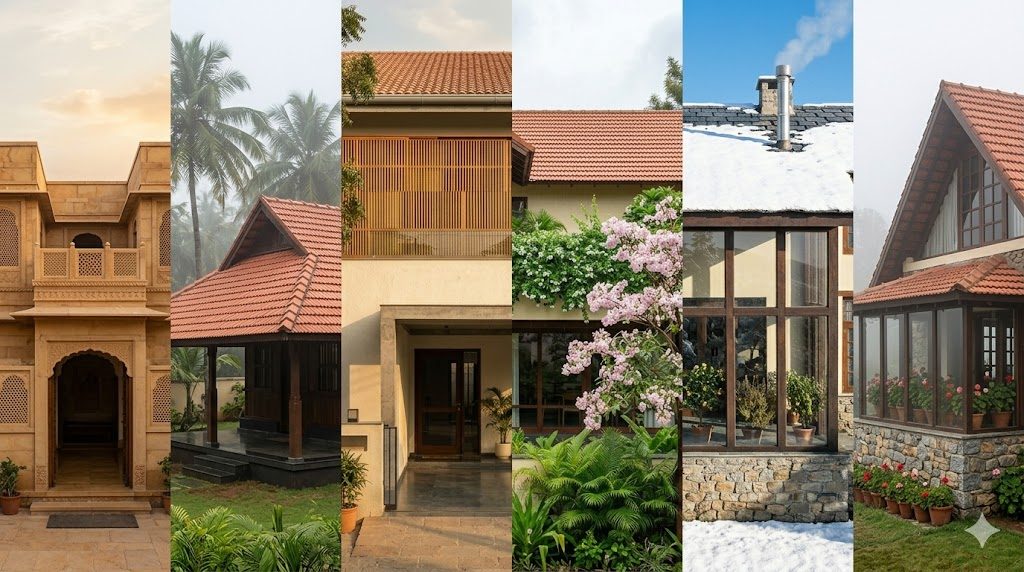
Which 30 × 40 ft House Plan is Right for You
A Climate-Zone Decision Framework for Indian Homeowners — Across Six Zones, Six Typologies, One Plot Size
India has six climate zones, one billion four hundred million people, and one of the world's worst residential-design pathologies: most homes are built with the wrong climate's detailing. A builder trained in Mumbai uses verandahs and steep roofs in Delhi. A builder trained in Delhi uses cavity walls and Trombe glass in Bengaluru. A Bengaluru architect copies Chandigarh details into Manali. The result is consistent — homes that fight their climate for seven months a year, run air-conditioners they shouldn't need, mould in monsoons they should breathe through, and freeze in winters they should harvest.
There is no single "Indian house plan." There never was. The country has six distinct climates, recognised in the National Building Code 2016 / SP 41 (BIS, 1987), and each one demands a different envelope, a different orientation, a different roof slope, a different material palette, and a different relationship with sun, wind, and water.
This guide is the decision framework for choosing a climate-appropriate plan on a typical Indian residential plot. We use 30 × 40 ft (1,200 sqft) — the most common small-plot size across Indian Tier-1 and Tier-2 cities, the size that the country's house-building middle class actually builds on, the size at which climate decisions become most consequential. Studio Matrx's House Plans library ships six anchor designs, one per climate zone, all on this same 30 × 40 ft plot. This guide pulls them together and tells you which one is yours.
In five minutes, you will know:
- Which of India's six climate zones your city sits in
- Which long-axis orientation works on your plot (E–W vs N–S vs corner)
- Which biophilic typology fits your zone (haveli, verandah pavilion, shaded cube, garden pavilion, Trombe cabin, hill cottage)
- What it will cost, broadly, in 2026 rupees
- The single most common mistake to avoid before you start
"Build with the climate, not against it. The climate will eventually win — the question is whether your home wins with it." — Laurie Baker (1917–2007)
1. India's Six Climate Zones — A Five-Minute Geography
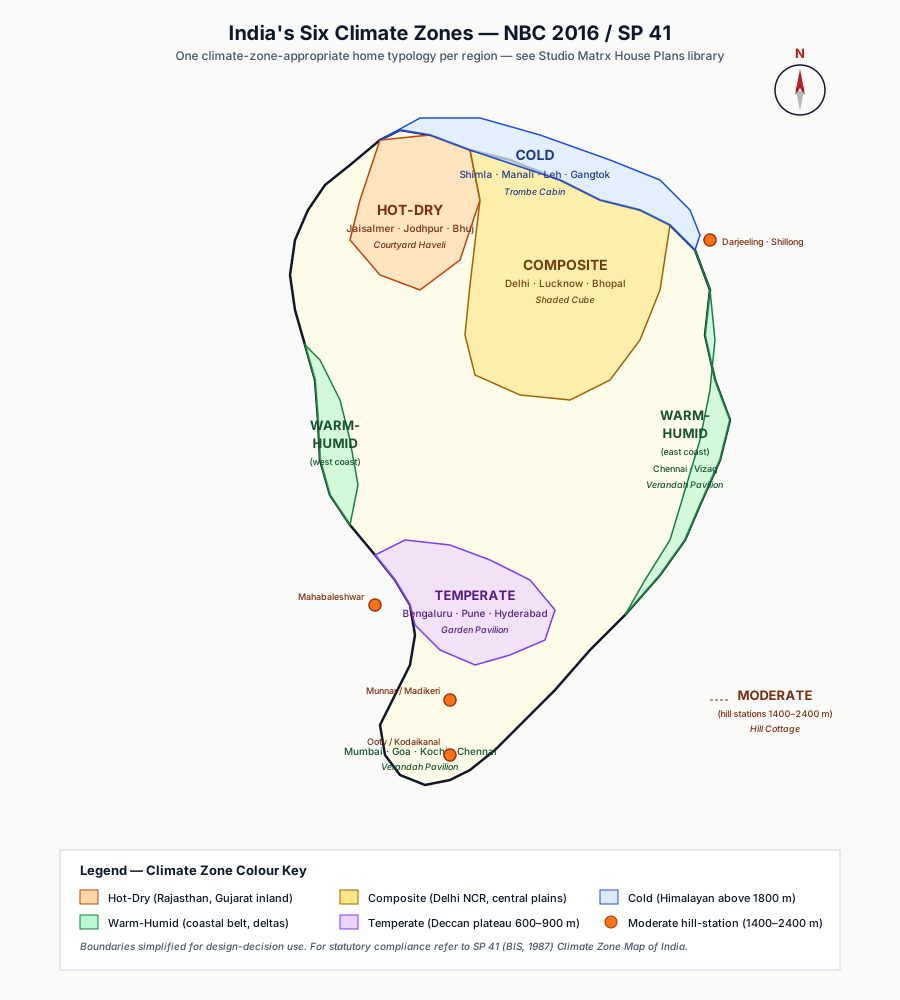
The National Building Code 2016, drawing on the older Special Publication 41 (BIS, 1987) Climate Zone Map, divides India into six climate zones. Each has a distinct combination of temperature range, humidity, rainfall, and diurnal swing — the four variables that drive every residential design decision.
| Zone | Where It Sits | Summer Range | Winter Range | Annual Rainfall | Dominant Constraint |
|---|---|---|---|---|---|
| Hot-Dry | Rajasthan, Gujarat (Kutch + inland), western MP, south-west Haryana | 32–45 °C (peak 48 °C) | 8–22 °C (occasional 4 °C) | 200–600 mm | Heat + diurnal swing 15 °C+ |
| Warm-Humid | Coastal belt: Mumbai, Goa, Kerala, coastal Karnataka / Tamil Nadu / Andhra / Odisha / West Bengal | 26–34 °C | 18–28 °C | 1,500–3,500 mm | Humidity 75%+ |
| Composite | Delhi NCR, UP, central + eastern MP, Maharashtra (Vidarbha), Punjab, Haryana, Bihar, Jharkhand | 32–45 °C | 4–22 °C | 600–1,200 mm | Four-season swing + dust |
| Temperate | Deccan plateau interior: Bengaluru, Pune, Mysuru, Hyderabad (uplands), Coimbatore (uplands), Belagavi | 18–32 °C | 14–28 °C | 700–1,000 mm | None — design lightly |
| Cold | Himalayan + Hindukush above ~1,800 m: Shimla, Manali, Srinagar, Leh, Gangtok, Dharamshala, Nainital | 8–28 °C | −10 to +14 °C | 800–1,600 mm (snow inclusive) | Cold + heat loss |
| Moderate | Hill stations 1,400–2,400 m: Mahabaleshwar, Ooty, Kodaikanal, Munnar, Madikeri, Chikkamagaluru, Darjeeling, Kalimpong, Shillong, Mussoorie | 14–25 °C | 5–18 °C | 2,500–4,500 mm | Monsoon + persistent fog |
The boundaries are simplified for design-decision use. For statutory compliance (ECBC, NBC 2016) refer to the SP 41 map, your local urban development authority, and the Passive Design — India Climate Zones guide which goes deeper into NBC code-mapping.
A few edge cases to be aware of when you place yourself on this map:
- Pune straddles Temperate (central, ≤ 600 m altitude) and Composite (PCMC industrial belt, hotter). The Temperate plan suits most central-Pune plots; Composite suits PCMC / hot side.
- Hyderabad city centre is Temperate (Deccan plateau interior, ~540 m). Outer suburbs at lower elevations drift toward Composite.
- Mumbai vs Pune — the 100 km that separate them are two different climate zones. Mumbai is Warm-Humid; Pune is Temperate. The same plan does not work in both.
- Goa is Warm-Humid year-round. Do not import Pune detailing.
- Pondicherry is Warm-Humid (coastal Tamil Nadu).
- Chandigarh is Composite (sub-Himalayan but on the plains).
- Dehradun straddles Composite (lower town) and Moderate (Mussoorie-adjacent slopes).
If you are unsure, our Plot Evaluation tool will geo-locate your plot and confirm the zone in 20 seconds.
"The open-to-sky space is, in a warm climate, the most important architectural element." — Charles Correa (1930–2015), in The New Landscape (1985)
2. Why 30 × 40 ft is the Right Scale for This Decision
Before we go further: why 30 × 40 ft (9.14 m × 12.19 m, 1,200 sqft), and not the bigger plots in design magazines or the row-house slivers in older neighbourhoods?
Three reasons.
First, it is the dominant Indian middle-class plot size. Across DDA's residential layouts, BBMP's BDA layouts, GHMC's HMDA layouts, BMC plot-divisions in newer suburbs, and the post-2000 plotted developments in Pune, Indore, Bhopal, Lucknow, and Patna, 30 × 40 ft (or its metric equivalent, 9 × 12 m or 1,200 sqft) is the single most common plot allocation. Hundreds of thousands of such plots exist; a much smaller number of 40 × 60 ft or 60 × 90 ft plots do.
Second, it is the threshold below which the central-courtyard typology becomes architecturally tight. A courtyard needs ~2.4 × 2.4 m (8 × 8 ft) minimum to function thermally (provides daylight to 4 surrounding rooms, allows stack ventilation, accommodates a small water bowl + planting). On a 30 × 40 ft plot with appropriate setbacks, an 8 × 8 ft court can fit alongside three rooms per floor; below 25 × 30 ft, the courtyard either shrinks to a lightwell or sacrifices a usable room.
Third, at this scale climate decisions become consequential. A larger plot can absorb design mistakes — the air-conditioning load is larger, but it's distributed across more rooms and the homeowner has more budget. At 30 × 40 ft, the family is exposed to every climatic mistake the home makes. The smaller the plot, the more disciplined the climate response must be.
If your plot is bigger than 30 × 40 ft, the typology guidance in this article still applies — orientations and material palettes don't change. The room schedule expands and the courtyard / verandah / sunspace can be more generous.
If your plot is smaller than 30 × 40 ft (e.g., 20 × 30 ft, common in Mumbai chawls or older Bengaluru layouts), you cannot put a 8 × 8 ft courtyard. The typology that scales best to small lots is the Warm-Humid Verandah Pavilion (verandahs on one face only, no internal court) or the Cold Trombe Cabin (compact mass with no court at all).
3. The Three-Step Decision Tree
The fastest way to use this framework is the three-step decision tree below. Trace your city across three decisions; the third step ends at your typology + plan slug.
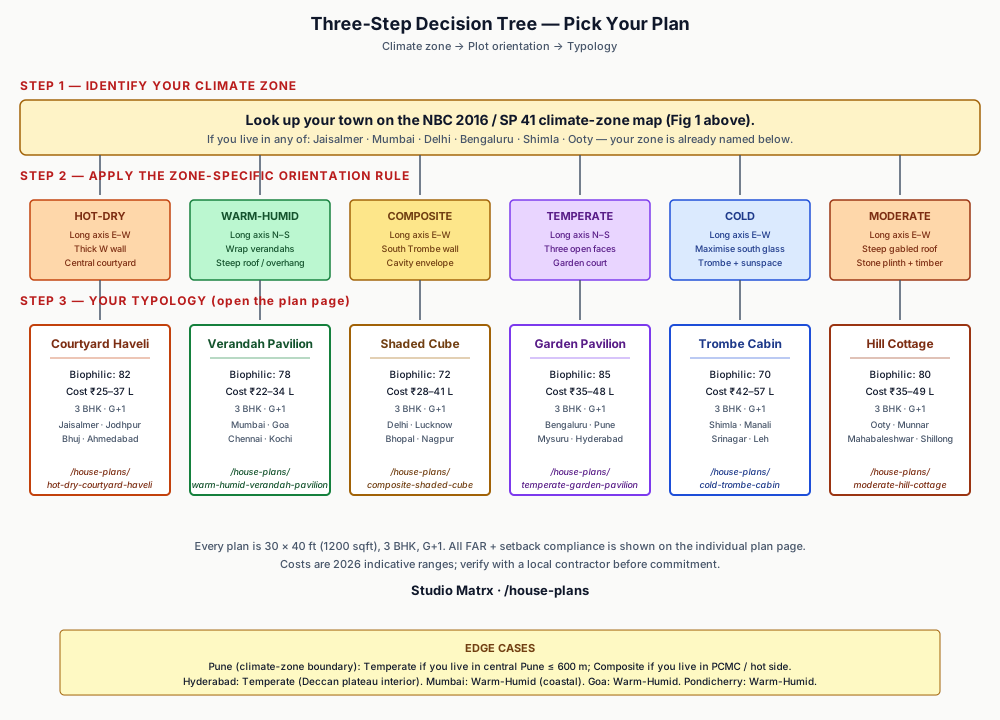
The three steps:
Step 1 — Identify your climate zone
Use the map in Section 1 or look up your city in the table. If you live in any of the named city anchors, your zone is determined.
Step 2 — Apply the zone-specific orientation rule
The rule changes per zone:
- Hot-Dry: Long plot axis E–W. The 40 ft (12.19 m) dimension runs east-west so the long facade faces north. Entry east. Thick west wall as thermal buffer.
- Warm-Humid: Long axis N–S. The 40 ft dimension runs north-south so the long facades face east + west, and verandahs wrap them. Entry east (or north-east in Vastu-priority).
- Composite: Long axis E–W. South facade is dominant — it carries the Trombe wall. Entry east.
- Temperate: Long axis N–S. The 40 ft dimension runs N-S so the long faces are east + west, open on all three habitable sides. Entry north-east (the most Vastu-auspicious orientation; the climate permits it).
- Cold: Long axis E–W. South facade is dominant — maximum south glass for winter passive solar. Entry east (with airlock vestibule).
- Moderate: Long axis E–W. South facade carries the sunporch. Entry east. Slope of plot typically drops N → S.
These rules are simple but not arbitrary. They derive from sun angles at the latitude of each zone, from the prevailing wind direction in each region, and from the centuries of vernacular practice that solved each climate before air-conditioning existed.
Step 3 — Open the plan page for your typology
The decision tree's six end-points are the six anchor designs in the Studio Matrx House Plans library. Each is a near-buildable 30 × 40 ft 3 BHK G+1 home, with full deep-content prose, FAR/setback compliance for 5–8 representative cities in the zone, materials schedule, cost band, plant palette, Vastu rating, and a biophilic score against the 16-criterion framework.
4. The Six Typologies
A brief tour of each — what defines it, who it's for, what it gets right.
Hot-Dry — Courtyard Haveli
The central courtyard is the climate engine: 8 × 8 ft open-to-sky court in the middle of the plan, paved in kota stone with a brass-rimmed water bowl. The court does five jobs simultaneously — stack ventilation, daylight to surrounding rooms, evaporative cooling, Vastu Brahmasthan, social heart. Thick lime-plastered AAC walls provide thermal mass. A west-facing carved sandstone jaali on the upper floor (60–70% perforation) blocks 85% of afternoon sun while admitting breeze.
Suitable cities: Jaisalmer, Jodhpur, Bikaner, Bhuj, Ahmedabad, Hisar.
Biophilic score: 82 / 100 — Exemplary. Cost band 2026: ₹25–37 L for 1,400 sqft built-up.
Plan: /house-plans/hot-dry-courtyard-haveli-1200sqft.
Warm-Humid — Verandah Pavilion
The wrap-around verandah is the climate engine. Generous overhangs (1.5–2.0 m) shade the building face year-round; the verandah itself doubles as a transitional living room, particularly during the monsoon. Steep Mangalore-tile gabled roof sheds 1,500–3,500 mm of annual rain. Lime mortar (not cement) tolerates 80%+ monsoon humidity without spalling. Cross-ventilation is the dominant comfort strategy — both faces of every habitable room are openable.
Suitable cities: Mumbai, Goa, Mangalore, Kochi, Chennai, Visakhapatnam, Pondicherry, Kolkata (coastal Bengal).
Biophilic score: 78 / 100 — Strong. Cost band 2026: ₹22–34 L.
Plan: /house-plans/warm-humid-verandah-pavilion-1200sqft.
Composite — Shaded Cube
The south Trombe wall is the climate engine: a 230 mm RCC + dark mineral paint + 50 mm air gap + 8 mm low-e tempered glass system that absorbs winter sun by day and releases heat into the living space after sunset, adding 4–7 °C to night-time indoor temperature without any active heating. AAC cavity-wall envelope (U = 0.32 W/m²K) addresses summer + winter equally. Deep east + west jaalis cut summer afternoon gain. 600 mm overhangs on south admit winter sun, block summer sun.
Suitable cities: Delhi, Lucknow, Bhopal, Nagpur, Indore, Patna, Chandigarh.
Biophilic score: 72 / 100 — Strong. Cost band 2026: ₹28–41 L.
Plan: /house-plans/composite-shaded-cube-1200sqft.
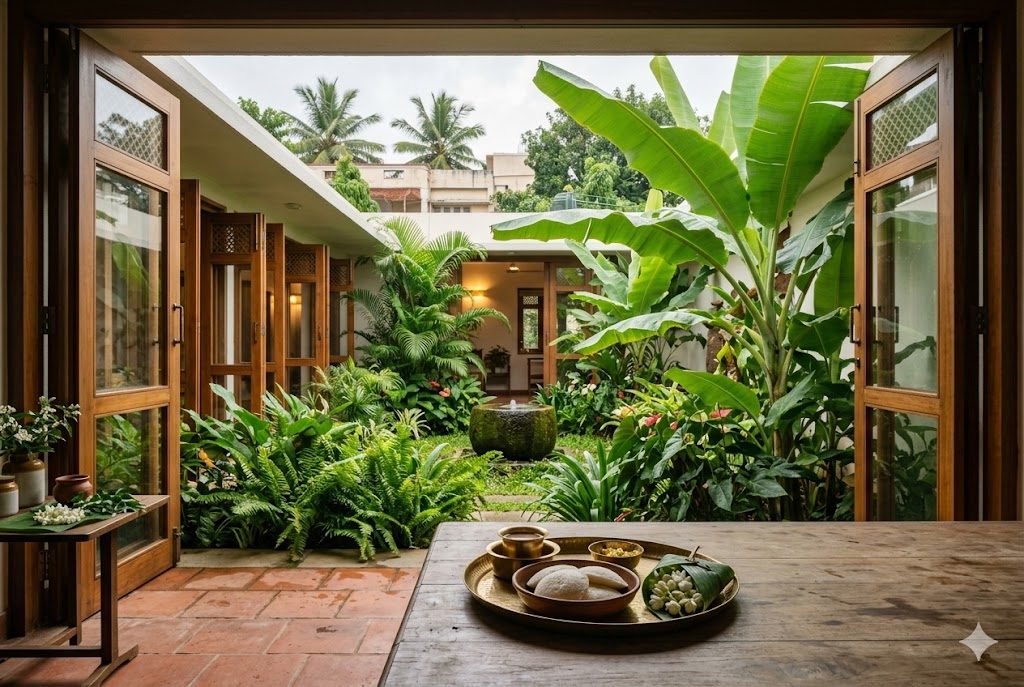
Temperate — Garden Pavilion
The climate is so forgiving that the design opens itself up. Three open faces with full-height openings, a planted ground-floor garden court, a wrap-around first-floor balcony herb spiral, and a productive roof terrace with kitchen-garden boxes + 3 kWp solar. Lightweight fly-ash brick envelope (insulation unnecessary). Burma teak window frames, terracotta Mangalore-tile roofs over verandahs. No air-conditioning needed.
Suitable cities: Bengaluru, Mysuru, Pune (central), Hyderabad (uplands), Coimbatore (uplands), Belagavi.
Biophilic score: 85 / 100 — Exemplary (the highest of all six anchors — the climate permits it). Cost band 2026: ₹35–48 L.
Plan: /house-plans/temperate-garden-pavilion-1200sqft.
Cold — Trombe Cabin
Compact, super-insulated, south-facing. Every cubic metre of enclosed volume costs in heat loss, so the building is small. South facade is dominant — a 8 × 12 ft glazed sunspace + a 230 mm RCC Trombe wall + south DGU bedroom windows. Together they carry 55% of daily winter heating load. A cast-iron bukhari (wood-burning stove) on a stone hearth provides ~20% of remaining load. Rockwool insulation (75 mm walls, 100 mm roof). Vestibule airlock entry. Sloped slate or GI roof for snow.
Suitable cities: Shimla, Manali, Srinagar, Leh, Gangtok, Dharamshala, Nainital.
Biophilic score: 70 / 100 — Strong (climate constraints limit biophilic expression). Cost band 2026: ₹42–57 L (~30% more expensive than plains construction).
Plan: /house-plans/cold-trombe-cabin-1200sqft.
Moderate — Hill Cottage
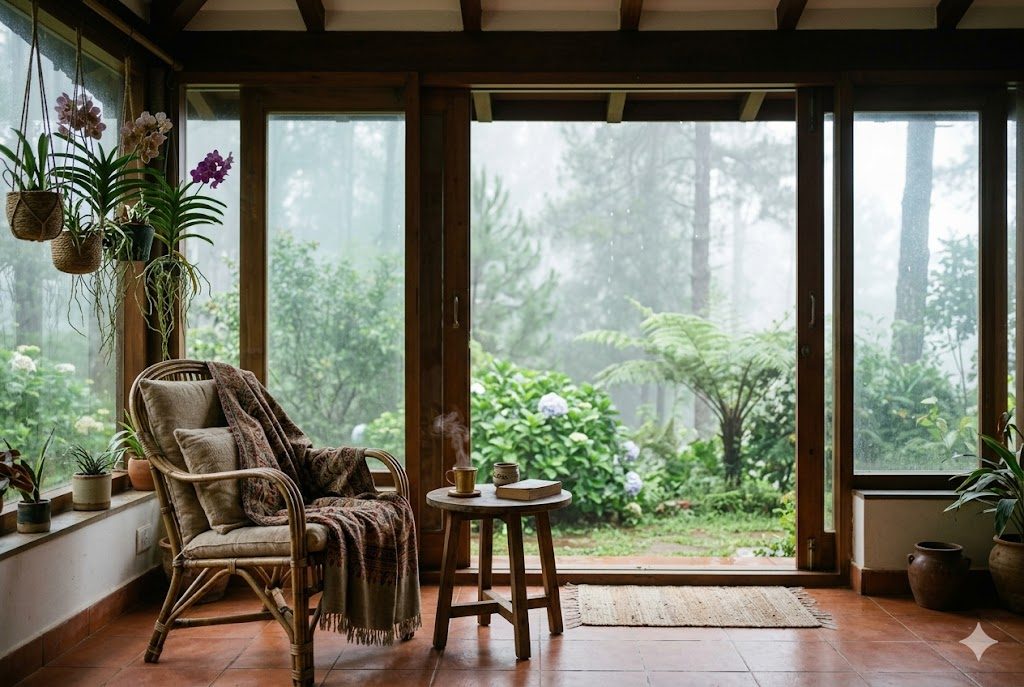
The double-height fireplace parlour is the emotional + thermal centre. Stone plinth + AAC cavity upper + 30–35° gabled Mangalore-tile or slate roof + 6 × 18 ft sunporch + mudroom airlock entry. Random-rubble Nilgiri-granite or Mahabaleshwar trap-rock plinth. Burma teak window frames. Heated bathroom floor (a hill-station luxury). Wraps Anglo-Indian + Khasi vernacular references — Nilgiri tea-estate bungalow, Mussoorie cottage, Darjeeling tea-garden quarters.
Suitable cities: Mahabaleshwar, Panchgani, Ooty, Kodaikanal, Munnar, Madikeri, Chikkamagaluru, Darjeeling, Kalimpong, Shillong, Mussoorie, Lansdowne.
Biophilic score: 80 / 100 — Exemplary. Cost band 2026: ₹35–49 L.
Plan: /house-plans/moderate-hill-cottage-1200sqft.
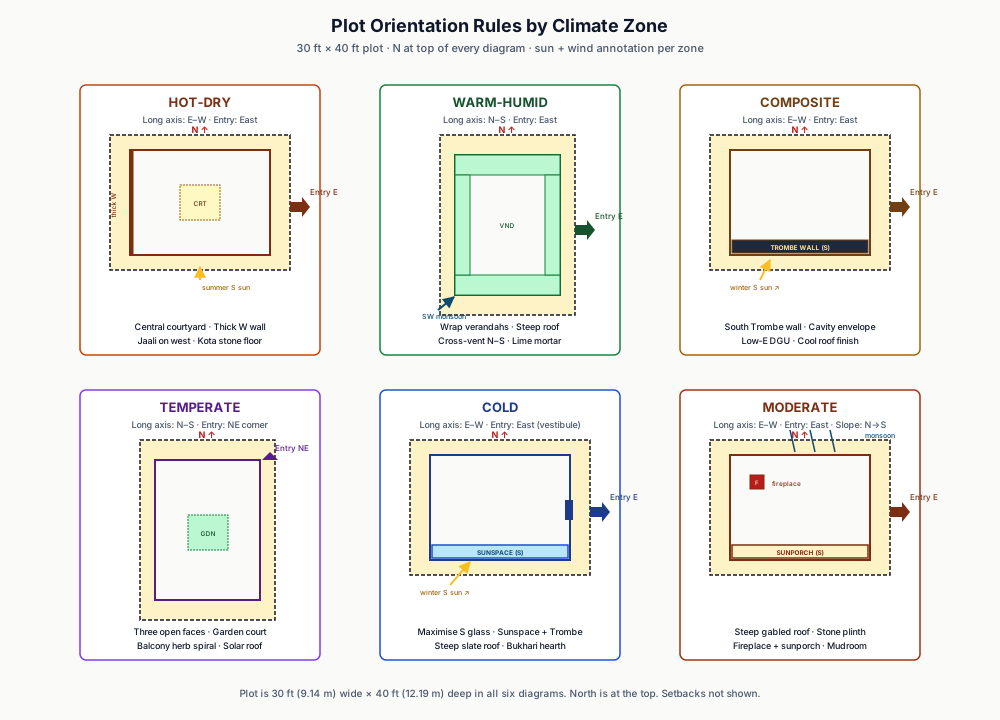
5. Plot Orientation Rules — Why Each Zone Differs
The orientation differences in the decision tree are not stylistic. They are direct responses to the latitude, sun angles, and prevailing wind of each zone.
| Zone | Long Axis | Why | Entry | Why |
|---|---|---|---|---|
| Hot-Dry | E–W | Long facade faces N (cool side); short west wall (afternoon sun) is thickest | E | Morning sun is gentle; entrance avoids SW summer wind |
| Warm-Humid | N–S | Both long faces face E + W; verandahs shade both equally; long axis catches SW monsoon | E or NE | Morning sun; monsoon hits west and rear, not entry |
| Composite | E–W | South facade dominant for Trombe wall; long axis maximises south glazing area | E | Vastu-positive; cool side for entry |
| Temperate | N–S | The climate doesn't punish any orientation; N–S gives best cross-vent and biggest south face for solar PV | NE corner | NE is the most Vastu-auspicious and the climate permits it |
| Cold | E–W | South-dominant facade for maximum winter solar capture; north minimised | E | Practical for vestibule + parking; south face reserved for sunspace + Trombe |
| Moderate | E–W | South facade carries sunporch + heated parlour; north slope handles drainage | E | Practical; mudroom airlock keeps fog + rain out |
The single most important corollary: if your plot has the wrong long-axis orientation relative to your climate zone, the plan must be mirrored, rotated, or in some cases redesigned. A 30 × 40 ft plot with the long dimension running N–S in Jaisalmer (where it should run E–W) cannot simply use the Hot-Dry Haveli design — the courtyard ends up shaded wrong, the west wall is on the wrong side, and the thermal strategy collapses. In such cases, your two options are:
1. Use the typology of a different climate zone whose orientation matches your plot (e.g., use the Warm-Humid Verandah Pavilion typology on a misaligned Hot-Dry plot — sub-optimal but workable).
2. Adapt the typology with a 90-degree shift — re-plan the rooms but keep the climate response (the courtyard moves; the thick wall moves; setbacks adjust).
Both adaptations need an architect's hand. Studio Matrx's Find Architect tool can connect you with local practitioners.
6. Comparison Matrix — Six Typologies at a Glance
| Feature | Hot-Dry Haveli | Warm-Humid Verandah | Composite Cube | Temperate Pavilion | Cold Trombe Cabin | Moderate Cottage |
|---|---|---|---|---|---|---|
| Long axis | E–W | N–S | E–W | N–S | E–W | E–W |
| Entry direction | E | E / NE | E | NE | E (airlock) | E (mudroom) |
| Central feature | Courtyard | Wrap verandah | South Trombe wall | Garden court | Sunspace + Trombe | Fireplace parlour |
| Roof | Cool-roof flat RCC | Steep Mangalore tile | Sloped RCC + cool finish | Mangalore tile + flat RCC mix | Steep slate / GI | Steep Mangalore / slate / CGI |
| Wall envelope | AAC + lime | AAC + lime + verandah | AAC cavity + rockwool | Fly-ash brick + lime | AAC + rockwool 75 mm | Stone plinth + AAC + rockwool 50 mm |
| Insulation | Mass (thermal) | None (cross-vent) | Mass + insulation | None | Maximum (passive house) | Cavity + roof insulation |
| Glazing | Single, jaali-screened | Single, deep overhang | Low-E DGU | Single, full-height | Low-E argon DGU | Single (basic) / DGU (premium) |
| AC need | Optional 1 BR | None | Optional 1 BR | None | Never | None |
| Built-up sqft | 1,400 | 1,400 | 1,500 | 1,600 | 1,500 | 1,450 |
| Cost (basic) | ₹25 L | ₹22 L | ₹28 L | ₹35 L | ₹42 L | ₹35 L |
| Cost (premium) | ₹37 L | ₹34 L | ₹41 L | ₹48 L | ₹57 L | ₹49 L |
| Biophilic score | 82 | 78 | 72 | 85 | 70 | 80 |
| Vastu rating | Excellent | Excellent | Excellent | Excellent | Good | Good |
| Spatial strategy | Courtyard-led | Verandah-led | Jaali-filtered | Balcony-gardened | Material-led | Material-led |
| Signature room | Courtyard with urli | Wrap verandah | Trombe wall living | Garden court | Sunspace + bukhari | Fireplace parlour |
Costs are 2026 indicative bands for the cited zone's labour + material market. Verify with a local contractor for your city before commitment. Cost Calculator lets you adjust by city.
7. The Five Most Common Mistakes
After eighteen years of Indian residential practice, we see the same five mistakes repeatedly. They are all preventable.
Mistake 1 — Importing the wrong climate's detailing
This is the single most common failure. A Mumbai-trained architect designs in Delhi using verandahs and 6 mm single glazing. A Bengaluru architect imports flat RCC slabs into Munnar. A Delhi builder uses cavity walls and Trombe glass in Pune (overkill — temperate doesn't need them). Each wastes money and degrades comfort.
Fix: Use the typology that matches your climate zone, even if your architect proposes a different one. If your architect insists on "modern" detailing inappropriate to your zone, request the Plot Evaluation and Biophilic Score reports — both will surface the mismatch.
Mistake 2 — Flat RCC roofs in monsoon or snow zones
Flat slabs work in Hot-Dry (rainfall < 600 mm). They tolerate Composite if waterproofing is renewed. They fail in Warm-Humid and Cold and Moderate — pooled water during monsoon penetrates within 5 years, and pooled snow with thaw-freeze cycling cracks the slab within 3 winters.
Fix: Use Mangalore-tile or slate gabled roof in Warm-Humid, Cold, and Moderate. The cost premium over flat RCC is ₹150–300/sqft; the lifecycle saving is 4× over 30 years.
Mistake 3 — Air-conditioning in Temperate zone
Bengaluru and Pune homes routinely install 3-tonne split AC in every bedroom, then never use them more than 15 days a year. Each AC plus its tariff is ₹85,000–₹1.5 L sunk cost.
Fix: Design for cross-ventilation and ceiling fans; install at most one AC in the master bedroom for the rare hot week in April. The Temperate Garden Pavilion plan doesn't include AC.
Mistake 4 — Vastu-priority overriding climate-priority
Vastu rules sometimes conflict with climate. The classic example: a south-facing entry is Vastu-negative but climate-positive in the cold zone (south gets winter sun). A doctrinaire Vastu architect will reject the south-facing plan; the home will then run a heater 6 hours/day for the next 30 years.
Fix: In Hot-Dry, Warm-Humid, Composite, Temperate, and Moderate — Vastu and climate agree (the Studio Matrx Vastu Compliance Checker verifies). In Cold, climate priority outranks Vastu — see Section 7 of the Cold Trombe Cabin plan for the full discussion. See also Vastu for Modern Homes.
Mistake 5 — Building too tight on the plot
Maximising FAR is a tempting Indian habit. On a 30 × 40 ft plot, every square foot built reduces the planted setback area, the cross-ventilation airflow, the daylight penetration, and the biophilic score. A 1,200 sqft built-up at 75% ground coverage is almost always more comfortable than a 1,800 sqft built-up at 95% coverage, on the same plot.
Fix: Target 60–70% ground coverage; reserve 30–40% of the plot for planted setbacks, courtyard, verandahs, and balcony. The six anchor plans hit 50–55% ground coverage with biophilic scores in the 70–85 band; pushing coverage to 85% would drop the scores to 50–60.
8. Cost Realities by Zone (2026)
Construction cost per sqft varies more by climate zone than most homeowners realise. The six anchor plans give the picture:
| Zone | Basic ₹/sqft | Premium ₹/sqft | Why |
|---|---|---|---|
| Hot-Dry | 1,800 | 2,600 | Local stone + lime cheapest; AAC is mass-market |
| Warm-Humid | 1,750 | 2,500 | Mangalore tile + jackwood + lime; coastal labour |
| Composite | 1,900 | 2,700 | Trombe + Low-E DGU + cavity wall premiums |
| Temperate | 2,200 | 3,000 | Teak frames + Mangalore tile + solar PV; Bengaluru/Pune labour premium |
| Cold | 2,800 | 3,800 | Rockwool + DGU + slate + transport premium; specialist hill-town labour |
| Moderate | 2,400 | 3,400 | Stone + slate + fireplace + hill-town labour |
The Cold zone is 40–50% more expensive than Hot-Dry per sqft. The Temperate zone is 20% more expensive because of the labour premium, not the materials. Within a zone, premium vs basic is a ~40% gap, mostly accounted for by glazing (Low-E DGU adds ₹350/sqft of glazing) and roof material (slate adds ₹250–400/sqft over GI).
The lifecycle cost picture flips this. A Bengaluru Garden Pavilion at ₹35 L plus zero air-conditioning + near-zero electricity bill (with 3 kWp solar) is cheaper over 25 years than a Bengaluru-built sealed glass-box at ₹28 L plus ₹35,000/year electricity. A Shimla Trombe Cabin at ₹42 L plus ₹15,000/year wood is cheaper over 25 years than a Shimla code-build at ₹32 L plus ₹85,000/year wood. Climate-appropriate design always wins on lifecycle cost, often by Rs 10 L+ over a 25-year horizon.
9. Quick FAQ
My plot is 25 × 35 ft, not 30 × 40 ft. Can I still use the framework?
Yes. The orientation and typology guidance applies. The room schedule shrinks proportionally. Below 25 × 30 ft, the central-court typology (Hot-Dry, Temperate) becomes tight — consider the Warm-Humid Verandah Pavilion or the Cold Trombe Cabin instead, which both work on small lots.
My city sits on a climate-zone boundary. Which plan do I use?
For Pune, see Section 1 edge cases. For Hyderabad outskirts (Shamshabad, etc.), default to Composite. For Goa, Warm-Humid. For Chandigarh, Composite. For Dehradun, Composite if in town, Moderate if hill-side.
Is the 30 × 40 ft plot orientation about the plot or about the building?
Both. The plot is rectangular; the long axis of the plot is the rule. The building footprint inside the setbacks aligns with the plot. If your plot is oriented the wrong way for your climate zone, see Section 5 for the two adaptation paths.
What if my city is not in any of the named anchors?
Find the climate zone (use the map or table). Then check the "Suitable Cities" list in the matching plan page — most plans cover 5–8 cities and reference the broader zone. Smaller towns inherit the typology of their zone.
Do these plans comply with my city's bye-laws?
Each plan ships with a 4–8 city FAR/setback compliance snapshot. The Hot-Dry plan covers Jodhpur, Bhuj, Ahmedabad, etc. The Cold plan covers Shimla, Manali, Srinagar, Leh, Gangtok, Dharamshala. Verify with your local urban development authority before submission — see the Setbacks Across India guide and the India Regulatory Atlas.
Can I actually build these plans?
They are near-buildable — the configuration, dimensions, FAR, and setback are valid for the cited jurisdictions. Before you build, each plan requires site-specific structural design, MEP layout, local plan sanction, soil testing, and an architect of record. Each plan page lists the buildability checklist in Section "Buildability."
Can I modify the plans?
Yes. The plans are open reference designs. You can rotate, mirror, change room sizes, and add elements — the Studio Matrx Biophilic Score tool will tell you whether your modifications preserve or degrade the climate performance.
10. Reading Pairings + Tools
Foundation guides
- Passive Design — India Climate Zones — the climate-physics foundation behind every move in this article.
- Cross-Ventilation in Indian Homes — the airflow physics chapter.
- Sustainable Home Design India — the broader sustainability lens.
- Vastu Shastra for Modern Homes — the Vastu lens, with climate priority calls.
- Functional House Layout — India — programming + zoning logic.
Materials + execution
- Sustainable Home Design India
- Solar Power for Homes India
- Rainwater Harvesting
- Seismic Zones India Design — required reading for Cold + Moderate zones.
- Pooja Room Design
Regulatory
- Setbacks Across India
- FSI / FAR Computation — India
- Building Plan Approval
- India Regulatory Atlas — city-by-city FAR + setback + bye-laws.
Tools
- Plot Evaluation — geo-locate your plot, identify your climate zone
- Biophilic Score — score your plan against the 16-criterion framework
- Vastu Compliance Checker
- Cost Calculator — adjust by your city + finish tier
- Sun Path Analyzer — visualise sun on your site's latitude
- Cross-Ventilation Analyzer — check the through-section airflow
- Rainwater Tank Sizer — for Warm-Humid + Moderate + monsoon-heavy sites
Browse all six anchor plans
- /house-plans — the full library hub.
References
1. Bureau of Indian Standards (1987). SP 41 — Handbook on Functional Requirements of Buildings (Other than Industrial Buildings) — Climate Zone Map of India. New Delhi: BIS.
2. Bureau of Indian Standards (2016). National Building Code of India 2016, Part 8 — Building Services, Section 1 Lighting and Ventilation. New Delhi: BIS.
3. Bureau of Energy Efficiency (2018). Eco-Niwas Samhita — Energy Conservation Building Code for Residential Buildings. New Delhi: Government of India.
4. Manu, S., Shukla, Y., Rawal, R., Thomas, L.E. & de Dear, R. (2016). "Field studies of thermal comfort across multiple climate zones for the subcontinent: India Model for Adaptive Comfort (IMAC)." Building and Environment, 98, 55–70.
5. Krishan, A., Baker, N., Yannas, S. & Szokolay, S.V. (2001). Climate Responsive Architecture: A Design Handbook for Energy Efficient Buildings. New Delhi: Tata McGraw-Hill.
6. Correa, C. (1985). The New Landscape: Urbanisation in the Third World. Mimar Book / Concept Media.
7. Baker, L. (1991). Houses: How to Reduce Building Costs. COSTFORD / Centre of Science and Technology for Rural Development.
8. Dili, A.S., Naseer, M.A. & Varghese, T.Z. (2010). "Passive control methods of Kerala traditional architecture for a comfortable indoor environment." Energy and Buildings, 42 (11), 2139–2150.
9. Indraganti, M. (2010). "Thermal comfort in naturally ventilated apartments in summer: Findings from a field study in Hyderabad, India." Applied Energy, 87 (3), 866–883.
10. Tata Energy Research Institute (TERI) (2014). Sustainable Habitat: Inspirational Building Models for India. New Delhi: TERI Press.
11. Saini, B.S. (1980). Building in Hot Dry Climates. Wiley.
12. Bureau of Indian Standards (1980). IS 8888 — Guide for Requirements of Low Income Housing. New Delhi: BIS.
Author's note: India has more climates per square kilometre than any country its size. The country has also, paradoxically, the most homogenised contemporary residential architecture — a generic glass-and-RCC apartment box that ignores climate and lifecycle in roughly equal measure. The six-typology framework in this guide is not a stylistic preference; it is a return to the climate-responsiveness that Indian vernacular practised for 2,000 years before air-conditioning made the question seem optional. It isn't optional. Every home you build in the wrong climate's detailing will be paying its tax in monthly electricity bills, in monsoon repairs, in winter chills, and in a quiet daily discomfort that the architect was never around to feel. The point of this article is to make the right climate visible at the start.
Disclaimer: This guide is intended as a decision-making aid for Indian homeowners considering a 30 × 40 ft residential plot. Climate zone boundaries are simplified; refer to SP 41 (BIS, 1987) for authoritative classification. Cost bands, FAR / setback compliance, and material specifications are indicative for 2026 in the cited regions and vary by city, contractor, and finish choices. All reference designs in the Studio Matrx House Plans library are near-buildable — they require site-specific structural design, MEP coordination, soil testing, and a licensed architect's review before construction. Vastu and Indigenous regulatory traditions vary across regional schools; the guidance in this article reflects mainstream consensus. Studio Matrx, its authors, and contributors accept no liability for decisions made on the basis of this guide.
Interactive · India Climate-Zone Explorer
Warm-Humid — Mumbai, Chennai, Kochi…
Climate
Cities: Mumbai, Chennai, Kochi, Mangalore, Kolkata
Temperature: Year-round 22–34 °C
Rainfall: Heavy (1500–3500 mm)
Passive design strategies
- ●Pavilion forms with wrap-around verandahs
- ●Cross-ventilation on every room — no dead corners
- ●Raised plinth (300–600 mm) against monsoon flooding
- ●Pitched roof with deep overhangs (1.2 m+)
- ●Movable louvre walls
Recommended materials
Signature features
- ◆East + west verandahs
- ◆Skylight venting
- ◆Gable ridges for hot air escape
Export this guide
City × topic atlas
30 × 40 ft House Plans — by city
This national-level guide is the umbrella; the city pages drill into the specific authority, matrix, and overrides for each metro.
Related Guides — Deep-dive reading
Designing a Naturally Energy-Efficient Indian Home
Comfort first, gadgets last — passive design, orientation, insulation, ventilation and the climate wisdom that cuts Indian energy bills
SustainabilityClimate-Responsive Facades for India: Designing Your Home's Skin for Your Weather
A homeowner's plain-language guide to the facade strategy for every Indian climate zone — what your walls, windows, shading, and colours should actually do where you live
Building FacadesUnderstanding Sun Path Analysis for Your Home
How the sun actually moves over an Indian site through the day and the year — and why that single fact quietly decides where your kitchen, bedroom and living room should sit.
Site PlanningRelated Tools — Try Free
Cross-Ventilation Analyzer
Estimate airflow and air changes per hour (ACH) from room size, window areas, layout, and local wind — with NBC 2016 Part 8 compliance check.
Ventilation CalculatorBrise-Soleil Visualizer
Interactive horizontal-louvre cut-off angle calculator — sun altitude, louvre depth, and spacing inputs with a live shadow preview. Computes θ = arctan(spacing/depth) for façade shading, ECBC envelope compliance, hospital daylight design, and tropical sun-control detailing.
Sun Shading ToolRainwater Tank Sizer
How big should your rainwater tank be? Computes annual harvest, recommended tank capacity in litres, water-bill savings, and payback — for 10 Indian cities.
RWH Calculator