
30 × 40 ft House Plan in Delhi — A 2026 Composite-Climate Reference
Building a 1200 sqft Delhi home on a 30 × 40 ft plot needs four envelope responses in one year: extreme summer, cold winter, monsoon dampness, and dust-storm shoulder. The Composite-climate Shaded Cube plan resolves the four-season swing with a south Trombe wall and an AAC cavity envelope. DDA / MCD bye-law compliance, climate logic, and 2026 cost realities, in one place.
Governing framework: Master Plan for Delhi 2021 (MPD 2021) + Unified Building Bye-laws 2016
Working reference tables
Print or screenshot these for the studio wall. Cross-check against the current authority notification before any specific filing.
DDA / MCD plot envelope for a 30 × 40 ft (≈ 111 sqm) Delhi plot
Setback, FAR, and height permitted on a typical 30 × 40 ft residential plot in Delhi under MPD 2021 + UBBL 2016. Plots in unauthorized regularised colonies, urban-village zones, or under DDA-approved layouts each carry incremental overlays — verify against your specific zonal sanction.
| Parameter | MPD 2021 / UBBL 2016 | This Plan (Shaded Cube) |
|---|---|---|
| Plot area | 100–200 sqm band | 111 sqm (1200 sqft) |
| Permissible FAR | 200 (i.e., 2.00) | 1.35 (well under limit) |
| Ground coverage | 60% max | 55% achieved |
| Front setback (≥ 9 m road) | 3.0 m minimum | 3.0 m (verandah + parking) |
| Rear setback | 1.5 m minimum | 1.5 m (utility yard) |
| Side setback (1) | 0.6 m (≤ 18 m height) | 1.0 m (skylight + planted strip) |
| Side setback (2) | 0.6 m | 0.9 m (Trombe wall buffer) |
| Building height max | 12 m (G+3 typical) | 8.4 m (G+1 + parapet) |
| Setback-to-projection clearance | 0.6 m chajja, 2.4 m clear | Compliant |
MPD 2041 transition is underway. Until MPD 2041 is gazetted (expected 2026–27), MPD 2021 + UBBL 2016 remains the operative regulatory regime for residential plot sanctions. See the city's full FAR + setback entries on this site for the multi-row matrices.
Delhi composite-climate strategy summary
How the Shaded Cube envelope responds to each of Delhi's four seasons. Each row drives a specific design move — none is optional in this climate.
| Season | Climate Reality | Design Response | Cost Driver |
|---|---|---|---|
| Summer (Apr–Jun) | 32–45 °C; PM10 dust storm shoulder | AAC cavity wall (U=0.32); cool roof; deep east + west jaalis; 600 mm overhangs | Cavity wall + cool roof finish |
| Monsoon (Jul–Sep) | 26–34 °C; 80% RH; 470 mm rainfall over 90 days | Sloped 1:80 RCC drained through internal pipes; lime render breathes; cross-ventilation N–S | Internal downpipes + sloped terrace |
| Post-monsoon (Oct–Nov) | 18–32 °C, clear, fog onset | Free-running, ceiling fans suffice | (no cost impact) |
| Winter (Dec–Feb) | 4–22 °C; lows occasionally 2 °C | South Trombe wall — passive solar collector; Low-E argon DGU south windows; sealed envelope | Trombe + DGU = ₹2 L premium over basic |
Trombe-wall test data from Pune and Bhopal prototypes show 4–7 °C night-time indoor lift in December–January over an equivalent un-Trombed home. The same wall — externally shaded by a roller blind — neutralises in summer.
Delhi 2026 cost band — 1500 sqft built-up Shaded Cube
Per-sqft and total cost for the Shaded Cube plan at three finish tiers, indicative for 2026 Delhi NCR labour and material market. PMC contractor premiums, monsoon construction delays, and DPCC dust-control surcharges add 3–8% to nominal figures.
| Tier | ₹/sqft | Total (₹ L) | Inclusions |
|---|---|---|---|
| Basic | 1,900 | 28.5 | AAC cavity, basic Trombe (manual), vitrified tile, UPVC + single 6 mm glaze |
| Recommended | 2,300 | 34.5 | AAC cavity + Trombe with manual roller, Indian green marble first floor, UPVC + Low-E DGU 6+12+6, jaali |
| Premium | 2,700 | 40.5 | Kota + IPS ground, marble first, Low-E argon DGU, motorised Trombe shade, 3 kWp solar PV, teak jaali |
Material transport from Rajasthan (kota, sandstone, marble) adds 5–8% over Jaipur basis prices. Skilled stone-masonry labour in Delhi NCR commands ₹1,200–₹1,800/day for premium work — book 3 months in advance.
Delhi-specific construction overlays
Beyond the standard MPD 2021 + UBBL 2016 sanction, six Delhi-specific overlays affect a 30 × 40 ft project. Most are non-blocking but require pre-construction filing.
| Overlay | Authority | When triggered | Architect action |
|---|---|---|---|
| DPCC dust-control + C&D waste plan | Delhi Pollution Control Committee | All sanctions above 200 sqm built-up | File C&D waste-management plan; site barrier + sprinkler |
| DJB rainwater harvesting | Delhi Jal Board | Plots ≥ 100 sqm | Borewell + recharge pit; 3,000–5,000 L tank |
| BSES / Tata Power solar net-metering | DISCOM | Solar PV install | Pre-install application; meter installation 6–10 weeks |
| Tree-cutting permission | Forest Department, GNCTD | Any existing tree on plot ≥ 80 mm girth | Online application 30–60 days before sanction |
| Yamuna flood-plain check | DDA Master Plan layer | Plots within Zone O | Plot history check; construction prohibition possible |
| Heritage / regulated colony | DUAC + ASI | Plots within heritage precincts (e.g., Lutyens) | Facade approval pre-sanction; 2–6 month additional process |
Of these six, DPCC + DJB + Forest Department clearances are the three that delay 30 × 40 ft suburban projects most often. File concurrently with the plan sanction submission to avoid sequential delays.
The working reference, in full
A 30 × 40 ft (≈ 111 sqm) plot is the most common middle-class residential allocation across DDA's planned colonies — from Dwarka and Rohini to Mayur Vihar and Vasant Kunj — and across MCD's unauthorised-regularised colonies that house the majority of Delhi's actual residential stock. Building on this plot is governed by the Master Plan for Delhi 2021 (MPD 2021), the Unified Building Bye-laws 2016 (UBBL 2016), and the MCD permit-issuing system on the PNN online portal. The single design question this entry answers is the one most architects skip: how should a Delhi 30 × 40 ft home respond to its climate?
The Delhi climate problem — four seasons, four envelope responses
Delhi sits squarely in the composite climate zone per NBC 2016 / SP 41 (BIS, 1987) — the hardest climate to design for in India because it requires four different envelope behaviours over a single year. Summer maxes out at 45 °C with dust-storm PM10 spikes; monsoon brings 470 mm of rain and 80% relative humidity over July–September; winter sees minimums of 4 °C with occasional fog and air-quality crises; the dust-storm shoulder in April–May adds a fifth challenge. Most Delhi builds import detailing from elsewhere — Mumbai verandahs, Bengaluru open layouts, or Gulf-style glass facades — and underperform on at least three of the four seasons. The composite-appropriate response, and the move this plan rests on, is the south Trombe wall on a compact, well-insulated cube.
The Shaded Cube plan — climate response, summarised
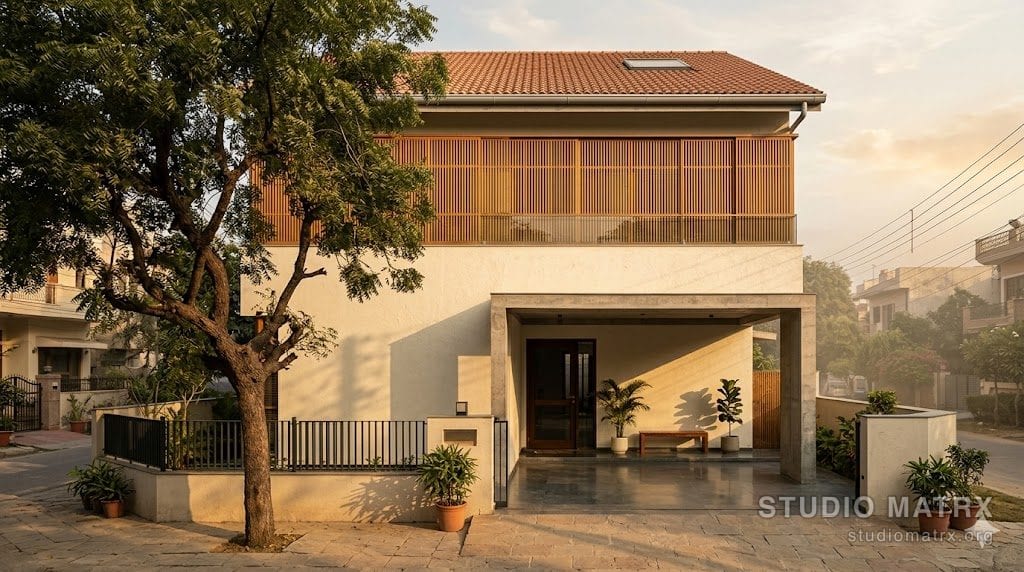
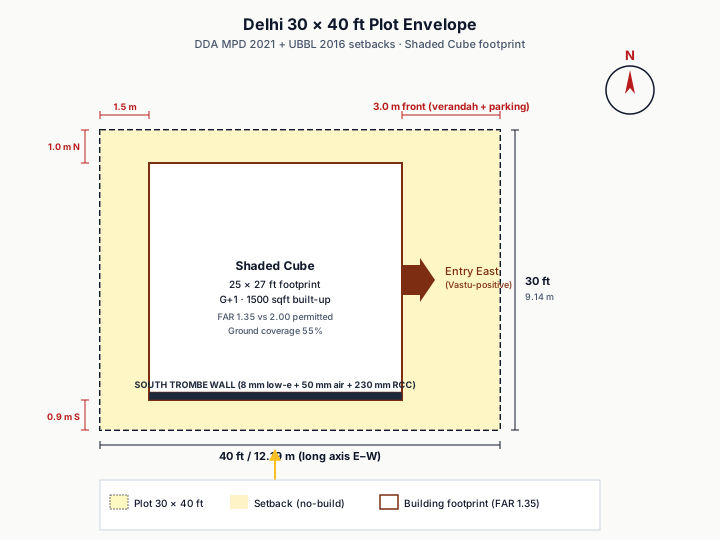
The Shaded Cube is a 30 × 40 ft, G+1, 3 BHK plan oriented with the long axis east-west so the long south facade faces the winter sun. The south Trombe wall (230 mm RCC + dark mineral paint + 50 mm air gap + 8 mm low-e tempered glass + roller blind) absorbs winter solar radiation by day, stores it in mass, and releases it into the living + stairs zone after sunset — adding 4–7 °C to night-time indoor temperature with zero energy input. The AAC cavity-wall envelope (230 mm + 50 mm rockwool + 100 mm AAC, U = 0.32 W/m²K) meets ECBC residential 2018 envelope targets and handles summer + winter equally. Deep east + west jaalis cut summer afternoon gain; 600 mm south overhangs admit winter sun and block summer sun. Sloped roof drains 470 mm of monsoon rainfall through internal pipes to a 3,000-litre underground tank. Full plan with floor schedules and materials.
FAR + setback compliance on a Delhi 30 × 40 ft plot
MPD 2021 + UBBL 2016 permits an FAR of 2.0 on residential plots in the 100–200 sqm band. The Shaded Cube uses an FAR of 1.35 — well under the limit — distributed over ground + first floor with a parapet stair head. The 3.0 m front setback (mandatory on roads ≥ 9 m) accommodates the verandah + parking; the 1.5 m rear gives the utility yard + drying. Side setbacks are 0.6 m minimum, generously extended in this plan to 0.9–1.0 m for the Trombe-wall buffer and the north skylight strip. Total ground coverage is 55% — under the 60% MPD ceiling — leaving 45% of the plot for planted setbacks and surface drainage. See the Delhi setback entry for the multi-row matrix.
Cost realities — Delhi 2026
A 1,500 sqft built-up Shaded Cube comes in at ₹28.5 L (basic) to ₹40.5 L (premium) in Delhi NCR 2026 prices. The largest single cost driver above basic is the Low-E DGU window package (~₹1.5 L on a typical 30 sqm glazing schedule), which is non-negotiable in Delhi for winter heat retention. The Trombe wall system adds ₹35,000–₹55,000 — paying back in roughly four winters through heating-bill avoidance, then yielding free heat for the next 25 years. The cavity wall envelope adds ₹120/sqft over single-leaf AAC — payback in 6–8 years through HVAC savings. Delhi labour and material premiums add 5–8% over the Bhopal / Nagpur comparable, mainly driven by transport (kota from Rajasthan, marble from Makrana) and a tight skilled-labour market.
Vastu in Delhi — where it agrees with climate, where it doesn't
Delhi homebuyers strongly prioritise Vastu. Fortunately, in the composite climate, Vastu and climate agree on the major moves: NE pooja, SE kitchen, SW master bedroom (with thermal mass), east entry. The Shaded Cube plan satisfies all major Vastu rules and is rated Excellent by the Vastu Compliance Checker. The one trade-off: the Trombe wall sits on the south face, which is Vastu-positive (heavy mass on south is auspicious) and climate-positive (south face captures winter sun) — convergent. Where Vastu and climate diverge — for instance, an east-facing plot that strictly Vastu-prefers an east main door but climate-prefers it shielded by a deep recessed porch — the design works the porch detail to satisfy both.
Air quality — a Delhi-specific obligation
Delhi's PM2.5 spikes between October and February, often exceeding 250 µg/m³ — 15× the WHO 24-hour guideline. The composite-climate envelope's sealed-in-winter operation is good for thermal performance but bad for indoor air quality if mechanical fresh-air supply is not provided. The premium tier of this plan includes two HEPA mechanical ventilation units (kitchen + master bedroom) at a cost of ₹40,000–₹1.5 L, providing 30–50 m³/h of HEPA-filtered fresh air per unit. For families with asthma or young children, this is not optional in Delhi. Whole-home water filtration for high-TDS Delhi groundwater (often 600+ ppm) adds another ₹35,000–₹80,000.
Pre-construction overlays — what to file in parallel with sanction
Six Delhi-specific overlays affect a 30 × 40 ft project beyond standard sanction. The three most commonly missed: DPCC's dust-control + C&D waste-management plan (mandatory for all sanctions above 200 sqm built-up), DJB's rainwater harvesting (mandatory for plots ≥ 100 sqm — this plot is right at threshold), and the Forest Department tree-cutting permission (any existing tree on plot ≥ 80 mm girth needs an online clearance, typically 30–60 days). File all three concurrently with the plan sanction submission to avoid sequential delays. See the Building Plan Approval guide for the full submission workflow.
Buildability — what to verify before the contractor breaks ground
Site-specific structural design is non-negotiable: Delhi NCR soils vary from 80–150 kPa Yamuna fill (Dwarka, Mayur Vihar east bank) to 200+ kPa Ridge soil (north and west Delhi), with black-cotton expansive zones along the Yamuna flood-plain band. Soil testing (₹15,000–₹40,000) confirms bearing capacity and any need for under-reamed piles. MEP layout — including provision for 3 kWp solar PV tie-in and HEPA mechanical ventilation — needs licensed engineering by a Delhi-registered consultant. Local plan sanction via PNN online portal typically takes 30–90 days for clean submissions; expect 60–120 days if overlays or tree-felling permissions are involved. See the full plan page for the buildability checklist.
Common pitfalls
- Treating Delhi as Hot-Dry or as Mumbai — both detailing imports fail because composite climate demands four seasonal responses, not one.
- Flat RCC roof without a sloped finish — monsoon ponding leads to internal seepage within 5 years; 1:80 slope to internal downpipes is the fix.
- Single-glaze south windows — winter heat loss + summer heat gain both excessive; Low-E DGU is non-negotiable for the south facade.
- Ignoring the DPCC dust-control C&D waste plan — site can be sealed mid-construction; file concurrently with sanction.
- Forgetting HEPA mechanical ventilation in the sealed-winter envelope — Delhi PM2.5 builds up indoors faster than outdoors in winter.
- Sizing solar PV under 3 kWp — Delhi households consume 6–10 kWh/day average; 3 kWp is the minimum economic threshold for net-metering payback.
Frequently asked questions
›What is the maximum FAR allowed on a 30 × 40 ft plot in Delhi?
›Is the Trombe wall regulated as a separate structural element by DDA?
›Can a 30 × 40 ft Delhi home avoid air-conditioning entirely?
›What does the Trombe wall actually cost to build and run?
›Does the plan comply with ECBC + Eco-Niwas Samhita for Delhi?
›What is the timeline from purchase to occupancy on a Delhi 30 × 40 ft Shaded Cube?
Sources & references
Master Plan for Delhi 2021 (MPD 2021)
Delhi Development Authority, Ministry of Housing and Urban Affairs — MPD 2021 with Volume II Zoning Regulations
Unified Building Bye-laws for Delhi 2016 (UBBL 2016)
Government of NCT of Delhi notification dated 23 March 2016; subsequent amendments incorporated
National Building Code of India 2016
Bureau of Indian Standards, NBC 2016 — Volume 1 Part 3 Development Control Rules and General Building Requirements
ECBC Residential — Eco-Niwas Samhita 2018
Bureau of Energy Efficiency, Government of India, ECBC Residential 2018 with 2021 amendments
SP 41 — Handbook on Functional Requirements of Buildings
Bureau of Indian Standards, SP 41 (1987) — Climate Zone Map of India and design recommendations
Delhi Pollution Control Committee — Construction & Demolition Waste Rules
DPCC notification on C&D waste management plan submission for sanctions above 200 sqm built-up
Delhi Jal Board — Rainwater Harvesting mandate
DJB notification mandating rainwater harvesting structures on all plots ≥ 100 sqm in Delhi
Disclaimer: Regulatory rates and dimensional rules change frequently and may be modified by mid-year notifications. Values reflect the framework as of 2026-05-15; verify against the current authority notification before any specific filing. This page is informational and is not legal or planning advice — engage a registered architect and a qualified planning consultant for project-specific compliance.
Related guides from the library
The companion deep-dives that practising architects keep alongside this reference.
Passive Design Strategies for Indian Climate Zones
A Climate-Zone-by-Zone Working Reference for Indian Architects
24 min read · Open SustainabilitySustainable Home Design in India
A Practical Guide to Climate, Craft, and Conscience in the Indian Home
15 min read · Open Design StylesVastu Shastra for Modern Homes
A Scientific Approach — Directions, Room Planning, Colours & Architect's Guide
26 min read · Open ConstructionBuilding Setbacks Across India
A State-by-State Guide to Development Control Regulations, Plot Setbacks, Ground Coverage, and FAR — for Architects, Planners, and Developers
42 min read · Open ConstructionFSI / FAR Computation in India
A State-by-State Working Reference for Indian Architects
24 min read · Open ConstructionBuilding Plan Approval Process in India
State-Wise Guide — BBMP, BMC, CMDA, GHMC, MCD, PMC & 14 More Cities
30 min read · OpenCompare across cities
The same House Plan 30×40 topic, different regulatory frameworks, different city quirks. Architects practising across metros should bookmark the adjacent reference.
House Plan 30×40 in Bengaluru
BBMP Building Bye-laws 2003 + Revised Master Plan 2031 (RMP 2031)
Open MCGM · MaharashtraHouse Plan 30×40 in Mumbai
Development Control and Promotion Regulations 2034 (DCPR 2034)
Open CMDA · Tamil NaduHouse Plan 30×40 in Chennai
Tamil Nadu Combined Development & Building Rules 2019 (TNCDBR 2019)
Open HMDA · TelanganaHouse Plan 30×40 in Hyderabad
Telangana Building Rules 2012 + GO Ms No. 168
Open