
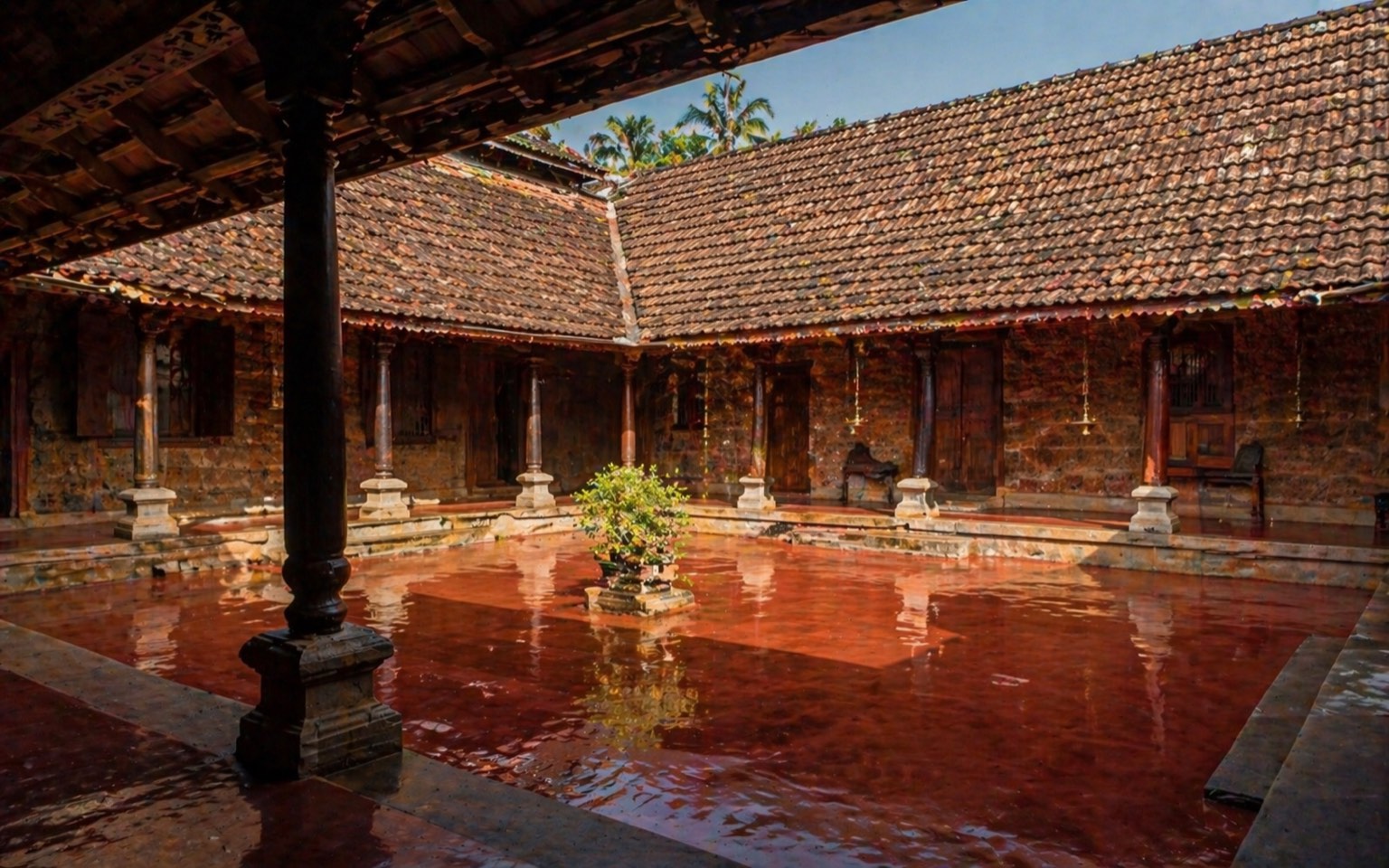
Vernacular Architecture — Lessons for Modern Homes
Regional Building Traditions of India and Their Architectural Logic — A Reference for Contemporary Practice
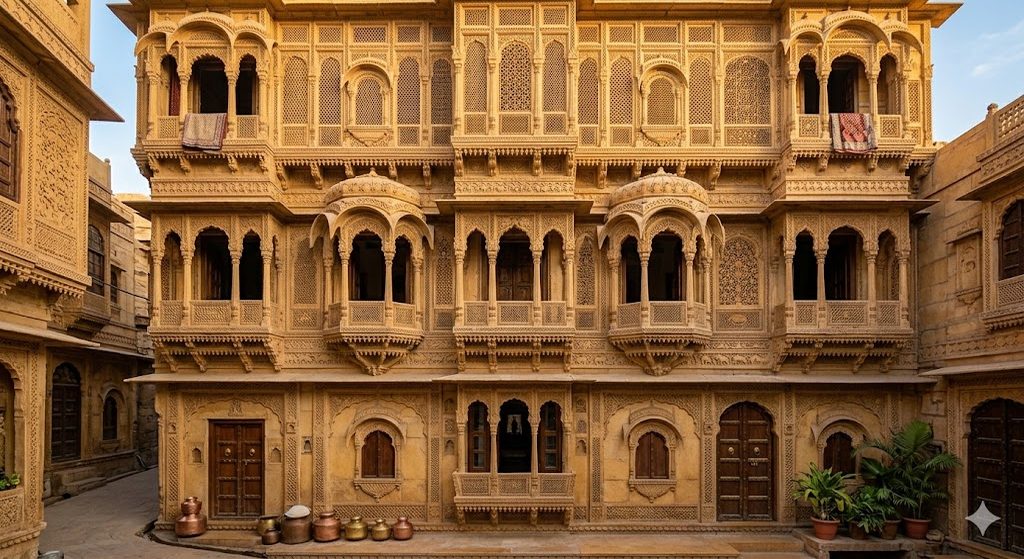
The vernacular house in India is not a primitive ancestor of modern architecture; it is, in many measurable respects, its superior. A 400 mm laterite wall in a coastal Konkani home maintains an interior temperature 6 to 8 degrees C cooler than the exterior in May. A Rajasthani haveli's seven-bay jharokha screen reduces solar gain by approximately 70 percent while maintaining cross-ventilation through a chowk that doubles as a thermal chimney. A Himachali kath-kuni dwelling has stood through the 1905 Kangra earthquake (M 7.8), the 1975 Kinnaur (M 6.8), and the 1991 Uttarkashi (M 6.8) — outperforming many of the RCC frame structures built around it after 1980. None of these houses were drawn by an architect.
The argument of this guide is not that vernacular architecture should be reproduced — it cannot be, because the cultural and economic conditions that produced it have largely dissolved. The argument is that vernacular architecture encodes design intelligence, accumulated over centuries of evolutionary trial and error, that contemporary Indian practice has often discarded without examining. Understanding why a vernacular form takes the shape it takes — the climatic, structural, social, and material logic — is the precondition for designing a modern home that performs as well as a traditional one.
This guide examines the major vernacular typologies of India, extracts their architectural principles, and proposes a framework for translation into contemporary practice. The focus is structural and spatial — form, massing, planning, material — not ornament.
"Vernacular architecture does not go through fashion cycles. It is nearly immutable, indeed, unimprovable, since it serves its purpose to perfection." — Bernard Rudofsky (1905–1988), architect and historian, from Architecture Without Architects (Rudofsky, 1964)
1. Defining Vernacular Architecture (and What It Is Not)
The term "vernacular" is loosely used in Indian discourse, often as a synonym for "traditional" or "ethnic." For a precise architectural reading, three distinctions matter.
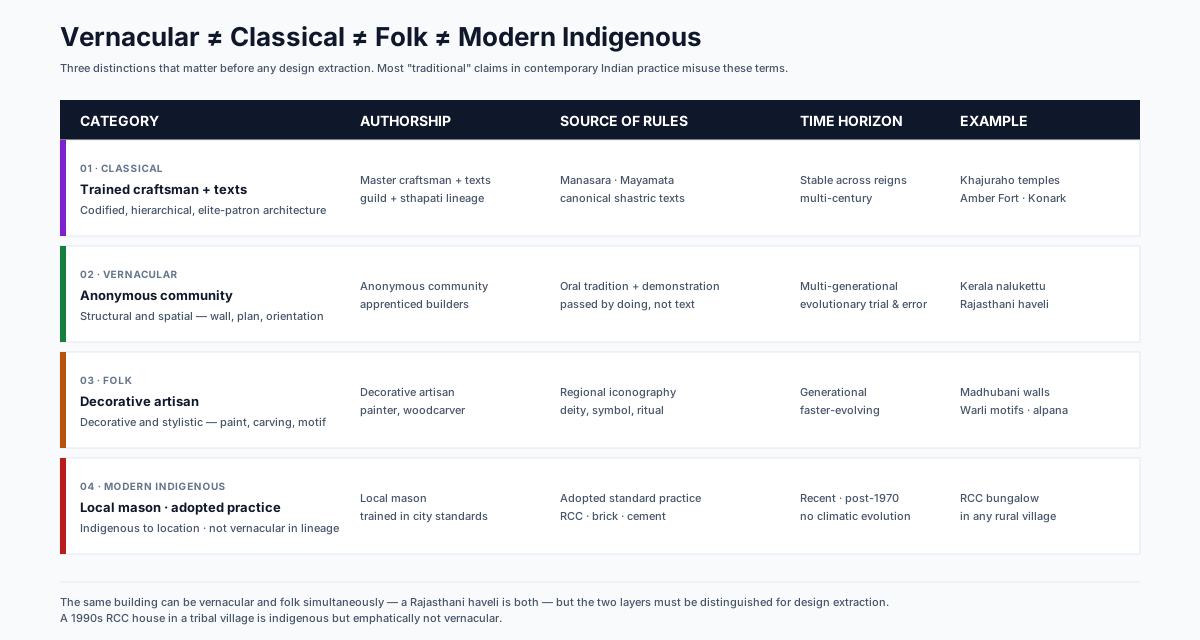
Vernacular vs Classical: Classical Indian architecture (temple, palace, fort) is governed by texts — the Manasara, Mayamata, and Vastu Shastras — and built by trained craftsmen for an elite patron. Vernacular architecture has no canonical text. Its rules are transmitted by demonstration and apprenticeship within a community of builders.
Vernacular vs Folk: Folk architecture is decorative and stylistic — the painted wall, the carved bracket, the regional motif. Vernacular is structural and spatial — the wall thickness, the roof pitch, the courtyard depth, the orientation. A Rajasthani haveli is both folk and vernacular, but the two layers must be distinguished for design extraction.
Vernacular vs Indigenous: All vernacular is indigenous, but not all indigenous building is vernacular. A 1990s reinforced-concrete house in a tribal village is indigenous to that village but not vernacular — it does not embody centuries of climatic and material adaptation specific to the region.
| Definition | Authorship | Source of Rules | Time Horizon | Example |
|---|---|---|---|---|
| Classical | Master craftsman + texts | Shastric texts (Manasara, Mayamata) | Stable across reigns | Khajuraho temples; Amber Fort |
| Vernacular | Anonymous community | Oral tradition + demonstration | Multi-generational evolution | Kerala nalukettu; Rajasthani haveli |
| Folk | Decorative artisan | Regional iconography | Generational | Madhubani painted walls; Warli motifs |
| Modern Indigenous | Local mason | Adopted standard practice | Recent (post-1970) | RCC bungalows in any village |
For the purposes of this guide, vernacular architecture is defined as: a regional building tradition, developed over multiple generations by anonymous builders, in response to specific climatic, material, and social conditions, transmitted through apprenticeship rather than text.
"Vernacular architecture is the architecture of the people, by the people, but not always for the people. It expresses the values and the constraints of the community — climate, materials, kinship, custom — with a directness that polite architecture rarely matches." — Paul Oliver (1927–2017), from the Encyclopedia of Vernacular Architecture of the World (Oliver, 1997)
2. The Climatic Logic of Indian Vernacular
India's vernacular variety is, more than any other factor, a function of its climatic variety. The five climatic zones identified by NBC 2016 (Composite, Hot-Dry, Warm-Humid, Temperate, Cold) each produced distinct vernacular responses with measurable performance characteristics.
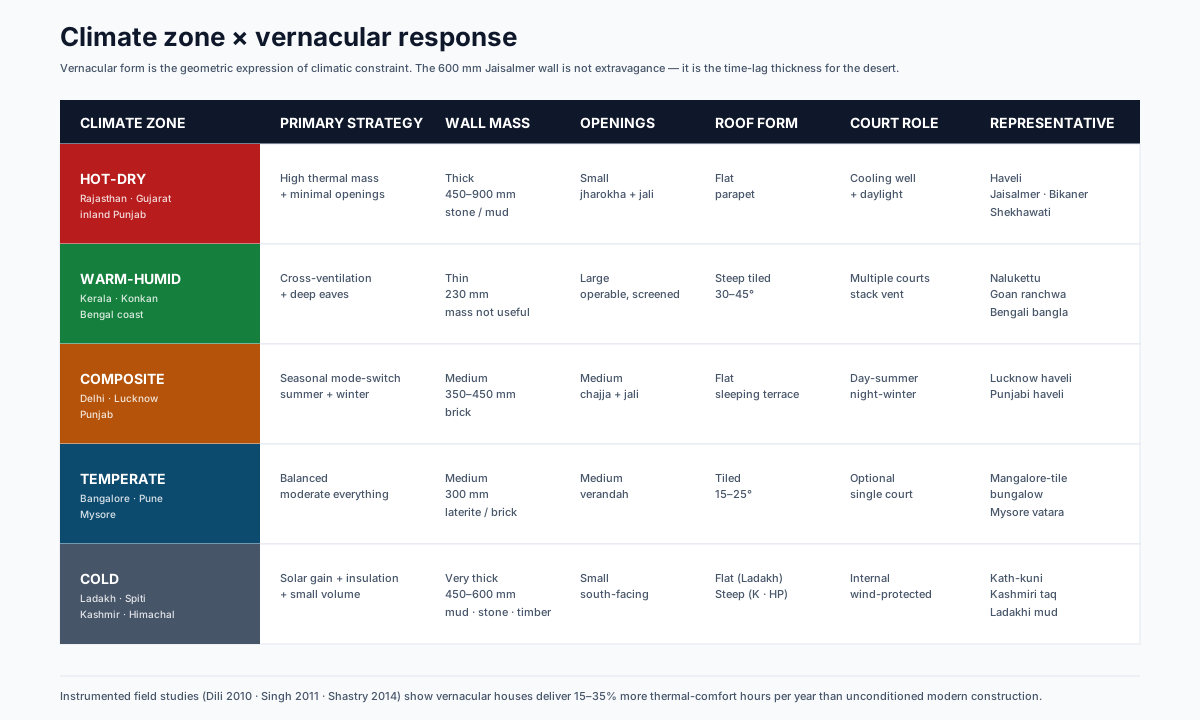
| Climate Zone | Primary Strategy | Wall Mass | Window Strategy | Roof Form | Courtyard Role | Representative Vernacular |
|---|---|---|---|---|---|---|
| Hot-Dry (Rajasthan, Gujarat) | High thermal mass + minimal openings | Thick (450–900 mm stone/mud) | Small, jharokha + jali | Flat or low parapet | Cooling well + light source | Haveli (Jaisalmer, Bikaner, Shekhawati) |
| Warm-Humid (Kerala, Konkan, Bengal coast) | Cross-ventilation + deep eaves | Thin (230 mm) — mass not useful | Large, operable, screened | Steep tiled (30–45 deg) | Multiple courts for stack ventilation | Nalukettu, Goan ranchwa, Bengali bangla |
| Composite (Delhi, Lucknow, Punjab) | Seasonal mode-switching | Medium (350–450 mm brick) | Medium with chajja + jali | Flat with sleeping terrace | Day-summer + night-winter use | Lucknow haveli; Punjabi haveli |
| Temperate (Bangalore, Pune, Mysore) | Balanced — moderate mass, moderate openings | Medium (300 mm laterite/brick) | Medium with verandah | Tiled (15–25 deg) | Optional, often single court | Mangalore-tile bungalow; Mysore vatara |
| Cold (Ladakh, Spiti, Kashmir, Himachal) | Solar gain + insulation + small volume | Very thick (450–600 mm mud/stone + timber) | Small, south-facing | Flat (Ladakh) or steep (Kashmir/HP) | Internal — protected from wind | Ladakhi mud house; Kashmiri taq; kath-kuni |
The pattern is consistent: vernacular form is the geometric expression of climatic constraint. A Konkani thatched roof at 45 degrees is not a stylistic choice — it is the minimum slope to shed 3,000 mm of monsoon rain. A Jaisalmer wall at 600 mm is not extravagance — it is the time-lag thickness required to delay the 48 degrees C exterior peak by 8–10 hours into the cool desert night. Instrumented field studies (Dili et al., 2010; Singh et al., 2011; Shastry et al., 2014) consistently show vernacular houses delivering thermal-comfort hours per year that exceed unconditioned modern construction by 15–35 percent.
"Form follows climate. The plan, the section, the orientation, the size of the openings — all are dictated by the sun and the wind, before they are dictated by anything else." — Charles Correa (1930–2015), architect, paraphrased from collected essays in A Place in the Shade (Correa, 2010)
3. Major Vernacular Typologies of India
A working architectural survey of India identifies twelve to fifteen distinct residential vernacular types. The table below summarises the principal ones with their formal and material characteristics — the elements an architect would extract for contemporary translation.
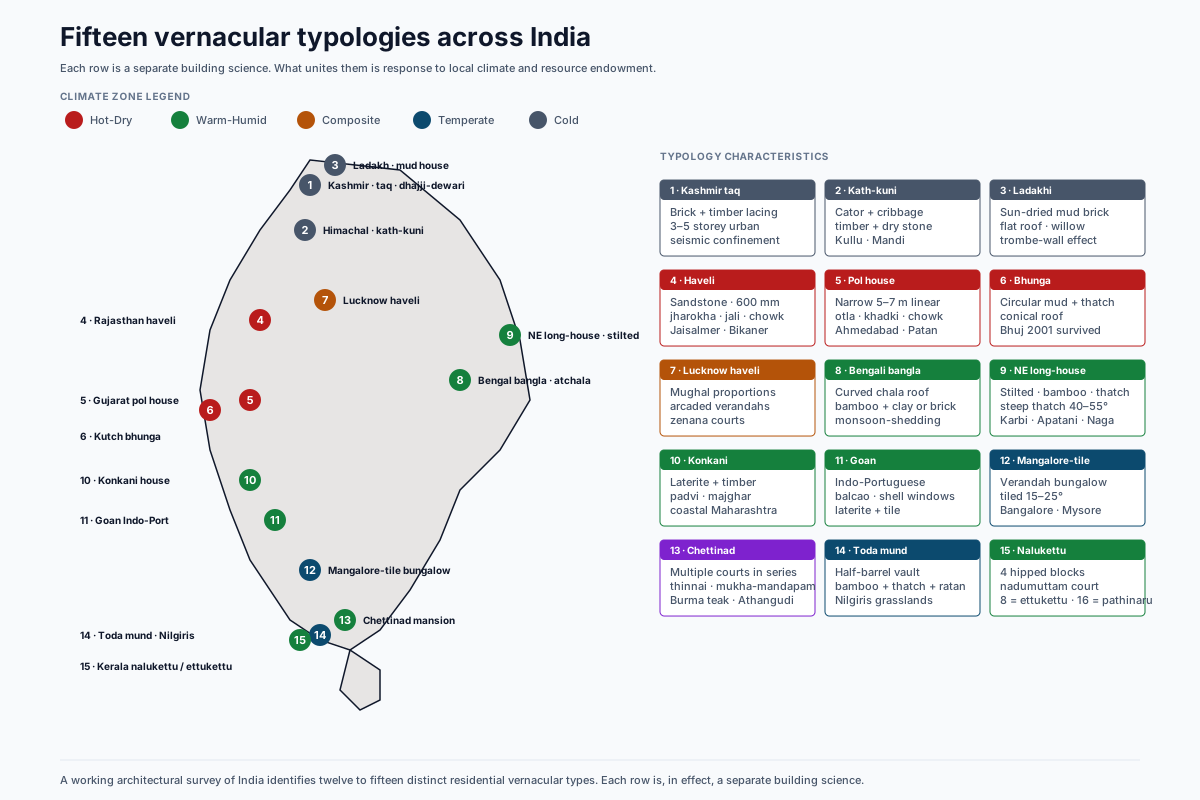
| Typology | Region | Plan Type | Primary Material | Roof | Defining Element |
|---|---|---|---|---|---|
| Nalukettu | Central & North Kerala | Four-block courtyard (nadumuttam) | Laterite + timber | Steep clay tile (40–45 deg), four hipped slopes | Open central courtyard with pillared verandah on all four sides |
| Ettukettu / Pathinarukettu | Kerala (extended) | 8-block / 16-block expansion | Same | Same | Multiple courtyards (joint-family scale) |
| Haveli (Rajasthani) | Rajasthan, Haryana, UP | Linear or perimeter around chowk | Sandstone, brick, lime | Flat with parapet | Jharokha (cantilevered bay window), jali screen, deep chowk |
| Pol house (Gujarati haveli) | Ahmedabad, Patan, Vadodara | Narrow linear (5–7 m wide) | Brick, timber columns | Flat or sloped tile | Otla (raised threshold), khadki (entrance), chowk, ord (storage block) |
| Chettinad mansion | Tamil Nadu (Chettinad region) | Linear, multiple courts in series | Lime, Burma teak, Athangudi tile | Flat with parapet | Thinnai (raised verandah), mukha-mandapam, valavu (women's court) |
| Goan Indo-Portuguese house | Goa, North Konkan | Linear with frontal balcao | Laterite stone | Tiled hip (35–45 deg) | Balcao (entrance porch with seats), shell-paned windows, internal courtyard |
| Konkani house | Maharashtra-Karnataka coast | Linear, deep verandah | Laterite, timber | Steep clay tile | Padvi (verandah), majghar (central hall) |
| Bengali bangla / atchala | Bengal, Bangladesh | Single-room or 4-room | Bamboo + clay or brick | Distinctive curved (chala) form | Curved roof to shed rain + raise eaves; raised plinth against flooding |
| Kath-kuni | Himachal (Kullu, Mandi, Shimla) | Linear, often multi-storey | Alternating timber + dry stone | Steep slate (35–45 deg) | Cator-and-cribbage construction (timber-laced); ground floor cattle, upper floor living |
| Dhajji-dewari | Kashmir | Linear with gable ends | Timber frame infilled with mud-brick | Pitched timber + sheet | Diagonal-bracing timber frame; flexible energy-dissipating system |
| Taq | Kashmir (Srinagar) | Tall (3–5 storeys) urban | Brick masonry with timber lacing | Pitched | Horizontal timber bands every 1.0–1.2 m for seismic confinement |
| Ladakhi house | Ladakh, Spiti | Compact 2-storey | Sun-dried mud brick, willow joists, mud roof | Flat (very low rainfall) | South-facing kitchen-living; animal byre below; trombe-wall effect |
| Karbi / Apatani / Naga long-house | Northeast hill states | Linear stilted | Bamboo + thatch | Steep thatch (40–55 deg) | Raised on stilts above damp + flood + animals |
| Toda mund | Nilgiris, Tamil Nadu | Half-barrel vault | Bamboo + thatch + ratan | Curved barrel | Wind-shedding form for high-altitude exposed grasslands |
| Bhunga | Kutch, Gujarat | Circular | Mud + thatch | Conical thatch | Aerodynamic — survives cyclonic winds; Bhuj 2001 earthquake performance |
Each row in this table is, in effect, a separate building science. What unites them is response to local climate and resource endowment. What separates them is the specific geometric and material vocabulary by which that response is expressed.
4. The Courtyard: A Pan-Indian Spatial Device
The courtyard is the single most pervasive spatial device in Indian vernacular — present, in some form, in every climate zone except the highest cold-arid (where heat-loss penalty exceeds benefit). It is also the most generalisable lesson for contemporary practice. The courtyard is not a room; it is a climatic instrument that performs four simultaneous functions.
| Function | Mechanism | Climatic Zones Where It Works |
|---|---|---|
| Daylighting | Wells light into deep plans without west/east-facing apertures | All except cold-arid |
| Stack ventilation | Hot air rises out of court, drawing cool air from surrounding rooms | Hot-dry, composite, warm-humid |
| Microclimate | Evapotranspiration from plant + water reduces court air temperature | Hot-dry, composite |
| Spatial-social | Defines a private outdoor room — joint-family interaction without exposure to street | Universal |
Court geometry — the rules vernacular evolved:
The hot-dry courtyard is narrow and deep — the Jaisalmer haveli chowk averages 4 m × 4 m × 8 m high (aspect ratio H/W = 2). Narrow courts maximise self-shading and stack effect, minimise direct solar exposure of the court floor.
The warm-humid courtyard is wider and shallower — the Kerala nadumuttam averages 4 m × 6 m × 4 m high (aspect ratio H/W = 0.7). Wider courts allow rainwater drainage, wind sweep, and vegetation growth.
The composite-climate courtyard is medium proportion — the Lucknow haveli sahn averages 6 m × 8 m × 6 m high (aspect ratio H/W = 0.85), serving day-summer (shaded by surrounding floors) and night-winter (warmed by retained mass) use.
| Court Type | Width × Depth × Height | Aspect Ratio H/W | Typical Climate | Performance Note |
|---|---|---|---|---|
| Jaisalmer chowk | 4 × 4 × 8 m | 2.0 | Hot-dry | Self-shaded; afternoon court air 6–8 deg C below ambient |
| Kerala nadumuttam | 4 × 6 × 4 m | 0.7 | Warm-humid | Rain admission; ventilation chimney during pre-monsoon |
| Lucknow sahn | 6 × 8 × 6 m | 0.85 | Composite | Seasonal switching: summer day shading, winter sun pocket |
| Gujarati pol chowk | 3 × 4 × 6 m | 1.7 | Hot-dry | Compact city version; high stack effect |
| Chettinad mukha-mandapam | 6 × 8 × 5 m | 0.7 | Warm-humid | Multiple courts in series — first male-public, last female-private |
Why the modern Indian house lost the courtyard: Three forces — plot economics (FAR rules favour built area), construction technology (RCC slabs make sealed plans cheaper), and air-conditioning (which makes the climatic role of the court appear redundant) — together eliminated the courtyard from the post-1970 Indian house. Restoring it requires deliberate architectural commitment because plot economics still discriminates against it.
"The open-to-sky space is the most precious room in the Indian house. The whole organisation of the dwelling can be founded upon it." — Charles Correa (Correa, 2010)
5. Wall Systems: Thermal Mass and Material Wisdom
Vernacular Indian wall construction is, almost without exception, high mass. The exceptions — Bengali bamboo-mat walls, Naga wattle-and-daub — are themselves climate-specific (warm-humid, where thermal mass is counter-productive because it stores daytime heat into the night). For all other climates, mass is the dominant strategy.
The principle is the time lag of a thick wall: the lag between exterior peak temperature and the interior surface temperature peak. A 600 mm sandstone wall in Jaisalmer has a time lag of 8–10 hours — meaning the 4 PM exterior peak (48 degrees C) reaches the interior wall surface at 12 AM to 2 AM, when the desert night air is 22 degrees C. The hot air radiated from the wall is then evacuated by the cool night and the cycle resets.
| Vernacular Wall System | Thickness | Density (kg/m3) | U-value (W/m2K) | Time Lag (hours) | Region |
|---|---|---|---|---|---|
| Jaisalmer sandstone | 450–600 mm | 2200 | 1.8–2.2 | 8–10 | Rajasthan |
| Mud-brick (cob) | 400–500 mm | 1800 | 1.0–1.4 | 10–12 | Rajasthan, Kutch, Ladakh |
| Laterite block (load-bearing) | 300–400 mm | 1900 | 1.5–1.8 | 6–8 | Kerala, Konkan, Goa |
| Stabilised mud (Auroville-type) | 300 mm | 1900 | 1.1–1.4 | 7–9 | Pan-India (modern revival) |
| Lime-stabilised brick | 230 mm + plaster | 1800 | 1.7–2.0 | 5–6 | UP, Punjab, Bihar |
| Kath-kuni timber + stone | 450–600 mm | varies | 1.4–1.8 | 6–9 | Himachal |
| Ladakhi mud + willow | 450–600 mm | 1700 | 0.9–1.2 | 9–12 | Ladakh |
| Bengali bamboo + clay | 100–150 mm | 800 | 1.5–2.0 | <1 | Bengal (intentionally lightweight) |
| Modern 230 mm brick + plaster (for comparison) | 250 mm | 1800 | 2.0–2.3 | 4–5 | Pan-India default |
The takeaway for contemporary practice: A modern 230 mm brick wall has a worse U-value and a worse time lag than almost every traditional system listed above, while consuming approximately 4–6 times the embodied energy per square metre (Reddy and Jagadish, 2003). The vernacular wall is not nostalgic — it is, on most engineering parameters, superior.
"Use what is available. Use what the local people use. The local building tradition is your starting library — not your final answer, but your starting library." — Laurie Baker (1917–2007), architect, paraphrased from Houses: How to Reduce Building Costs and collected essays (Bhatia, 1991)
6. Roof Forms: Climate Response in Geometry
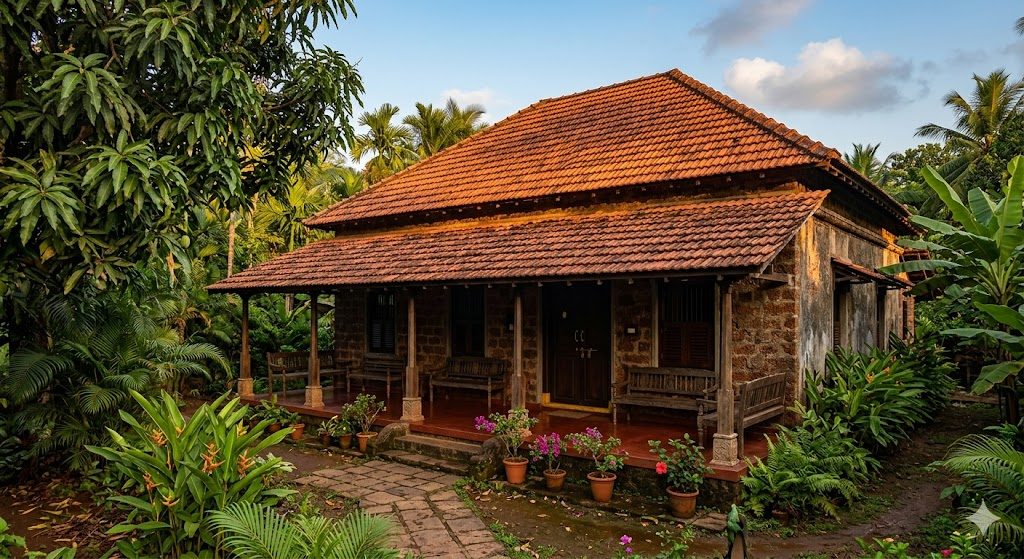
Roof geometry in Indian vernacular follows rainfall and temperature gradients with mathematical precision. Where rainfall is below 500 mm/year, the roof tends toward flat. Where rainfall exceeds 1500 mm/year, the roof is steep — and where it exceeds 3000 mm/year, the steep roof is also extended into deep eaves.
| Region | Annual Rainfall (mm) | Typical Roof Pitch | Typical Eave Projection | Vernacular Roof System |
|---|---|---|---|---|
| Rajasthan / Kutch | 100–500 | Flat (1–3 deg drainage slope) | 0–300 mm | Mud over timber joists; lime terrace |
| Ladakh | <100 | Flat (mud roof, 150–200 mm thick) | 0 mm | Willow joists + brushwood + mud |
| Punjab / Haryana | 400–700 | Flat with parapet | 200–400 mm chajja | Flat brick terrace with lime |
| UP / Bihar | 700–1100 | Mixed flat / sloped | 400–600 mm | Burnt brick + lime terrace |
| Delhi / Composite | 600–800 | Flat | 400–600 mm | Brick + lime terrace, often with sleeping pavilion |
| Bangalore / Mysore | 800–1100 | 15–25 deg tile | 600–900 mm | Mangalore-tile on timber rafters |
| Konkan / Goa | 2500–3500 | 35–45 deg tile | 900–1200 mm | Mangalore tile or country tile |
| Kerala | 2500–3500 | 40–45 deg tile | 1200–1800 mm | Country tile with ridge ventilator |
| Bengal | 1500–2200 | Curved (chala) | 600–900 mm | Thatch on bamboo; later brick |
| Northeast | 2000–4000 | 40–55 deg | 900–1500 mm | Thatch on bamboo |
| Himachal | 1500–2500 | 30–45 deg slate | 600–900 mm | Slate on timber rafters |
The four lessons of vernacular roof design:
1. Pitch is a function of rainfall and material, not aesthetics. Steep roofs evolved where rain is heavy; flat roofs where rain is sparse and useful occupiable surface is at a premium.
2. Eave projection is a function of rainfall and wall material. Deep eaves protect mud, lime, and timber walls; flat roofs over masonry walls in dry climates need only modest projection.
3. Roof colour and finish modulate solar gain. Lime-washed flat roofs in Rajasthan reflect 70–80 percent of solar radiation; tile roofs in Kerala absorb but rapidly emit at night.
4. Ventilation through the roof is intentional. Kerala ridge ventilators, Goan ridge tiles, and Northeast smoke holes all evacuate the warmest air at the apex, driving stack ventilation through the lower floor.
7. Openings, Verandahs, and the Threshold Hierarchy
The vernacular Indian house does not pass directly from "outside" to "inside." It transitions through a hierarchy of intermediate spaces — each performing climatic, social, and security functions.
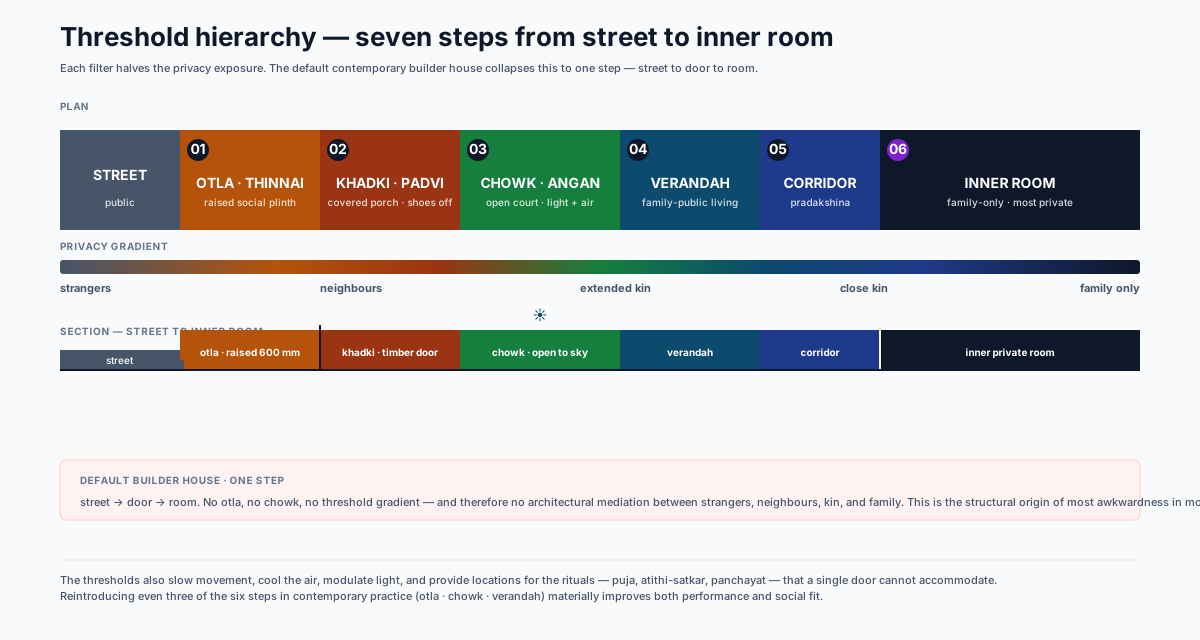
| Threshold Element | Position | Climatic Function | Social Function | Found In |
|---|---|---|---|---|
| Otla / thinnai | Raised street-side platform | Shaded transition zone | Public greeting; watchful seating | Gujarat (otla), Tamil Nadu (thinnai) |
| Padvi / verandah | Open or columned around perimeter | Buffer space; rain barrier | Family gathering; sleeping in summer | Konkan, Karnataka, Maharashtra |
| Balcao | Front entry porch with built-in seats | Rain shelter | Visitor reception | Goa |
| Khadki / pol gate | Compound-level entry | Defensive | Public-private boundary | Gujarati pols, Rajasthani havelis |
| Aangan / chowk | Internal courtyard | Daylight + ventilation | Family-private outdoor room | Pan-India |
| Antarala | Inner court annex | Privacy buffer | Women's domain | Chettinad, Kerala |
| Jharokha / oriel | Cantilevered bay window | Self-shading; cross-ventilation | Female view of street without exposure | Rajasthan, MP |
| Jali screen | Perforated wall | Shade + ventilation + light filtering | Privacy without isolation | Pan-India (Mughal influence widespread) |
| Roshandan | Clerestory / ventilator above door | Hot-air evacuation | Stack ventilation | Composite climate, urban |
The threshold hierarchy is one of the most extractable lessons of vernacular practice for the contemporary house. The modern Indian flat collapses every threshold into a door — public corridor opens directly into living room. The vernacular sequence (street → otla → khadki → chowk → osri → room) provides not nostalgia but functional layering: each threshold filters something — sun, sound, view, social access.
"An architect must always be sensitive to the spirit of place. A door is not just a door — it is the meeting of two worlds, and the architect's job is to make that meeting graceful." — Geoffrey Bawa (1919–2003), architect, attributed in collected interviews and writings (Robson, 2002)
8. Seismic Wisdom in Traditional Construction
India's seismic zones IV and V — Kashmir, Himachal, Uttarakhand, Sikkim, the Northeast, Kutch — produced vernacular construction systems that have survived earthquakes which modern unreinforced masonry has failed. The 2005 Kashmir, 1991 Uttarkashi, 2001 Bhuj, and 2015 Nepal events all produced field-survey evidence that timber-laced vernacular outperformed unreinforced concrete-block masonry of comparable age (Langenbach, 2009; cited basis for IS 13828:1993 provisions).
| System | Region | Mechanism | Performance Evidence |
|---|---|---|---|
| Dhajji-dewari | Kashmir | Timber post-and-beam frame infilled with masonry; diagonal struts | Survived 2005 Kashmir M 7.6 with minor damage; adjacent unreinforced brick collapsed |
| Taq | Kashmir (Srinagar) | Brick masonry with horizontal timber bands every 1.0–1.2 m | Survived 1885 Sopore and 2005 Kashmir |
| Kath-kuni | Himachal | Alternating courses of dry stone and timber (cator-and-cribbage) | Survived 1905 Kangra M 7.8, 1975 Kinnaur, 1991 Uttarkashi, 1999 Chamoli |
| Bhunga (round mud hut) | Kutch | Circular plan, low height, conical thatch — aerodynamic + symmetric | Bhuj 2001 — bhungas largely intact; rectangular RCC nearby collapsed |
| Assamese ekra | Assam | Bamboo lattice + mud plaster — ductile and lightweight | Survived multiple Northeast earthquakes; light system, low collapse mass |
The structural principle: vernacular seismic systems are flexible and ductile — they absorb seismic energy through frame deformation rather than resisting it through brittle strength. This is the same principle behind modern reinforced-concrete moment frames — but the vernacular versions are made from materials with negligible embodied energy.
The Bureau of Indian Standards has formally recognised these systems: IS 13828:1993 ("Improving Earthquake Resistance of Low Strength Masonry Buildings") references timber-laced and band-strengthened systems, and IS 13827:1993 addresses earthen buildings with seismic provisions. Where these systems are deployed in original or revived form within applicable seismic zones, they are not exotic — they are code-recognised.
9. Embodied Energy and the Vernacular Carbon Advantage
The contemporary case for vernacular construction is not merely climatic; it is also carbon. Reddy and Jagadish (2003), in the most-cited Indian study of building-material embodied energy, established the order-of-magnitude difference between vernacular and modern wall systems.
| Wall System | Embodied Energy (MJ/m2) | Embodied Carbon (kg CO2e/m2) | Cost (Rs/m2, 2026) |
|---|---|---|---|
| Sun-dried mud-brick | 100–200 | 10–20 | 400–800 |
| Mud-block stabilised wall (300 mm) | 250–400 | 25–40 | 800–1,200 |
| Laterite block (load-bearing) | 300–500 | 35–60 | 1,000–1,800 |
| Stabilised compressed earth block | 400–600 | 45–70 | 1,500–2,500 |
| Burnt brick wall (230 mm + plaster) | 1,800–2,400 | 200–280 | 2,200–3,500 |
| AAC block wall (200 mm + plaster) | 1,400–1,800 | 150–200 | 2,400–3,500 |
| Concrete block + plaster | 1,600–2,000 | 180–230 | 2,000–3,200 |
| RCC wall (150 mm + finish) | 2,800–3,500 | 350–450 | 3,500–5,500 |
Sources: Reddy and Jagadish (2003); Reddy (2009); Ramesh, Prakash and Shukla (2010).
A mud-block wall has approximately one-tenth the embodied energy of an equivalent burnt-brick wall and approximately one-twelfth that of an RCC wall. For a typical 1,500 sqft Indian house with around 250 m2 of external wall area, this is the difference between roughly 25,000 kg CO2e and roughly 350,000 kg CO2e — an order-of-magnitude carbon penalty that modern construction pays before the house is even occupied.
The IGBC and GRIHA recognition: Both major Indian green-building rating systems (IGBC Green Homes and GRIHA) award credits for use of regional vernacular materials and techniques. IGBC awards up to 5 credits for "Regional Materials and Bio-based Materials"; GRIHA awards points under Criterion 13 ("Sustainable Building Materials") for use of locally-sourced traditional construction. A vernacular-revival home can earn 8–12 percent of total available certification points from material strategies alone.
10. The Modernist Translators: Correa, Doshi, Baker, Bawa
The case for vernacular as a contemporary design source is best made not in argument but in built work. Four post-Independence architects — three Indian, one Sri Lankan whose influence on Indian practice is profound — established the methodology of vernacular translation that the contemporary Indian architect inherits.
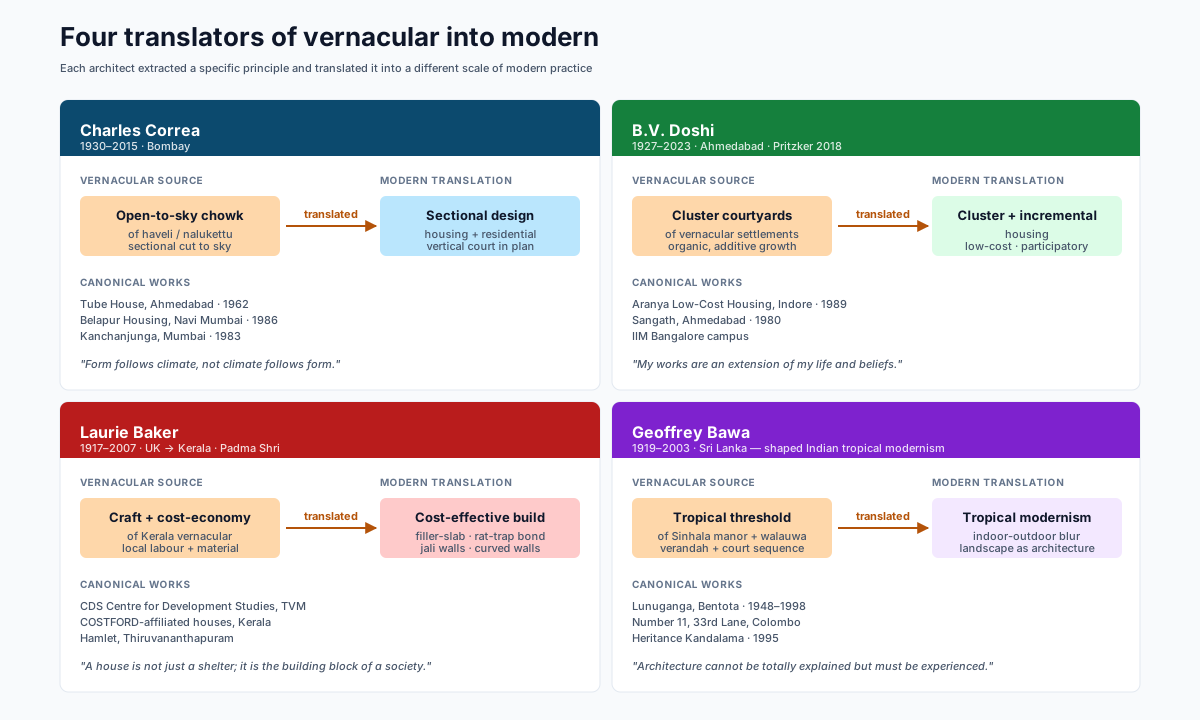
| Architect | Period | Vernacular Source | Translation Strategy | Representative Work |
|---|---|---|---|---|
| Charles Correa (1930–2015) | 1958–2015 | Pan-Indian courtyard + open-to-sky | "Open-to-sky space" as modern design principle; tube-house section for cross-ventilation | Tube House (Ahmedabad, 1962); Kanchanjunga Apartments (Mumbai, 1983); Belapur Housing (1986) |
| B.V. Doshi (1927–2023) | 1955–2023 | Rajasthani / Gujarati havelis; Le Corbusier | Cluster-courtyard housing; vault as climate device | Aranya Low-Cost Housing (Indore, 1989); Sangath (Ahmedabad, 1980) |
| Laurie Baker (1917–2007) | 1945–2007 | Kerala nalukettu + Kerala mason traditions | Cost-reduction through traditional details; rat-trap bond, jali, filler-slab | Centre for Development Studies (Trivandrum, 1971); thousands of low-cost houses across Kerala |
| Geoffrey Bawa (1919–2003) | 1957–1998 | Sri Lankan walauwa + South Indian courtyard | Seamless inside-outside; modern materials in vernacular layout | Lunuganga (1948–98); Heritance Kandalama (1995); influenced Indian "tropical modernism" |
| Anant Raje (1929–2009) | 1965–2009 | Louis Kahn + Indian courtyard | Monumental brick + courtyard organisation | IIM Ahmedabad faculty extensions; Forest Research Institute (Bhopal, 1998) |
| Raj Rewal (b. 1934) | 1962–present | Rajasthani street-pattern; Gujarati pol | Pedestrian street + courtyard cluster at urban scale | Asian Games Village (Delhi, 1982); CIDCO Housing (Belapur) |
The methodology — common to all of them:
1. Identify the climatic problem the vernacular form was solving.
2. Extract the geometric principle — not the ornament.
3. Translate into modern materials and construction — RCC, brick, glass, steel.
4. Preserve the spatial sequence — threshold hierarchy, courtyard, verandah.
5. Discard what no longer applies — joint-family pattern, animal-byre ground floor, defensive enclosure.
What none of them did was reproduce vernacular architecture literally. The argument of all four was that literal reproduction is itself a misreading — vernacular form is the answer to a question, and the contemporary architect must first ask whether the question is still being asked.
"An architect cannot deny the place where he is. The grammar must come from the soil — but the sentences are written in the present." — B.V. Doshi (1927–2023), architect, from Paths Uncharted (Doshi, 2012)
11. Eight Design Lessons for Contemporary Indian Homes
Distilling the foregoing material, eight architectural lessons emerge from the Indian vernacular tradition that are directly translatable into contemporary residential practice.
| # | Lesson | Vernacular Source | Contemporary Translation |
|---|---|---|---|
| 1 | Orient to the sun, not to the road | All climate-sensitive vernacular | Plan major living spaces toward N/NE; service spaces W/SW |
| 2 | Build the courtyard back into the plan | Nalukettu, haveli, pol house | Open-to-sky court even on small urban plots; light + ventilation + plant |
| 3 | Layer the threshold | Otla, padvi, balcao, verandah | Sequence: street → porch → entry transition → main space; not direct |
| 4 | Increase wall mass — or insulate | Mud, stone, laterite | Cavity wall with insulation; AAC + insulation; or revival of stabilised mud |
| 5 | Match roof pitch to rainfall | Kerala steep tile vs Rajasthan flat | Don't put a flat roof in Kerala; don't put steep pitch in Jodhpur |
| 6 | Project the eaves to protect the wall | Konkan padvi, Goa balcao | 600–1200 mm eaves where rainfall > 1500 mm/year; protects masonry |
| 7 | Use the jali for shade + ventilation + privacy | Pan-India, Mughal-influenced | Modern jali screens — terracotta, perforated brick, GRC, metal — for west-facing facades |
| 8 | Build with what is local | All vernacular | Specify regional stone, brick, lime, timber — embodied energy + cost + character all benefit |
These eight lessons together form a checklist that can be applied to almost any contemporary residential project, in any climate zone, at any scale. They do not produce a "vernacular-style" house — they produce a climate-appropriate, locally-rooted, low-embodied-energy contemporary house that bears a recognisable cultural relationship to the Indian tradition.
"House form is not simply the result of physical forces or any single causal factor, but is the consequence of a whole range of socio-cultural factors seen in their broadest terms." — Amos Rapoport (1929–2024), architect-theorist, from House Form and Culture (Rapoport, 1969)
12. Where Vernacular Falls Short — and How Modern Practice Responds
A balanced reading of vernacular architecture must also identify its limitations. Pretending that the traditional house was perfect is as misleading as dismissing it.
| Vernacular Limitation | Modern Architectural Response |
|---|---|
| No provision for modern services (water, sewerage, electricity) | Service core integrated within courtyard plan; vertical chases in masonry walls |
| Limited to joint-family social organisation; nuclear family awkward fit | Court-clustered housing (Aranya, Belapur model) — courtyard for cluster, not single family |
| Mud and lime require seasonal maintenance | Stabilisation (cement/lime) reduces but does not eliminate maintenance — disclose to client |
| Long span limited by timber and stone | Steel beams in concealed locations; RCC slabs over masonry walls |
| Single-floor pattern doesn't suit urban density | Stacked courtyard typologies — Kanchanjunga Apartments, Tara Group Housing |
| Defensive enclosure (haveli, kath-kuni) inappropriate today | Replace with porous boundary; retain spatial sequence without fortification |
| No provision for car parking | Dedicated parking court; basement parking in dense urban; setback parking in suburban |
| Daylight from courtyard inadequate for screen-based work | Supplementary north-facing skylights; ECBC-compliant glazing on north facade |
| Earthen floors not durable for modern use | Stabilised earthen floors; or Athangudi tile, IPS, Kota stone, terrazzo as compatible alternatives |
| Privacy inadequate by current standards | Layered boundary planting; threshold elements at room-cluster scale; visual but not acoustic separation acknowledged |
The honest contemporary practitioner uses vernacular as a starting library — not a final answer. Where the tradition holds (climatic logic, threshold sequence, material economy, courtyard organisation), it is preserved. Where it fails (services, density, modern social patterns), it is supplemented by modern technology, deployed with discipline.
"We must recover that organic harmony between man and his environment which we have lost. Then perhaps we can build again with the certainty and the dignity our ancestors brought to building." — Hassan Fathy (1900–1989), architect, from Natural Energy and Vernacular Architecture (Fathy, 1986)
References
- Bhatia, G. (1991) Laurie Baker: Life, Work, Writings. New Delhi: Penguin Viking.
- Bhatt, V. and Scriver, P. (1990) Contemporary Indian Architecture: After the Masters. Ahmedabad: Mapin Publishing.
- Brown, P. (1942) Indian Architecture (Hindu and Buddhist Period). Bombay: D.B. Taraporevala Sons.
- Bureau of Energy Efficiency (2018) Eco-Niwas Samhita 2018: Energy Conservation Building Code for Residential Buildings. New Delhi: Ministry of Power, Government of India.
- Bureau of Indian Standards (1993) IS 13827:1993 — Improving Earthquake Resistance of Earthen Buildings — Guidelines. New Delhi: BIS.
- Bureau of Indian Standards (1993) IS 13828:1993 — Improving Earthquake Resistance of Low Strength Masonry Buildings — Guidelines. New Delhi: BIS.
- Bureau of Indian Standards (2016) National Building Code of India 2016 (SP 7:2016). New Delhi: BIS.
- Cooper, I. and Dawson, B. (1998) Traditional Buildings of India. London: Thames & Hudson.
- Correa, C. (2010) A Place in the Shade: The New Landscape and Other Essays. New Delhi: Penguin India.
- Curtis, W.J.R. (1988) Balkrishna Doshi: An Architecture for India. New York: Rizzoli.
- Dili, A.S., Naseer, M.A. and Varghese, T.Z. (2010) 'Passive environment control system of Kerala vernacular residential architecture for a comfortable indoor environment: A qualitative and quantitative analysis', Energy and Buildings, 42(6), pp. 917–927.
- Doshi, B.V. (2012) Paths Uncharted. Ahmedabad: Vastu Shilpa Foundation.
- Fathy, H. (1986) Natural Energy and Vernacular Architecture: Principles and Examples with Reference to Hot Arid Climates. Chicago: University of Chicago Press.
- Jain, K. and Jain, M. (1994) Mud Architecture of the Indian Desert. Ahmedabad: Aadi Centre.
- Khan, H.U. (1987) Charles Correa: Architect in India. London: Concept Media / Mimar.
- Koenigsberger, O.H., Ingersoll, T.G., Mayhew, A. and Szokolay, S.V. (1974) Manual of Tropical Housing and Building: Part 1 — Climatic Design. London: Longman.
- Krishan, A., Baker, N., Yannas, S. and Szokolay, S. (2001) Climate Responsive Architecture: A Design Handbook for Energy Efficient Buildings. New Delhi: Tata McGraw-Hill.
- Lang, J., Desai, M. and Desai, M. (1997) Architecture and Independence: The Search for Identity — India 1880 to 1980. Delhi: Oxford University Press.
- Langenbach, R. (2009) Don't Tear It Down: Preserving the Earthquake Resistant Vernacular Architecture of Kashmir. New Delhi: UNESCO / Oinfroin Media.
- Manu, S., Shukla, Y., Rawal, R., Thomas, L.E. and de Dear, R. (2016) 'Field studies of thermal comfort across multiple climate zones for the subcontinent: India Model for Adaptive Comfort (IMAC)', Building and Environment, 98, pp. 55–70.
- Mehrotra, R. (2011) Architecture in India Since 1990. Mumbai: Pictor / Hatje Cantz.
- Oliver, P. (Ed.) (1997) Encyclopedia of Vernacular Architecture of the World. Cambridge: Cambridge University Press.
- Oliver, P. (2003) Dwellings: The Vernacular House Worldwide. London: Phaidon.
- Pramar, V.S. (1989) Haveli: Wooden Houses and Mansions of Gujarat. Ahmedabad: Mapin Publishing.
- Pramar, V.S. (2005) A Social History of Indian Architecture. New Delhi: Oxford University Press.
- Ramesh, T., Prakash, R. and Shukla, K.K. (2010) 'Life cycle energy analysis of buildings: An overview', Energy and Buildings, 42(10), pp. 1592–1600.
- Rapoport, A. (1969) House Form and Culture. Englewood Cliffs, NJ: Prentice-Hall.
- Reddy, B.V.V. (2009) 'Sustainable materials for low carbon buildings', International Journal of Low-Carbon Technologies, 4(3), pp. 175–181.
- Reddy, B.V.V. and Jagadish, K.S. (2003) 'Embodied energy of common and alternative building materials and technologies', Energy and Buildings, 35(2), pp. 129–137.
- Robson, D. (2002) Geoffrey Bawa: The Complete Works. London: Thames & Hudson.
- Rudofsky, B. (1964) Architecture Without Architects: A Short Introduction to Non-Pedigreed Architecture. New York: Museum of Modern Art.
- Shastry, V., Mani, M. and Tenber, R. (2014) 'Evaluating thermal comfort and building climatic response in warm-humid climates for vernacular dwellings (Suggi tradition) in Goa', Architectural Science Review, 59(1), pp. 12–28.
- Singh, M.K., Mahapatra, S. and Atreya, S.K. (2009) 'Bioclimatism and vernacular architecture of north-east India', Building and Environment, 44(5), pp. 878–888.
- Singh, M.K., Mahapatra, S. and Atreya, S.K. (2011) 'Solar passive features in vernacular architecture of North-East India', Solar Energy, 85(9), pp. 2011–2022.
- Tillotson, G.H.R. (1989) The Tradition of Indian Architecture: Continuity, Controversy and Change since 1850. New Haven: Yale University Press.
Author's Note: This guide synthesises a body of literature that has matured significantly over the last three decades — driven by Indian researchers (Reddy, Jagadish, Manu, Shastry, Dili, Singh) building rigorous performance evidence for what was previously asserted on intuition alone. The case for vernacular intelligence is no longer rhetorical; it is now backed by instrumented thermal-comfort studies, life-cycle embodied-energy analysis, and post-earthquake field surveys. The contemporary Indian architect who ignores this body of work is choosing to design with one hand tied. The challenge — and the discipline — is to extract the principles without pastiche, and to translate them into a contemporary architectural language appropriate to current materials, current social organisation, and current economics. The eight lessons in Section 11 are offered as a working checklist, not a manifesto.
Disclaimer: This article is for informational and educational purposes only. It does not constitute professional architectural or structural engineering advice. Climate-responsive design, seismic-resistant construction, and material selection must be undertaken by qualified architects and engineers with site-specific assessment and reference to applicable IS codes (NBC 2016, IS 13828, IS 13827, IS 1893) and local building bye-laws. Studio Matrx, its authors, and its contributors accept no liability for decisions made on the basis of the information contained in this guide.
Interactive · Indian vernacular map
Nalukettu · Kerala · Centuries-old vernacular, formalised 16th c.
Traditional
Four-block house ringing a central open courtyard (nadumuttom); steep tiled roofs handle monsoon; teak/jackfruit structure raised on laterite plinth.
- ▸Nadumuttom (central court open to sky)
- ▸Padippura (gateway pavilion)
- ▸Steep clay-tile roof (35-45°)
- ▸Polished oxide / Athangudi flooring
- ▸Teak / Anjili structural timber
Modern adaptation
Vernacular revivalism led by Laurie Baker remains the dominant aesthetic in upscale Kerala homes.
Designers
Design rules
- • Pitched terracotta roof + extended eaves (1.2 m+)
- • Open court + light wells for daylight
- • Local laterite / lime / oxide finishes
Climate
Warm-Humid (year-round 22-34°C; 2500-3500mm rain).
Export this guide
Related Guides — Deep-dive reading
Modern vs Traditional Indian House Architecture
A Comparative Architectural Analysis of Plan, Structure, Envelope, Performance, and Cost
Design StylesBrick House, Wada: How iSTUDIO Bent an Ancient Craft into a Curve
A 2,500-square-foot farmhouse in rural Maharashtra bends the poorest, most ordinary building material — the fired clay brick — into free-flowing curved walls, and proves that low-cost, low-carbon, hand-built architecture can be as spatially ambitious as anything made of steel and glass. A close reading of its rat-trap-bond masonry, earthen-pot filler slabs, ferrocement roofs, and the Laurie Baker lineage it carries forward.
The Future of ArchitectureWhy Vernacular Design Is Returning: Climate, Carbon & the Future of the Indian Home
How India's cooling crisis and carbon reckoning are reviving courtyards, earth walls and passive design — and how to adapt vernacular intelligence honestly, not romanticise it
Vernacular ArchitectureRelated Tools — Try Free
Brise-Soleil Visualizer
Interactive horizontal-louvre cut-off angle calculator — sun altitude, louvre depth, and spacing inputs with a live shadow preview. Computes θ = arctan(spacing/depth) for façade shading, ECBC envelope compliance, hospital daylight design, and tropical sun-control detailing.
Sun Shading ToolCross-Ventilation Analyzer
Estimate airflow and air changes per hour (ACH) from room size, window areas, layout, and local wind — with NBC 2016 Part 8 compliance check.
Ventilation CalculatorWindow Orientation Planner
Pick the best window type, glass and shading by wall direction — north, east, south and west.
Window Tool