

Building Setbacks Across India
A State-by-State Guide to Development Control Regulations, Plot Setbacks, Ground Coverage, and FAR — for Architects, Planners, and Developers
Of all the constraints that shape an Indian building, the setback is the most universal and the least uniform. Every plot in every city must observe minimum distances from its boundaries — to admit light, to allow fire access, to preserve neighbours' rights, and to maintain the visual coherence of the street. But the numbers that define those distances vary dramatically across the country's 28 states and 8 union territories: what is compulsory in Bengaluru may be optional in Chennai, what is permitted in Kochi may be forbidden in Chandigarh.
This guide exists to map that variation. It is written for architects, planners, developers, and informed clients who need to understand how setback regulations are constructed, how they differ across India's administrative landscape, and how to apply them correctly to residential, commercial, and mixed-use projects. It covers the regulatory hierarchy from the National Building Code through state Development Control Regulations down to municipal building bye-laws, provides comprehensive tables for every state and UT, and explains the reasoning — sometimes historical, sometimes climatic, sometimes purely administrative — behind the variation.
"Every building bye-law is a local response to a universal problem. The problem is how people and buildings can share the ground. The answer varies because the ground varies." — Charles Correa, Foreword to National Building Code of India 2005 (Correa, 2005)
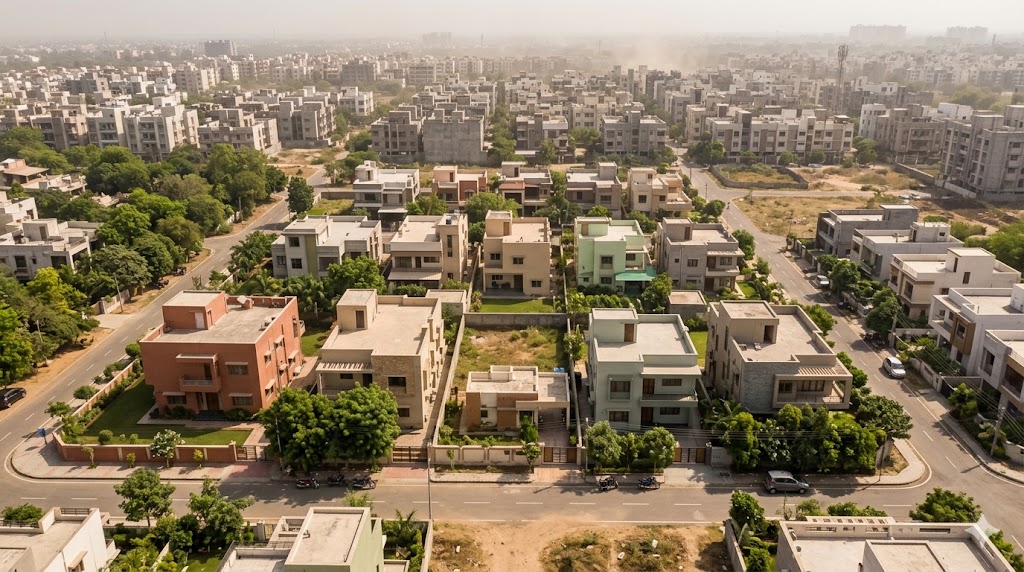
1. Why India Has No Single Setback Standard
In federal constitutional terms, land and urban development are State List subjects under the Seventh Schedule of the Constitution of India (Government of India, 1950). This means the Union Government cannot mandate setback values on state-level land; it can only recommend them through the National Building Code, which is an advisory document. Each state is free to adopt, adapt, or ignore NBC recommendations, and every one of them has done so to a different degree.
This federal arrangement has produced India's characteristic regulatory patchwork. The Maharashtra Unified Development Control and Promotion Regulations (UDCPR 2020) governs 99% of Maharashtra's urban area but explicitly excludes Greater Mumbai, which continues under the separate Development Control and Promotion Regulations (DCPR 2034). Tamil Nadu unified its rules under the Combined Development and Building Rules (TNCDBR 2019), while neighbouring Karnataka retains separate bye-laws for BBMP Bengaluru, Mysore, Mangalore, and smaller municipalities. West Bengal's Kolkata Municipal Corporation Building Rules 2009 is technically municipal, not state-level, though KMC's jurisdiction covers the metropolitan core.
Beyond legal structure, three substantive factors drive inter-state variation in setbacks:
- Urban form history. Cities that grew on pre-industrial street patterns (Delhi, Ahmedabad, Varanasi, old Hyderabad) retain bye-laws that accommodate narrow plots and zero-setback row housing; cities planned post-1950 (Chandigarh, Bhubaneswar, Gandhinagar) apply uniform grid-based setbacks.
- Climate and solar access. Tropical southern states (Kerala, Tamil Nadu, Karnataka) permit higher ground coverage and smaller setbacks than temperate northern states (Himachal Pradesh, Jammu & Kashmir), reflecting the cooling-driven imperative to shade streets with building mass.
- Fire and seismic regulation. Seismic Zone V states (Gujarat Kutch, Assam, NE states, Andaman) impose stricter side-setback minimums to allow emergency access; Zone II states (interior Deccan, Odisha plateau) permit tighter lot-to-lot configurations.
The result is a regulatory landscape where a 300 sqm plot in Bengaluru might permit 60% ground coverage while the same plot in Chandigarh is capped at 50%, where a 150 sqm plot in Delhi may build to the boundary on all four sides while the same plot in Guwahati requires 1.5 m sides for seismic access.
2. The Regulatory Hierarchy
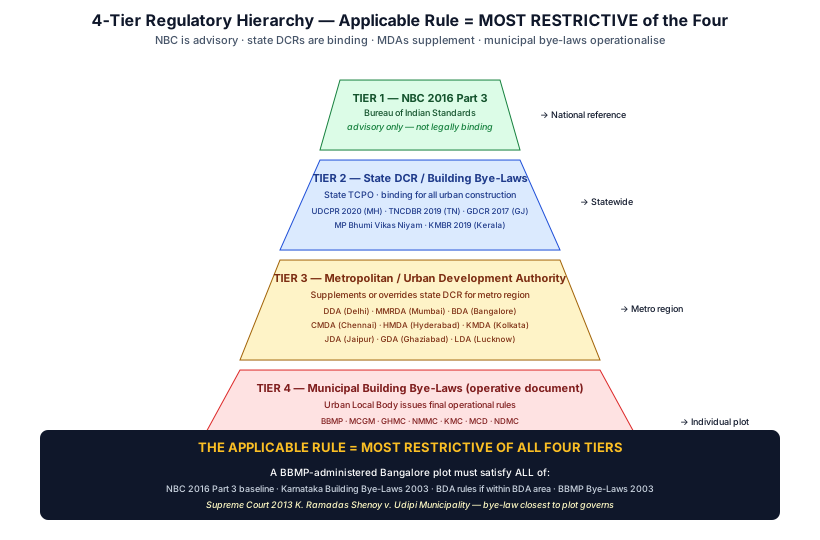
Understanding Indian setback regulation begins with appreciating the four-tier hierarchy that governs it:
Tier 1 — National Building Code of India (NBC 2016)
The NBC is published by the Bureau of Indian Standards and provides recommended minimum standards across structural, fire, electrical, plumbing, and planning domains. NBC 2016 Part 3 (Development Control Rules and General Building Requirements) contains setback recommendations that most state codes use as a reference point (Bureau of Indian Standards, 2016). NBC is advisory — its values only become legally binding when adopted by a state or municipality.
Tier 2 — State Development Control Regulations / Building Bye-Laws
Every state publishes its own DCR, typically issued by the State Town and Country Planning Organisation (SCPO) or equivalent. These are the legally binding rules for all urban construction in the state, subject to further refinement by local bodies. Key state instruments include Maharashtra UDCPR 2020, TNCDBR 2019 (Tamil Nadu), MP Bhumi Vikas Niyam 2012, and Kerala Municipality Building Rules 2019.
Tier 3 — Metropolitan / Urban Development Authority Rules
Larger cities typically have a Development Authority (DDA Delhi, MMRDA Mumbai, BDA Bangalore, CMDA Chennai, HMDA Hyderabad, KMDA Kolkata, JDA Jaipur, GDA Ghaziabad, LDA Lucknow) that issues additional rules for the metropolitan planning region. These rules can supplement or override state DCRs for the metropolitan area.
Tier 4 — Municipal Building Bye-Laws
The Urban Local Body — Municipal Corporation, Municipal Council, or Nagar Panchayat — issues the final set of operational rules. In practice, these bye-laws are what the plan-sanction officer consults when approving a building permit. BBMP Bangalore, MCGM Mumbai, GHMC Hyderabad, NMMC Navi Mumbai, and KMC Kolkata each publish their own bye-laws that must be read together with state and metropolitan rules.
Navigating the Hierarchy
For any Indian project, the architect must consult all four tiers. The applicable rule for a specific plot is generally the most restrictive of the four. A BBMP-administered plot in Bangalore must satisfy NBC 2016 Part 3 baseline, Karnataka Building Bye-Laws 2003, BDA rules if within the Bangalore Development Area, and BBMP Building Bye-Laws 2003 (as amended). In contested cases, Indian courts have consistently held that the bye-law closest to the specific plot governs — typically the municipal rule (Supreme Court of India, 2013, K. Ramadas Shenoy v. Udipi Municipality).
"India's building regulation is not a pyramid but a layered deposit. Each tier adds its own sediment, and the architect must read all the layers to know what applies today." — Shirish B. Patel, urban planner (Patel, 2018)
3. The Factors That Determine a Setback
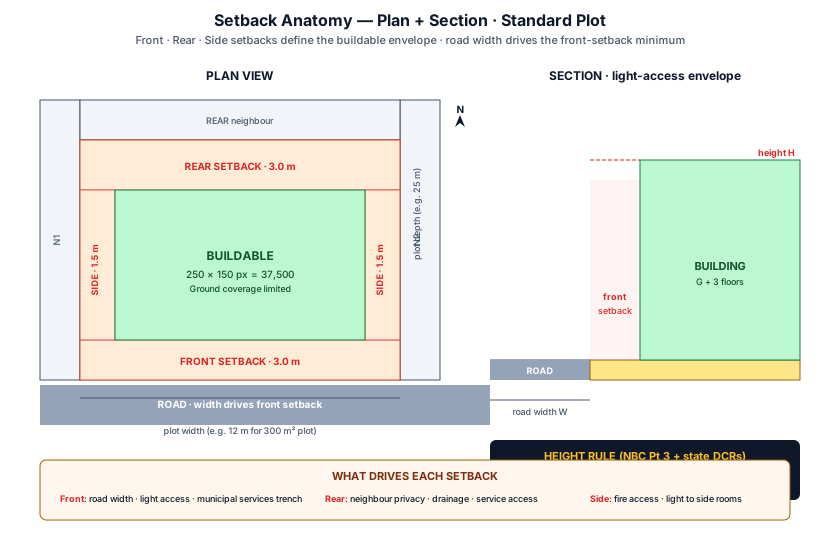
Across all Indian jurisdictions, setback values are determined by a consistent set of factors — though the numerical values differ. Understanding these factors helps architects navigate any new bye-law document:
Plot Area
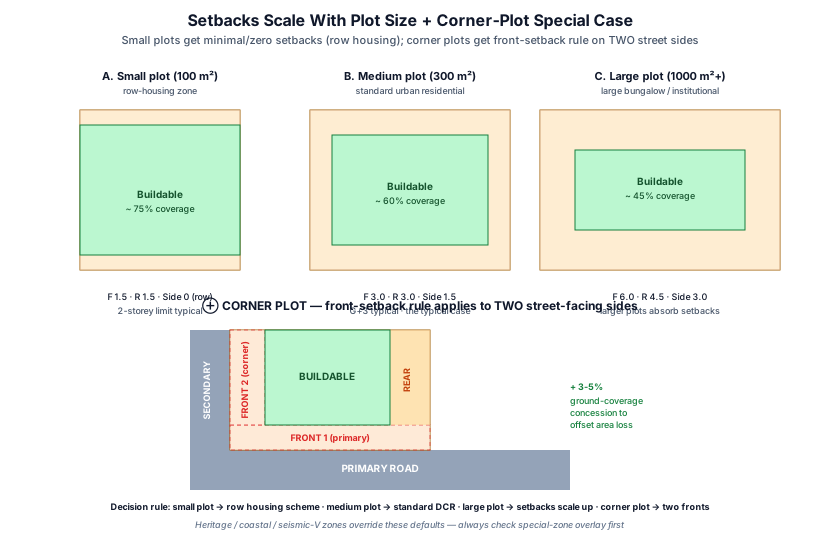
The single most important determinant. Every state DCR contains a plot-area bracket table: small plots (typically under 100 sqm) get zero or minimal setbacks (enabling row housing); as plot size increases, setbacks increase progressively. The rationale is economic and urbanistic — small-plot developments cannot afford to lose area to setbacks, while larger plots can absorb them.
Road Width
The width of the abutting public road determines both the front setback and the maximum permissible building height. Narrow roads (under 6 m) typically restrict buildings to 2 storeys; wider roads (18+ m) permit 4+ storeys with correspondingly increased front setbacks to maintain proportion. The rule encoded in most DCRs is: building height ≤ 1.5 × (road width + front setback).
Building Height / Number of Storeys
Taller buildings require greater setbacks to maintain light-access ratios between buildings. NBC 2016 Part 3 Clause 6.4 recommends that side and rear setbacks increase by 0.5 m for each additional storey above four storeys (Bureau of Indian Standards, 2016). Most state DCRs adopt some version of this progression.
Land Use / Zoning
Residential, commercial, industrial, institutional, and mixed-use zones each have distinct setback regimes. Industrial plots typically require larger setbacks (for fire and emergency vehicle access); commercial plots in central business districts often have smaller setbacks to maintain street wall continuity; institutional plots (schools, hospitals) have campus-scale setbacks.
Corner Plot Status
Plots at street intersections face public streets on two or more sides. Most state DCRs apply front-setback rules to both street-facing sides, often with a small ground-coverage concession (3–5%) to compensate for the additional area loss.
Special Zones
Heritage conservation zones (Old Delhi Shahjahanabad, Walled City Jaipur, Pondicherry French Quarter) impose additional restrictions — typically height caps, mandatory facade conformity, and sometimes reduced setbacks to preserve historic street alignment. Coastal Regulation Zones (CRZ) under CRZ Notification 2019 impose setback rules on coastal plots regardless of state (Ministry of Environment, Forest and Climate Change, 2019).
4. Master Reference — State-Wise Setback Summary
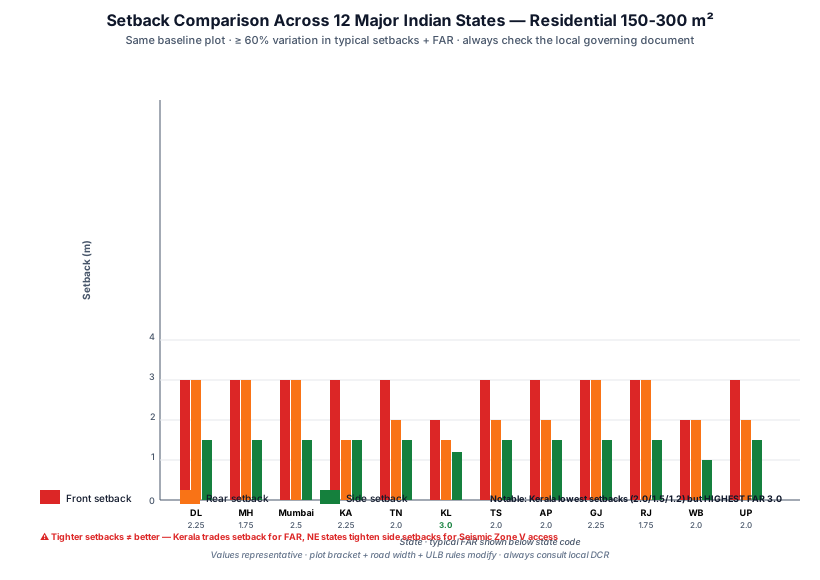
The following table summarises typical residential setback requirements across all 28 states and 8 Union Territories of India. Values are representative for mid-range plots (150–300 sqm); actual setbacks depend on plot bracket, road width, and specific ULB rules. All figures are in metres unless specified.
4a. Setback Summary — Northern India
| State / UT | Governing Document | Authority | Typical Front | Typical Rear | Typical Side | Typical FAR |
|---|---|---|---|---|---|---|
| Delhi (NCT) | UBBL 2016 + MPD 2021 | DDA / MCD / NDMC | 3.0 | 3.0 | 1.5 | 2.25 |
| Chandigarh (UT) | Chandigarh Estate Rules 2007 | Chandigarh Administration | 3.65 | 3.0 | 1.5 | 1.25 |
| Punjab | Punjab Urban Development Authority Rules | PUDA + ULBs | 3.0 | 2.0 | 1.5 | 1.75 |
| Haryana | Haryana Building Code 2017 | HSVP + HUDA + ULBs | 3.0 | 3.0 | 1.5 | 1.65 |
| Himachal Pradesh | HP Town and Country Planning Rules 2014 | TCP Dept + ULBs | 3.0 | 3.0 | 1.5 | 1.75 |
| Uttarakhand | UA Urban Building Bye-Laws 2011 | MDDA + ULBs | 3.0 | 3.0 | 1.5 | 2.0 |
| Jammu & Kashmir (UT) | J&K Development Act + Srinagar MC Rules | SMC + JDA + Dev Authorities | 3.0 | 2.5 | 1.5 | 1.5 |
| Ladakh (UT) | Ladakh Building Bye-Laws 2021 | Leh MC + LAHDC | 3.0 | 2.0 | 1.5 | 1.25 |
Sources: Delhi UBBL 2016 (MoHUA, 2016); Chandigarh Estate Rules 2007; Punjab Urban Development Authority Act 1995; Haryana Building Code 2017; HP TCP Act 1977 Rules 2014; UA Urban Development Act Rules 2011; J&K Development Act 1970 Rules; Ladakh UT Building Bye-Laws 2021.
4b. Setback Summary — Eastern India
| State / UT | Governing Document | Authority | Typical Front | Typical Rear | Typical Side | Typical FAR |
|---|---|---|---|---|---|---|
| West Bengal | KMC Building Rules 2009 (WB) | KMC + KMDA + ULBs | 2.0 | 2.0 | 1.0 | 2.0 |
| Odisha | Odisha DA Rules 2020 | BDA + ULBs | 3.0 | 2.0 | 1.5 | 2.0 |
| Bihar | Bihar Building Bye-Laws 2014 | ULBs (PMC, BMC etc.) | 3.0 | 2.0 | 1.5 | 2.25 |
| Jharkhand | Jharkhand Building Bye-Laws 2016 | Ranchi MC + ULBs | 3.0 | 2.0 | 1.5 | 2.0 |
| Sikkim | Sikkim Building Construction Regulations 1991 | Gangtok MC + UDHD | 3.0 | 2.5 | 1.5 | 1.5 |
Sources: KMC Building Rules 2009; Odisha DA (Planning and Building Standards) Rules 2020; Bihar Building Bye-Laws 2014; Jharkhand Urban Development Department Rules 2016; Sikkim Urban Development and Housing Department.
4c. Setback Summary — Western India
| State / UT | Governing Document | Authority | Typical Front | Typical Rear | Typical Side | Typical FAR |
|---|---|---|---|---|---|---|
| Maharashtra (except Mumbai) | UDCPR 2020 | TCPO + ULBs | 3.0 | 3.0 | 1.5 | 1.75 |
| Maharashtra (Greater Mumbai) | DCPR 2034 | MCGM + MMRDA | 3.0 | 3.0 | 1.5 | 2.5 |
| Gujarat | GDCR 2017 | AUDA + SUDA + VUDA + ULBs | 3.0 | 3.0 | 1.5 | 2.25 |
| Rajasthan | Rajasthan UBBL 2020 | JDA + ADA + ULBs | 3.0 | 3.0 | 1.5 | 1.75 |
| Goa | Goa Land Development and Building Construction Regulations 2010 | Goa TCP + ULBs | 3.0 | 3.0 | 1.5 | 2.0 |
| Dadra & Nagar Haveli and Daman & Diu (UT) | DNH & DD Building Bye-Laws 2021 | UT Administration | 3.0 | 2.5 | 1.5 | 1.8 |
Sources: Maharashtra UDCPR 2020; MCGM DCPR 2034; Gujarat GDCR 2017; Rajasthan Urban Development Department UBBL 2020; Goa TCP Act 1974 Rules 2010; DNH & DD UT Administration.
4d. Setback Summary — Southern India
| State / UT | Governing Document | Authority | Typical Front | Typical Rear | Typical Side | Typical FAR |
|---|---|---|---|---|---|---|
| Karnataka | KMC Act 1976 + Karnataka Bye-Laws + BBMP | BBMP + BDA + Mysore + ULBs | 3.0 | 1.5 | 1.5 | 2.25 |
| Tamil Nadu | TNCDBR 2019 | CMDA + DTCP + ULBs | 3.0 | 2.0 | 1.5 | 2.0 |
| Kerala | Kerala Municipality Building Rules 2019 | KMBR + Panchayat Building Rules | 2.0 | 1.5 | 1.2 | 3.0 |
| Andhra Pradesh | AP Building Rules 2017 | APCRDA + ULBs | 3.0 | 2.0 | 1.5 | 2.0 |
| Telangana | Telangana Building Rules 2012 + TSbPASS 2020 | GHMC + HMDA + ULBs | 3.0 | 2.0 | 1.5 | 2.0 |
| Puducherry (UT) | Puducherry Municipalities Act 1973 Rules | Puducherry Municipal Council | 3.0 | 2.0 | 1.5 | 2.0 |
Sources: Karnataka Municipal Corporations Act 1976 Building Bye-Laws; BBMP Building Bye-Laws 2003; TNCDBR 2019 (TCP Dept); Kerala KMBR 2019; AP Municipal Administration Rules 2017; Telangana Building Rules 2012; Puducherry Municipal Council Rules.
4e. Setback Summary — Central India
| State / UT | Governing Document | Authority | Typical Front | Typical Rear | Typical Side | Typical FAR |
|---|---|---|---|---|---|---|
| Madhya Pradesh | MP Bhumi Vikas Niyam 2012 | TCPO + ULBs (BMC, IMC, etc.) | 3.0 | 2.0 | 1.5 | 1.5 |
| Chhattisgarh | Chhattisgarh Land Development Rules 1984 (revised 2020) | TCP Dept + ULBs | 3.0 | 2.0 | 1.5 | 1.5 |
| Uttar Pradesh | UP Building Bye-Laws 2008 | LDA + GDA + KDA + ULBs | 3.0 | 2.0 | 1.5 | 2.0 |
Sources: MP Nagar Tatha Gram Nivesh Adhiniyam 1973 Bhumi Vikas Niyam 2012; Chhattisgarh Town and Country Planning Department; UP Urban Planning and Development Act 1973 Rules.
4f. Setback Summary — North-Eastern India
| State / UT | Governing Document | Authority | Typical Front | Typical Rear | Typical Side | Typical FAR |
|---|---|---|---|---|---|---|
| Assam | Assam Building Bye-Laws 2014 | GMC + GMDA + ULBs | 3.0 | 2.0 | 1.5 | 2.0 |
| Arunachal Pradesh | AP Building Regulations 2015 | Itanagar MC | 3.0 | 2.5 | 1.5 | 1.5 |
| Manipur | Manipur Building Construction Regulations 2015 | Imphal MC | 3.0 | 2.5 | 1.5 | 1.5 |
| Meghalaya | Meghalaya Building Bye-Laws 2014 | Shillong MB + Tura MB | 3.0 | 2.5 | 1.5 | 1.5 |
| Mizoram | Mizoram Building Regulations 2013 | Aizawl MC | 3.0 | 2.5 | 1.5 | 1.5 |
| Nagaland | Nagaland Building Regulations 2015 | Kohima MC + Dimapur MC | 3.0 | 2.5 | 1.5 | 1.5 |
| Tripura | Tripura Building Rules 2011 | Agartala MC | 3.0 | 2.5 | 1.5 | 1.75 |
Sources: North-Eastern States Council records; individual state Urban Development Department rules and Municipal Corporation bye-laws as published in respective state gazettes.
4g. Setback Summary — Island Territories
| State / UT | Governing Document | Authority | Typical Front | Typical Rear | Typical Side | Typical FAR |
|---|---|---|---|---|---|---|
| Andaman & Nicobar Islands (UT) | A&N Island Building Regulations 2016 | Port Blair MC | 3.0 | 3.0 | 1.5 | 1.5 |
| Lakshadweep (UT) | Lakshadweep Panchayati Raj Rules | Lakshadweep Administration | 2.5 | 2.0 | 1.5 | 1.5 |
Sources: A&N Administration Urban Development Department; Lakshadweep UT Administration Building Regulations.
Note on the above tables: Values are representative for 150–300 sqm residential plots. All setbacks may be relaxed for smaller plots (with row-housing provisions) and tightened for larger plots, high-rises, or sensitive zones. Always consult the specific governing document and the local ULB's building plan-scrutiny office before finalising a design.
5. Deep Dives — The Most Complex State Regimes
While the summary tables above give an overview, five state regimes merit detailed discussion because of their complexity, their historical importance, and their influence on national practice.
5.1 Delhi — DDA + MCD + NDMC + Unified Building Bye-Laws
Delhi operates under a tripartite municipal structure: the three MCDs (North, South, East — amalgamated since 2022) cover most of the NCT, while New Delhi Municipal Council (NDMC) governs Lutyens' Delhi and the Delhi Cantonment Board governs the cantonment area. Over all three, the Delhi Development Authority (DDA) imposes master-plan-level regulations through the Master Plan for Delhi 2021 (DDA, 2007 and subsequent amendments), and the Ministry of Housing and Urban Affairs publishes the Unified Building Bye-Laws 2016 that harmonise all four local bodies.
The Delhi setback regime has three distinctive features:
Zero-setback row housing. Plots under 100 sqm in DDA layouts can build to all four boundaries without any setback, producing the dense row housing typical of Rohini, Dwarka, Mayur Vihar, and older DDA colonies. This is the most permissive urban residential regulation in India.
Road-width FAR uplift. DDA Table 4.13 permits FAR increases of 0.25 for every 6 m increase in road width beyond 9 m, up to a maximum of 3.5 FAR on 24 m+ roads. This concentrates higher density on arterial corridors.
Mixed-use on arterial roads. UBBL 2016 permits residential plots abutting roads wider than 24 m to operate up to 20% of floor area as commercial use without conversion charges — a provision that has transformed the retail character of Delhi's outer ring road and other arterials.
The Delhi regime has been described by planner Ashok B. Lall as "optimised for settlement at scale but poorly calibrated to individual site quality" (Lall, 2017). The uniform bracket approach produces efficient land use but suppresses site-specific design responses to orientation, topography, and mature tree cover.
5.2 Maharashtra — UDCPR 2020 and the Mumbai Exception
Maharashtra's Unified Development Control and Promotion Regulations 2020 consolidated dozens of separate municipal DCRs that had accumulated over decades into a single state-wide document (Government of Maharashtra, 2020). UDCPR applies to all Maharashtra ULBs except Greater Mumbai — which continues under MCGM's own Development Control and Promotion Regulations (DCPR 2034). The bifurcation reflects Mumbai's unique density pressures and its historical administrative separation.
UDCPR introduced three transformative provisions:
Premium FSI. Landowners can purchase additional FSI from the state above the base bye-law entitlement, at rates linked to the ready-reckoner rate. Premium FSI is capped at the lesser of 0.5 additional FSI or the road-width-based total limit.
Transfer of Development Rights (TDR). Plot owners surrendering land for public purposes (road widening, amenities) receive TDR certificates usable elsewhere in the planning area. This has become the primary mechanism for acquiring road widening without cash compensation.
Green and premium compensation. Projects conforming to UDCPR's green building provisions receive an additional 0.10 FSI; projects providing premium amenities receive up to 0.15. Combined with base and premium FSI, well-planned Maharashtra projects can achieve effective FSI of 3.0–4.5.
Mumbai's DCPR 2034 is uniquely complex because it recognises three zones — Island City, Suburbs, and Extended Suburbs — each with different base FSI (1.33, 1.0, 1.0 respectively) and premium FSI entitlements. The resulting calculations are so intricate that most Mumbai projects engage a specialist DCR consultant; the practice of plan approval has become a sub-discipline of Indian urban development.
5.3 Karnataka — BBMP and the Plot-Bracket Tradition
Karnataka's Municipal Corporations Act 1976 delegates building bye-law authority to each of the state's municipal corporations (BBMP Bangalore, Mysore City Corporation, Mangaluru City Corporation, Hubballi-Dharwad, Belagavi). Each corporation has its own bye-law document, though all follow a consistent plot-bracket structure derived from Karnataka's historical residential pattern.
BBMP Building Bye-Laws 2003 (as amended through 2019) is the most detailed — governing approximately 1.3 million plots across 800 sq km of Bangalore metropolitan area. Its distinctive features include:
Granular plot brackets. BBMP uses six plot brackets (under 110 sqm, 110–230, 230–370, 370–560, 560–1000, over 1000) — more than any other Indian city. This granular approach allows progressive setback tightening without step discontinuities.
Road-width-adjusted FAR. FAR ranges from 1.75 on 9 m roads to 3.25 on 30 m+ roads for residential use. Commercial use receives an additional 0.25–0.50 uplift depending on road width and corridor designation.
Cauvery Water Supply contribution. Plans for plots over 500 sqm require a Cauvery water supply contribution — a unique Bangalore provision reflecting the city's chronic water scarcity.
BBMP has historically suffered from enforcement inconsistency, with a widely-noted gap between bye-law and as-built construction in legacy neighbourhoods. The Karnataka High Court's 2018 judgement in Citizens' Action Forum v. State of Karnataka mandated digital plan-approval workflows to improve enforcement (Karnataka High Court, 2018), and BBMP launched its Saral Sevege Sulige (3S) portal in 2019 — though adoption remains uneven.
5.4 Tamil Nadu — TNCDBR 2019
The Tamil Nadu Combined Development and Building Rules 2019 replaced the earlier Multi-Storeyed Buildings Act and various municipal bye-laws with a single state-wide document (Government of Tamil Nadu, 2019). TNCDBR applies uniformly across all Tamil Nadu ULBs including Chennai (CMDA), Coimbatore (CCMC), Madurai, Tiruchirapalli, and Salem.
TNCDBR's distinctive feature is its OSR (Open Space Reservation) regime: residential plots above 1500 sqm must reserve 10% of the plot as Open Space Reservation, transferred to the ULB at no cost. This has produced a network of neighbourhood parks in Chennai's post-2019 developments, though smaller plots (the majority) are exempt.
TNCDBR also introduced green building incentives: projects rated above GRIHA 3-star or LEED Gold receive 5–10% additional FSI and expedited plan approval. This has driven adoption of green certification in large Chennai commercial developments.
5.5 Kerala — The Highest FAR Regime
Kerala's Municipality Building Rules 2019 permits some of the highest FAR values in India — up to 5.0 for residential high-rises in Kochi and Thiruvananthapuram, compared to 2.0–2.5 in most other states (Government of Kerala, 2019). The rationale is the state's tight land availability: Kerala has the highest population density of any major Indian state (860 per sqkm, vs. national average 416) and must accommodate urban growth vertically.
KMBR 2019 also permits unusually generous ground coverage (75% for plots under 125 sqm) and small side setbacks (1.2 m). Combined with high FAR, this has transformed the character of Kochi and Thiruvananthapuram's middle-class neighbourhoods from single-storey bungalows to 3–5 storey apartment buildings over the past decade.
The Kerala regime offers a cautionary contrast to Delhi's permissive zero-setback row housing. Where Delhi maximises ground coverage in low-rise form, Kerala maximises building height in vertical form. Both produce high density; both sacrifice different amenities.
6. National Building Code 2016 Part 3 — The Floor Beneath All State Codes
Where state DCRs are silent or ambiguous, NBC 2016 Part 3 (Development Control Rules and General Building Requirements) provides fallback standards. Most state codes adopt NBC recommendations as their baseline; where state values are more permissive than NBC, NBC values generally apply under court rulings as the safety floor (Supreme Court of India, 2019).
NBC 2016 Part 3 Recommended Residential Setbacks
| Plot Size (sqm) | Front (m) | Rear (m) | Side each (m) | Max GC (%) | Max FAR |
|---|---|---|---|---|---|
| Up to 100 | 3.0 | 1.2 | 0 (row) | 75 | 1.5 |
| 100–250 | 3.0 | 2.0 | 1.2 | 65 | 1.5 |
| 250–500 | 3.0 | 3.0 | 1.5 | 55 | 1.5 |
| 500–1000 | 4.5 | 3.0 | 3.0 | 45 | 1.5 |
| 1000–2500 | 6.0 | 3.0 | 3.0 | 40 | 1.5 |
| Above 2500 | 6.0 | 6.0 | 3.0 | 35 | 1.5 |
Source: NBC 2016 Part 3 Clause 6.2.2 (Bureau of Indian Standards, 2016). Values are recommended minimums.
NBC 2016 Part 3 also specifies critical derivative rules:
- Building height ≤ (Road width + front setback) × 1.5 — applies to all residential construction.
- Minimum 1.2 m side setback where side rooms have habitable openings — NBC Part 4 (Fire Safety) requires this for fire-fighting access.
- Rear setback may be reduced to 1.5 m on plots abutting open spaces (parks, water bodies) that effectively provide the rear amenity.
- Driveway width minimum 3.0 m, 3.6 m for plots above 250 sqm — required for fire-tender access.
Where these derivative rules conflict with state DCR values — which they occasionally do — the more restrictive (safer) value governs.
7. Special Zones and Jurisdictions
Several zone classifications impose setback rules that override the standard state DCR:
Coastal Regulation Zone (CRZ)
CRZ Notification 2019 imposes setback requirements measured from the High Tide Line (HTL) rather than the plot boundary, and governs plots within 500 m of the coast (Ministry of Environment, Forest and Climate Change, 2019). CRZ Zones I, II, III, and IV each have distinct rules; no new construction is permitted in CRZ I (ecologically sensitive areas), while CRZ II (developed coastal areas) permits construction under special setback rules. Applicable to Maharashtra, Gujarat, Karnataka, Kerala, Tamil Nadu, Andhra Pradesh, Odisha, West Bengal, Goa, Andaman & Nicobar, Daman & Diu, Lakshadweep, and Puducherry.
Heritage Conservation Zones
Old Delhi Shahjahanabad, Walled City Jaipur, Pondicherry French Quarter, Fort Kochi, Mysore Palace area, Hampi, and UNESCO-designated zones impose facade and setback restrictions to preserve historic urban form. Typical rules include: no demolition without TCPO approval, mandatory facade conformity, height caps at existing cornice level, and zero additional setbacks to preserve the historic street wall.
Airport Funnel / Defence / Religious Zones
Airport authorities impose height restrictions within specified radii (typically 4 km from runway centreline); these apply in addition to state DCR limits. Cantonment boards have separate building regulations outside civil DCR jurisdiction. Zones adjacent to temples, mosques, and religious buildings may have state-specific buffer requirements.
TOD (Transit Oriented Development) Corridors
States with metro rail systems (Delhi, Mumbai, Bangalore, Chennai, Hyderabad, Kolkata, Kochi, Nagpur, Pune, Jaipur, Lucknow, Kanpur, Ahmedabad) have declared TOD corridors along metro lines where higher FAR (up to 4.0) is permitted, with corresponding setback adjustments. Delhi TOD Policy 2015 and Maharashtra TOD Policy 2017 are the most developed; others are in various stages of implementation.
8. The Architect's Compliance Workflow
For any Indian residential or commercial project, the following workflow reliably navigates the multi-layered regulation:
Step 1 — Confirm Plot Details
- Plot area (by survey, not brochure)
- Plot dimensions (length × width, or polygon vertices for irregular)
- Abutting road width (public right-of-way, not metalled width)
- Corner or interior plot
- Zone designation (residential, commercial, industrial, special)
Step 2 — Identify Governing ULB
- Municipal Corporation, Municipal Council, or Nagar Panchayat
- Development Authority (DDA, MMRDA, BDA, CMDA, GHMC, etc.)
- Any overriding zone (CRZ, heritage, defence, airport)
Step 3 — Consult Documents in Order
- Municipal Bye-Laws (most specific)
- Development Authority Rules (if applicable)
- State DCR / Building Bye-Laws
- NBC 2016 Part 3 (for fallback standards)
- Special zone notifications (CRZ, heritage, airport)
Step 4 — Determine Applicable Values
- Plot bracket setbacks
- Road-width adjustment to front setback
- Corner-plot adjustment
- Special zone modifications
- Fire access requirements (NBC Part 4)
Step 5 — Apply Most Restrictive Value
Where different documents prescribe different values, the most restrictive governs — with one exception: state DCR values that are more restrictive than NBC override NBC. NBC generally acts as a floor (minimum safety standard) but state codes can tighten it.
Step 6 — Submit for Approval
Most Indian ULBs now operate online plan-approval portals (Saral Sevege Sulige Bangalore, MCGM Auto-DCR Mumbai, TSbPASS Hyderabad, DoBPA Delhi). Pre-submission consultation with the plan-scrutiny officer is strongly recommended for any non-standard plot or complex approval.
9. Common Errors Architects Make
Three decades of practice across Indian cities have produced a consistent pattern of setback-related errors that deserve explicit warning:
Reading one document only. Architects who consult only the municipal bye-law, or only the NBC, regularly under- or over-estimate applicable setbacks. The multi-tier hierarchy requires cross-referencing.
Ignoring road-width adjustments. Most DCRs require increased front setback with wider roads. Architects working from memory or rule-of-thumb often miss this provision — leading to plan rejections at the ULB scrutiny stage.
Forgetting corner-plot rules. A plot abutting two streets triggers front-setback rules on both sides. Defaulting to one-front-one-side produces a plan that fails approval.
Underestimating fire access setbacks. NBC Part 4 (Fire Safety) imposes minimum side setbacks (1.2 m) for buildings with habitable rooms opening to the side, and wider setbacks for buildings over 15 m height. Many architects treat fire access as an afterthought rather than a design driver.
Missing special zone overrides. CRZ, heritage, and airport zones override standard DCR values. Checking the applicable zone at concept stage prevents expensive rework.
Assuming state DCR uniformity within a state. UDCPR 2020 excludes Greater Mumbai; TNCDBR 2019 includes Chennai but still requires CMDA approval; Karnataka operates separate BBMP rules. Within-state variation is the rule, not the exception.
Ignoring building height ratio. The building-height ≤ 1.5 × (road + front setback) rule caps many designs before FAR becomes the binding constraint. Architects who compute FAR first and height second often produce designs that must be revised to fit the envelope.
Relying on older DCR editions. State DCRs are revised every 5–10 years; older copies circulating in architectural offices or online may not reflect current rules. Always verify the current edition through the state Urban Development Department or TCPO website.
10. Negotiating Non-Standard Setbacks
Indian DCRs permit deviation from prescribed setbacks through formal mechanisms — though not informally. The two standard pathways are:
Variance Application
Most ULBs permit a variance application (called different names in different states — concession in Karnataka, relaxation in Tamil Nadu, special permission in Maharashtra) for specific plots where standard setbacks create unreasonable hardship. Grounds include: irregular plot shape, pre-existing encroachment, steep topography, mature trees of heritage value. Approval rates vary widely by ULB — Bangalore's BBMP approves roughly 40% of residential variance applications; Mumbai's MCGM closer to 15%.
Premium FSI / TDR
Maharashtra, Gujarat, and a growing number of other states permit additional FSI in exchange for monetary payment or Transfer of Development Rights. This is technically not a setback variance but achieves similar design flexibility by allowing larger buildings within standard setbacks.
What Cannot Be Negotiated
Fire access setbacks (NBC Part 4), CRZ setbacks, airport-funnel height caps, and heritage zone restrictions cannot be varied through ULB-level approval. These require state-level environmental approval or central government permissions that typically take 12–24 months.
11. Measurement and Enforcement
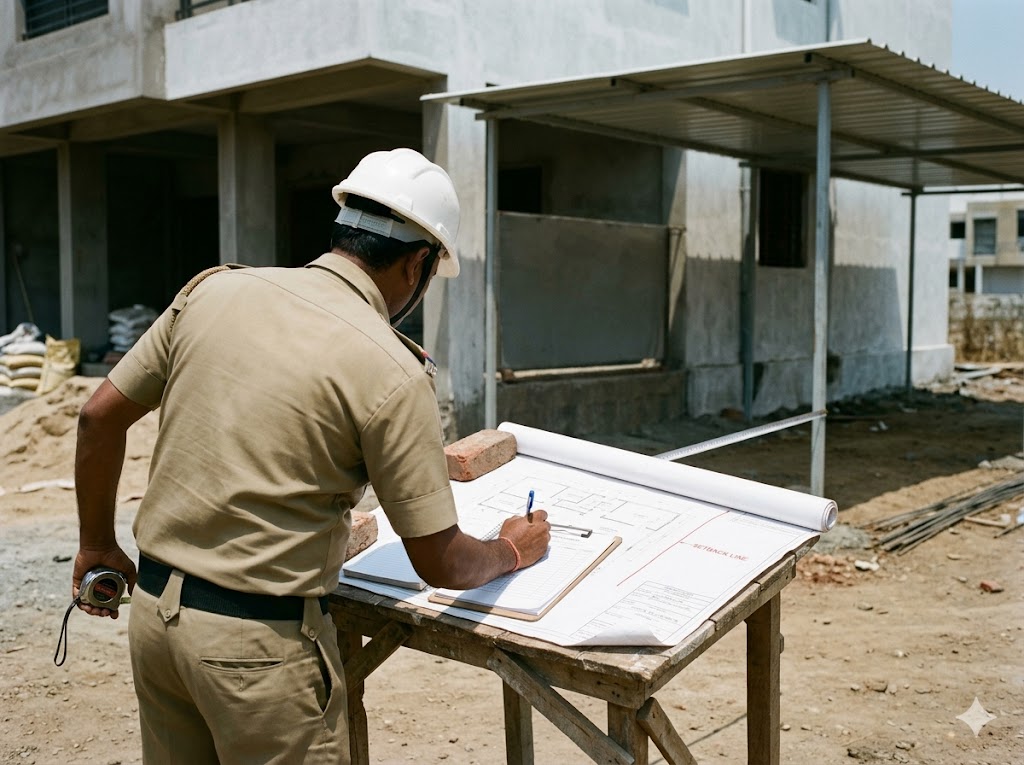
Setback measurement is an area where practice often diverges from the letter of the bye-law. Three measurement questions consistently arise:
From what line is the setback measured? The ULB plan-scrutiny measures from the building line — the actual external wall of the building — not from projections such as balconies, eaves, or sunshades (chhajjas). Most DCRs permit balconies up to 1.5 m into the setback zone and chhajjas up to 0.6 m.
To what line is it measured? The setback is measured to the plot boundary (cadastral line), not to the compound wall (which may be set inside the plot line). Encroachments of compound walls into the plot reduce the effective setback; ULB scrutiny may or may not catch this.
What about basement projection? Most DCRs permit basement walls to project up to 1.0–1.5 m into the setback zone, provided the basement is below ground and provides no habitable use. Semi-basement parking (common in Mumbai and Bangalore) typically must observe half the ground-floor setback.
Enforcement occurs at three stages: plan approval (pre-construction), construction inspection (during), and occupancy certificate (post). In practice, the most thorough enforcement is at plan approval; once construction begins, incremental deviations often go unchallenged until the occupancy certificate stage — by which point rectification is expensive.
The Supreme Court's judgement in MC Mehta v. Union of India (1997) established the doctrine that unauthorised construction is not regularised by the passage of time; the Delhi Monitoring Committee subsequently demolished thousands of structures that had exceeded their sanctioned setbacks (Supreme Court of India, 1997). Architects should treat setback compliance as a long-term risk management issue, not a one-time approval exercise.
12. The Future of Indian Setback Regulation
Three trends are reshaping Indian setback regulation and merit the architect's attention:
Digitisation. Every major state has launched an online plan-approval portal in the past decade. TSbPASS Telangana, BBMP Saral Sevege Sulige, MCGM Auto-DCR, Delhi DoBPA, and Tamil Nadu's OneStopPermission system enable digital submission, automated compliance checking, and faster approval — but only for plots within their coverage areas. Over the next decade, most Indian ULBs will migrate to digital-only approvals.
Unification. Maharashtra's UDCPR 2020 and Tamil Nadu's TNCDBR 2019 represent a trend toward state-wide unification of previously fragmented municipal bye-laws. Karnataka is expected to follow with a Karnataka Unified Building Regulation in the next 3–5 years. Unification reduces regulatory arbitrage and improves architectural practice across jurisdictions.
TOD-led liberalisation. Transit-oriented development corridors along metro lines permit higher FAR with adjusted setbacks, gradually dismantling the uniform plot-bracket approach in favour of location-sensitive regulation. As Indian cities expand their metro networks through the 2020s, more of the urban fabric will fall under TOD rules.
Architects who understand these trends can advise clients not just on today's permissible building, but on how changing regulation may open future possibilities — the extra storey that TOD reclassification might permit, the premium FSI purchase that justifies a larger initial plot, the digital pre-approval that accelerates a project timeline.
References
- Bureau of Indian Standards (2016) National Building Code of India 2016 — Part 3: Development Control Rules and General Building Requirements. New Delhi: BIS.
- Bureau of Indian Standards (2016) National Building Code of India 2016 — Part 4: Fire and Life Safety. New Delhi: BIS.
- Correa, C. (2005) 'Foreword', in National Building Code of India 2005. New Delhi: Bureau of Indian Standards.
- DDA (2007) Master Plan for Delhi 2021. New Delhi: Delhi Development Authority, Ministry of Urban Development, Government of India.
- DDA (2019) Transit Oriented Development Policy. New Delhi: Delhi Development Authority.
- Government of India (1950) Constitution of India. Seventh Schedule, Lists I, II, III. New Delhi.
- Government of Karnataka (2003, as amended 2019) BBMP Building Bye-Laws 2003. Bengaluru: Bruhat Bengaluru Mahanagara Palike.
- Government of Kerala (2019) Kerala Municipality Building Rules 2019. Thiruvananthapuram: Urban Affairs Department.
- Government of Maharashtra (2020) Unified Development Control and Promotion Regulations 2020. Mumbai: Town Planning and Valuation Department.
- Government of Maharashtra (2034) Development Control and Promotion Regulations 2034 (Greater Mumbai). Mumbai: Municipal Corporation of Greater Mumbai.
- Government of Tamil Nadu (2019) Tamil Nadu Combined Development and Building Rules 2019. Chennai: Housing and Urban Development Department.
- Government of Telangana (2020) TSbPASS (Telangana State Building Permission Approval and Self-Certification System) Rules. Hyderabad: Municipal Administration and Urban Development Department.
- Karnataka High Court (2018) Citizens' Action Forum v. State of Karnataka. Writ Petition No. 23942/2016. Bengaluru: Karnataka High Court.
- Lall, A.B. (2017) 'Towards a responsive building regulation', Architecture + Design, 34(6), pp. 32–41.
- Ministry of Environment, Forest and Climate Change (2019) Coastal Regulation Zone Notification 2019. New Delhi: MoEFCC.
- Ministry of Housing and Urban Affairs (2016) Unified Building Bye-Laws for Delhi 2016. New Delhi: MoHUA.
- Nagar Tatha Gram Nivesh Adhiniyam 1973 (1973) Madhya Pradesh Bhumi Vikas Niyam 2012. Bhopal: TCP Directorate.
- Patel, S.B. (2018) Urban Design in India — Lessons from a Lifetime of Practice. Mumbai: Indian Institute of Architects.
- Shenoy, K.R. (2013) K. Ramadas Shenoy v. Udipi Municipality. AIR 2013 SC 193. Supreme Court of India.
- Supreme Court of India (1997) M.C. Mehta v. Union of India. (1997) 11 SCC 312. New Delhi.
- Supreme Court of India (2019) DDA v. Kenneth Builders and Developers. Civil Appeal No. 4717/2015. New Delhi.
- Tiwari, G. (2017) 'Plot regulations and urban form in Delhi', Environment and Urbanization Asia, 8(2), pp. 234–252.
- URDPFI Guidelines (2015) Urban and Regional Development Plans Formulation and Implementation Guidelines. New Delhi: Ministry of Urban Development, Government of India.
- World Bank (2020) Doing Business 2020 — Dealing with Construction Permits (India Subnational Report). Washington, DC: World Bank Group.
Author's Note: Indian building bye-laws are revised frequently — typically every 5–10 years, with amendments in between. The tables and references in this guide reflect the position as of early 2026; readers should verify current editions through the relevant State Town and Country Planning Department, Urban Local Body, or Development Authority website before acting on any specific recommendation. The Studio Matrx Setback Visualizer implements the typical residential brackets for 20 major Indian cities and provides downloadable SVG/PNG output suitable for inclusion in drawing submissions; for final compliance, always verify with the plan-scrutiny officer of the relevant ULB.
Disclaimer: This article is for informational and educational purposes only. It does not constitute legal, architectural, or engineering advice. Building regulations vary between jurisdictions, change frequently, and are interpreted differently by different enforcement authorities. For any specific project, consult a qualified architect, a licensed engineer, and the relevant municipal authority. Studio Matrx, its authors, and its contributors accept no liability for decisions made on the basis of the information contained in this guide.
Interactive · Setback visualizer
Bengaluru (BBMP) · Buildable footprint 117.0 m² (54% coverage)
Front
3.0 m
Rear
2.0 m
Side 1
1.5 m
Side 2
1.5 m
Export this guide
City × topic atlas
Building Setbacks — by city
This national-level guide is the umbrella; the city pages drill into the specific authority, matrix, and overrides for each metro.
Related Guides — Deep-dive reading
How Urban Regulations Shape Cities in India
How the abstract rulebook of FAR, setbacks, height, parking and zoning literally builds the streets, skylines and neighbourhoods you live in
Building Regulations & ComplianceCompound Wall Regulations in India: Height Limits, Setbacks and Bye-Laws (2026)
A regulatory-literacy guide to the rules that govern a boundary wall in India — the things municipal bye-laws and development-control regulations typically cover, from maximum height and the open-grille front-wall rule to setbacks, corner-plot sight lines, gate swing, fire-tender access and neighbour law — and, most importantly, a plain method for finding and confirming the rule that actually applies to YOUR plot.
Compound WallsSecurity and Fire Regulations Guide for India (2026): Know the Rules and How to Navigate Them
There is no single national rulebook you can read off. This is the map of the whole regulatory landscape for home, housing-society and commercial security and fire systems in India, and a calm way to navigate it: who sets the rules, who approves what, and how to stay on the right side of them.
SecurityRelated Tools — Try Free
Brise-Soleil Visualizer
Interactive horizontal-louvre cut-off angle calculator — sun altitude, louvre depth, and spacing inputs with a live shadow preview. Computes θ = arctan(spacing/depth) for façade shading, ECBC envelope compliance, hospital daylight design, and tropical sun-control detailing.
Sun Shading ToolProperty Tax Calculator — 10 Indian Cities
Estimate annual municipal property tax across BBMP / MCD / MCGM / GHMC / GCC / KMC / PMC / AMC / TMC / PCMC — with self-occupied, tenanted, and age-rebate adjustments.
Property TaxBuilding Bylaw Checker
Check FAR, setbacks, and height limits for 12 Indian cities (BBMP, CMDA, BMC, DDA, and more).
ArchitectAI