
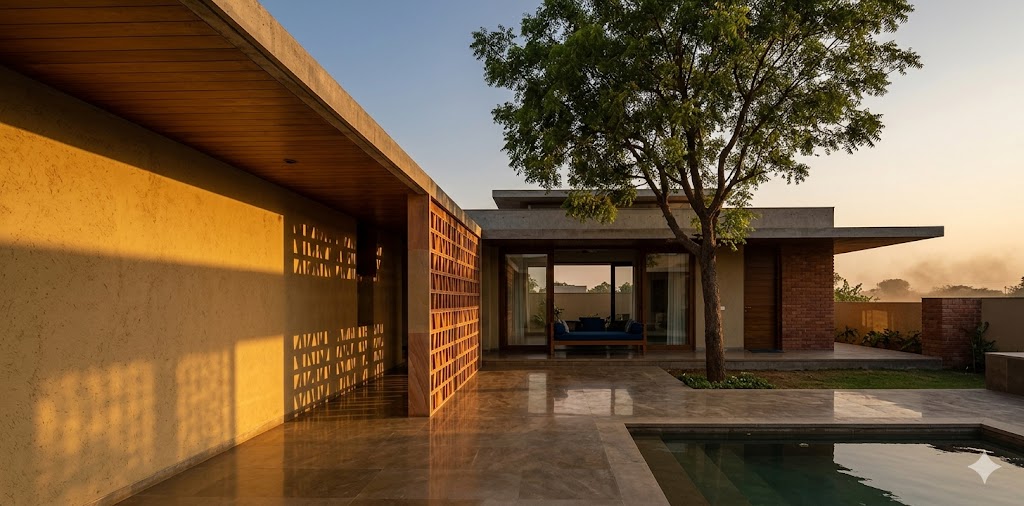
Passive Design Strategies for Indian Climate Zones
A Climate-Zone-by-Zone Working Reference for Indian Architects
Active mechanical cooling consumes roughly 40–60% of operational energy in an Indian residence with year-round air-conditioning, and the percentage is rising as climate zones warm. Passive design — the use of building form, mass, ventilation, shading, and orientation to deliver thermal comfort without mechanical input — is no longer an aesthetic preference. In ECBC-compliant projects, in IGBC-rated projects, and increasingly in any project that takes a 30-year energy-cost view, passive performance is a project parameter the architect must hit on the drawing board.
This guide is a working reference for the Indian architect designing for thermal performance. It covers the five NBC-defined climate zones, the shading-mask geometry that varies with latitude, the ECBC envelope U-value targets for compliant construction, and the strategy toolkit that differs by zone. It is intended to sit on the architect's desk through Stages 1–4 of a project — informing massing, orientation, envelope, and aperture decisions before they are locked into the working drawings.
"The problem of architecture is not how to give a function form, but how to give a place a soul." — Louis Kahn (1901–1974), in 'The Room, the Street, and Human Agreement' (1971)
1. The Climate Zone Map of India
The National Building Code 2016, Part 11 (Approach to Sustainability) divides India into five climatic zones based on monthly mean temperature and relative humidity. Every passive-design decision an Indian architect makes is downstream of which zone the site falls into.
NBC 2016 Climate Zones
| Zone | Defining Conditions | Representative Cities |
|---|---|---|
| Hot & Dry | Mean monthly temp >30°C; RH <55% for ≥6 months | Jaipur, Ahmedabad, Jodhpur, Bhuj, parts of Rajasthan and Gujarat |
| Warm & Humid | Mean monthly temp >25–30°C; RH >55% for ≥6 months | Chennai, Mumbai, Kochi, Goa, Bhubaneswar, coastal Andhra |
| Composite | Conditions vary seasonally, neither hot-dry nor warm-humid persistently | Delhi NCR, Bhopal, Lucknow, Kanpur, Nagpur, parts of UP/MP |
| Temperate | Mean monthly temp 25–30°C; humidity moderate; cool winters | Bengaluru, Pune (mostly), Hyderabad (some literature classifies as composite) |
| Cold | Mean monthly temp <25°C and many months below 5°C | Shimla, Srinagar, Leh, Manali, Gangtok, Darjeeling |
Source: National Building Code of India 2016, Part 11; Energy Conservation Building Code 2017; ISHRAE handbook on climatology of Indian cities.
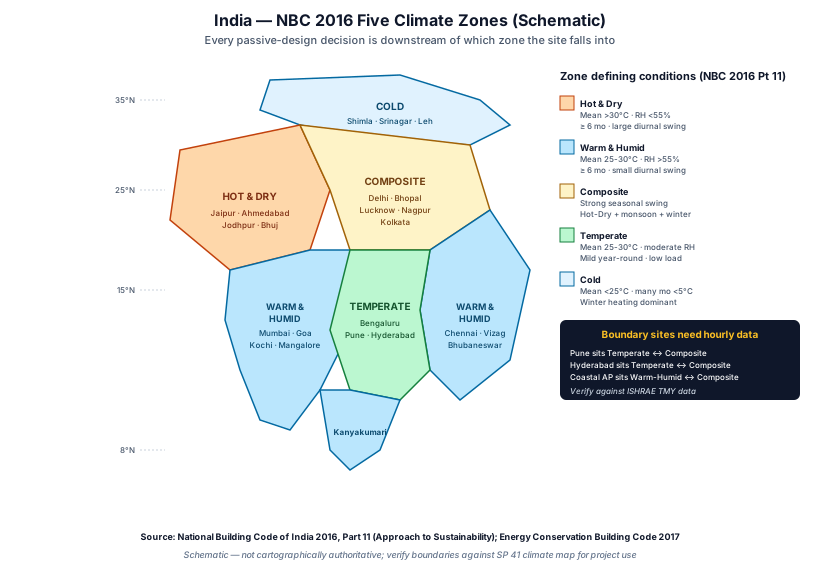
A site at the boundary between two zones (such as Pune, which sits between Temperate and Composite) requires the architect to verify with hourly weather data — the monthly mean is a coarse classifier, and design strategies for some boundary sites borrow from both zones.
"There is nothing more intolerable than days of fine weather." — Goethe, often misread; here a reminder that 'good' weather is climate-relative
2. Sun-Path Geometry and Shading Mask Logic
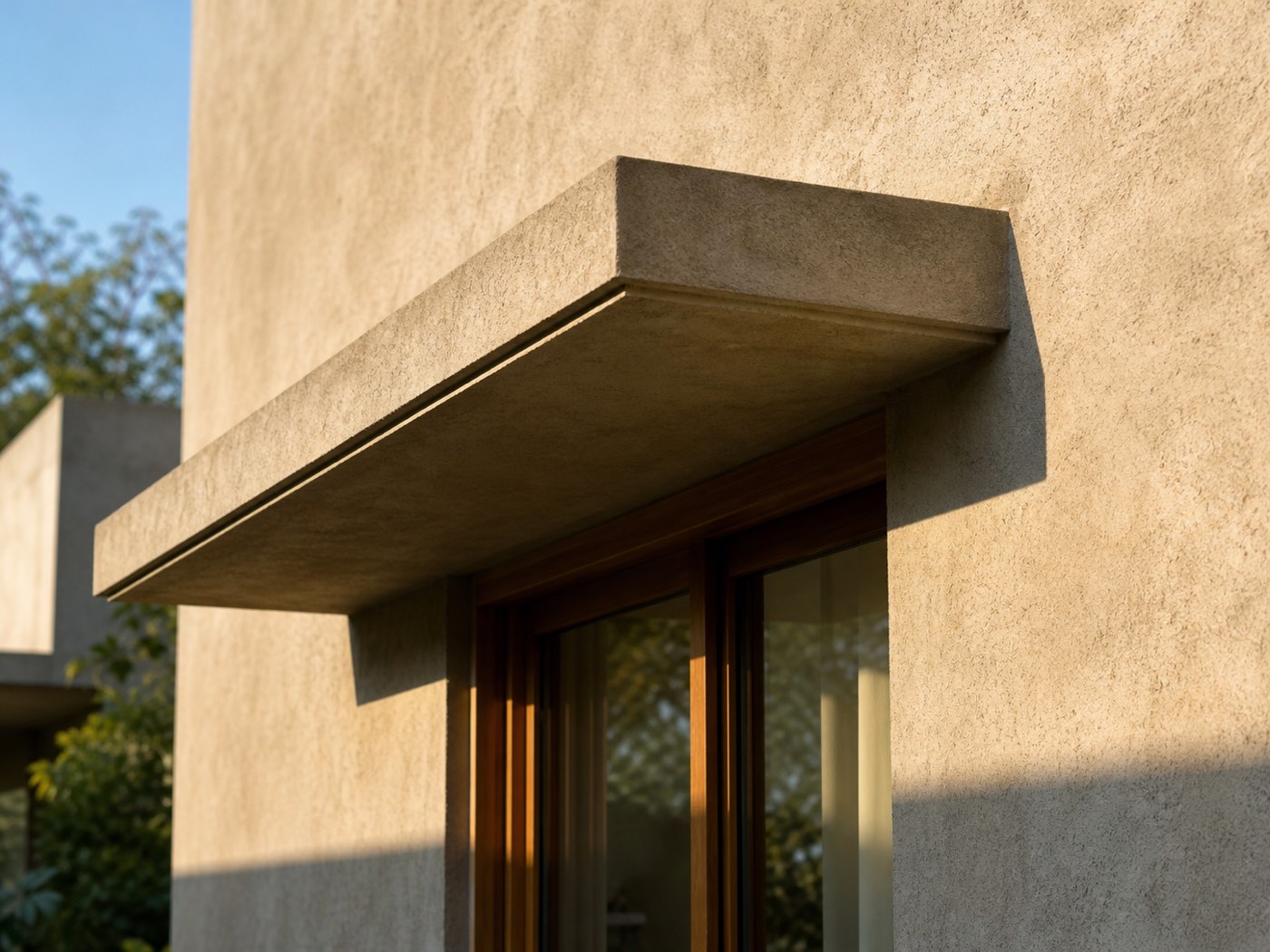
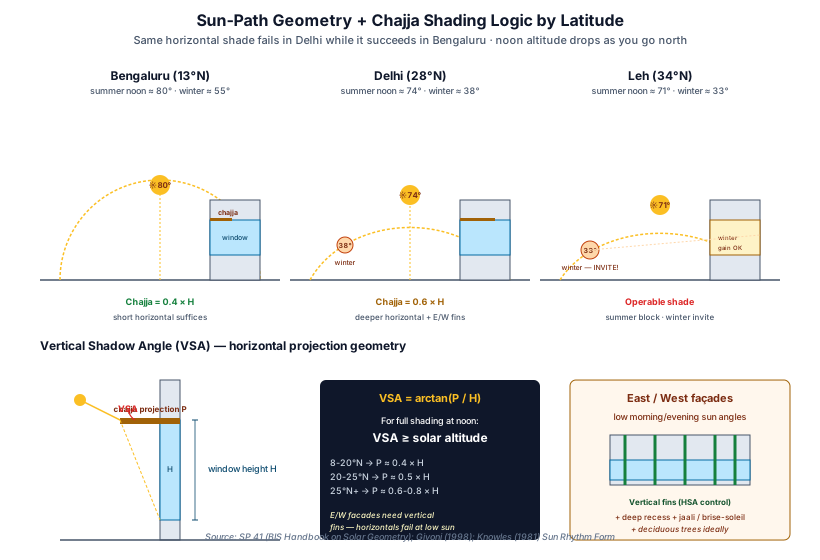
India spans roughly 8°N (Kanyakumari) to 35°N (Leh) in latitude. Sun altitude at solar noon on the summer solstice is therefore 75–82° at the southern tip (sun nearly overhead) and 58° at Leh (sun lower in the sky). Shading strategies that work in Bengaluru fail in Delhi; horizontal sunshades that protect a Mumbai window let direct gain into a Jaipur window for hours every winter morning.
The stereographic sun path for the project's latitude is the architect's primary geometry tool. Two angular quantities matter most:
- Vertical Shadow Angle (VSA): the angle a horizontal projection (chajja, eaves, balcony) needs to subtend to fully shade an opening at solar noon during the cooling season.
- Horizontal Shadow Angle (HSA): the angle a vertical projection (fin, brise-soleil) needs to subtend to shade against low-altitude morning/evening sun.
Solar Geometry by Latitude — Quick Reference
| Latitude | Summer Noon Sun Altitude | Winter Noon Sun Altitude | Shading Strategy |
|---|---|---|---|
| 8–13°N (Kanyakumari, Bengaluru, Chennai) | 80–82° | 53–58° | Short horizontal shades suffice; minimal vertical fins |
| 13–20°N (Hyderabad, Mumbai, Goa) | 78–80° | 47–52° | Horizontal shades + east/west fins |
| 20–25°N (Ahmedabad, Bhopal, Kolkata) | 75–78° | 42–47° | Deeper horizontals + verticals on E/W |
| 25–30°N (Delhi, Jaipur, Lucknow) | 73–75° | 37–42° | Aggressive horizontal + vertical shading; trees east/west |
| 30–35°N (Shimla, Srinagar, Leh) | 70–73° | 32–37° | Horizontal shading for summer; winter solar gain invited on south |
Source: Synthesised from BIS Handbook on Solar Geometry (SP 41), and Givoni (1998) bioclimatic charts for Indian cities.
The rule of thumb for an architect designing south-facing apertures: the chajja projection should equal 0.4 × the window opening height for latitudes 8–20°N, 0.5 × for 20–25°N, and 0.6–0.8 × for 25°N and above. East and west exposures cannot be effectively shaded by horizontals alone — they require vertical fins, deep recess, or external louvres.
3. The Strategy Toolkit
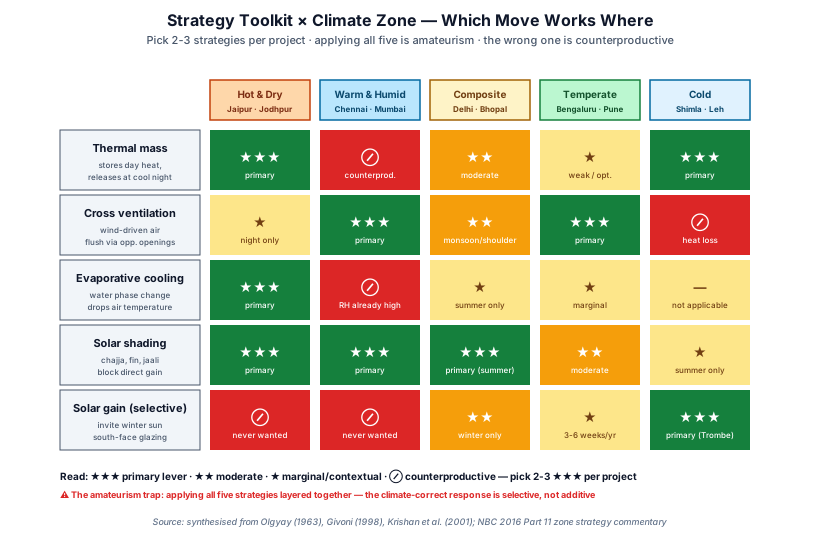
Five primary strategies recur across climate zones, each addressing a specific physical mechanism:
| Strategy | What It Does | Where It Works |
|---|---|---|
| Thermal mass | Stores daytime heat, releases at night when air cools | Hot-Dry, Cold; not Warm-Humid |
| Cross ventilation | Replaces hot indoor air with cooler outdoor air via wind-driven flow | Warm-Humid, Temperate, Composite (night) |
| Evaporative cooling | Lowers air temperature via water phase change | Hot-Dry only (low ambient humidity) |
| Solar shading | Blocks direct gain on the building envelope | All zones except Cold winter |
| Solar gain (selective) | Invites winter sun deep into south rooms | Cold, Composite winter |
The competent designer selects two or three of these strategies as the project's primary thermal logic, rather than attempting to apply all five. In a Bengaluru residence, cross-ventilation plus moderate shading does most of the work; thermal mass adds little because the diurnal temperature swing is narrow. In a Jaipur residence, thermal mass plus shading plus evaporative cooling is the core triad; cross-ventilation is counterproductive when outdoor air is hotter than indoor for 8+ hours of the day.
"Light is the first condition of all visibility." — John Ruskin (1819–1900), in The Stones of Venice (1851)
4. Zone-by-Zone Strategy Synthesis
Hot & Dry — Jaipur, Ahmedabad, Jodhpur
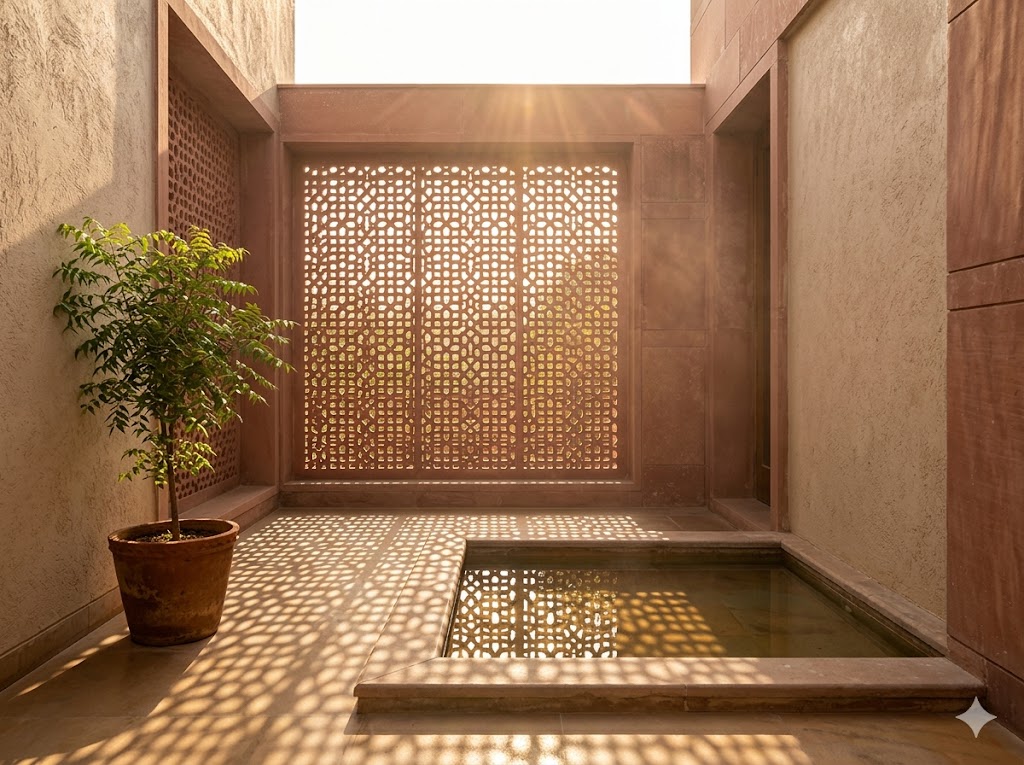
The defining condition is large diurnal temperature swing (often 18–22°C between day and night) with low humidity. The historic vernacular response — courtyards, thick masonry walls, small punched openings, and water bodies — is fundamentally correct and translates directly to contemporary design.
Design strategy:
- High thermal mass walls (230 mm brick or stone, U-value <2.0 W/m²K) buffer day-night temperature swings
- Small, deeply-recessed openings with external shading; window-to-wall ratio (WWR) <30%
- Internal courtyards with water bodies for evaporative cooling and air-shaft effect
- High roof insulation (R-value >2.5 m²K/W) and reflective surface to reject solar gain
- Mutual shading of walls — narrow streets, deep verandahs, jaalis on west elevations
- Operable openings sized for night ventilation to flush stored heat
The single biggest hot-dry design error in contemporary practice is large unshaded glass. A floor-to-ceiling window on a Jaipur villa converts the room into an oven; the AC load to recover from solar gain often exceeds the load the rest of the design saves.
Warm & Humid — Chennai, Mumbai, Goa
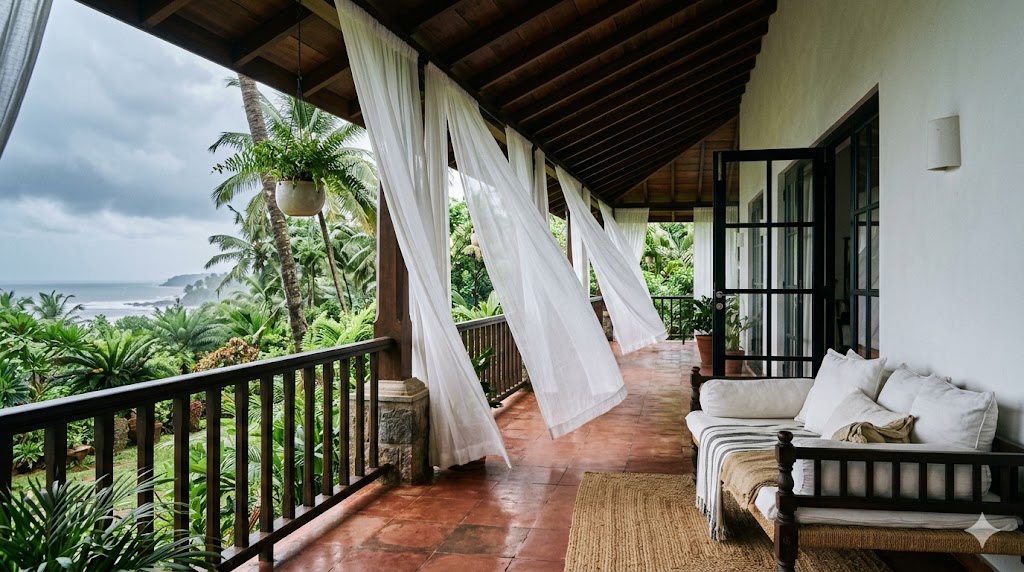
The defining condition is persistent high humidity with moderate temperature. Thermal mass works against the design here — high mass holds humid heat through the night when comfort depends on continuous air movement.
Design strategy:
- Lightweight construction — brick or RCC structure with low-mass infill, reflective roof
- Maximum cross-ventilation — opposed openings on prevailing wind axis, low sill heights
- Wide overhanging roofs and verandahs for shading without trapping heat against walls
- Stack ventilation — high openings to release rising hot air; courtyards with chimney effect
- Open plan or permeable partitions to maintain airflow
- Insulated roof (R-value >2.5) — primary heat gain path in the tropics
- Avoid air-tight construction — ECBC's airtightness targets are calibrated for tempered climates and can be counterproductive in warm-humid
Composite — Delhi, Bhopal, Nagpur, Kolkata
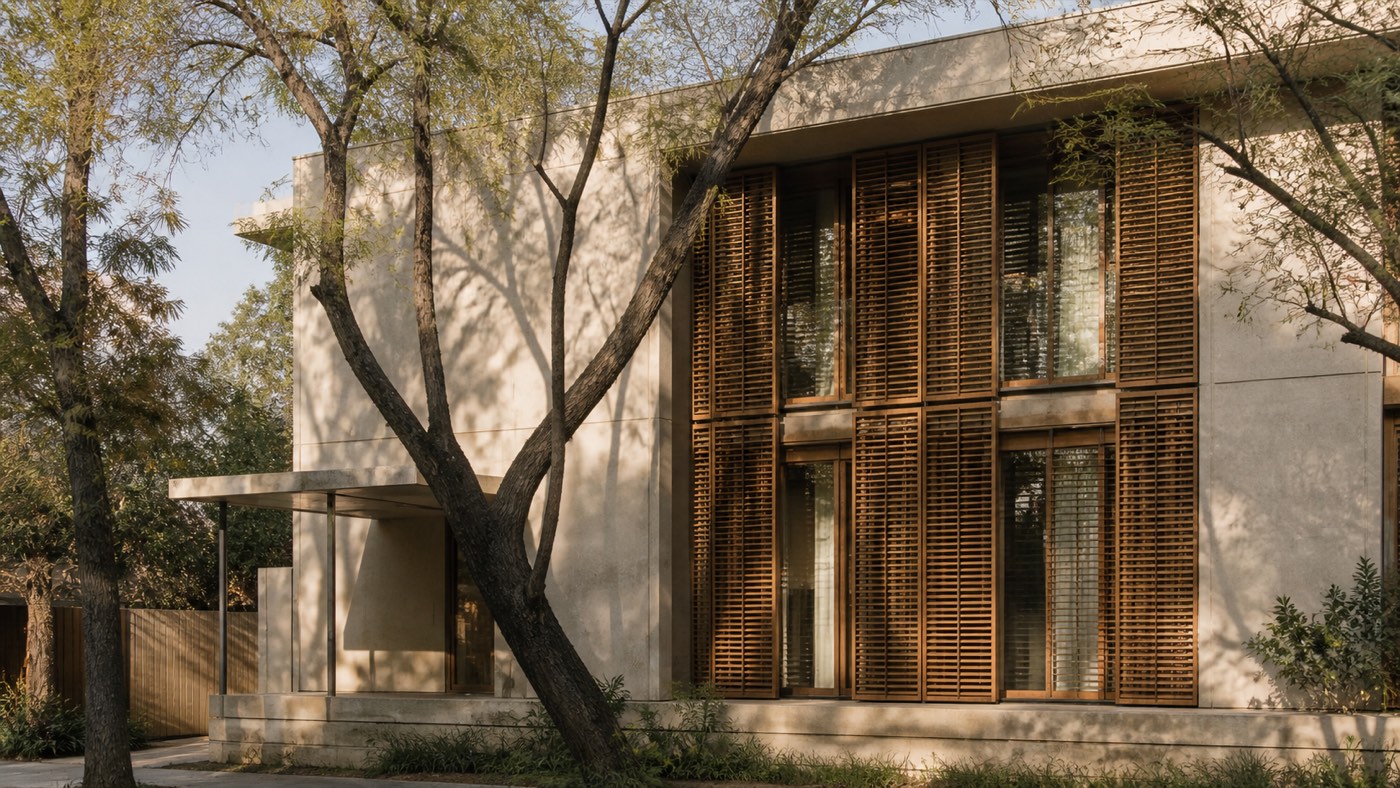
The defining condition is seasonal swing: hot summers (Hot-Dry behaviour), monsoon (Warm-Humid behaviour), cool dry winters (Cold/Temperate behaviour). The design must respond to all three.
Design strategy:
- Moderate thermal mass — sufficient for summer heat buffering, not so high that winter mornings remain cold
- Operable shading — fixed for summer, retractable or removable for winter solar gain
- Cross-ventilation pathways available for monsoon and shoulder seasons
- Glazed openings on south face designed for winter gain with summer shading (chajja calibrated to seasonal sun-altitude difference)
- Trees on east and west — deciduous where available, for shade in summer and gain in winter
- Roof insulation aggressive — composite cities have the harshest summer roof loads outside true Hot-Dry
The composite zone is the most technically demanding because no single strategy suffices. The architect's design process involves seasonal mode-switching — the building behaves differently in May than in January.
Temperate — Bengaluru, Pune
The defining condition is mild year-round temperatures, moderate humidity, and a small cooling load that is easily addressable passively. A Bengaluru residence designed well needs no air-conditioning except for 3–6 weeks per year.
Design strategy:
- Cross-ventilation primary — Bengaluru's prevailing winds make this highly effective
- Moderate shading on east, west, and south
- Light to moderate thermal mass — RCC frame with brick infill is sufficient
- Window-to-wall ratio 30–40% — generous daylight without thermal penalty
- Open verandahs and balconies for indoor-outdoor living during favourable months
- Roof shading by terrace garden, pergola, or insulated finish to reduce summer peak
The design temptation in Bengaluru is to over-engineer for thermal performance. The climate forgives modest envelope choices; the design effort is better spent on daylighting, ventilation, and indoor-outdoor connection.
Cold — Shimla, Srinagar, Leh
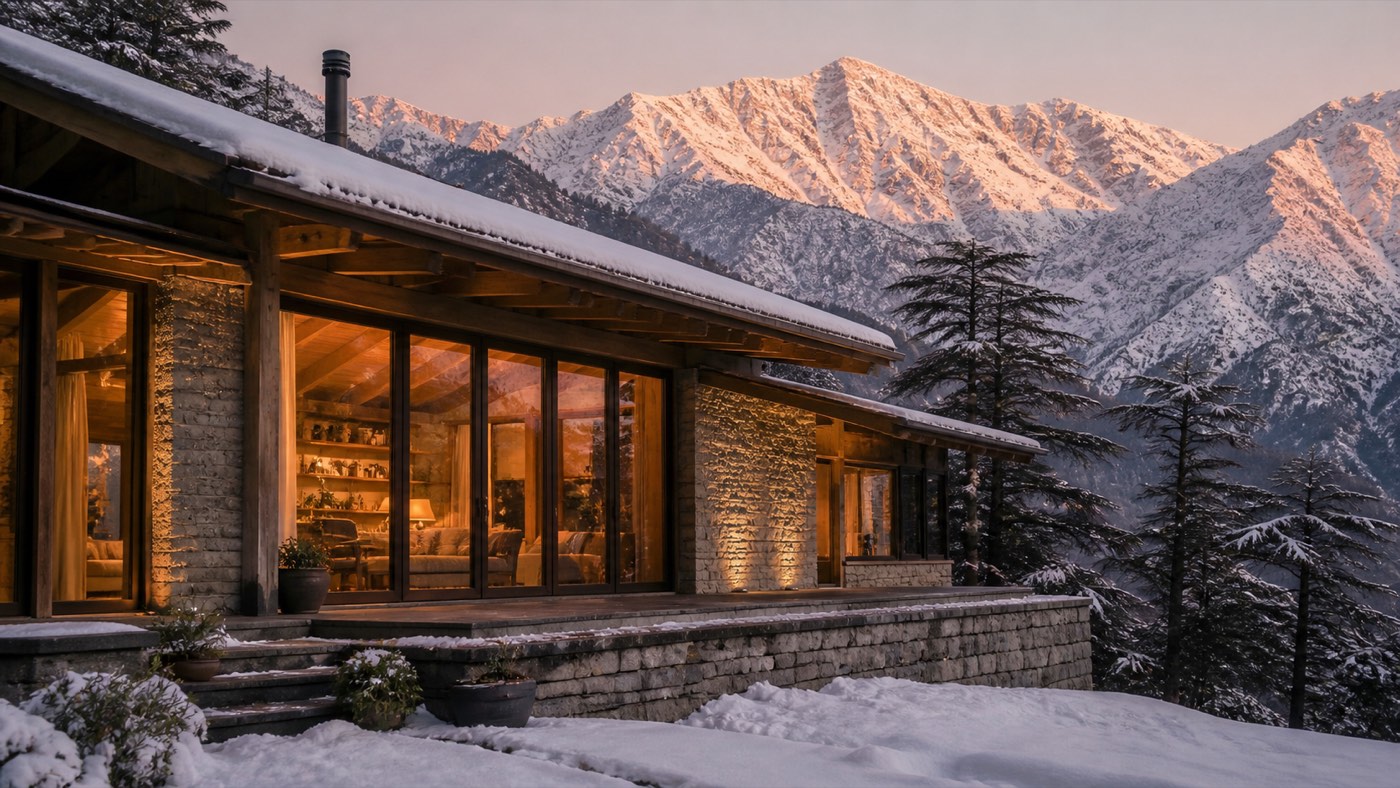
The defining condition is winter heating dominance. Many days fall below 5°C; some below freezing. The design must conserve heat, not reject it.
Design strategy:
- High insulation — wall U-value <0.4 W/m²K, roof <0.3 W/m²K (well above ECBC defaults)
- Solar gain invited on south face — large glazed openings sized for winter sun penetration; storage walls (Trombe walls) where applicable
- Compact form — minimum surface-to-volume ratio reduces heat-loss area
- Air-tight construction — sealed joints, double or triple glazing
- Sun-spaces and verandahs as thermal buffers between cold exterior and conditioned interior
- Low-altitude apertures on north minimised — north-facing windows lose heat without compensating gain
- Floor insulation — typically overlooked in non-cold-zone practice but critical here
"The sun does not realise how wonderful it is until after a room is made." — Louis Kahn, in 'Light is the Theme' (1975)
5. Envelope U-Value Targets — ECBC 2017
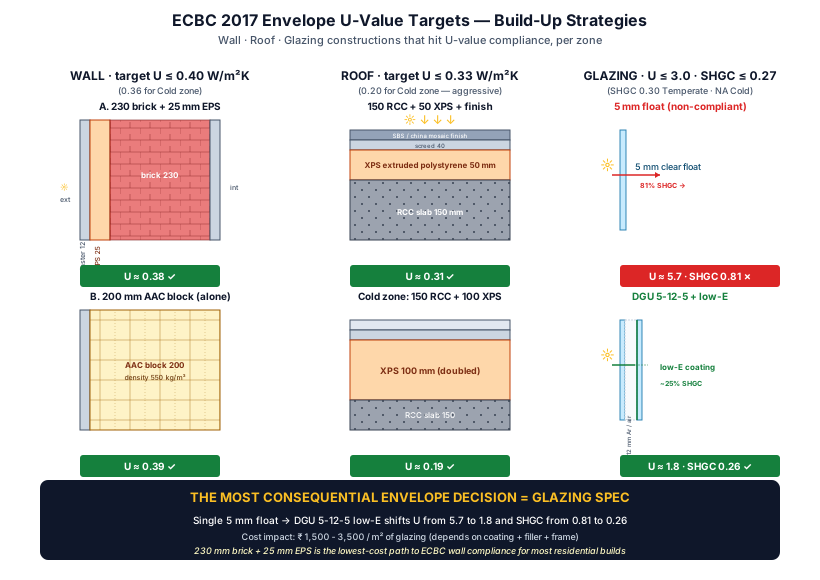
The Energy Conservation Building Code 2017 (and its 2024 revisions) prescribes maximum U-values by climate zone for compliance. These are mandatory for buildings above stated connected loads (typically commercial/institutional) and serve as a quality benchmark for residential.
ECBC Maximum U-Values (W/m²K)
| Component | Hot-Dry | Warm-Humid | Composite | Temperate | Cold |
|---|---|---|---|---|---|
| Roof (above-grade) | 0.33 | 0.33 | 0.33 | 0.33 | 0.20 |
| Wall (opaque, above-grade) | 0.40 | 0.40 | 0.40 | 0.40 | 0.36 |
| Vertical fenestration (glazing) | 3.0 | 3.0 | 3.0 | 3.0 | 2.2 |
| Solar Heat Gain Coefficient (SHGC) for fenestration | 0.27 | 0.27 | 0.27 | 0.30 | NA |
Source: Energy Conservation Building Code 2017 (Bureau of Energy Efficiency, Government of India), Table 4.3 — ECBC residential building code values referenced where applicable.
For residential design, hitting these targets typically requires:
- 230 mm brick wall + 25 mm EPS insulation (or 200 mm AAC block alone) for U <0.40
- 150 mm RCC slab + 50 mm extruded polystyrene + roof finish for U <0.33
- 5 mm + 12 mm air gap + 5 mm DGU (double-glazed unit) with low-E coating for U <3.0 and SHGC <0.27
A single-glazed standard 5 mm float window has U ≈ 5.7 and SHGC ≈ 0.81 — non-compliant on every climate zone. The shift to double-glazed low-E is the most consequential envelope decision for ECBC compliance, and it affects cost by ₹1,500–₹3,500 per square metre of glazing depending on specification.
6. EPI (Energy Performance Index) Benchmarks
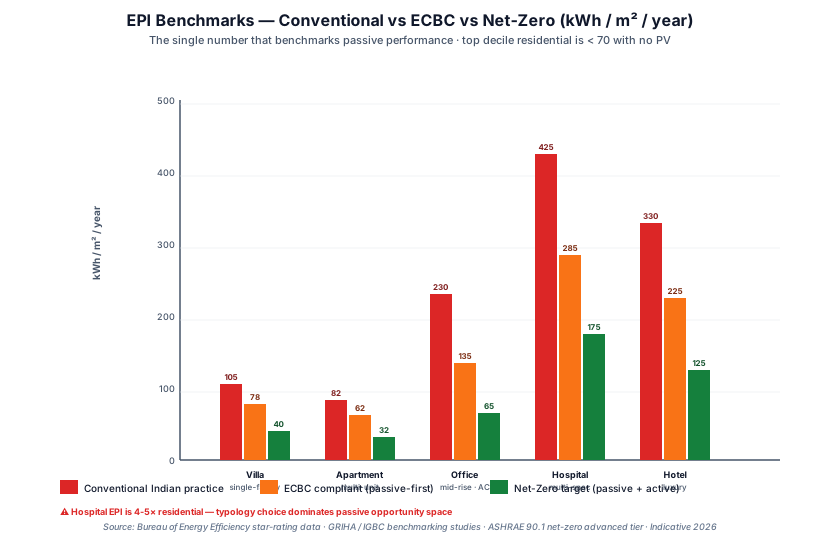
EPI is the annual energy consumption per unit floor area, expressed in kWh/m²/year. It is the single-number performance benchmark used by ECBC, GRIHA, and IGBC to compare buildings.
EPI Benchmarks by Building Type — India 2026 Indicative
| Building Type | Conventional EPI | ECBC Compliant | Net-Zero Target |
|---|---|---|---|
| Residential (single-family villa) | 90–120 | 70–85 | 30–50 |
| Residential (apartment) | 70–95 | 55–70 | 25–40 |
| Office (mid-rise, AC) | 200–260 | 120–150 | 50–80 |
| Hospital (multi-speciality) | 350–500 | 250–320 | 150–200 |
| Hotel (luxury) | 280–380 | 200–250 | 100–150 |
Source: Bureau of Energy Efficiency star-rating data; GRIHA and IGBC benchmarking studies; Net-Zero figures based on ASHRAE 90.1 advanced tier and IGBC Net-Zero criteria.
A residential project that achieves EPI <70 with passive-first design (no PV, no heat pumps) is performing in the top decile of Indian residential design. A project at EPI 50 or below typically requires either a Cold-zone or Temperate-zone climate plus very disciplined envelope and shading work, or active strategies (PV, heat pumps) layered onto a strong passive base.
7. Modelling, Verification, and Decision Support
Passive design decisions made on intuition alone are unreliable; the same design move can save 10% in one orientation and add 5% in another. The architect's modelling toolkit:
| Tool | Best For | License Cost |
|---|---|---|
| Climate Consultant (UCLA) | Bioclimatic chart generation, strategy selection per site | Free |
| DesignBuilder (with EnergyPlus) | Detailed thermal simulation, ECBC compliance | Commercial |
| Ladybug + Honeybee (Grasshopper / Rhino) | Sun-path, radiation, ventilation studies | Free, requires Rhino |
| Sefaira (Trimble) | SketchUp-based early-stage analysis | Commercial |
| EQuest / OpenStudio | EnergyPlus with simpler interface | Free |
For most residential projects, Climate Consultant for site analysis + Ladybug for sun-path + a hand-calculated U-value spreadsheet is sufficient. Full simulation in DesignBuilder is overhead beyond the scale of most residential design fees.
The shading-mask diagram generated in Ladybug at the start of Stage 1 is the single most valuable passive-design output an architect can produce. It quantifies, for the specific site latitude and orientation, how many hours of summer sun a given chajja blocks — converting passive design from intuition to engineering decision.
"In matters of building, do not trust intuition unless it has been calibrated by measurement." — Architectural-engineering aphorism, sourced to Ralph Knowles (1981) in 'Sun Rhythm Form'
8. Practitioner's Closing Note
Passive design in India is a layered competence. The first layer is climate-zone literacy — knowing whether the site is Hot-Dry or Composite changes every subsequent decision. The second is solar-geometry literacy — knowing the latitude's sun path informs aperture, shading, and orientation. The third is envelope literacy — knowing the U-value and SHGC targets for the zone informs material choice. The fourth is performance literacy — knowing what EPI a competent design should achieve, and modelling against that target.
The architect who works through these four layers on every project, even briefly, designs buildings that perform measurably better than those of peers who skip them. Passive design is not an aesthetic; it is engineering applied early in the design process — and the ECBC, NBC, and IGBC frameworks have given Indian architects the targets, the tools, and the language to do it well.
Cross-References Within Studio Matrx
- How to Design for the Indian Climate — climate-design overview at the homeowner level
- Cross Ventilation in Indian Homes — deep dive on the ventilation strategy
- Natural Light Planning for Indian Homes — daylight as a passive lever
- Daylighting Indian Homes and Buildings — daylight-factor calculation reference
- Facade Design for Indian Climates — envelope detailing in climate context
- Courtyard Homes in India — Climate-Responsive Design — vernacular precedent for Hot-Dry and Composite zones
- Vernacular Architecture — Lessons for Modern Homes — historical climate logic
- Use the Sun Path Analyzer to study site-specific solar geometry
- Use the Cross Ventilation Analyzer to model airflow paths
References
1. Bureau of Indian Standards (2016) National Building Code of India 2016, Part 11 (Approach to Sustainability). New Delhi: BIS.
2. Bureau of Energy Efficiency (2017) Energy Conservation Building Code 2017. New Delhi: Ministry of Power, Government of India.
3. Bureau of Energy Efficiency (2024) ECBC Residential — Eco-Niwas Samhita. Updated edition.
4. Bureau of Indian Standards SP 41 — Handbook on Functional Requirements of Buildings.
5. Givoni, B. (1998) Climate Considerations in Building and Urban Design. New York: John Wiley & Sons.
6. Knowles, R.L. (1981) Sun Rhythm Form. Cambridge, MA: MIT Press.
7. Olgyay, V. (1963) Design with Climate: Bioclimatic Approach to Architectural Regionalism. Princeton: Princeton University Press.
8. Krishan, A., Baker, N., Yannas, S. & Szokolay, S.V. (eds.) (2001) Climate Responsive Architecture: A Design Handbook for Energy Efficient Buildings. New Delhi: Tata McGraw-Hill.
9. Indian Society of Heating, Refrigerating and Air-Conditioning Engineers (ISHRAE) (2014) ISHRAE Weather Data Files for Indian Cities.
10. American Society of Heating, Refrigerating and Air-Conditioning Engineers (2022) ASHRAE 90.1 — Energy Standard for Buildings Except Low-Rise Residential Buildings.
11. Indian Green Building Council (2024) IGBC Green Homes Rating System v3.0. Hyderabad: IGBC.
12. The Energy and Resources Institute (2019) GRIHA v.2019 — Manual for Architects and Designers. New Delhi: TERI.
Author's Note: Passive design is one of those domains where the literature is rich, the codes are clear, and the practical adoption in Indian residential practice still lags significantly. This guide is intended as a desk reference an architect can consult in Stage 1 of every new commission. The Studio Matrx Sun Path Analyzer and Cross Ventilation Analyzer tools are built to operationalise these concepts at site-specific resolution.
Disclaimer: This article is for informational and educational purposes only. It does not constitute professional engineering advice. Climate data, U-value targets, and EPI benchmarks reflect current Indian regulatory frameworks and may change with code revisions. Architects must verify ECBC, NBC, IGBC, and GRIHA values against current published editions before specifying envelope and HVAC systems. Studio Matrx, its authors, and contributors accept no liability for decisions based on this guide.
Interactive · India Climate-Zone Explorer
Warm-Humid — Mumbai, Chennai, Kochi…
Climate
Cities: Mumbai, Chennai, Kochi, Mangalore, Kolkata
Temperature: Year-round 22–34 °C
Rainfall: Heavy (1500–3500 mm)
Passive design strategies
- ●Pavilion forms with wrap-around verandahs
- ●Cross-ventilation on every room — no dead corners
- ●Raised plinth (300–600 mm) against monsoon flooding
- ●Pitched roof with deep overhangs (1.2 m+)
- ●Movable louvre walls
Recommended materials
Signature features
- ◆East + west verandahs
- ◆Skylight venting
- ◆Gable ridges for hot air escape
Export this guide
Related Guides — Deep-dive reading
Designing a Naturally Energy-Efficient Indian Home
Comfort first, gadgets last — passive design, orientation, insulation, ventilation and the climate wisdom that cuts Indian energy bills
SustainabilityEnergy-Efficient Facades in India: How the Building Skin Cuts Your Cooling, Heating & Lighting Bills
How a building facade drives cooling, heating and lighting energy in India, the three levers of solar-heat-gain control, insulation and daylighting, U-value, SHGC, VLT and WWR in plain terms, ECBC and Eco-Niwas expectations, and real Indian green buildings.
Building FacadesNatural Light Planning for Indian Homes
Orientation, Windows, and Openings — A Professional Guide for Architects
Room PlanningRelated Tools — Try Free
Brise-Soleil Visualizer
Interactive horizontal-louvre cut-off angle calculator — sun altitude, louvre depth, and spacing inputs with a live shadow preview. Computes θ = arctan(spacing/depth) for façade shading, ECBC envelope compliance, hospital daylight design, and tropical sun-control detailing.
Sun Shading ToolCross-Ventilation Analyzer
Estimate airflow and air changes per hour (ACH) from room size, window areas, layout, and local wind — with NBC 2016 Part 8 compliance check.
Ventilation CalculatorGreen Building Window Compliance Tool
Check your window design against Eco-Niwas Samhita — WWR, VLT, SHGC and U-value pass or fail.
ENS Pre-check