
30 × 40 ft House Plan in Hyderabad — A 2026 Temperate-Plateau Reference
Hyderabad's uplands sit in the temperate climate band — milder than Delhi, warmer than Bengaluru, with the Deccan plateau's two-monsoon rhythm. The Garden Pavilion plan opens the home to three faces, plants generously, and runs minimal air-conditioning. HMDA Master Plan 2031 + Telangana Building Rules 2012 compliance, lake-buffer overlays, and 2026 cost realities, in one place.
Governing framework: Telangana Building Rules 2012 + GO Ms No. 168
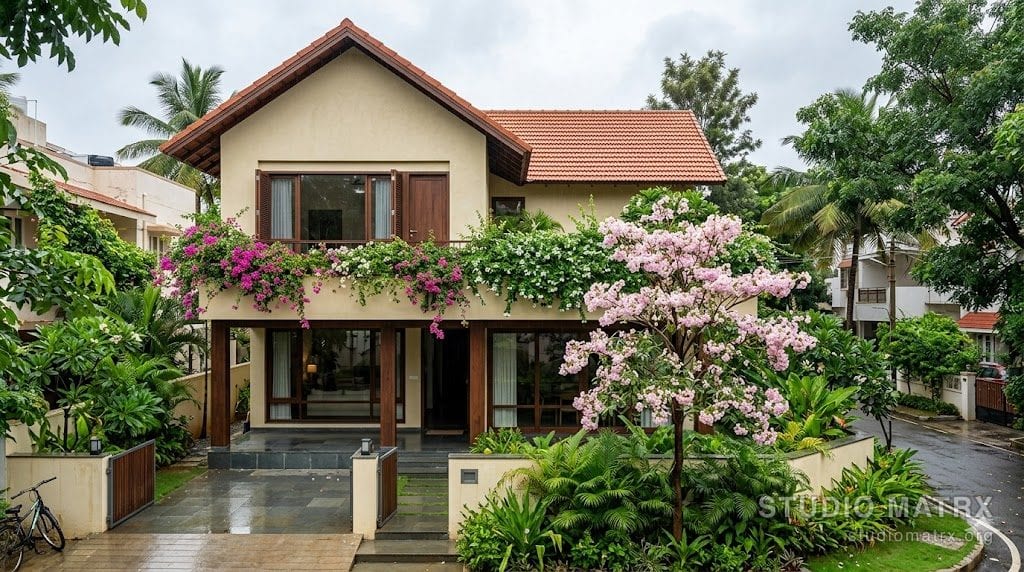
Working reference tables
Print or screenshot these for the studio wall. Cross-check against the current authority notification before any specific filing.
HMDA / GHMC plot envelope for a 30 × 40 ft (≈ 111 sqm) Hyderabad plot
Setback, FSI, and height permitted on a typical 30 × 40 ft residential plot in Hyderabad under HMDA Master Plan 2031 + Telangana Building Rules 2012 (amended). Plots within GHMC limits route through GHMC building permit; outer HMDA layouts route through HMDA. Verify the specific zonal designation before sanction.
| Parameter | HMDA / GHMC (Residential Use, ≤ 250 sqm) | This Plan (Garden Pavilion) |
|---|---|---|
| Plot area | 100–250 sqm band | 111 sqm (1200 sqft) |
| Permissible FSI | 1.65 (≤ 12 m road) | 1.17 (well within base) |
| Ground coverage | 65% max | 55% achieved |
| Front setback | 1.5 m (≤ 9 m road) / 2.0 m (9–12 m road) | 1.8 m (verandah + planted strip) |
| Rear setback | 1.0 m | 1.2 m (utility yard) |
| Side setback (one side) | 0.9 m | 1.2 m (planted) |
| Side setback (other) | 0.9 m | 0.9 m (parking access) |
| Building height max | 10 m for ≤ 9 m road (G+2 typical) | 8.6 m (G+1 + roof terrace + pergola) |
| Stilt parking FSI exemption | Excluded if ≤ 2.4 m height | Designed for pergola, not stilt |
HMDA Master Plan 2031 zonal classifications (Residential R1 / R2, Mixed-Use M1 / M2) modify the matrix. Telangana Building Rules 2012 provides the dimensional rules; specific GHMC ward bye-laws can add overlays. A 30 × 40 ft plot in standard suburban R1 zoning has comfortable headroom against base FSI 1.65 with the plan's 1.17 actual usage.
Hyderabad temperate-plateau climate strategy summary
How the Garden Pavilion envelope responds to Hyderabad's two-monsoon rhythm + the slightly drier, warmer profile compared to Bengaluru. Hyderabad sits on the boundary of temperate and composite — closer to temperate for design purposes, but with the warmer summer.
| Season | Climate Reality | Design Response | Cost Driver |
|---|---|---|---|
| Pre-monsoon (Apr–Jun) | 32–40 °C; clear, dry heat; diurnal swing 15 °C | Three open faces; verandahs shade ground floor; cross-vent dawn + dusk | Verandah depth + planted setbacks |
| SW monsoon (Jul–Sep) | 26–32 °C; 600 mm rain over 80 days | Mangalore tile on verandahs + 600 mm eaves; lime mortar; garden court drinks rain | Mangalore tile + carpentry |
| NE retreating monsoon (Oct–Nov) | 22–28 °C; 200 mm rain; pleasant | Free-running; ceiling fans suffice; planted court luscious | (no premium) |
| Winter (Dec–Feb) | 14–28 °C; clear, cool nights at 14 °C | Single glaze sufficient; no heater needed; light shawl at night | (no premium) |
Hyderabad's peak summer (April–June 35–40 °C) is the one harder season vs Bengaluru. A small AC in the master bedroom for 3–4 hours/day during these peak weeks is the practical compromise; the verandah + cross-vent + planted court handle the rest of the year.
Hyderabad 2026 cost band — 1600 sqft built-up Garden Pavilion
Per-sqft and total cost for the Garden Pavilion plan at three finish tiers, indicative for 2026 Hyderabad labour and material market. Outer HMDA layouts (Kompally / Bachupally / Tellapur / Shamshabad) at this band; central GHMC ~10% higher; high-end (Jubilee Hills / Banjara Hills) ~25% higher with custom premium-stone selections.
| Tier | ₹/sqft | Total (₹ L) | Inclusions |
|---|---|---|---|
| Basic | 2,100 | 33.6 | Fly-ash brick + lime, vitrified tile, jackwood frames, 6 mm single glaze, basic balcony planters |
| Recommended | 2,500 | 40.0 | Fly-ash + lime, terracotta + Indian green marble first floor, teak frames, balcony herb spiral, 3 kWp solar |
| Premium | 2,900 | 46.4 | Premium teak frames, Tandur stone selectively, shower garden, 5 kWp solar, automated rain-guard screens, EV charger |
Hyderabad's local stone market (Tandur stone, Shahabad polished, Telangana granite) makes premium stone finishes ~10–15% cheaper than Bengaluru. Labour rates ~5% lower than Bengaluru. The premium tier here under-cuts the Bengaluru Garden Pavilion premium tier by ~₹1.6 L for the same specification.
Hyderabad-specific construction overlays
Beyond standard HMDA / GHMC sanction, four Hyderabad-specific overlays affect a 30 × 40 ft project. Lake-buffer is the most commonly missed by non-Hyderabad architects.
| Overlay | Authority | When triggered | Architect action |
|---|---|---|---|
| Lake / FTL (Full Tank Level) buffer | HMDA + Irrigation Department | Plots within 30 m of notified lake | FTL boundary verification; no-build within FTL + 30 m buffer |
| Tree-cutting permission | GHMC + Forest Department | Any tree on plot ≥ 5 m height | Online application 30–60 days before sanction |
| HMDA NOC for outer layouts | HMDA | Plots in HMDA-approved layouts beyond GHMC | HMDA NOC required before building permit |
| TSSPDCL solar net-metering | Telangana State Southern Power Distribution Company | Solar PV install | Pre-install application 4–8 weeks |
| Heritage zone facade approval | GHMC Heritage Cell | Plots in heritage precincts (e.g., Charminar / Golconda buffer) | Facade approval pre-sanction; 2–4 month process |
Hyderabad has dozens of notified lakes (Hussain Sagar, Osman Sagar, Himayat Sagar, Sahebnagar Cheruvu, etc.) and many smaller water bodies — the FTL + buffer overlay is binding and not always flagged on the standard pattadar / sub-registrar documents. The architect's pre-design check must include HMDA's land-use layer query against the plot survey number.
The working reference, in full
A 30 × 40 ft (~111 sqm) plot is the most common middle-class residential allocation in Hyderabad's HMDA-approved peripheral layouts — Kompally, Bachupally, Tellapur, Pragathi Nagar, Mokila, Shamshabad band — and in older GHMC neighbourhoods (Mehdipatnam, Begumpet, Sanath Nagar). Building on this plot is governed by the Telangana Building Rules 2012 (as amended), the HMDA Master Plan 2031, and GHMC's permit-issuing system for plots within Corporation limits. Hyderabad's plot regulatory environment is closer to Bengaluru's than to Mumbai's or Chennai's — generous FSI, modest setbacks, predictable timelines.
The Hyderabad climate problem — temperate with a hot shoulder
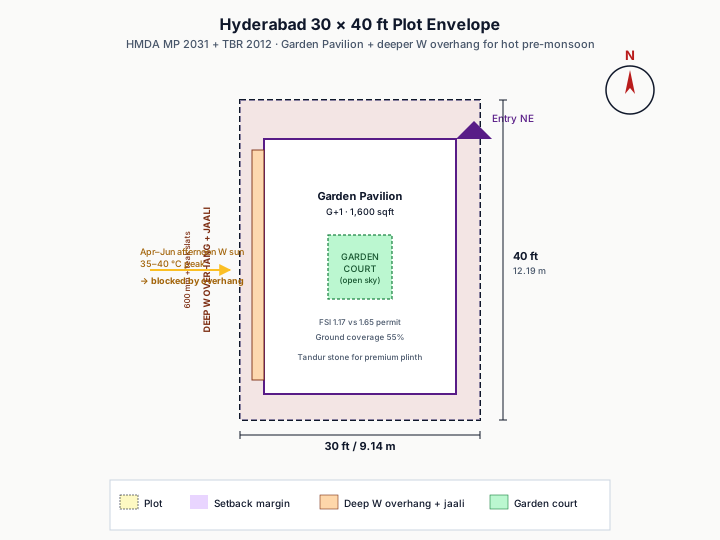
Hyderabad sits at the southern edge of the Deccan plateau at ~540 m elevation. It is classified as temperate climate per NBC 2016 / SP 41 (BIS, 1987), but with a hotter pre-monsoon (April–June) than Bengaluru — peak summers reach 38–40 °C. The two-monsoon rhythm (SW June–September, NE October–November) brings ~800 mm of annual rain. Winter minimums rarely drop below 14 °C; diurnal swings are modest (8–12 °C). The design response is similar to Bengaluru's Garden Pavilion — three open faces, planted ground-floor court, wrap-around balcony — with one variation: a slightly heavier east + west overhang or jaali to manage the hotter pre-monsoon shoulder.
The Garden Pavilion plan — climate response, summarised
The Garden Pavilion is a 30 × 40 ft, G+1, 3 BHK plan oriented with the long axis north-south so the long facades face east + west, with three open building faces (E, N, W) carrying full-height openings, a central planted ground-floor garden court (8 × 8 ft, open to sky), a wrap-around first-floor balcony, and a productive roof terrace with tomato / brinjal / drumstick + 3 kWp solar PV. The envelope is light — fly-ash brick + lime render — because the climate doesn't ask for insulation. For Hyderabad's hotter shoulder, deepen the west balcony parapet to 1.1 m and add a teak-slatted jaali screen for the western afternoon sun. Full plan with floor schedules and materials.
FSI + setback compliance on a Hyderabad 30 × 40 ft plot
Telangana Building Rules 2012 + HMDA Master Plan 2031 permit a base FSI of 1.65 on residential plots ≤ 250 sqm with road width ≤ 12 m — the typical 30 × 40 ft scenario. The Garden Pavilion uses an FSI of 1.17 — substantial 0.48 FSI headroom for a future extension. Ground coverage 55% (against the 65% ceiling); 45% of the plot reserved for planted setbacks, central garden court, and the front planted strip. The plan satisfies the standard setback matrix (1.5 m front, 1.0 m rear, 0.9 m sides) generously. See the Hyderabad setback entry for the multi-row matrix and the Hyderabad FSI entry for the road-width tiers.
Cost realities — Hyderabad 2026
A 1,600 sqft built-up Garden Pavilion comes in at ₹33.6 L (basic) to ₹46.4 L (premium) in Hyderabad 2026 prices — typically ~5% below the comparable Bengaluru build for the same plan. Hyderabad's local stone market (Tandur slabs, Shahabad polished, Telangana granite) is its cost advantage; premium stone finishes are 10–15% cheaper than Bengaluru. Labour rates are 5% lower. Mangalore tile + teak rafters + 600 mm eaves still drive the climate-fidelity premium (~₹300/sqft) — non-negotiable on a Garden Pavilion. Net lifecycle cost vs an AC-dependent sealed build: similar to Bengaluru, with ₹2–3 L of cooling-electricity savings over 25 years.
Vastu in Hyderabad — east entry preferred, NE for the diagonal
Hyderabad homebuyers care strongly about Vastu, with a mix of north Indian (Mayamatam / Manasara) and south Indian (Aagama) traditions. The Garden Pavilion's NE entry is the most auspicious orientation in both traditions, and is also climate-positive (NE catches gentle morning sun, prevailing SW monsoon hits the rear). For plots aligned with the road on the east side, east entry is the next-best Vastu-positive option. Kitchen at SW is an acceptable variant (orthodox prefers SE but SE is the master balcony in this plan); the burner faces east on the platform to mitigate. Pooja niche NE — exact Vastu fit. Rated Excellent by the Vastu Compliance Checker.
Lake-buffer + FTL — the silent regulatory filter
Hyderabad has dozens of notified lakes — Hussain Sagar at the city centre, Osman Sagar + Himayat Sagar in the west, and a chain of smaller cheruvus (tanks) across the metro. The Telangana Irrigation Department and HMDA jointly maintain a Full Tank Level (FTL) boundary for each, with a 30-metre buffer beyond the FTL where construction is restricted or prohibited. The standard pattadar / sub-registrar document does not flag the overlay — the architect's pre-design check must include HMDA's land-use layer query against the plot survey number. Plots within FTL: zero-construction. Plots in the 30 m buffer: supplemental setbacks per HMDA notification. Plots beyond 30 m but in the broader watershed: full FSI but rainwater + sewer routing must respect the catchment.
Rainwater harvesting + solar — Telangana's two passive incentives
HMDA and GHMC both mandate rainwater harvesting on plots ≥ 200 sqm — the 30 × 40 ft plot is below the strict threshold but voluntary RWH is strongly recommended and qualifies for a Telangana rainwater-harvesting tax rebate. The plan integrates a 5,000-litre underground tank fed by the sloped terrace's internal downpipes, with overflow to a soak pit. Cost ₹50,000–₹1.2 L. Solar PV: Hyderabad's 13 kWh/day-per-kWp yield (annual average — slightly above Bengaluru's 12) makes 3–5 kWp the economic sweet spot. TSSPDCL net-metering brings the electricity bill close to zero for a 3-person family. Install cost ₹1.8–₹3.0 L for 3–5 kWp turnkey. See Solar Power for Homes India for sizing.
Buildability — what to verify before the contractor breaks ground
Hyderabad soils are generally favourable for residential construction — granite gneiss at 1.5–2.5 m depth provides 200–400 kPa bearing capacity in most HMDA layouts, but some peripheral areas (Bachupally, Mokila) have black-cotton expansive soil pockets that need under-reamed piles or extended footings. Soil testing (₹15,000–₹40,000) is mandatory regardless. MEP layout: 3–5 kWp solar tie-in, EV-ready 32A circuit in parking, full house surge protection (Telangana lightning during monsoons). HMDA / GHMC plan sanction via DPMS portal: 30–60 days for clean submissions; longer with FTL overlay. Construction: 12–16 months for the Garden Pavilion. TSSPDCL connection 4–8 weeks at sanction. See the full plan page for the buildability checklist.
Common pitfalls
- Treating Hyderabad like Bengaluru without adjusting for the hotter pre-monsoon — west overhangs need to be 600 mm minimum, not 400 mm.
- Skipping FTL lake-buffer query — the pattadar doesn't flag it; missing it means rejection at sanction or demolition post-OC.
- Felling existing trees without GHMC + Forest Department clearance — Hyderabad has prosecuted for unpermitted felling, especially in older neighbourhoods.
- Single-glaze on west without overhang / jaali — Hyderabad's afternoon western sun is significantly harsher than Bengaluru's; 600 mm overhang or teak jaali is non-negotiable.
- Cement render on east + west exteriors — minor humidity from the two monsoons + diurnal swing causes hairline cracking; lime render is more durable in this micro-climate.
- Sizing solar PV under 3 kWp — Telangana yields are excellent (13 kWh/day per kWp); 3 kWp pays back in 4–5 years.
Frequently asked questions
›What is the maximum FSI on a 30 × 40 ft plot in Hyderabad?
›Is Hyderabad really classified as temperate climate? It feels hot.
›Do I need rainwater harvesting on a 30 × 40 ft plot?
›How do I check if my Hyderabad plot is in a lake-buffer / FTL zone?
›What is the timeline from purchase to occupancy on a Hyderabad 30 × 40 ft Garden Pavilion?
›Is Tandur stone or Shahabad really cheaper than Bengaluru kota?
Sources & references
Telangana Building Rules 2012 (as amended)
Government of Telangana — Telangana Building Rules 2012 with amendments through 2024
Hyderabad Metropolitan Development Authority Master Plan 2031 — Zoning Regulations and Land Use Plan
Greater Hyderabad Municipal Corporation Building Permit Rules — DPMS online portal
Telangana State Town and Country Planning Act
Telangana State Town and Country Planning Act (as adopted from undivided Andhra Pradesh) — statutory framework
National Building Code of India 2016
Bureau of Indian Standards, NBC 2016 — Volume 1 Part 3 Development Control Rules
SP 41 — Handbook on Functional Requirements of Buildings
Bureau of Indian Standards, SP 41 (1987) — Climate Zone Map of India
ECBC Residential — Eco-Niwas Samhita 2018
Bureau of Energy Efficiency, Government of India, ECBC Residential 2018
HMDA Lake + FTL Notification
HMDA notifications on Full Tank Level (FTL) boundaries for Hussain Sagar, Osman Sagar, Himayat Sagar and other notified water bodies
Disclaimer: Regulatory rates and dimensional rules change frequently and may be modified by mid-year notifications. Values reflect the framework as of 2026-05-15; verify against the current authority notification before any specific filing. This page is informational and is not legal or planning advice — engage a registered architect and a qualified planning consultant for project-specific compliance.
Related guides from the library
The companion deep-dives that practising architects keep alongside this reference.
Passive Design Strategies for Indian Climate Zones
A Climate-Zone-by-Zone Working Reference for Indian Architects
24 min read · Open SustainabilitySustainable Home Design in India
A Practical Guide to Climate, Craft, and Conscience in the Indian Home
15 min read · Open Design StylesVastu Shastra for Modern Homes
A Scientific Approach — Directions, Room Planning, Colours & Architect's Guide
26 min read · Open Room PlanningCross Ventilation in Indian Homes
Science, Physics, and Planning — A Professional Guide for Architects
28 min read · Open SustainabilityRainwater Harvesting for Indian Urban Homes
A Complete Guide — Design, Regulations, Costs & ROI
22 min read · Open SustainabilitySolar Power for Homes
ROI, Feasibility & the Indian Home Architecture Imperative
22 min read · OpenCompare across cities
The same House Plan 30×40 topic, different regulatory frameworks, different city quirks. Architects practising across metros should bookmark the adjacent reference.
House Plan 30×40 in Bengaluru
BBMP Building Bye-laws 2003 + Revised Master Plan 2031 (RMP 2031)
Open MCGM · MaharashtraHouse Plan 30×40 in Mumbai
Development Control and Promotion Regulations 2034 (DCPR 2034)
Open DDA · Delhi (NCT)House Plan 30×40 in Delhi
Master Plan for Delhi 2021 (MPD 2021) + Unified Building Bye-laws 2016
Open CMDA · Tamil NaduHouse Plan 30×40 in Chennai
Tamil Nadu Combined Development & Building Rules 2019 (TNCDBR 2019)
Open