
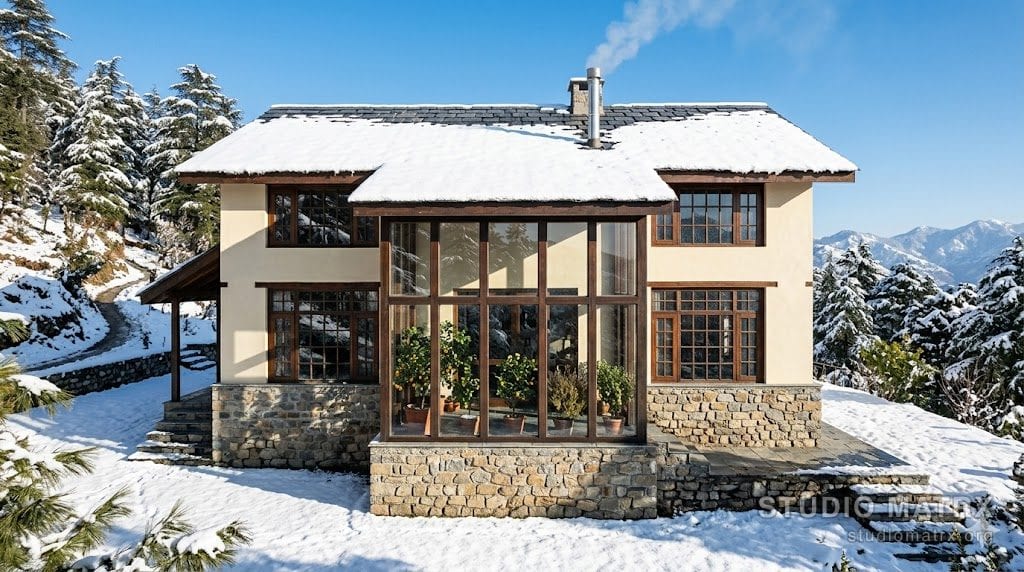
Trombe Cabin — 30 × 40 ft Cold Climate Home
1200 sq ft plot · G+1 · 3 BHK · Shimla · Manali · Srinagar · Gangtok
Plot
40 × 30 ft
1200 sqft
Built-up
1500 sqft
G+1
Config
3 BHK
2 bath
Facing
S
Vastu: good
Strategy
Material-led
Predominantly natural/local
Cost
₹42–57 L
₹2,800–3,800/sqft
Suits: Shimla · Manali · Srinagar · Leh · Gangtok · Dharamshala · Nainital
Climate zone — Cold: Severe winters, short summers, snow. Compact insulated forms, south-facing glazing, double-skin walls, Trombe walls, sloped roofs.
Interactive Floor Plan · 40 × 30 ft · 1200 sq.ft plot
Trombe Cabin — 30 × 40 ft Cold Climate Home
Ground floor · 640 sq ft built (compact-cube against heat loss)
India's cold climate zone — the Himalayan belt covering Shimla, Manali, Srinagar, Leh, Gangtok, and high-altitude Uttarakhand — flips every design assumption that works in the rest of the country. The sun is your friend (not your enemy). Mass is for storing heat (not for repelling it). Cross-ventilation is a winter liability (not a comfort strategy). Openings face south aggressively (not east cautiously). Roofs slope steeply (not flatten for terrace gardens). The home is sealed (not breathable). And every cubic metre of enclosed volume costs you in heat loss — so you build compact.
The Trombe Cabin is the right answer for this zone. South-facing. Compact. Super-insulated. With a single dramatic south wall that doubles as the passive solar collector — 230 mm stone or RCC behind low-e glass, painted dark to absorb radiation, releasing the stored heat into the living space after sunset. Paired with an 8 × 12 ft sunspace (glazed buffer room) and a vestibule entry that traps cold air at the door, the home maintains 18–22 °C indoor temperature through Shimla's December–February with a single bukhari (wood/pellet stove) for the coldest mornings.
This typology draws directly on Himalayan vernacular — Kashmiri kothi-banai timber-stone construction, Himachali dhajji-dewari infill-frame, Ladakhi rabsel sun-rooms — translated into a contemporary code-compliant Indian plot.
Site & Orientation
The plot is 30 ft wide × 40 ft deep, with the 40 ft dimension running east-west so the 40 ft south facade becomes the dominant solar collector. Every other facade is a heat-loss liability. The orientation rule for cold climate is simple and unforgiving:
Maximise south glazing. Minimise everything else.
- South facade (40 ft) — main glazing + sunspace + Trombe wall. As much south glass as the budget allows.
- North facade (40 ft) — minimum openings (one small window per north room, max 10% of wall area). Heavily insulated.
- East 30 ft — entry vestibule + secondary openings.
- West 30 ft — service end (kitchen, utility, bukhari flue).
This is the only Indian plan in the library where the long axis runs E-W with the south face dominating — and the only one where the north is treated as a wall, not a face.
Setbacks (per Himachal Pradesh TCP / Shimla Municipal Corporation for plots in the 100–250 sqm band):
| Setback | Required | This Design |
|---|---|---|
| Front (south, road side) | 1.5 m | 2.0 m (sunspace + entry court) |
| Rear (north) | 1.5 m | 1.5 m (north buffer + service access) |
| Side (east) | 1.5 m | 1.5 m (parking + entry vestibule) |
| Side (west) | 1.5 m | 1.5 m (utility + bukhari flue) |
Hill towns mandate larger sides than plains cities because of slope drainage + landslide buffer + access. This gives a buildable envelope of 24 × 27 ft = 648 sqft per floor, totalling ~1,500 sqft over G+1 including the sunspace cantilever. FAR consumed ≈ 1.25 against the typical hill-town allowance of 1.50 — modest, conservative, defensible against the local seismic + landslide risk (most Himalayan towns sit in Seismic Zone IV–V).
Hill-town specifics:
- Shimla MC + Himachal TCP: 4 m height limit per storey, max 11 m total. Plinth raised 600 mm minimum.
- Srinagar (J&K Building Bye-laws): Seismic Zone V detailing mandatory; flat-slab construction restricted near Jhelum.
- Leh (Ladakh UT, no detailed bye-law yet): Following NDMC / J&K legacy; mud-brick + willow vernacular often permitted.
- Gangtok (Sikkim): Landslide hazard categorisation per SLMA before sanction.
Always verify the latest local bye-law before submission — see Setbacks Across India guide.
Ground Floor Plan
The ground floor is organised around two heat zones: a warm zone (sunspace → living → dining → bukhari hearth → kitchen) that wraps the south face, and a cool zone (vestibule entry → boot room → corridor → stairs → bath) on the cool east-north band. The two zones are separated by insulated internal partitions and self-closing doors so the warm zone can be sealed in deep winter and the cool zone tolerated as a transition.
Room Schedule (Ground Floor)
| Space | Size | Notes |
|---|---|---|
| Entry vestibule + boot room (in setback) | 5 × 8 ft | East-facing, double-door airlock; coats, boots, snow shovel, drying rack |
| Sunspace (glazed buffer, south) | 8 × 12 ft | South-facing, full-glazed, slate-tile floor, buffer between living + outside |
| Living | 11 × 14 ft | South of dining, opens to sunspace via double sliding glass |
| Dining + bukhari hearth | 9 × 12 ft | Centre of warm zone; cast-iron bukhari with stone surround |
| Kitchen | 8 × 11 ft | South-west, gas + wood-fired option, masonry oven on west wall |
| Pooja niche | 3 × 4 ft | North-east (cool zone) — see Pooja Room Design |
| Powder / WC | 4 × 5 ft | Off vestibule corridor, ventilated to north light shaft |
| Stairs | 4 × 9 ft | East-central, against thermal-mass spine (warm in deep winter) |
| Utility yard (in setback) | 4 × 8 ft | Rear north-west, woodshed + tank covers + flue access |
| Parking (in setback) | 8 × 16 ft | South-east, terraced into slope, gable-roofed |
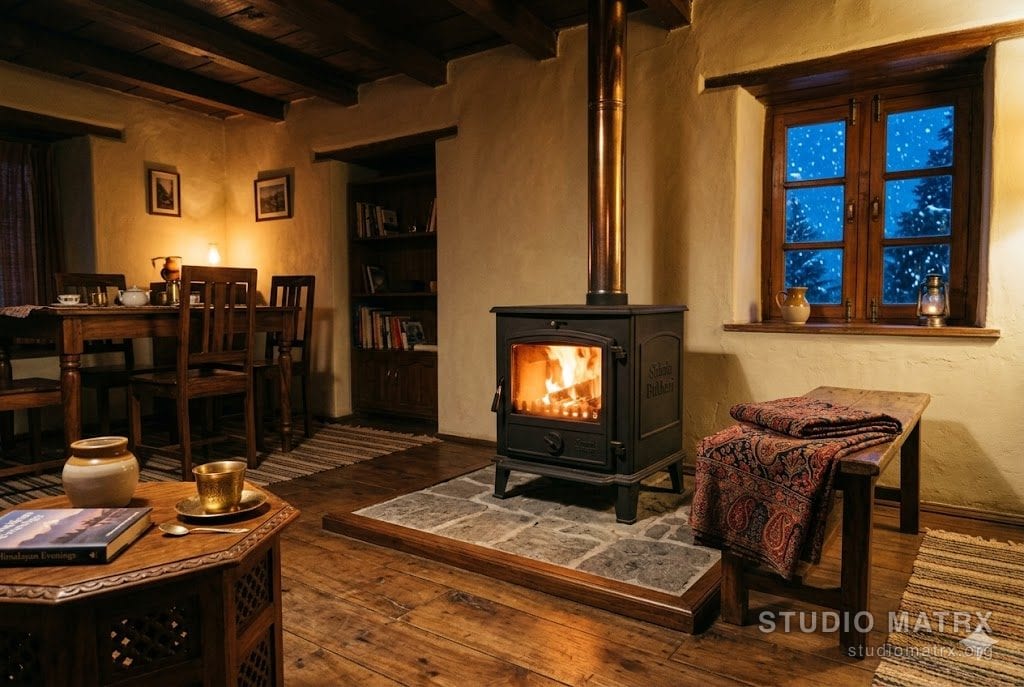
The bukhari hearth in the dining-living zone is the home's emotional and thermal centre. A 600 × 600 mm cast-iron stove on a 1200 × 1200 mm stone hearth, with a 200 mm Kashmiri walnut surround and a flue rising through the first-floor master bath (where it warms the bath wall) to a stainless-steel chimney exiting the roof at the ridge. Annual wood consumption ~2 tonnes for primary heating in Shimla (4–5 months); the bukhari runs at most 4 hours/day because the Trombe wall does the heavy lifting.
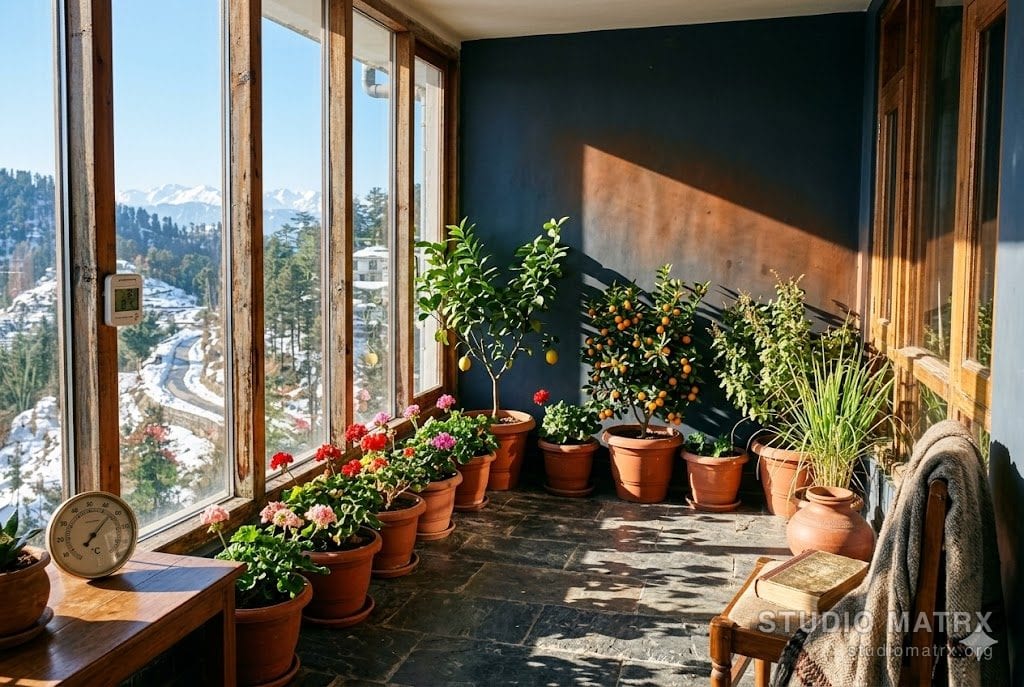
Sunspace — The Climate Engine
The 8 × 12 ft south sunspace is the first room of the house in solar terms. It receives ~85% of the home's incident winter solar radiation, with a glazing area of ~60 sqft (south-facing low-e DGU, U = 1.3 W/m²K). On a clear Shimla January day:
- 10:00 — sunspace air at 12 °C (outdoor 4 °C)
- 12:00 — sunspace air at 22 °C (outdoor 8 °C)
- 14:00 — sunspace air at 28 °C (outdoor 10 °C)
- 16:00 — sunspace air at 24 °C (outdoor 8 °C)
- 18:00 — sunspace air at 18 °C; warmth migrates inward as living-room doors open
- 22:00 — sunspace air at 8 °C; living room holds 18–20 °C from stored mass
In summer (May–September), the sunspace is vented through high-level operable windows to dump excess heat. It functions as an indoor garden — citrus, herbs, tulsi (which Shimla otherwise cannot grow) — for the warm months.
The Trombe wall behind the sunspace is 230 mm RCC + dark mineral paint + 50 mm cavity + 8 mm low-e glass along the inside of the sunspace, with manually-operable vents at floor and ceiling of the living room. These vents are closed in summer (Trombe inactive) and opened in winter (Trombe collects 25–35% of daily heating load).
First Floor Plan
The first floor is the night zone — three bedrooms, two bathrooms, a small study or workspace, and the stair continuing to a sealed attic (for water tank + insulation). All bedrooms have deep windows on south (passive solar gain for daytime, drawn curtains at night) and minimal windows on north (insulation priority).
Room Schedule (First Floor)
| Space | Size | Notes |
|---|---|---|
| Master bedroom | 12 × 14 ft | South-east, over living + sunspace; south DGU paired window; deep curtains |
| Master bath (attached) | 5 × 8 ft | Shower + WC + basin; bukhari flue inside wall (heated bath wall) |
| Second bedroom | 10 × 11 ft | South-west, over kitchen; south DGU; partial west window |
| Third bedroom / study | 8 × 11 ft | North-west, smaller window (insulation priority); cosy retreat |
| Shared bath | 4 × 7 ft | Off corridor, ventilated stack only |
| North storage / linen | 4 × 8 ft | Insulated storage along the cold north wall — converts a wall into a buffer |
| Stairs continuing to attic | 4 × 9 ft | Sealed door at top; attic for tank + extra insulation |
The north storage wardrobes running along the bedroom walls are doing double duty. They give the home generous built-in storage (rare at this plot size), and they serve as a thermal buffer between the bedroom and the cold north exterior. The wardrobe back wall takes the temperature gradient; the bedroom never feels the chill. This is the Himachali vernacular trick — store grain or hay against the coldest wall — applied to a contemporary home.
Roof — Snow, Slope, Snow Again
The roof is the most underestimated detail in cold-climate homes. Indian flat-slab terraces — the norm everywhere south of Pathankot — fail catastrophically in snow country. Pooled snow melts under solar gain, refreezes at night, expands, and cracks the slab. Within 5 winters a flat slab is a leak factory.
Sloped roof at 35–45° is the only Indian-cold-zone answer:
- 35° slope (Shimla, Dharamshala) — sheds wet snow regularly without massive snow load
- 40° slope (Manali, Gangtok) — heavier snow load, faster shedding
- 45° slope (Leh, Tawang) — driest, dry-snow conditions, alpine standard
Snow load design:
| Town | Design Snow Load | Roof Material |
|---|---|---|
| Shimla | 60 kg/m² | Slate (Kullu black) on timber rafters + sarking |
| Dharamshala | 80 kg/m² | Slate (Kangra) or GI corrugated |
| Manali | 100 kg/m² | GI sheet over timber + boarding |
| Srinagar | 80 kg/m² | Mangalore tile (low-altitude) or GI |
| Leh | 200+ kg/m² | Flat earthen-roof (vernacular) or pitched GI with snow-stops |
| Gangtok | 50 kg/m² | Mangalore tile or GI; persistent rain more than snow |
The structural system is 150 mm × 200 mm pine or fir rafters @ 600 mm c/c, 150 mm × 100 mm purlins, 20 mm cedar boarding, vapour barrier, 100 mm rockwool insulation, breather membrane, 50 mm air gap, slate/GI/tile finish. U-value of this build-up: 0.22 W/m²K — meets passive-house standard for cold climate.
Facade — Street View
The south facade reads as a stone-and-glass cottage — slate-roofed, stone-base, dark timber upper, and a continuous glazed sunspace anchoring the ground floor. The composition references the British-era Shimla hill-station typology and the Kashmiri dab (timber overhang) without literal pastiche.
Materials palette (facade):
- Stone plinth + ground floor base — 450 mm local stone (Kullu deodar grit, Kashmir limestone, or Sikkim slate), random rubble masonry
- Upper-floor walls — dhajji-dewari timber frame + 230 mm AAC infill + 75 mm rockwool + cement render outside + lime render inside (U = 0.28 W/m²K)
- Trombe wall (south, ground) — 230 mm RCC + dark blue-grey paint + 50 mm cavity + 8 mm low-e tempered glass
- Sunspace glazing — full-height low-e DGU 6+16+6 mm argon-filled, timber frames
- Windows — timber-frame with low-e DGU; reduced area on north and west
- Roof — slate or GI per altitude (see snow table)
- Doors — solid deodar entry with brass hinges, double-door airlock vestibule
Section — Climate Logic
The section explains the heat economy of the home — every cubic metre is enclosed for a reason, every square metre of surface accounted for.
Winter (November–March, lows −10 °C to +4 °C)
| Time | Outdoor | Sunspace | Living | Bedrooms |
|---|---|---|---|---|
| 06:00 | −5 °C | 4 °C | 16 °C | 17 °C |
| 09:00 | 2 °C | 12 °C | 17 °C | 17 °C |
| 12:00 | 8 °C | 22 °C | 19 °C | 18 °C |
| 14:00 | 10 °C | 28 °C | 21 °C | 19 °C (curtains open) |
| 18:00 | 4 °C | 18 °C | 22 °C | 20 °C |
| 22:00 | −1 °C | 8 °C | 20 °C (bukhari off 1 hr) | 18 °C |
| 02:00 | −5 °C | 0 °C | 17 °C (Trombe radiating) | 16 °C |
Heat sources contributing to a typical Shimla January day:
- Trombe wall: 35% of daily heating load
- Sunspace passive gain: 20%
- South-window solar gain: 15%
- Bukhari (~4 hours): 20%
- Internal gains (cooking, occupants, appliances): 10%
Without the Trombe + sunspace, a code-built Shimla home would need the bukhari running 10–12 hours/day. With them, 3–4 hours. That's a real-money difference of ₹35,000–₹50,000/year in firewood.
Summer (April–October, 8–28 °C)
Summer in the cold zone is the easy season. The same envelope that keeps heat in during winter keeps it stable in summer. Operable high windows in the sunspace vent excess solar gain. North-window opening pulls cool air through. Indoor temperature rarely exceeds 24 °C even on hot July days in Shimla. No air-conditioning, ever.
Biophilic Score — 70 / Strong
This design scores 70 / 100 on the 16-criterion biophilic framework (see Biophilic Score Calculator). Lower than the courtyard-led Hot-Dry or the open-pavilion Temperate because the cold climate forces a sealed envelope that constrains biophilic expression.
| Dimension | Score | Comments |
|---|---|---|
| Nature in the Space | 28 / 40 | NIS01 (daylight) = 5 (south glazing maximised); NIS04 (thermal variability) = 5 (Trombe creates dramatic indoor gradients); weaker NIS06 (cross-ventilation = winter liability, limited); no central court |
| Natural Analogues | 26 / 30 | NAA01 = 5 (stone, deodar, slate); NAA02 = 5 (wool kani, namda, pashmina, walnut); NAA04 = 4 (slate-roof geometry); strong wood-stone palette |
| Nature of the Space | 16 / 30 | NOS01 (prospect from south windows to Himalayan view) = 5; NOS02 (refuge in deep south-facing rooms with bukhari) = 5; weaker on NOS04 (mystery) and NOS05 (risk) in a sealed compact volume |
Strategy classification: Material-led · Predominantly natural/local. The cold climate forces a material-first biophilic approach — the wood, stone, and slate textures + the bukhari hearth + the Himalayan view from the sunspace carry the biophilic narrative more than the spatial moves.
FAR / Setback Compliance Snapshot
The plan complies with the following representative jurisdictions:
| City | FAR Used | FAR Allowed | Notes |
|---|---|---|---|
| Shimla (MC + Himachal TCP) | 1.25 | 1.50 (≤ 200 sqm) | Conservative; 11 m height limit OK; slate roof acceptable in heritage zones |
| Manali (Kullu TCP) | 1.25 | 1.40 | Acceptable; pitched roof mandatory; timber-on-stone style fits |
| Srinagar (J&K Town Planning) | 1.25 | 1.50 | Seismic Zone V — additional shear-wall + tie-beam required |
| Leh (Ladakh UT) | 1.25 | 1.40 (interim) | Local mud-brick / willow vernacular acceptable substitute for AAC; air gap critical for high-altitude winter |
| Gangtok (Sikkim UD&HD) | 1.25 | 1.40 | Landslide hazard cat 3 max; additional foundation reinforcement |
| Dharamshala (HP TCP) | 1.25 | 1.50 | Heritage Tibetan-influence facade acceptable; slate roof preferred |
Hill-town bye-laws are conservative for good reason — see local landslide and seismic hazard maps before finalising. Both the Setbacks Across India guide and Seismic Zones India Design guide cover the additional structural detailing the cold zone needs.
Cost — Indicative
For 1,500 sqft built-up at cold-climate 2026 prices (Shimla basis; Manali/Leh ~10% higher due to material transport; Srinagar comparable):
| Tier | Per sqft (₹) | Total (₹ L) | Includes |
|---|---|---|---|
| Basic | 2,800 | 42.0 | AAC + 50 mm rockwool, GI roof, single-glaze, basic Trombe, cast bukhari |
| Recommended | 3,300 | 49.5 | AAC + 75 mm rockwool, slate roof, low-e DGU, full Trombe with vents, sunspace, deodar interior |
| Premium | 3,800 | 57.0 | Stone-base + dhajji-dewari upper, slate roof, low-e argon DGU, premium Trombe, pellet stove + flue heat-recovery, 3 kWp solar PV |
Why this is more expensive than every other climate zone (₹400–800/sqft premium):
- Rockwool insulation (75 mm) — not used in plains: + ₹150/sqft
- Low-e DGU (argon-filled) instead of single 6 mm: + ₹350/sqft of glazing
- Sloped slate or GI roof + structural timber rafters: + ₹250/sqft over flat RCC
- Material transport premium for hill towns: + ₹120/sqft (Shimla); + ₹200 (Leh)
- Skilled labour premium: + ₹80/sqft (hill-town carpenter rates are 20–30% higher than plains)
- Trombe + sunspace: + ₹50,000–₹1.2 L systems cost
Payback on premium: A code-built Shimla home consumes ₹70,000–₹1 L/year in winter firewood + electric heating. This home consumes ₹15,000–₹25,000/year. Annual saving ~₹50,000. Premium investment of ~₹6 L (over basic) recovers in ~12 years; everything thereafter is free Himalayan winter comfort.
Headroom items not in cost:
- Furniture and soft furnishings (allow for wool dhurries, kashida shawls, walnut furniture — material palette continues indoors)
- Compound wall + gate (often stone + timber post-and-rail in hill towns)
- Internal landscaping (sunspace planting + outdoor terracing — ₹50,000–₹1.5 L)
- Solar PV beyond 3 kWp (panel snow-shedding required in heavy-snow towns)
- Sewage treatment package plant where municipal sewer unavailable (common in Manali outskirts, Leh)
Materials Schedule
| Element | Specification | Reason |
|---|---|---|
| Stone plinth + GF base | 450 mm local stone (deodar grit / Kashmir limestone / Sikkim slate), random rubble | Vernacular; mass at base; flood / snowmelt resilience |
| GF upper walls | 230 mm AAC + 75 mm rockwool + cement render + lime inside (U = 0.28) | Insulated envelope per ECBC cold-zone target |
| First-floor walls | Dhajji-dewari timber frame + 200 mm AAC infill + 50 mm rockwool + timber-clad outside | Vernacular + insulated; lighter on stone base |
| Trombe wall | 230 mm RCC + dark mineral paint + 50 mm cavity + 8 mm low-e tempered glass | Passive solar collector |
| Roof | 150 × 200 mm rafters + 20 mm boarding + vapour barrier + 100 mm rockwool + breather + 50 mm air gap + slate/GI (U = 0.22) | Snow-shed + insulation + air-circulation prevention of ice-dam |
| Flooring (sunspace) | 25 mm slate (Kullu black), riven finish | Thermal mass; absorbs solar gain |
| Flooring (living, dining) | 25 mm slate inset + 18 mm pine plank surround | Stone where Trombe + bukhari heat radiates; wood elsewhere |
| Flooring (bedrooms, first) | 18 mm Kashmiri walnut or pine plank + 8 mm cork underlay | Warm underfoot, traditional |
| Bathroom walls + floor | 12 mm matte ceramic + heated floor coil (optional) | Frost prevention; cosy in winter |
| Doors | 50 mm solid deodar entry + 35 mm pine internal + airlock self-closing on vestibule | Vernacular + thermal seal |
| Windows | Timber frame + low-e DGU 6+12+6 argon | Frame material matters in cold (UPVC OK; timber traditional) |
| Insulation | Rockwool 75 mm (walls) + 100 mm (roof) | Closed-cell, non-combustible (bukhari) |
| Trombe glass | 8 mm low-e tempered + UV-stable timber frame | Lets short-wave in, traps long-wave |
| Bukhari | Cast-iron 600 × 600 mm + 200 mm walnut surround + stainless flue + roof-exit cap | Primary heat; secondary cooking; emotional centre |
Plant Palette
Native to Himalayan + Hindukush belt, frost-tolerant outdoors, tropical indoors in the sunspace:
- Sunspace (year-round indoor garden): Lemon (Citrus limon), tulsi, lemongrass, mint, coriander, geranium, jasmine — these grow year-round inside the sunspace temperatures of 8–28 °C
- South planter strip outdoors: Lavender (Lavandula officinalis), rosemary (Mediterranean-hardy)
- East entry court: Apple (one — Shimla / Kashmir; espalier on south wall), pomegranate (one — south-facing slope only)
- North buffer planting: Deodar (one — symbolic; if plot has 2 m+ buffer), Kashmir walnut (one if possible)
- Roof attic vent area: None — keep accessible for snow clearing
Vastu Notes
| Element | Direction | Notes |
|---|---|---|
| Entry | East (with south-facing primary glazing) | Vastu-good; south orientation overrides for climate priority |
| Kitchen | South-West | Acceptable variant; orthodox prefers SE but SE is sunspace |
| Pooja niche | North-East | Exact Vastu fit |
| Master bedroom | South-East (first floor) | Acceptable; orthodox prefers SW but SW is kitchen |
| Stairs | East-central | Acceptable |
| Toilets | NW + central east (first) | Acceptable; mitigated by buffer walls |
| Brahmasthan | Dining + bukhari hearth | Hearth at centre is auspicious; "energy" radiates outward |
| Trombe + sunspace | South | South-facing solar collector is climate-positive, Vastu-neutral |
Rating: Good — the plan satisfies the major Vastu directional rules to the extent that climate physics permits. Climate priorities outrank Vastu in the cold zone — a south-facing home is non-negotiable for winter survival; an east-only entry would compromise the design. See Vastu for Modern Homes for how to balance the two.
Buildability — What to Verify Before Construction
This is a near-buildable design — the configuration, dimensions, FAR, and setback are valid for the cited jurisdictions. Before construction you will need:
1. Site-specific structural design by a licensed RCC consultant who specialises in hill-town construction — soil-bearing in Shimla varies 100–250 kPa depending on micaceous schist content; Manali alluvium often 80–150 kPa; Leh permafrost-adjacent zones need specialist input. See Soil Bearing Capacity guide.
2. Seismic detailing for Zone IV (Shimla, Manali) or Zone V (Srinagar, Leh, Gangtok) — additional shear walls, tie beams at lintel level, IS 13920 compliant detailing. See Seismic Zones India Design.
3. Snow + wind load engineering — design snow loads above; design wind speed 39–47 m/s (3-sec gust) in most hill towns per IS 875 Part 3.
4. Landslide / slope stability assessment — mandatory in Gangtok (SLMA hazard category), strongly recommended in Shimla outskirts + Manali. Hire a geotechnical consultant.
5. MEP layout — electrical SLD with provision for bukhari flue clearance + solar tie-in; plumbing isometric with anti-freeze loops on external runs (a Plains-engineer oversight); drainage to municipal sewer (rare) or septic + soak-pit per Septic Tank Sizer.
6. Local plan sanction — Himachal Pradesh online (HP Single Window), Shimla MC, Manali Town Planning, Srinagar Municipal, Leh DC's office (interim). See Building Plan Approval guide.
7. Heritage zone approval (Shimla, Dharamshala, parts of Srinagar) — facade material restrictions; slate roof typically mandated; consult local DLF + INTACH chapter.
8. Bukhari + chimney inspection — annual mandatory in some HP municipalities; design flue per chimney sweep access.
9. Solar PV with snow-shedding tilt — panels at roof slope (35–45°) shed snow naturally; net-metering per HPSEB / J&K Power / KPDCL policies.
Reading Pairings
- Passive Design — India Climate Zones
- Vastu Shastra for Modern Homes
- Sustainable Home Design India
- Solar Power for Homes India
- Seismic Zones India Design
- Cross-Ventilation in Indian Homes — read this for the temperate / warm zones; cross-ventilation is a winter liability in cold zone
- Soil Bearing Capacity guide
- Pooja Room Design
Tools to Use With This Plan
- Vastu Compliance Checker — verify your plot orientation matches the plan
- Biophilic Score — score variations you make to this design
- Cost Calculator — adjust the cost band for your hill town
- Sun Path Analyzer — visualise winter + summer sun at a Shimla (31° N), Srinagar (34° N), or Leh (34.15° N) site
- Solar Calculator — size the PV array for snow-shedding orientation
- Seismic Zone Checker — confirm your site's seismic zone
Author's note: The cold zone is the smallest population in India but the most under-served by mainstream Indian residential architecture. Builders in Shimla, Manali, and Srinagar routinely copy Chandigarh detailing — flat slabs, single-glazed windows, no Trombe — and the result is homes that consume 100,000+ rupees a year in firewood and still feel cold. This is not a complex problem to solve. South orientation, super-insulation, low-e DGU, a Trombe wall, and a sunspace. Five moves. The technology is 80 years old and the vernacular has done it for 500. The only thing missing is the contemporary Indian architect's willingness to design for the Himalayas rather than against them.
Disclaimer: This is a reference design intended to illustrate climate-responsive biophilic design at a 1200 sqft plot in India's cold climate. Local building bye-laws, soil and slope conditions, seismic zone, snow load, statutory approvals, and structural engineering must be verified by a licensed architect and structural engineer experienced in Himalayan construction before construction. Costs are indicative for 2026 in the cited regions and vary significantly by altitude, site access, contractor, finish choices, and material transport distance.
Related Guides — Deep-dive reading
Designing a Naturally Energy-Efficient Indian Home
Comfort first, gadgets last — passive design, orientation, insulation, ventilation and the climate wisdom that cuts Indian energy bills
SustainabilityFloor-to-Ceiling Windows (India): Maximum Light, and the Heat Trade-Off
Full-height glazing for Indian homes — how to win the daylight and view without losing the energy code, comfort or safety.
Windows & GlazingRoofing for Cold & Snow Regions
In the Himalaya and high hills — Kashmir, Himachal, Uttarakhand, Ladakh, Sikkim and the North-East highlands — a roof has two jobs at once: shed the snow so it never piles into a crushing load, and hold the winter’s heat inside. A plain-language guide to steep pitch, snow load, heavy insulation and the ice-dam problem.
RoofingRelated Tools — Try Free
Cross-Ventilation Analyzer
Estimate airflow and air changes per hour (ACH) from room size, window areas, layout, and local wind — with NBC 2016 Part 8 compliance check.
Ventilation CalculatorBrise-Soleil Visualizer
Interactive horizontal-louvre cut-off angle calculator — sun altitude, louvre depth, and spacing inputs with a live shadow preview. Computes θ = arctan(spacing/depth) for façade shading, ECBC envelope compliance, hospital daylight design, and tropical sun-control detailing.
Sun Shading ToolRainwater Tank Sizer
How big should your rainwater tank be? Computes annual harvest, recommended tank capacity in litres, water-bill savings, and payback — for 10 Indian cities.
RWH Calculator