
Garden Pavilion — 30 × 40 ft Temperate Home
1200 sq ft plot · G+1 · 3 BHK · Bengaluru · Pune · Hyderabad uplands
Plot
40 × 30 ft
1200 sqft
Built-up
1600 sqft
G+1
Config
3 BHK
2 bath
Facing
NE
Vastu: excellent
Strategy
Balcony-gardened
Predominantly natural/local
Cost
₹35–48 L
₹2,200–3,000/sqft
Suits: Bengaluru · Mysuru · Pune · Hyderabad · Coimbatore · Belagavi
Climate zone — Temperate: Year-round mild temperatures, moderate humidity, two monsoons. Free planning, large openings, lightweight construction, balcony gardens.
Interactive Floor Plan · 40 × 30 ft · 1200 sq.ft plot
Garden Pavilion — 30 × 40 ft Temperate Home
Ground floor · 700 sq ft built + balconies + garden
India's temperate climate zone — the Deccan plateau covering Bengaluru, Mysuru, Pune, Hyderabad's uplands, and Coimbatore — is the country's most forgiving climate. Annual mean temperature 23–25 °C. Two monsoons. Rarely above 35 °C, almost never below 10 °C. Diurnal swing 8–12 °C year-round.
This generosity is also a design trap. Builders in Bengaluru routinely import Mumbai detailing (heavy, sealed, AC-dependent) or Chennai detailing (warm-humid, low overhang) when the right answer is the opposite: open the home up. Large openings on three faces, deep verandahs that double as living rooms, planted setbacks that work with the climate rather than fighting it. The temperate zone is the only Indian climate where you can design lightly and have it work all year.
The Garden Pavilion does exactly that. A north-east-facing 30 × 40 ft plot with a deep planted ground-floor courtyard, three open faces with full-height openings, a first-floor balcony that wraps east + south + west as an outdoor room, and a productive roof terrace. Built lightly in AAC + timber + terracotta. No air-conditioning needed. Designed for the way Bengaluru and Pune families actually live.
Site & Orientation
The plot is 30 ft wide × 40 ft deep, with the 40 ft dimension running north-south so the long facades face east and west. Entry is on the north-east corner — auspicious in Vastu, with morning sun penetrating the entry court and the prevailing Bengaluru south-west monsoon wind hitting the rear (south-west).
Why the long axis runs N-S rather than E-W (the hot-dry choice):
- In the temperate climate, the sun is rarely high enough or hot enough to be a problem on east or west — a 600 mm overhang manages it.
- The N-S axis maximises cross-ventilation end to end, which is the dominant comfort strategy in Bengaluru and Pune year-round.
- The long west face becomes the main garden frontage — afternoon sun warms the planted strip into the evening, encouraging blooms.
Setbacks (per BBMP Bye-laws / Karnataka Town & Country Planning Act for plots in the 100–250 sqm band):
| Setback | Required | This Design |
|---|---|---|
| Front (north-east, road side) | 1.5 m (≤ 9 m road) | 1.8 m (entry court + planted strip) |
| Rear (south-west) | 1.0 m | 1.2 m (utility yard + tank cover) |
| Side (north-west) | 0.9 m | 1.2 m (south-side garden + drainage gutter) |
| Side (south-east) | 0.9 m | 0.9 m (parking access) |
This gives a buildable envelope of 25 × 27 ft = 675 sqft per floor, totalling ~1,400 sqft over G+1 plus a 200 sqft accessible roof terrace garden. FAR consumed ≈ 1.17 against the BBMP allowance of 1.75 for plots ≤ 240 sqm — substantial 0.58 FAR headroom for a future extension or a roof gazebo.
Bengaluru-specific compliance: see Bengaluru FAR / FSI and Bengaluru Setbacks. Pune (PMC) requires similar setbacks but mandates a 5% open-to-sky in plots ≥ 100 sqm — the central garden court satisfies this. Hyderabad (HMDA) and Mysuru (MUDA) bye-laws are within range.
Ground Floor Plan
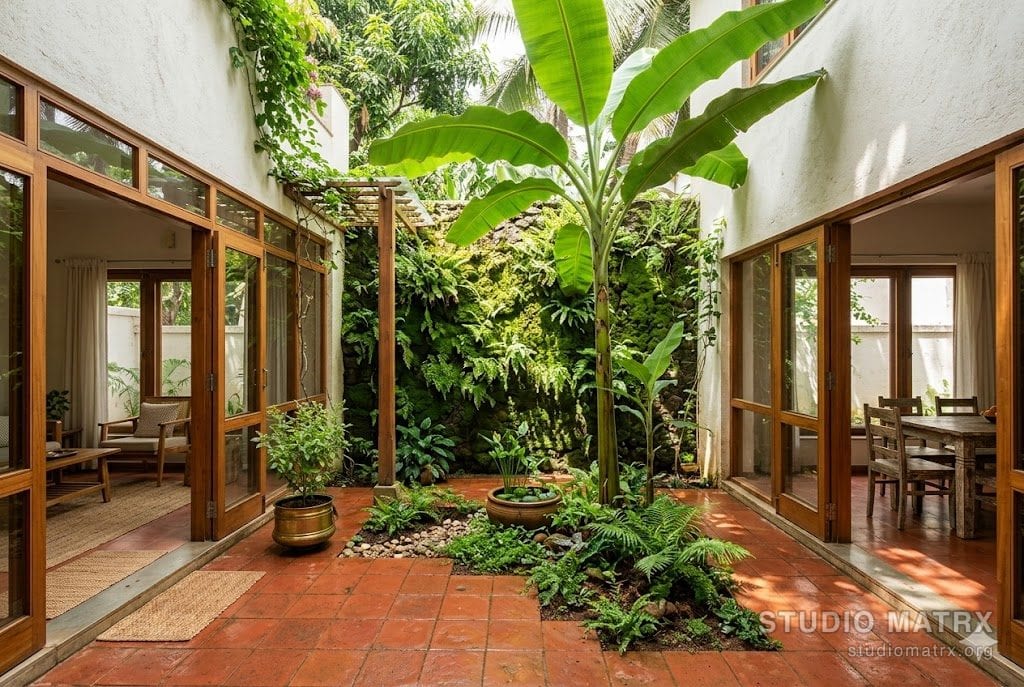
The ground floor opens itself to a planted garden court at the centre — not a courtyard in the Rajasthani sense (no thermal-mass walls, no evaporative imperative) but a garden room that the living, dining, and verandah look onto. Three of the four exterior walls have full-height openings; the fourth (south-west, the service wall) is the only opaque face.
Room Schedule (Ground Floor)
| Space | Size | Notes |
|---|---|---|
| Entry verandah (in setback) | 6 × 10 ft | NE-facing, terracotta-tiled, planter ledge, shoe storage |
| Living | 12 × 16 ft | East-facing, opens to verandah and garden court; full-height sliding |
| Dining | 8 × 11 ft | South of living, opens onto garden court |
| Garden court (open to sky) | 8 × 8 ft | Central planted court — banana, fern wall, evening lighting |
| Kitchen | 8 × 10 ft | South-west, platform on south wall, utility behind |
| Pooja niche | 3 × 4 ft | North-east, against the entry wall — see Pooja Room Design |
| Powder room | 4 × 5 ft | Off corridor, north-light strip |
| Stairs | 4 × 9 ft | West-central, open-tread timber, planter base |
| Utility yard (in setback) | 5 × 7 ft | Rear south-west, sink + drying + gas + electrical |
| Parking (in setback) | 8 × 16 ft | South-east, pergola with passion-fruit creeper |
The central garden court is the design's biophilic engine. Open to sky, paved in 75% terracotta tile + 25% planted bed, with a fern wall on the south side (cool, shaded, monsoon-loving) and one banana or papaya as the vertical accent. It draws diffuse north light into the dining and living rooms year-round, and during Bengaluru's two monsoons (June–September SW monsoon, October–November NE retreating monsoon) it becomes a rain-watered indoor jungle that doesn't need irrigation. Total planted area on ground floor: ~70 sqft.
First Floor Plan
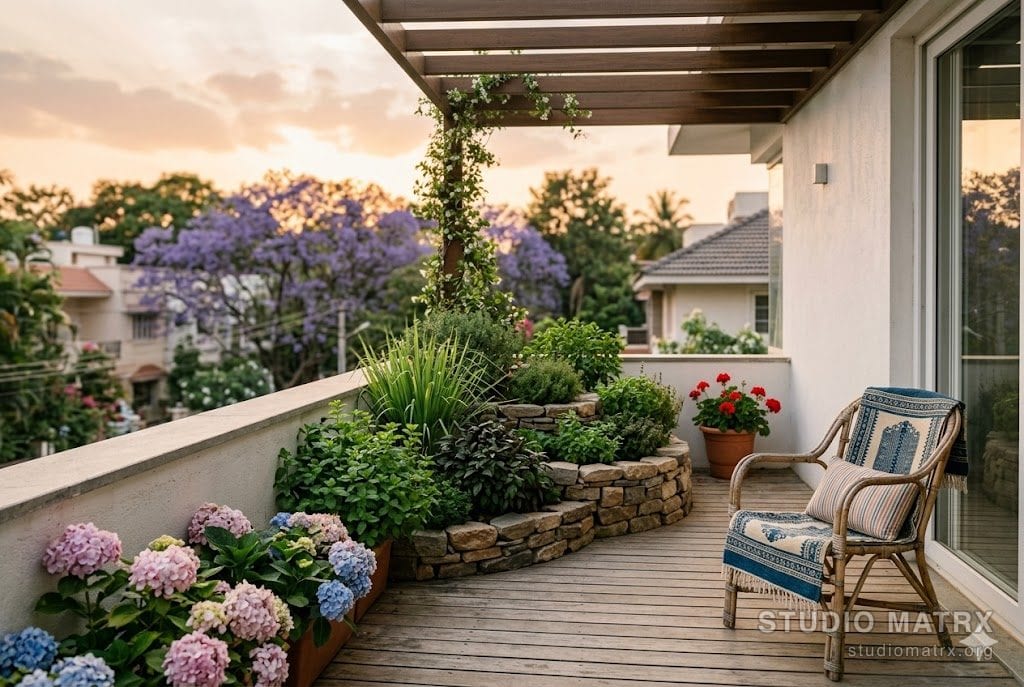
The first floor is a wrap-around outdoor-indoor weave. Three bedrooms, two bathrooms, a study, and an L-shaped balcony that wraps east + south + west. Every habitable room opens onto the balcony with French-door pairs. The balcony itself is a herb-and-flower spiral garden in the gardener's terms — 8 ft deep, planted along the parapet edge, with seating pockets at the east and south corners.
Room Schedule (First Floor)
| Space | Size | Notes |
|---|---|---|
| Master bedroom | 12 × 14 ft | South-east, paired French doors onto balcony, deep timber-floored ceiling |
| Master bath (attached) | 5 × 8 ft | Shower garden niche, shower head over a planted strip |
| Second bedroom | 10 × 11 ft | North-west, paired french doors onto north-west balcony segment |
| Third bedroom | 9 × 11 ft | North-east, doubles as guest or family room |
| Study (alcove) | 6 × 8 ft | Off corridor, north window, built-in desk |
| Shared bath | 4 × 7 ft | Off corridor, top-lit via roof skylight |
| Wrap-around balcony | 5 × 28 ft total | E + S + W; herb spiral on south, flower cascade on west |
| Stairs continuing to terrace | 4 × 9 ft | Open-tread timber continuing up |
The shower garden in the master bath — a 1.2 × 1.2 m planted strip under the shower head, drained to the balcony herb spiral — is the kind of move only the temperate climate enables. It would mould in Mumbai and freeze in Shimla; in Bengaluru's 22 °C average and balanced humidity it thrives, the water gets second use, and the bath becomes a tropical indoor garden. Built cost adds ~₹35,000; experiential payoff is generational.
Roof Terrace — Productive Landscape
The roof terrace is the third habitable level — accessed from the first-floor stair, 200 sqft of accessible space, with the parapet hidden behind a wooden-frame trellis. The terrace is conceived as a productive landscape:
- South strip (60 sqft): kitchen-garden boxes — tomato, brinjal, chilli, beans (year-round in Bengaluru, two main harvests in Pune)
- East strip (40 sqft): fruit grow-bags — banana (one), papaya (two), passion-fruit on trellis
- West edge (40 sqft): citrus container row — lemon (3), curry leaf, drumstick (Moringa)
- Centre (60 sqft): pergola-shaded sit-out, lime-washed bench, water bowl for birds, herb scattered planters
A 3 kWp solar PV array sits over the stair head and the south pergola, generating ~12 kWh/day annual average in Bengaluru — sufficient to net-meter the home to zero electricity bills for a 3-person family. (Pune yields ~11 kWh/day; Hyderabad ~13.)
The terrace is sloped 1:80 toward two internal downpipes that feed a 5,000-litre underground rainwater tank below the utility yard — meets the BBMP rainwater mandate for plots ≥ 60 sqm.
Facade — Street View
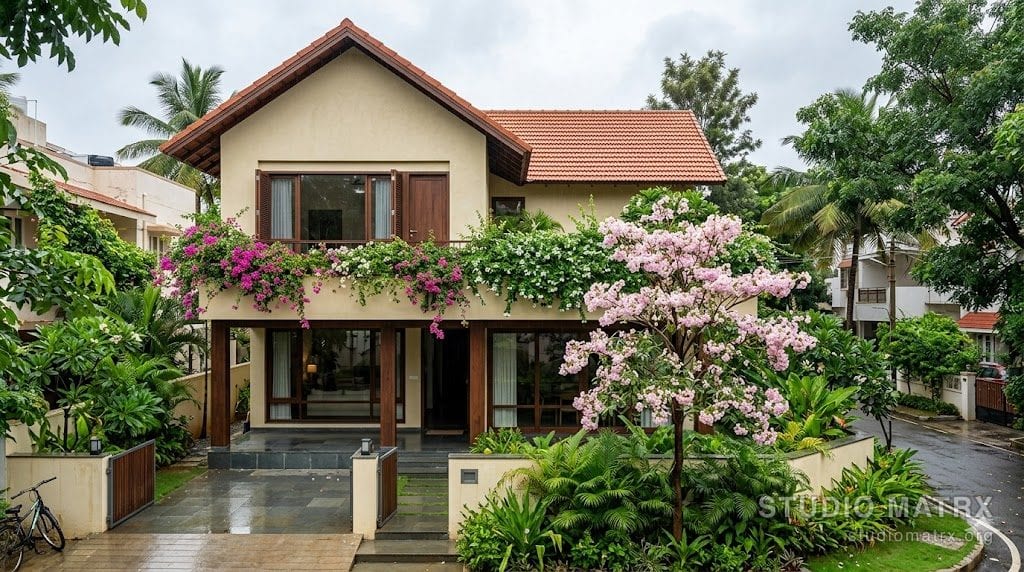
The north-east street facade reads as a light tropical pavilion — terracotta-tiled gable over the entry verandah, lime-washed walls in a warm cream tone, dark teak window frames, and a planted balcony that bleeds the building edge into greenery. Generous, open, and unmistakably Indian.
Materials palette (facade):
- Walls — 200 mm fly-ash brick + 20 mm lime plaster, lime-wash finish (U-value 1.1 — temperate climate doesn't demand insulation)
- Window frames — solid Burma teak or treated jackwood, 50 mm
- Glazing — 6 mm clear toughened, single (DGU unnecessary in temperate)
- Entry verandah roof — exposed timber rafters + terracotta Mangalore tiles + 50 mm reed mat insulation
- Balcony parapet — 900 mm masonry + teak hand-rail + planter ledge
- Roof terrace parapet — 1.1 m masonry + 400 mm pergola trellis above
Section — Climate Logic
The section makes the open-pavilion strategy legible: three open faces, no thermal mass, generous overhangs.
Year-Round Comfort Strategy
| Condition | Frequency | Strategy |
|---|---|---|
| Mild daytime (23–28 °C) | 60% of year | Open everything; cross-ventilation N to SW |
| Warm afternoon (28–32 °C) | 25% of year | Close east windows midday; open after 16:00 |
| Cool morning / night (16–20 °C) | 30% of year | Close openings overnight, open at sunrise; light blanket |
| Cold spell (10–14 °C) | < 5% of year | Close everything, ceiling fan reversed; rarely needed |
| Monsoon (24–28 °C, 90% RH) | 4 months | Open balcony doors with rain-guard timber screens, ceiling fan for circulation |
| Pre-monsoon heat (30–34 °C, dry) | March–May | Operate as warm-afternoon; verandah shade is enough |
Sun on the Facades
- East: Sun penetrates the verandah 06:00–09:00; deep overhang stops it after 09:00.
- South: Summer noon sun at 85° altitude — overhead, blocked by parapet + balcony slab.
- West: 16:00–18:00 sun warms the planted west face — desirable for plant growth.
- North: Diffuse only — feeds the garden court fern wall.
In Bengaluru this strategy never requires air-conditioning. In Pune, peak summer (April–May, 36–38 °C maximums) may need a ceiling-fan-plus-water-mist day or two; AC ownership in temperate-climate homes built this way is typically a guest-room luxury rather than a daily need.
Biophilic Score — 85 / Exemplary
This design scores 85 / 100 on the 16-criterion biophilic framework (see Biophilic Score Calculator) — the highest of the six anchor designs, reflecting the temperate climate's permission to design generously.
| Dimension | Score | Highlights |
|---|---|---|
| Nature in the Space | 39 / 40 | NIS01 (daylight) = 5; NIS02 (plants on all three levels) = 5; NIS04 (thermal variability) = 5; NIS05 (water in shower garden) = 4; NIS06 (natural ventilation) = 5; NIS07 (visual nature) = 5 — perfect across the board |
| Natural Analogues | 26 / 30 | NAA01 (natural materials) = 5; NAA02 (natural fabrics) = 5 (cotton dhurries, jute); NAA03 (biomorphic forms) = 4 (terracotta tile undulations); NAA04 (natural geometry) = 4 |
| Nature of the Space | 20 / 30 | NOS01 (prospect from west balcony) = 5; NOS02 (refuge in verandah corners) = 4; NOS04 (mystery via L-balcony) = 4; NOS05 (risk / awe — present but compact plot limits scale) = 3 |
Strategy classification: Balcony-gardened · Predominantly natural/local. This is the prototype temperate-climate biophilic typology — open the house, plant it, and let the climate work.
FAR / Setback Compliance Snapshot
The plan complies with the following representative jurisdictions:
| City | FAR Used | FAR Allowed | Notes |
|---|---|---|---|
| Bengaluru (BBMP) | 1.17 | 1.75 (≤ 240 sqm, ≤ 9 m road) | 0.58 FAR headroom; setbacks satisfy zone B; see Bengaluru FSI |
| Mysuru (MUDA) | 1.17 | 1.50 | Acceptable; corner-plot variation applies if at intersection |
| Pune (PMC) | 1.17 | 1.10 base + 0.50 TDR = 1.60 effective | Slightly above base; TDR purchase covers it, or trim 80 sqft |
| Hyderabad (HMDA) | 1.17 | 1.65 (≤ 240 sqm, ≤ 12 m road) | Acceptable |
| Coimbatore (CCMC) | 1.17 | 1.50 | Acceptable; cyclone wind-zone IV detailing for parapet |
| Belagavi (BMC) | 1.17 | 1.50 | Acceptable |
Always verify the latest local building bye-law before submitting drawings — see our Setbacks Across India guide and FSI / FAR Computation guide. Bengaluru-specific compliance is fully mapped in Architect Compliance Map: Bengaluru.
Cost — Indicative
For 1,600 sqft built-up at temperate-climate 2026 prices (Bengaluru basis; Pune ~5% higher, Hyderabad ~5% lower):
| Tier | Per sqft (₹) | Total (₹ L) | Includes |
|---|---|---|---|
| Basic | 2,200 | 35.2 | Fly-ash brick + lime, vitrified tile, jackwood frames, 6 mm single glaze, basic balcony planters |
| Recommended | 2,600 | 41.6 | Fly-ash + lime, terracotta + Indian green marble first floor, teak frames, balcony herb spiral, 3 kWp solar |
| Premium | 3,000 | 48.0 | Premium teak frames, kota stone selectively, shower garden, 5 kWp solar, automated rain-guard screens, EV charger |
Why this is more expensive than Hot-Dry (₹1,800–2,600 per sqft):
- Teak / jackwood frames cost more than UPVC: + ₹150/sqft
- Terracotta Mangalore tile roof + exposed rafters cost more than RCC slab: + ₹120/sqft
- Larger glazing area (3× a courtyard-led plan) at single-glaze: + ₹80/sqft
- Solar PV + battery-ready inverter: + ₹40/sqft
- Bengaluru / Pune labour premium: + ₹100/sqft over Jaisalmer
Net ₹400–500/sqft premium is offset over 15–20 years by zero AC running cost and near-zero net electricity bill (with solar). Lifecycle cost is lower than Hot-Dry.
Headroom items not in cost:
- Furniture and soft furnishings
- Compound wall + gate (often replaced with planted hedge in Bengaluru new layouts)
- Internal landscaping (₹1.5–4 L for the three-level planted programme — herb spiral, flower cascade, terrace productive)
- Solar PV beyond 5 kWp
- Borewell + UV water filtration (Bengaluru groundwater is hard; ₹1.5–3 L combined)
Materials Schedule
| Element | Specification | Reason |
|---|---|---|
| External walls | 200 mm fly-ash brick + 20 mm lime plaster, lime-wash finish | Lightweight; lime breathes through monsoon; low embodied carbon |
| Internal walls | 115 mm fly-ash brick + 12 mm POP | Light, fast, monsoon-tolerant |
| Roof (RCC main) | 125 mm RCC slab + 50 mm EPS insulation + waterproofing + 25 mm broken china mosaic | Year-round comfort; takes 5 kWp solar |
| Verandah / balcony roofs | Exposed Burma teak rafters + terracotta Mangalore tile + 50 mm reed-mat insulation | Vernacular, breathable, distinctive |
| Flooring (ground living + dining) | 25 mm terracotta tile, polished | Cool underfoot, vernacular, ages beautifully |
| Flooring (ground kitchen + service) | 12 mm anti-skid vitrified tile | Practical for spills |
| Flooring (first bedrooms) | 18 mm Burma teak strip or laminate (basic) | Warm underfoot, evening sit-out feel |
| Flooring (balcony) | 25 mm terracotta + planted strip | Continuous with ground floor visual |
| Bathroom walls + floor | 12 mm matte ceramic + 12 mm Indian granite ledge | Slip-safe, monsoon-tolerant |
| Doors | 50 mm solid teak entry + 35 mm jackwood internal | Long-life entry; cost-managed internal |
| Windows | Burma teak + 6 mm clear toughened single glaze | Frame quality > glass complexity in this climate |
| Skylights | Polycarbonate UV-stabilized, 6 mm twin-wall | Top-light to stair + shared bath |
| Plant supports | 16 mm steel rod trellis + jute fibre | For passion-fruit, money plant, snake gourd |
| Solar PV | 3–5 kWp polycrystalline, micro-inverters | South + west pergola orientation |
Plant Palette
Native to Deccan plateau, monsoon-fed, low-irrigation post-establishment:
- Garden court (ground): Banana or papaya (centre), fern wall on south face, tulsi (entry), one Bougainvillea (south-east corner)
- First-floor balcony (south herb spiral): Mint, basil, lemongrass, curry leaf, ajwain, tulsi, coriander
- First-floor balcony (west flower cascade): Bougainvillea (cascading), Plumbago (blue), Lantana (mixed)
- First-floor balcony (east): Jasmine on trellis, Hibiscus, Rangoon creeper
- Roof terrace (productive south): Tomato, brinjal, chilli, beans (rotated)
- Roof terrace (east): Banana, papaya, passion-fruit on trellis
- Roof terrace (west): Lemon, curry leaf, drumstick
- Front setback: One Tabebuia rosea (Pink Trumpet — Bengaluru's iconic March bloom) or one Indian Coral tree
- Side gutters: Crinum bulbs, low Iris
Vastu Notes
| Element | Direction | Notes |
|---|---|---|
| Entry | North-East | Excellent (most auspicious orientation) |
| Kitchen | South-West (acceptable variant) | Mitigated by burner facing east on the platform |
| Pooja niche | North-East | Exact Vastu fit |
| Master bedroom | South-East (first floor, over living) | Acceptable variant; orthodox prefers SW but SW is balcony |
| Stairs | West-central | Acceptable; open-tread allows energy flow |
| Toilets | NW (ground powder) + SE-adjacent (first) | NW good; SE adjacency mitigated by buffer to master |
| Brahmasthan | Garden court | Open to sky — perfect |
| Open faces | NE + E + N + parts of W | All Vastu-positive directions kept open |
Rating: Excellent — the plan satisfies the major Vastu directional rules. The NE-facing entry with diagonal axis is the highest Vastu-rated orientation per Vastu for Modern Homes.
Buildability — What to Verify Before Construction
This is a near-buildable design — the configuration, dimensions, FAR, and setback are valid for the cited jurisdictions. Before construction you will need:
1. Site-specific structural design by a licensed RCC consultant — Bengaluru soil typically 150–200 kPa (red murum) and uneventful; Hyderabad uplands often have rock at 1.5–2.5 m and need rock anchoring; Pune varies by zone. See Soil Bearing Capacity guide.
2. MEP layout by a licensed contractor — electrical SLD with provision for 5 kWp solar + EV charging, plumbing isometric with rainwater drop-pipes, drainage to municipal sewer or septic tank per Septic Tank Sizer.
3. Local plan sanction — BBMP / PMC / HMDA / MUDA online submission (Sakala portal in Karnataka). See Building Plan Approval guide.
4. Soil testing at the site (₹15,000–₹35,000) — confirms red-murum bearing capacity in Bengaluru and any expansive-soil mitigation in Pune.
5. Tree-felling clearance — Bengaluru BBMP requires permission to fell any existing tree on the plot; design preserves what's there.
6. Rainwater harvesting — BBMP mandates for plots ≥ 60 sqm; this plot is well over. The 5,000-litre tank meets the rule. See Rainwater Harvesting guide.
7. Solar PV net-metering — BESCOM in Bengaluru, MSEDCL in Pune, TSSPDCL in Hyderabad; each has its own application + meter installation timeline (typically 6–10 weeks).
8. Borewell registration — Karnataka groundwater authority requires registration for any new borewell ≥ 100 ft.
Reading Pairings
- Vastu Shastra for Modern Homes
- Sustainable Home Design India
- Passive Design — India Climate Zones
- Cross-Ventilation in Indian Homes
- Solar Power for Homes India
- Architect Compliance Map: Bengaluru
- Functional House Layout — India
- Pooja Room Design
Tools to Use With This Plan
- Vastu Compliance Checker — verify your plot orientation matches the plan
- Biophilic Score — score variations you make to this design
- Cost Calculator — adjust the cost band for your city
- Cross-Ventilation Analyzer — check the N–SW through-section airflow
- Rainwater Tank Sizer — size the underground tank for your local rainfall
- Sun Path Analyzer — visualise sun on a Bengaluru-latitude (12.97° N) site
Author's note: Bengaluru and Pune are the only Indian cities where you can build a small home, not run an air-conditioner, and not suffer — provided you trust the climate. Most new construction in both cities fails because the builder doesn't trust it. The Garden Pavilion is a permission slip: open it up, plant it generously, and the temperate climate will reward you for the next 100 years. Of the six climate-zone anchor designs in this library, this one scores highest on biophilic precisely because it asks the least of the materials and the most of the climate.
Disclaimer: This is a reference design intended to illustrate climate-responsive biophilic design at a 1200 sqft plot in India's temperate climate. Local building bye-laws, soil conditions, statutory approvals, and structural engineering must be verified by a licensed architect and structural engineer before construction. Costs are indicative for 2026 in the cited regions and vary by site, contractor, finish choices, and material market.
Related Guides — Deep-dive reading
Designing a Naturally Energy-Efficient Indian Home
Comfort first, gadgets last — passive design, orientation, insulation, ventilation and the climate wisdom that cuts Indian energy bills
SustainabilityUnderstanding Sun Path Analysis for Your Home
How the sun actually moves over an Indian site through the day and the year — and why that single fact quietly decides where your kitchen, bedroom and living room should sit.
Site PlanningOrientation, Light & Views: Designing With Your Space, Not Against It
How reading your plot's sun, breeze and views — and placing each room on the right face — gives an Indian home that is cooler, brighter and quietly right, instead of one that fights its site forever.
Design PrinciplesRelated Tools — Try Free
Cross-Ventilation Analyzer
Estimate airflow and air changes per hour (ACH) from room size, window areas, layout, and local wind — with NBC 2016 Part 8 compliance check.
Ventilation CalculatorBrise-Soleil Visualizer
Interactive horizontal-louvre cut-off angle calculator — sun altitude, louvre depth, and spacing inputs with a live shadow preview. Computes θ = arctan(spacing/depth) for façade shading, ECBC envelope compliance, hospital daylight design, and tropical sun-control detailing.
Sun Shading ToolRainwater Tank Sizer
How big should your rainwater tank be? Computes annual harvest, recommended tank capacity in litres, water-bill savings, and payback — for 10 Indian cities.
RWH Calculator