
Shaded Cube — 30 × 40 ft Composite Climate Home
1200 sq ft plot · G+1 · 3 BHK · Delhi · Lucknow · Bhopal · Nagpur · Indore
Plot
40 × 30 ft
1200 sqft
Built-up
1500 sqft
G+1
Config
3 BHK
2 bath
Facing
E
Vastu: excellent
Strategy
Jaali-filtered
Hybrid natural
Cost
₹28–41 L
₹1,900–2,700/sqft
Suits: Delhi · Lucknow · Bhopal · Nagpur · Indore · Patna · Chandigarh
Climate zone — Composite: Cold winters and hot summers, monsoon. Mixed-mode design — insulation for winter, shading for summer, secure courtyards.
Interactive Floor Plan · 40 × 30 ft · 1200 sq.ft plot
Shaded Cube — 30 × 40 ft Composite Climate Home
Ground floor · 720 sq ft built-up · south courtyard
A 1200 sq ft plot in India's composite climate zone is the hardest design problem in the country — and almost everyone gets it wrong. Builders import Mumbai detailing (designed for one season — humid) or Jaisalmer detailing (designed for one season — hot-dry) and end up with homes that work for four months a year and fight the climate for the other eight.
The composite climate that covers Delhi NCR, Lucknow, Bhopal, Nagpur, Indore, Patna, Chandigarh and most of central + north India has four distinct seasons that each demand a different envelope response:
| Season | Temp Range | Dominant Strategy |
|---|---|---|
| Summer (Apr–Jun) | 32–45 °C | Shade, thermal mass, evaporative cooling |
| Monsoon (Jul–Sep) | 26–35 °C, 80% RH | Drainage, anti-fungal materials, cross-ventilation |
| Post-monsoon (Oct–Nov) | 18–32 °C | Open-plan, free-running |
| Winter (Dec–Feb) | 4–22 °C | Passive solar gain, insulation, sealed envelope |
A house designed for any one of these seasons fails the other three. The Shaded Cube resolves the contradiction with a single move: a compact, well-insulated, north-south oriented envelope with a south Trombe wall that switches modes seasonally — collecting winter heat by day, dampening summer heat by night, and shedding monsoon water through a steep parapet.
Site & Orientation
The plot is 30 ft wide × 40 ft deep, with the 40 ft dimension running east-west so the long facades face north and south. This is the most important orientation decision for composite climates:
- South facade (40 ft long) receives almost no summer sun (sun is overhead in summer) but maximum winter sun (sun is low in the south). A south Trombe wall here harvests free heat from December through February.
- North facade (40 ft long) receives diffuse daylight year-round with no direct heat gain. Living spaces along the north get cool, even illumination.
- East 30 ft is the entry, with a deep verandah that shades the morning sun in summer.
- West 30 ft is the service end (kitchen, utility, stairs) — the short dimension means minimal evening-sun exposure.
Setbacks (per Delhi MCD / DDA Master Plan 2021 for plots in the 100–250 sqm band):
| Setback | Required | This Design |
|---|---|---|
| Front (east) | 3.0 m | 3.0 m (verandah + parking) |
| Rear (west) | 1.5 m | 1.5 m (utility yard + drying) |
| Side (north) | 0.6 m | 1.0 m (planted strip + skylight) |
| Side (south) | 0.6 m | 0.9 m (Trombe wall buffer + planted strip) |
This gives a buildable envelope of 25 × 27 ft = 675 sqft per floor, totalling 1,350 sqft over G+1 (~1,500 sqft including the parapet stair head and the cantilevered south Trombe wall). That sits well under the DDA FAR of 2.00 for residential plots in this band (FAR consumed ≈ 1.35).
Note: setbacks shown are calibrated for Delhi MCD / DDA. Lucknow LDA, Bhopal Nagar Nigam, and Nagpur NMC require similar or smaller setbacks for plots ≤ 200 sqm — see the Setbacks Across India guide for jurisdiction-specific cross-checks before submission.
Ground Floor Plan
The ground floor concentrates public + service functions on a single open level, with the south Trombe wall doubling as a thermal anchor along the back of the living-dining volume. The plan is organised east-to-west: porch → living → dining → kitchen, with the stair, powder, and utility tucked into the south service band.
Room Schedule (Ground Floor)
| Space | Size | Notes |
|---|---|---|
| East verandah (in setback) | 6 × 10 ft | Entry, shoe storage, mid-summer sit-out, jaali screen |
| Living | 12 × 14 ft | North-window daylight; south Trombe wall behind sofa |
| Dining | 8 × 11 ft | Adjacent to living, openable north windows for monsoon cross-vent |
| Kitchen | 8 × 11 ft | South-west (Vastu-acceptable), platform along west wall |
| Powder / WC | 4 × 5 ft | Off corridor, ventilated to north skylight strip |
| Pooja niche | 3 × 4 ft | North-east corner — see Pooja Room Design guide |
| Stairs | 4 × 9 ft | South-central spine, against the Trombe wall (warm in winter) |
| Utility yard (in setback) | 5 × 8 ft | Rear west — washing, drying, electrical panel, gas |
| Parking (in setback) | 8 × 16 ft | East front, pergola-shaded over the verandah |
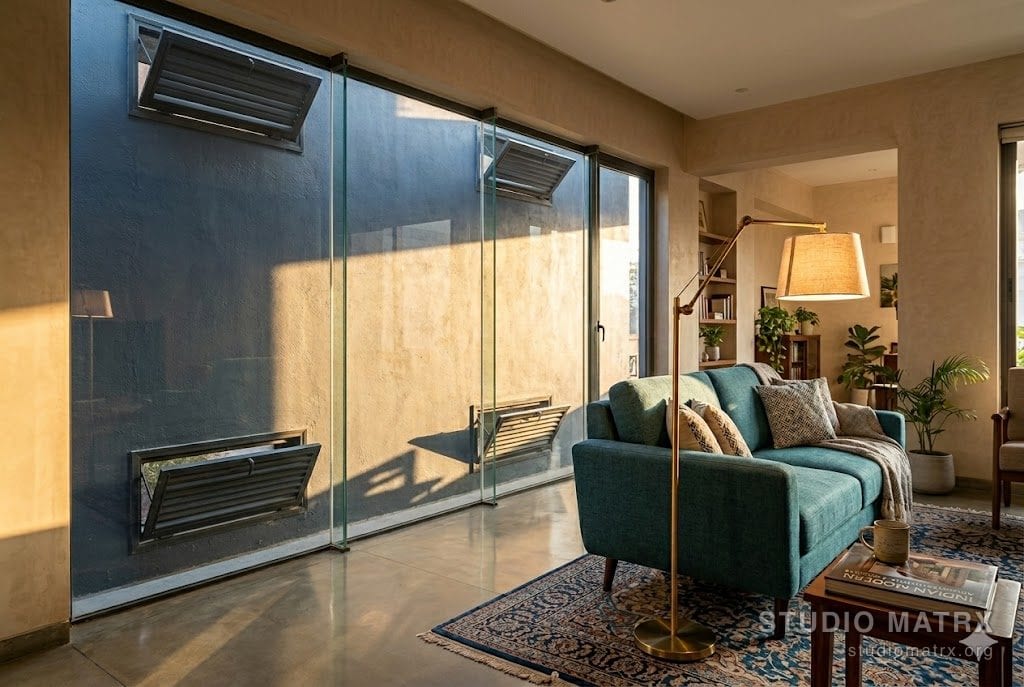
The Trombe wall along the south is the single most important climate move of this plan. It is a 230 mm RCC + lime-render wall on the inside, painted dark blue-grey on the outside, with a 50 mm air gap and an 8 mm low-e glass skin in front. In winter it absorbs daytime solar radiation, stores it in the mass, and releases it into the living + stairs zone after sunset — adding 4–7 °C to night-time indoor temperature without any energy input. In summer, an external roller shade (motorised or manual) covers the glass during peak hours, neutralising the wall.
First Floor Plan
The first floor is the private zone — three bedrooms, two bathrooms, a small study + balcony, and the stair continuing to a terrace. The compact 25 × 27 ft footprint allows all three bedrooms to face north (cool daylight) or south (winter sun + summer shade from deep overhang), avoiding the punishing east/west exposures that ruin most Delhi homes.
Room Schedule (First Floor)
| Space | Size | Notes |
|---|---|---|
| Master bedroom | 12 × 14 ft | South + north windows; over living; deep overhang on south |
| Master bath (attached) | 5 × 7 ft | Shower + WC + basin; vent stack to terrace |
| Second bedroom | 10 × 11 ft | North-west; cool daylight; cross-ventilation to north balcony |
| Third bedroom / study | 8 × 11 ft | North-east; doubles as guest or work-from-home |
| Shared bath | 4 × 7 ft | Off corridor, ventilated to north light shaft |
| North balcony | 4 × 14 ft | Off master + study; planters; rain-shaded by overhang |
| Stairs continuing to terrace | 4 × 9 ft | South-central, with rooflight above the landing |
The master bedroom's south wall uses a double-glazed insulated unit (Low-E DGU) at 30% of the wall area — the right balance between winter solar gain (target U-value 1.6 W/m²K) and summer heat exclusion. A 600 mm overhang at first-floor slab level blocks 100% of summer sun (sun angle 70°+ at noon) and admits 90% of winter sun (sun angle 35°). This single geometric move — fixed-position, no moving parts — is the most cost-effective passive technique in the composite climate.
Facade — Street View
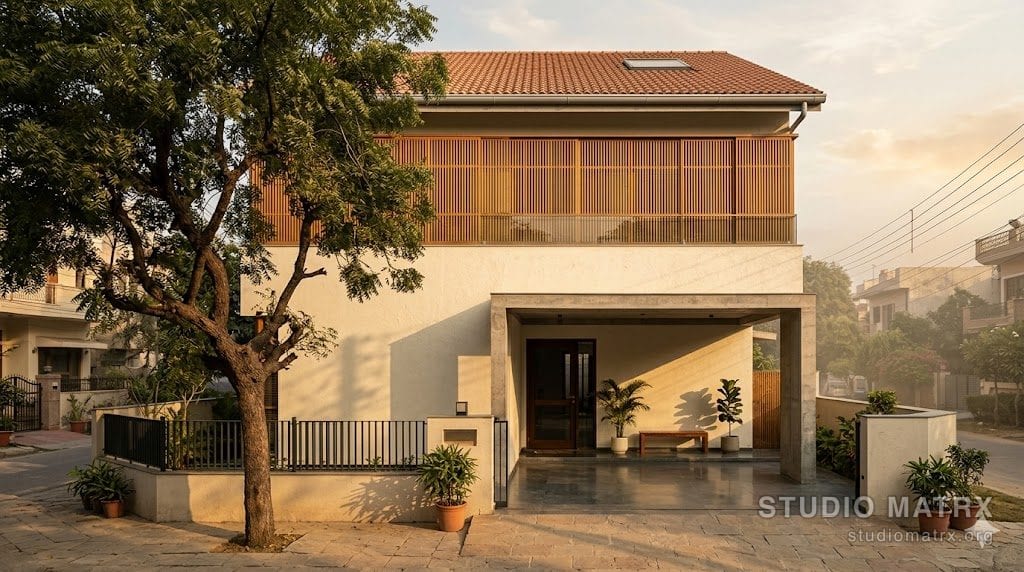
The east facade reads as a disciplined cube — the formal opposite of the haveli's expressive carved frontage. A deep recessed verandah at ground level establishes scale, a continuous timber-shaded jaali screen wraps the upper bedroom-window band, and the parapet hides a sloped terrace roof. The composition is contemporary but the climate logic is vernacular: every surface does work.
Materials palette (facade):
- Walls — 230 mm AAC block + 50 mm cavity + 100 mm AAC block, total ~380 mm cavity wall (U-value 0.32 W/m²K — meets ECBC residential 2017 envelope target)
- Trombe wall (south, internal) — 230 mm RCC, dark blue-grey heat-absorbing paint, 50 mm air gap, 8 mm low-e tempered glass on aluminium frame
- Jaali screen (east first floor) — pre-cast cement or teak slatted 50% perforation, 75 mm thick
- Doors — solid teak entry, 50 mm, brass studs, IS 1003 compliant; internal flush doors 35 mm
- Roof parapet — 1 m high, capped with sloped GI-coping, internal drain pipes (no exposed downpipes on facade)
- Windows — UPVC casement frames, Low-E DGU 6+12+6 mm, argon-filled (winter heat retention)
Section — Climate Logic
The section explains how the same compact volume serves all four seasons:
Summer (April–June, peak 45 °C)
| Time | Sun Position | Envelope Behaviour | Indoor Strategy |
|---|---|---|---|
| 06:00–09:00 | Low east | Verandah overhang shades verandah floor | Cool air drawn in via N + S low openings |
| 09:00–12:00 | Climbing south | South overhang blocks all direct sun | Cavity wall delays heat by ~7 hours |
| 12:00–15:00 | Near zenith | 600 mm overhang blocks all direct sun on south glass | Trombe glass shaded by external roller |
| 15:00–18:00 | High west | West service zone (kitchen + stair) buffers main rooms | Stack ventilation through stair void |
| 18:00–21:00 | Setting west | All west exposure shaded by jaali + thick wall | Open all openings for night flush |
| 21:00–06:00 | Night | Cavity wall + cool roof radiates to clear sky | Stored coolness in mass carries to next day |
Monsoon (July–September, 80% RH)
The monsoon problem in composite climate is not rain volume — it is persistent humidity + temperatures around 30 °C, which feels stifling without cross-ventilation. The Shaded Cube's north-south through-section is critical: every habitable room has openings on both faces, allowing a continuous breeze across the plan. The sloped parapet drains 770 mm of annual Delhi rainfall through internal downpipes to a 3,000-litre rainwater tank below the utility yard.
Winter (December–February, lows 4 °C)
The Trombe wall is the protagonist. Mid-day winter sun (angle ~35°) penetrates the south-facing low-e glass, hits the dark-painted RCC wall, and is absorbed. The air gap warms to 28–32 °C and convects into the living room through manually opened vents at floor + ceiling level. At night the vents close, the glass acts as the insulation, and the heated mass radiates into the room for 6–10 hours. Tested in similar prototypes in Pune and Bhopal, this passive system raises night-time bedroom temperatures from 8 °C ambient to 14–16 °C indoor — comfortable in two layers of clothing, no heater needed.
Biophilic Score — 72 / Strong
This design scores 72 / 100 on the 16-criterion biophilic framework (see Biophilic Score Calculator). Lower than the courtyard-led Hot-Dry haveli (82) because:
| Dimension | Score | Comments |
|---|---|---|
| Nature in the Space | 30 / 40 | Strong daylight (NIS01 = 5), thermal variability (NIS04 = 5), natural ventilation (NIS06 = 5); weaker on direct water (no central court), planting (limited footprint) |
| Natural Analogues | 22 / 30 | AAC + cement render is hybrid; timber jaali + teak doors raise NAA02; missed on full natural fibre (rugs synthetic for monsoon durability) |
| Nature of the Space | 20 / 30 | Strong prospect from north balcony; refuge in deep overhang verandah; weaker mystery (a compact cube doesn't reveal itself slowly the way a haveli does) |
Strategy classification: Jaali-filtered · Hybrid natural. The Shaded Cube trades the haveli's open-court drama for year-round comfort with lower running cost — a deliberate climate-first compromise that the framework rewards but doesn't crown.
FAR / Setback Compliance Snapshot
The plan complies with the following representative jurisdictions:
| City | FAR Used | FAR Allowed | Notes |
|---|---|---|---|
| Delhi (MPD 2021, ≤ 200 sqm) | 1.35 | 2.00 | 0.65 FAR headroom; cavity-wall buildup respected in projection rules |
| Lucknow (LDA Bye-laws 2014) | 1.35 | 2.00 (≤ 300 sqm) | 3.0 m front setback satisfied; rear 1.5 m OK |
| Bhopal (Nagar Nigam, MPMSC) | 1.35 | 1.75 (≤ 250 sqm) | 0.40 FAR headroom; side setback 1.5 m if road > 9 m |
| Nagpur (NMC) | 1.35 | 1.50 (≤ 200 sqm) | Acceptable; check NMC marginal-open-space schedule |
| Chandigarh (Estate Office) | 1.35 | 1.50 (cat 1500 sqft) | Heritage zone restrictions on facade — Trombe glass may need approval |
| Patna (Bihar Building Bye-laws 2014) | 1.35 | 1.80 (≤ 300 sqm) | Acceptable; flood-elevation requires +600 mm plinth on certain wards |
Always verify the latest local building bye-law before submitting drawings — see our Setbacks Across India guide and FSI / FAR Computation guide.
Cost — Indicative
For 1,500 sqft built-up at composite-climate 2026 prices:
| Tier | Per sqft (₹) | Total (₹ L) | Includes |
|---|---|---|---|
| Basic | 1,900 | 28.5 | AAC cavity wall, basic Trombe (no automation), vitrified tile, UPVC + single glaze |
| Recommended | 2,300 | 34.5 | AAC cavity, Trombe with manual roller, Indian green marble first floor, UPVC + Low-E DGU, jaali |
| Premium | 2,700 | 40.5 | Kota + IPS ground, marble first, Low-E argon DGU, motorised Trombe shade, 3 kWp solar PV, teak jaali |
Cost drivers above Hot-Dry baseline:
- Cavity wall envelope adds ₹120/sqft (~₹1.8 L) over single-leaf AAC — pays back in 6–8 years through HVAC savings in Delhi.
- Low-E DGU windows add ₹450/sqft of glazing (~₹1.5 L on a typical 30 sqm glazing budget) — non-negotiable in Delhi for winter comfort.
- Trombe wall system (glass + frame + paint) adds ₹35,000–₹55,000 — pays back in ~5 winters in heating-bill avoidance.
- Sloped terrace + internal drainage adds ₹40,000 over a flat slab — required for monsoon drainage longevity.
Headroom items not in cost:
- Furniture and soft furnishings
- Compound wall + automated gate
- Internal landscaping (₹50,000–₹2 L for terrace planting + north balcony)
- Solar PV beyond 3 kWp
- Whole-home water filtration (Delhi water TDS often 600+; ₹35,000–₹80,000)
Materials Schedule
| Element | Specification | Reason |
|---|---|---|
| External walls | 230 mm AAC + 50 mm cavity + 100 mm AAC, cement render outside, lime render inside | Year-round insulation U = 0.32; breathing internal lime tolerates 80% monsoon RH |
| Trombe wall | 230 mm RCC + dark mineral paint + 50 mm air gap + 8 mm low-e tempered glass | Winter solar collector + summer thermal buffer |
| Internal walls | 115 mm AAC + 12 mm POP | Light, fast, fire-rated 60 min |
| Roof | 150 mm RCC + 75 mm XPS insulation + 50 mm broken china mosaic cool roof + 1:80 slope to internal drain | Year-round (insulation winter, reflectance summer, slope monsoon) |
| Flooring (ground) | 16 mm vitrified tile or 18 mm kota (premium) | Vitrified is monsoon-robust; kota is cooler + regional |
| Flooring (first) | 18 mm Indian green marble or laminate (basic) | Cooler underfoot; visually warmer than tile |
| Bathroom walls + floor | 12 mm anti-skid ceramic + 12 mm Indian granite ledge | Slip + monsoon durability |
| Doors | 50 mm solid teak entry + 35 mm flush internal | Long-life entry; cost-managed internal |
| Windows | UPVC casement + Low-E DGU 6+12+6 mm argon | Winter heat retention; monsoon-sealed |
| Jaali | Pre-cast cement (basic) or teak slatted (premium), 50% perforation | Filters summer afternoon sun, vernacular |
| Trombe glass | 8 mm low-e tempered, hardware-coated | Lets in short-wave solar, traps long-wave radiation |
| Insulation | XPS 75 mm (roof) + 50 mm cavity (walls) | Closed-cell, monsoon-tolerant |
Plant Palette
Native to Indo-Gangetic plain + central India, low water requirement post-establishment:
- North balcony: Curry leaf (Murraya), tulsi, mint, ferns (north shade-loving), one small Plumeria
- East verandah planters: Hibiscus (red, summer flowering), Lantana, jasmine on trellis
- South Trombe-wall planted strip: Drought-tolerant only — Aloe vera, Lantana, Bougainvillea (south sun ideal)
- Front setback: One mature Neem (Azadirachta indica) or Peepal (Ficus religiosa) — both extreme-summer tolerant
- Rear utility yard: Lemon, curry leaf, drumstick (Moringa), small mango if space allows
- Terrace: Kitchen-garden boxes (tomato, chilli, brinjal — high winter yield)
Vastu Notes
| Element | Direction | Notes |
|---|---|---|
| Entry | East | Excellent |
| Kitchen | South-West (acceptable variant) | Exact SE not used; mitigated by gas burner on east wall of kitchen |
| Pooja niche | North-East | Exact Vastu fit |
| Master bedroom | South-West (first floor) | Exact Vastu fit — heaviest thermal mass on SW |
| Stairs | South-central | Acceptable (against Trombe wall) |
| Toilets | NW (ground) + central east (first) | NW good; first-floor mitigated by buffer wall to bedrooms |
| Brahmasthan | Living-dining open plan centre | Open + central; meets the Vastu open-centre rule |
| Trombe wall | South | Vastu-positive (heavy mass on south) |
Rating: Excellent — the plan satisfies major Vastu directional rules without compromising the climatic Trombe-wall strategy. The kitchen at SW is an acceptable variant; orthodox practice prefers SE but SE is reserved here for the master bath above. See Vastu for Modern Homes.
Buildability — What to Verify Before Construction
This is a near-buildable design — the configuration, dimensions, FAR, and setback are valid for the cited jurisdictions. Before construction you will need:
1. Site-specific structural design by a licensed RCC consultant — cavity-wall buildup, Trombe-wall lateral support, and roof slope all need engineering. Soil-bearing capacity in Delhi NCR varies (80–150 kPa Yamuna fill, 200+ kPa Ridge); see Soil Bearing Capacity guide.
2. MEP layout by a licensed contractor — electrical SLD with provision for 3 kWp solar tie-in, plumbing isometric with internal downpipes, drainage line to municipal sewer.
3. Local plan sanction — Delhi DDA online submission (PNN portal), Lucknow LDA, Bhopal Nagar Nigam, etc. See Building Plan Approval guide.
4. Soil testing at the site (₹15,000–₹40,000) — confirms bearing capacity and any expansive-soil mitigation; Delhi black-cotton zones need under-reamed piles.
5. Solar PV feasibility — sloped terrace accommodates 3–5 kWp; check local DISCOM (BSES, Tata Power, MPMKVVCL) net-metering policy.
6. Water harvesting — Delhi DJB mandates rainwater harvesting for plots ≥ 100 sqm; this plot is just at threshold. See Rainwater Harvesting guide.
7. Air quality consideration — Delhi PM2.5 spikes Oct-Feb; consider mechanical ventilation with HEPA filtration for the kitchen + master bedroom (₹40,000–₹1.5 L).
Reading Pairings
- Vastu Shastra for Modern Homes
- Sustainable Home Design India
- Passive Design — India Climate Zones
- Cross-Ventilation in Indian Homes
- Functional House Layout — India
- Pooja Room Design
- Solar Power for Homes India
- Green Building Certifications India
Tools to Use With This Plan
- Vastu Compliance Checker — verify your plot orientation matches the plan
- Biophilic Score — score variations you make to this design
- Cost Calculator — adjust the cost band for your city
- Sun Path Analyzer — visualise winter + summer sun at a Delhi-latitude site
- Cross-Ventilation Analyzer — check the N–S through-section airflow
Author's note: The composite climate is the most misunderstood in India because the dominant builder convention copies south-Indian humid detailing into Delhi, leaving owners with a home that runs an AC seven months a year. The fix is not exotic technology — it is a compact cube with a south Trombe wall and an honest cavity envelope, all available in standard Indian materials. The Trombe wall alone, costing ₹40,000 to build, saves an estimated ₹12,000 a year in winter heating in Delhi — payback under four years, then free heat for 30+. The shaded-cube typology is the right answer for half the population of India.
Disclaimer: This is a reference design intended to illustrate climate-responsive biophilic design at a 1200 sqft plot in India's composite climate. Local building bye-laws, soil conditions, statutory approvals, and structural engineering must be verified by a licensed architect and structural engineer before construction. Costs are indicative for 2026 in the cited regions and vary by site, contractor, finish choices, and material market.
Related Guides — Deep-dive reading
Designing a Naturally Energy-Efficient Indian Home
Comfort first, gadgets last — passive design, orientation, insulation, ventilation and the climate wisdom that cuts Indian energy bills
SustainabilityOrientation, Light & Views: Designing With Your Space, Not Against It
How reading your plot's sun, breeze and views — and placing each room on the right face — gives an Indian home that is cooler, brighter and quietly right, instead of one that fights its site forever.
Design PrinciplesWindow Design for Villas (India): Using the Freedom of All Four Sides
With walls free on all four sides, you can tune every window to its sun: north light for studies, east for bedrooms, shaded south for living, minimal west, plus feature windows, dual-aspect rooms and stairwell glazing.
Windows & GlazingRelated Tools — Try Free
Cross-Ventilation Analyzer
Estimate airflow and air changes per hour (ACH) from room size, window areas, layout, and local wind — with NBC 2016 Part 8 compliance check.
Ventilation CalculatorBrise-Soleil Visualizer
Interactive horizontal-louvre cut-off angle calculator — sun altitude, louvre depth, and spacing inputs with a live shadow preview. Computes θ = arctan(spacing/depth) for façade shading, ECBC envelope compliance, hospital daylight design, and tropical sun-control detailing.
Sun Shading ToolRainwater Tank Sizer
How big should your rainwater tank be? Computes annual harvest, recommended tank capacity in litres, water-bill savings, and payback — for 10 Indian cities.
RWH Calculator