
Interactive Scorer · 2026
Biophilic Design Score
Score your home across 16 India-specific nature-integration criteria — daylight, ventilation, courtyards, jaali patterns, indigenous plants. Weighted score /100, band, and AI image prompt.
Project Details
Score Each Criterion (0–5)
0 = Absent · 1 = Minimal · 2 = Emerging · 3 = Strong · 4 = Advanced · 5 = Exemplary. Prefer solutions that are climate-responsive, culturally grounded, maintainable, and materially honest.
Quick scenarios
Apply a baseline, then fine-tune individual criteria below.
Nature in the Space
NIS01 — Daylight & circadian support(9%)
Access to natural daylight with glare control and day-night rhythm awareness.
Indian: Large openings, shaded skylights, filtered sun through jaali, layered curtains.
NIS02 — Cross-ventilation & airflow variability(9%)
Fresh air movement produced by openable windows, verandahs, jaali, stack effect, fans and layout.
Indian: Opposed openings, high-low vents, breezeways, ceiling fans supporting passive comfort.
NIS03 — Indoor greenery & edible greens(8%)
Living plants used as part of daily life, from accent plants to balcony food gardens.
Indian: Tulsi, money plant, palms, spice/herb ledge, balcony greens, indoor courts.
NIS04 — View to nature / sky(6%)
Sightlines to trees, landscape, terrace, courtyard or open sky.
Indian: Tree-framed windows, courtyard views, balcony outlooks, rooftop garden view.
NIS05 — Water presence(4%)
Calming visual or acoustic cues from water without causing maintenance or moisture problems.
Indian: Urli bowl, lotus trough, recirculating fountain, reflective basin.
NIS06 — Passive thermal comfort(4%)
Shading, thermal mass, insulation and layout choices that reduce dependence on mechanical conditioning.
Indian: Deep overhangs, thick walls, shaded courts, lime plaster, cool roofs.
Natural Analogues
NAA01 — Natural / local materials(8%)
Use of real wood, bamboo, cane, stone, terracotta, lime or natural fiber.
Indian: Teak, sheesham, bamboo cane, kota stone, cuddapah, terracotta, lime wash.
NAA02 — Natural textures & tactility(5%)
Surface roughness, grain, weave and hand-finished cues that feel organic.
Indian: Handloom cotton, jute, rattan, cane weave, rough stone, carved wood.
NAA03 — Biomorphic / fractal / jaali patterns(7%)
Nature-derived geometry or patterns that echo leaf forms, branching, honeycomb or lattice screens.
Indian: Jaali screens, leaf motifs, cane lattice, carved floral panels, fractal rugs.
NAA04 — Earth palette & non-toxic finishes(4%)
Colors and finishes drawn from soil, foliage, sky and stone while limiting harmful emissions.
Indian: Terracotta, muted green, indigo accents, clay beige, mineral paints.
NAA05 — Craft / vernacular expression(6%)
Design language that respectfully references local building traditions or crafts.
Indian: Chettinad tile, Assamese bamboo, Kashmiri woodwork, Rajasthani stone, Kerala timber details.
Nature of the Space
NOS01 — Refuge(6%)
Protected, comfortable niches that create psychological safety and retreat.
Indian: Window seat, diwan nook, low-light reading corner, backed seating.
NOS02 — Prospect(5%)
Open sightlines and a sense of outward reach or spaciousness.
Indian: Clear view across room to balcony or garden, double-height lookouts.
NOS03 — Threshold / verandah / balcony transition(7%)
Semi-open in-between space linking indoors and outdoors.
Indian: Verandah, sit-out, shaded balcony, deep foyer with planters.
NOS04 — Mystery & layered reveal(4%)
Partial concealment, filtered light or views that invite exploration.
Indian: Layered screens, offset entries, glimpses of greenery through partitions.
NOS05 — Courtyard / internal green core(8%)
Central or side open-to-sky space that organizes light, air and social life.
Indian: Nalukettu-inspired court, lightwell with planting, internal green spine.
Classification
Your Biophilic Score
Score at least one criterion above to see your results.
Download Your Biophilic Score Report PDF
Project details, all 16 criterion scores, dimension breakdown, classification, and generated prompt — in a branded PDF.
Please score at least one criterion before downloading.
Disclaimer: This Biophilic Score Calculator is provided by Studio Matrx – DesignAI for educational and planning purposes only. Scores are indicative assessments based on self-reported inputs, not professional audits. The framework adapts Terrapin Bright Green's 14 Patterns of Biophilic Design, Kellert's practice guidance, and WHO healthy-housing principles. Always consult qualified design professionals for project-specific guidance. Studio Matrx is not liable for decisions made based on this tool. Governed by the laws of India — Courts of Karnataka.
Biophilic design in Indian homes
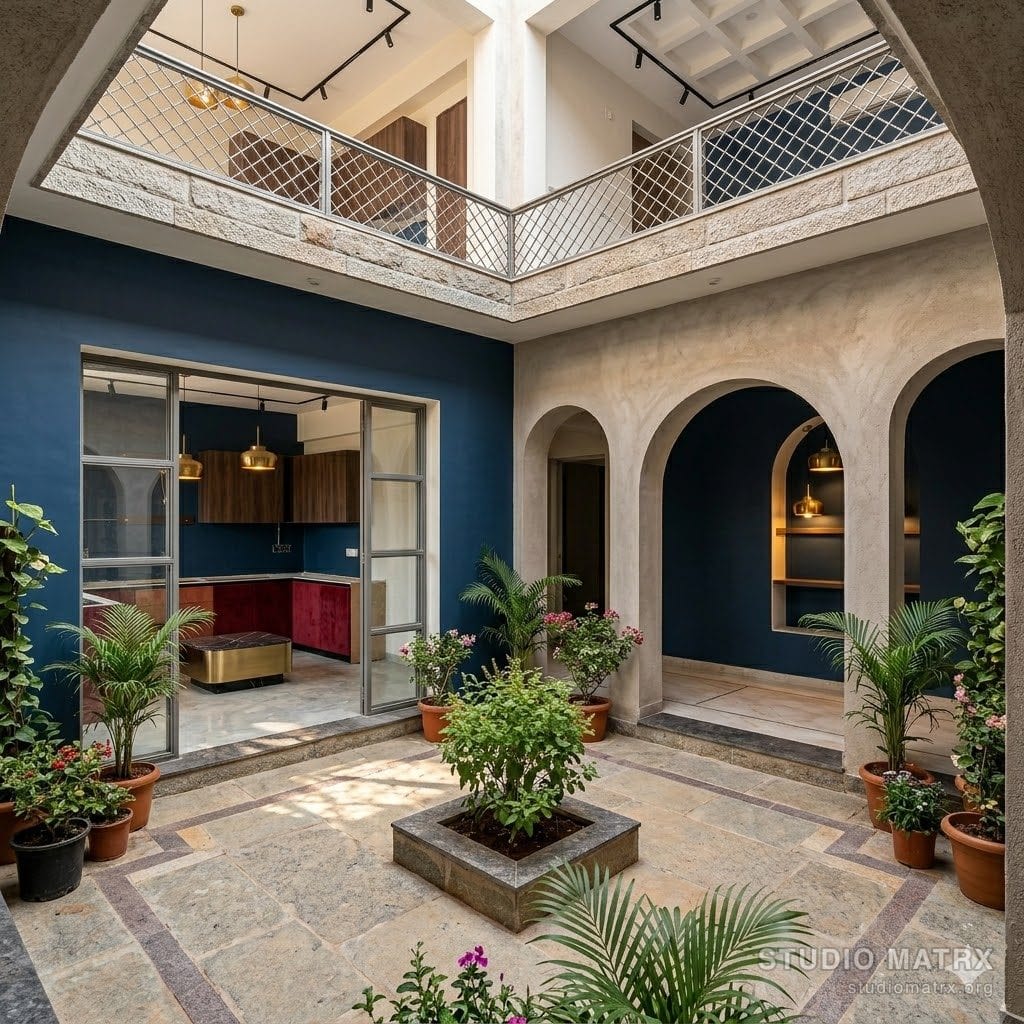
Courtyard · brahmasthan
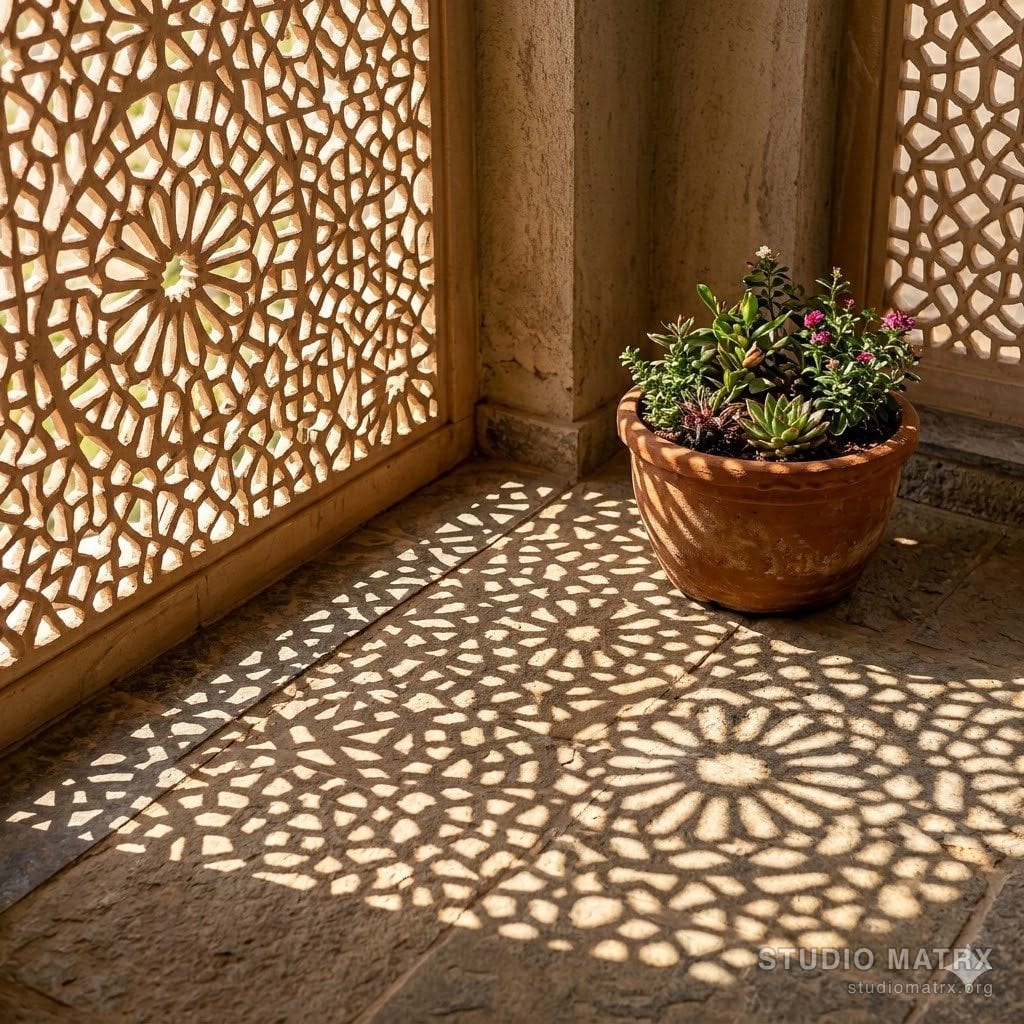
Jaali · patterned light
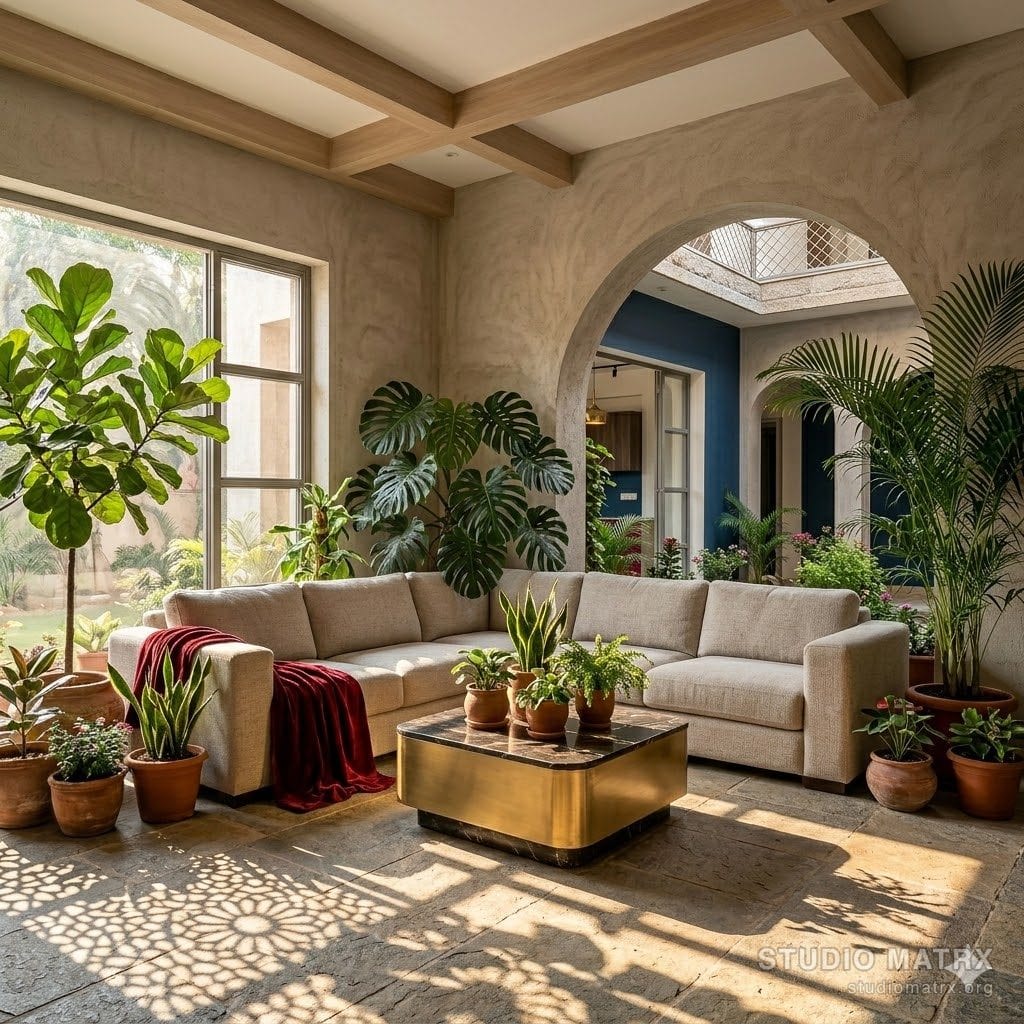
Indoor plants
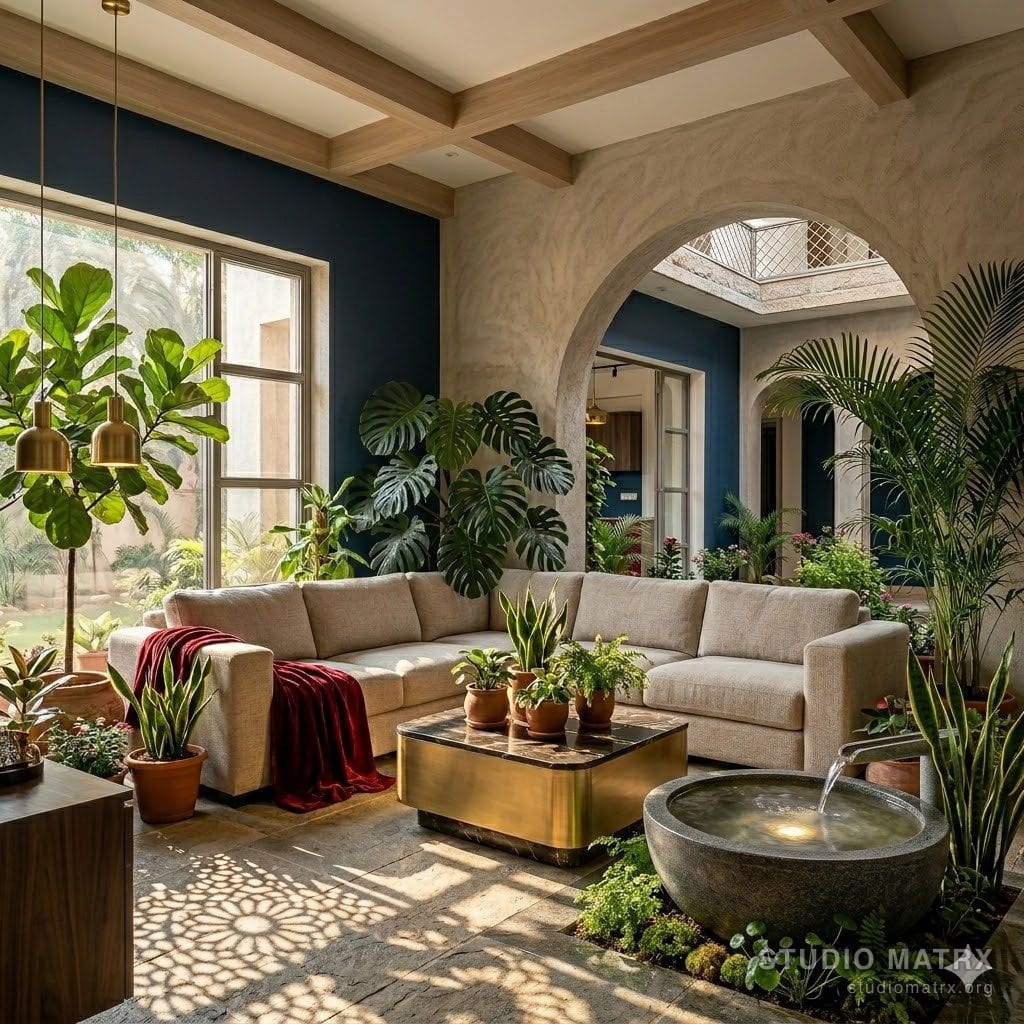
Water feature
Generate biophilic design concepts
DesignAI takes your biophilic prompt and renders India-specific concepts.
Biophilic Design — A Working Reference
Biophilic design is the intentional integration of nature — directly, symbolically, and spatially — into the spaces where we live. The Indian vernacular tradition has been quietly biophilic for centuries: the Kerala nalukettu places a courtyard at the heart of the home; the Tamil mutram, the Rajasthani haveli, and the Goan veranda all do similar work. The calculator above scores a home across 16 criteria; this reference covers the framework and the highest-leverage Indian-vernacular elements that lift the score.
The Three Dimensions
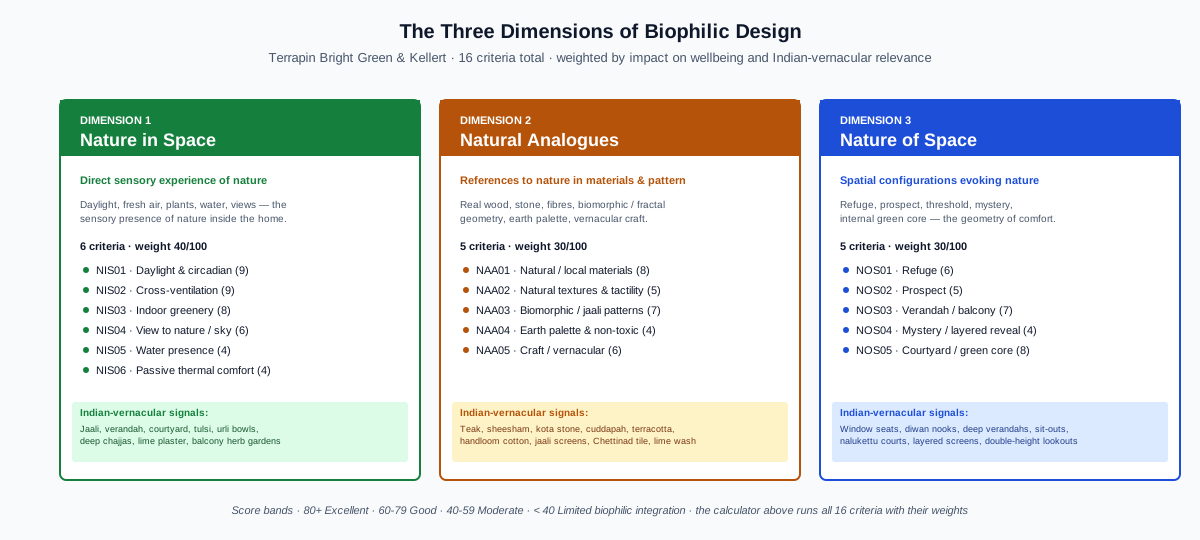
Drawing on Terrapin Bright Green's “14 Patterns of Biophilic Design” and Kellert's typology, the framework groups 16 criteria into three dimensions: Nature in Space (direct sensory experience — light, air, plants, water, views, thermal comfort), Natural Analogues (references to nature in materials and pattern — wood, stone, biomorphic geometry, earth palette, craft), and Nature of Space (spatial configurations — refuge, prospect, threshold, mystery, internal green core).
All 16 Criteria, Weighted
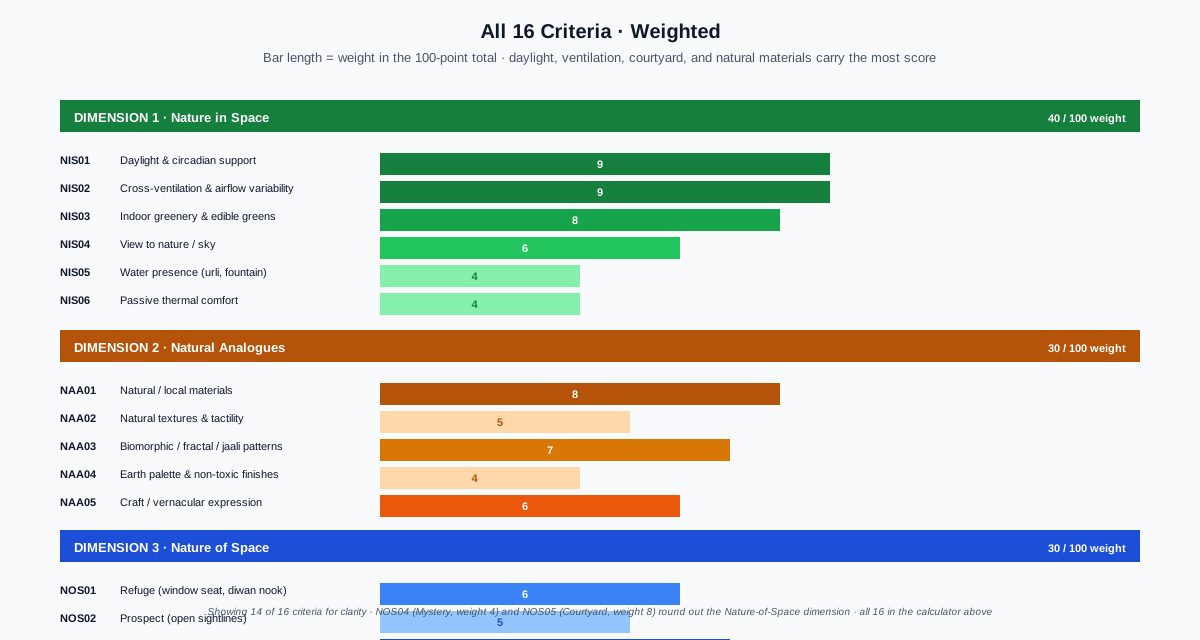
Each criterion has a weight from 4 to 9 reflecting evidenced wellbeing impact and Indian-vernacular relevance. The biggest-weight items — daylight + circadian (9), cross-ventilation (9), indoor greenery (8), courtyard / green core (8), natural materials (8) — together account for 42 of the 100 points. The chart below shows all criteria as horizontal bars sized by weight.
Indian-Vernacular Elements
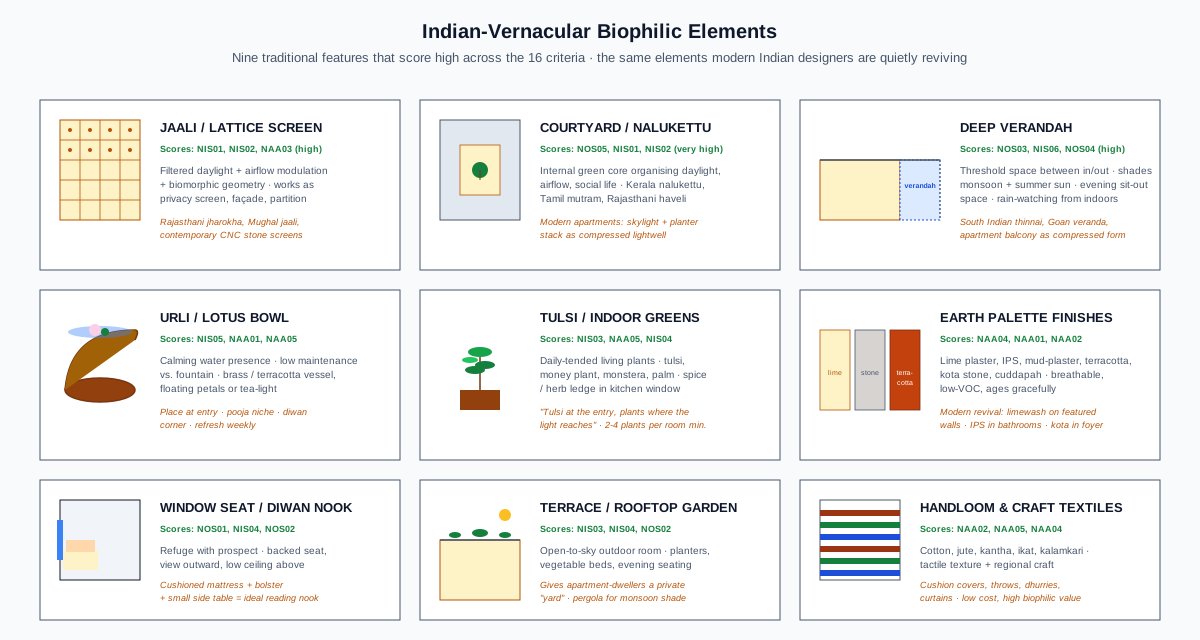
The traditional Indian home is a goldmine of biophilic patterns. Nine elements deserve specific mention because they each score across multiple criteria and are easy to retrofit into modern apartments and houses.
Practical High-Leverage Moves
- Plants, plants, plants. 4-8 indoor plants distributed across rooms moves NIS03 from 0 to 4-5 with negligible cost. A balcony herb ledge adds an edible-greens dimension that doubles the criterion's impact.
- One jaali element per home. A CNC-cut MDF screen, carved wood partition, or perforated metal panel as a foyer divider, kitchen-living separator, or pooja niche enclosure scores NAA03 (weight 7) with one architectural move.
- Refuge nook. A window seat with a backed cushion, or a corner diwan with bolster pillows, converts a wall corner into NOS01-scoring refuge for the cost of one piece of furniture.
- Lime plaster on a feature wall. One wall in lime plaster (or limewash over existing plaster) shifts NAA01 + NAA04 + NAA02 simultaneously — natural material, earth palette, tactile texture — for ~₹100-150/sqft.
- Threshold 'deep balcony'. Treat the balcony as a thinnai — small table + chairs + planters + one shaded corner — converts “balcony” from clothes-drying to NOS03-scoring threshold space.
- Urli at the entry. A brass or terracotta urli with floating lotuses or tea-lights scores NIS05 (water presence) with no plumbing, no maintenance beyond weekly refresh.
Cross-References
- Biophilic Design for Indian Homes (Guide) — deeper treatment with case studies and primary research
- Cross-Ventilation Analyzer — quantify NIS02
- Sun Path Analyzer — quantify NIS01
- Colour Palette Generator — earth-palette options for NAA04
- Material Compare — natural-material trade-offs for NAA01
Disclaimer: The framework synthesises Terrapin Bright Green, Kellert, Browning, and the Indian vernacular literature. Weights are calibrated for Indian residential contexts; commercial, healthcare, and educational projects need different weighting. Use the score as a directional tool, not a certification.
Related Guides — Deep-dive reading
Homes That Improve Mental Wellbeing
The whole-home, indoor-biophilia approach to calm — how plants, light, air, quiet and the right balance of togetherness and retreat make an Indian home restorative.
Healthy HomesHow Good Architecture Reduces Stress
The measurable ways your home calms or strains your nervous system — and how to design for calm
Design EducationBuilding Materials in India: The Complete Guide (2026)
The anchor map of the Building Materials hub - what building materials are, how to classify them, and an eight-criteria framework to select and specify the right one for every layer of an Indian home.
Building MaterialsRelated Tools — You may also find these useful
Cross-Ventilation Analyzer
Estimate airflow and air changes per hour (ACH) from room size, window areas, layout, and local wind — with NBC 2016 Part 8 compliance check.
Ventilation CalculatorRainwater Tank Sizer
How big should your rainwater tank be? Computes annual harvest, recommended tank capacity in litres, water-bill savings, and payback — for 10 Indian cities.
RWH CalculatorAC Capacity Calculator
Find the right air-conditioner tonnage for a room — from area, sun, floor, occupancy and climate. Right-sized, not oversized.
HVAC