
30 × 40 ft House Plan in Chennai — A 2026 Warm-Humid + Cyclone Reference
Chennai is hotter than Mumbai, drier in the SW monsoon, and pounded harder in the NE retreating monsoon — plus cyclonic wind exposure that Mumbai is mostly spared. The Verandah Pavilion plan answers it with deep verandahs, cyclone-tested gable detailing, salt-air-tolerant materials, and CMDA / TNCDBR 2019 compliance. Climate logic + 2026 cost realities for Chennai 30 × 40 ft self-builds, in one place.
Governing framework: Tamil Nadu Combined Development & Building Rules 2019 (TNCDBR 2019)
Working reference tables
Print or screenshot these for the studio wall. Cross-check against the current authority notification before any specific filing.
CMDA / TNCDBR 2019 plot envelope for a 30 × 40 ft (≈ 111 sqm) Chennai plot
Setback, FSI, and height permitted on a typical 30 × 40 ft residential plot in Chennai metropolitan area under TNCDBR 2019 + CMDA Development Regulations. Plots in Chennai Corporation limits route through GCC; outer plots in CMA route through DTCP.
| Parameter | TNCDBR 2019 / CMDA (Residential Use) | This Plan (Verandah Pavilion) |
|---|---|---|
| Plot area | 100–250 sqm band | 111 sqm (1200 sqft) |
| Permissible FSI (continuous building) | 1.50 (≤ 9 m road) / 2.00 (9–12 m road) | 1.17 (within base) |
| Ground coverage | 65% max for plots ≤ 240 sqm | 55% achieved |
| Front setback | 1.5 m (≤ 9 m road) / 3.0 m (9–12 m road) | 1.8 m (verandah projecting + planted) |
| Rear setback | 1.5 m | 1.8 m (utility yard + drying) |
| Side setback | 0.6 m minimum on one side (continuous building) | 0.9 m + verandah wrap on east |
| Building height max | 9 m / 12 m / 15.5 m by road width | 8.5 m (G+1 + gable ridge) |
| Stilt parking FSI exemption | Excluded if ≤ 2.4 m height | Designed for parking-pergola, not full stilt |
Chennai's TNCDBR 2019 rules treat a 30 × 40 ft plot in the standard suburban zone with substantial generosity — base FSI of 1.5–2.0 against an actual usage of 1.17 leaves substantial headroom for future first-floor extension or terrace expansion.
Chennai warm-humid + cyclone strategy summary
How the Verandah Pavilion envelope responds to Chennai's two distinct monsoons + cyclone exposure + general humidity. Chennai's climate is harder than Mumbai because of the NE monsoon brutality + cyclone-wind detailing requirement.
| Season | Climate Reality | Design Response | Cost Driver |
|---|---|---|---|
| Summer (Mar–Jun) | 30–40 °C; 65% RH; sea breeze at 16:00–18:00 | Deep east + south verandahs; cross-ventilation primed for sea breeze | Verandah depth + carpentry |
| SW Monsoon (Jun–Sep) | 26–34 °C; modest 350 mm rain; cloudy | Lime mortar; cross-ventilation; not overspec for SW rain | (no premium) |
| NE retreating Monsoon (Oct–Nov) | 24–30 °C; 800 mm rain in 60 days; cyclone risk | Steep Mangalore tile + cyclone-grade flashing + tie-down detailing | Cyclone-grade roof + downpipes |
| Winter (Dec–Feb) | 20–28 °C; 70% RH; pleasant | Free-running; ceiling fans; no envelope changes | (no premium) |
Chennai's NE monsoon is more intense than the SW monsoon — the opposite pattern from Mumbai. Cyclone exposure (Wind Zone V along the coast) requires IS 875 Part 3 wind-load detailing for roof tie-downs, gable bracing, and parapet anchoring. Routine for cyclone-aware contractors; missed by mainland-style builders.
Chennai 2026 cost band — 1400 sqft built-up Verandah Pavilion
Per-sqft and total cost for the Verandah Pavilion plan at three finish tiers, indicative for 2026 Chennai labour and material market. Tambaram / Velachery / OMR mid-suburbs band; central Chennai (T. Nagar / Mylapore) ~15% higher; outer (Sriperumbudur / Chengalpattu / Mahabalipuram) ~10% lower.
| Tier | ₹/sqft | Total (₹ L) | Inclusions |
|---|---|---|---|
| Basic | 1,800 | 25.2 | Brick + cement render (transitional), terracotta tile, jackwood frames, single glaze, basic gutter |
| Recommended | 2,200 | 30.8 | Lime mortar, Mangalore tile + exposed teak rafters, terracotta + Indian green marble first floor, cyclone-rated tie-downs |
| Premium | 2,700 | 37.8 | Hand-laid Mangalore tile + ridge details, full Burma teak frames, marble + polished IPS, marine-stainless hardware, 3 kWp solar, full RWH |
Chennai-coastal material market is well-developed (Mangalore tile via the Kerala-TN supply chain, teak via Burma-route imports, granite from Pallavaram). Skilled cyclone-tested carpentry crews command a 10–15% premium over comparable inland work — the right premium to pay.
Chennai-specific construction overlays
Beyond standard CMDA / GCC sanction, four Chennai-specific overlays affect a 30 × 40 ft project. CRZ + cyclone-wind detailing are the two non-negotiable.
| Overlay | Authority | When triggered | Architect action |
|---|---|---|---|
| Coastal Regulation Zone (CRZ) | Tamil Nadu State Coastal Zone Management Authority (TNSCZMA) | Plots within 500 m of HTL | CZMP zonal check + TNSCZMA clearance |
| Cyclone-wind detailing (IS 875 Part 3) | TNCDBR + structural consultant | All sites within Wind Zone V (entire metro) | Roof tie-down, gable bracing, parapet anchoring in working drawings |
| Flood-plain check (Cooum / Adyar) | Public Works Department, GoTN | Plots in 100-year flood-plain | Plot history check; elevation requirement may apply |
| Tree-felling permission | Greater Chennai Corporation parks dept | Any tree on plot ≥ 5 m height | Online application 30–60 days before sanction |
| RWH structure | Tamil Nadu Government (statewide mandate) | All plots, all construction | Recharge pit + 5,000 L tank minimum; OC withheld without compliance |
Tamil Nadu's statewide rainwater harvesting mandate (one of the strictest in India, dating to the 2003 J. Jayalalithaa initiative) is enforced at OC stage. Designs without integrated RWH cannot obtain occupancy; retrofits cost 2–3× the cost of integrated builds.
The working reference, in full
A 30 × 40 ft (~111 sqm) plot is the most common middle-class residential allocation in Chennai's suburbs — Velachery, Tambaram, Pallavaram, OMR (Old Mahabalipuram Road) layouts, Sholinganallur, Porur — and in the pre-1990 plotted layouts within Chennai Corporation. Building on this plot is governed by the Tamil Nadu Town and Country Planning Act 1971, the Chennai Metropolitan Development Authority (CMDA) Development Regulations, and the Tamil Nadu Combined Development and Building Rules (TNCDBR) 2019. Greater Chennai Corporation (GCC) is the permit-issuing authority within Chennai Corporation limits; CMDA's DTCP handles outer-suburb plots in the metropolitan area.
The Chennai climate problem — humidity + cyclone, not just heat
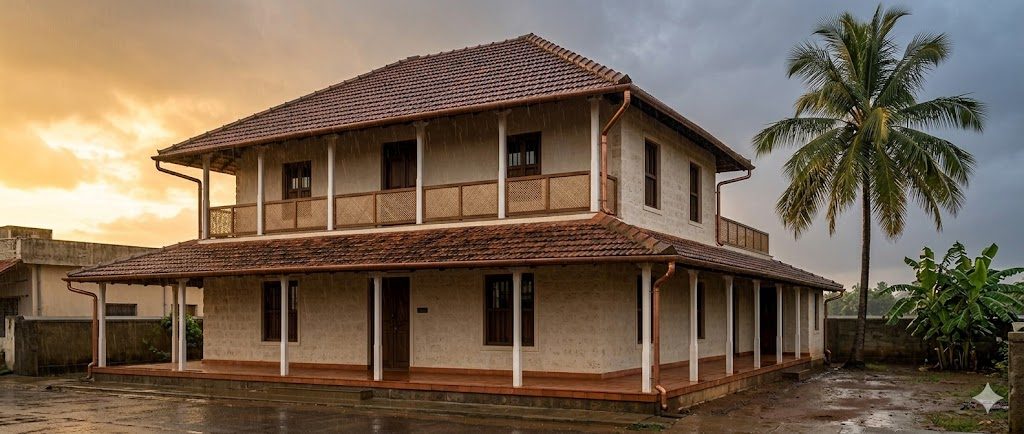
Chennai sits in the warm-humid coastal climate zone per NBC 2016 / SP 41 (BIS, 1987) — like Mumbai, but with three important differences: hotter summers (30–40 °C in April–June vs Mumbai's 30–35), NE monsoon as the dominant rain driver (October–November, 800 mm in 60 days vs Mumbai's SW pattern), and cyclone exposure (Wind Zone V per IS 875 Part 3, with regular landfall risk October–December). The defining design constraints are continuous cross-ventilation through humidity, steep monsoon roof + 600 mm eaves, and cyclone-grade tie-down detailing on the roof + parapet + gable. The Verandah Pavilion is the natural answer — vernacular Chennai bungalow logic re-stated in contemporary 30 × 40 ft form.
The Verandah Pavilion plan — climate response, summarised
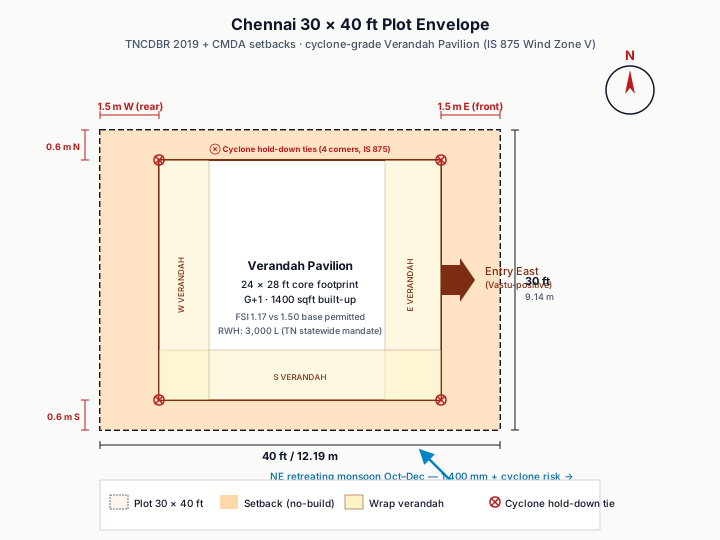
The Verandah Pavilion is a 30 × 40 ft, G+1, 3 BHK plan oriented with the long axis north-south so the long facades face east + west, with a wrap-around verandah on east + north + west (depth 1.5 m), a steep 35° Mangalore-tile gable roof with 600 mm eaves to shed 800 mm of NE-monsoon rainfall, cyclone-grade tie-downs on every rafter-to-purlin and purlin-to-wall connection, lime mortar on external walls (60–80% RH average tolerates lime; cement spalls), and N–S cross-ventilation primed for the 16:00–18:00 sea breeze. Marine-grade stainless or brass hardware for salt-air corrosion. Full plan with floor schedules and materials.
FSI + setback compliance on a Chennai 30 × 40 ft plot
TNCDBR 2019 + CMDA Development Regulations permit a base FSI of 1.5 on residential plots ≤ 240 sqm with road width below 9 m, rising to 2.0 for plots on wider roads. A 30 × 40 ft plot in standard suburban zoning gets the base 1.5 FSI — ample for the Verandah Pavilion's 1.17 actual usage. Ground coverage 55% (against 65% ceiling). Setbacks: 1.5 m front + 1.5 m rear + 0.6 m sides (one side; continuous building permitted on the other), extended to 0.9 m + verandah wrap in this plan. Stilt parking exemption: ≤ 2.4 m stilt height excluded from FSI — not used here; the plan provides a pergola-shaded surface parking instead. See the Chennai setback entry for the matrix and the Chennai FSI entry for the road-width tiers.
Cost realities — Chennai 2026
A 1,400 sqft built-up Verandah Pavilion comes in at ₹25.2 L (basic) to ₹37.8 L (premium) in Chennai 2026 prices. Cyclone-grade tie-down detailing adds ₹40,000–₹80,000 over standard roof construction — non-negotiable in Chennai. Mangalore tile + teak rafters + 600 mm eaves add ₹350/sqft over flat RCC (~₹4.9 L). The biggest single saving vs. an AC-dependent sealed build: ₹2.5–4.0 L over 25 years in cooling-electricity-equivalent, plus avoided mould-driven renovation (a chronic problem with sealed AC homes in Chennai). Tamil Nadu's mandatory rainwater harvesting structure adds ₹50,000–₹1.2 L depending on tank size and recharge-pit detail — but the saving over 25 years of borewell + tanker dependency is ₹3–6 L.
Vastu in Chennai — east entry, climate-positive
Chennai homebuyers — especially Tamil Brahmin and Tamil Mudaliar buyers — care strongly about Vastu, with the South Indian (Aagama) tradition being slightly different from north-Indian Vastu. The Verandah Pavilion's east entry is auspicious in both traditions, and the kitchen on the south-east + master bedroom on the south-west + pooja on the north-east all match. The plan is rated Excellent by the Vastu Compliance Checker against North Indian Vastu; verification by a Tamil shastra practitioner is recommended for traditionally-priority families. See Vastu for Modern Homes for the broader framework.
Rainwater harvesting — the OC-blocking mandate
Tamil Nadu's statewide rainwater harvesting mandate (the strictest in India, dating to 2003) requires every new residential construction to integrate rainwater harvesting before occupancy certificate. The design must include a recharge pit + collection tank + roof-to-tank-to-recharge plumbing — sized for the local rainfall (1,200 mm in Chennai, 95% from NE monsoon). The Verandah Pavilion integrates a 5,000-litre underground tank fed by the gable's internal copper downpipes, with overflow to a 3 m × 1 m × 2 m gravel-backfilled recharge pit. Cost ₹50,000–₹1.2 L depending on plumbing run + tank type. OC will not be issued without functional RWH — verified at the on-site inspection. See the Rainwater Harvesting guide for sizing.
Cyclone-grade roof — the detailing that saves the house
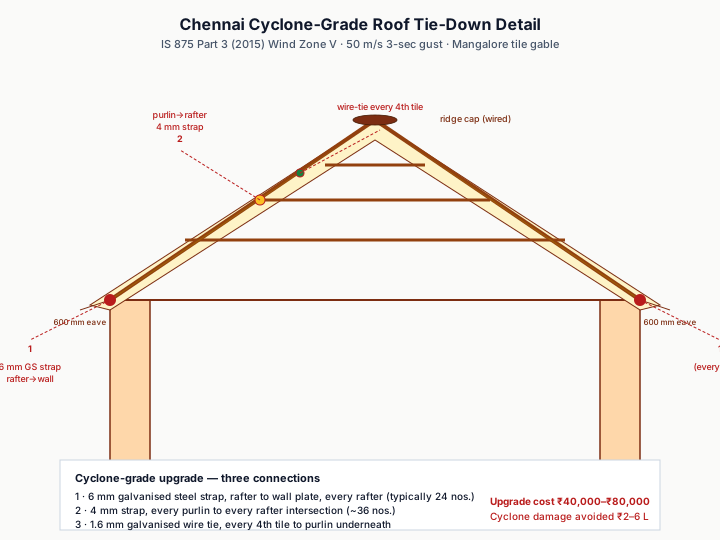
Chennai sits in IS 875 Part 3 Wind Zone V with 50 m/s 3-second-gust design wind speed near the coast (50 km/h sustained during severe cyclones). Standard inland Mangalore-tile roof construction fails under cyclone loading — tiles lift, ridge caps tear off, rafters separate from walls. The cyclone-grade upgrade: each rafter is tied down to the wall plate with a 6 mm galvanised steel strap, each purlin is tied to the rafter with a 4 mm strap, and every fourth tile is wire-tied to the purlin underneath. The gable wall is reinforced with internal bracing at the apex. Total cyclone-grade upgrade cost: ₹40,000–₹80,000 over standard roof construction. The 2015 Vardah cyclone caused approximately ₹4 L of un-insured roof damage to typical Chennai suburban homes; the cyclone-grade detailing reduces this exposure by ~80%.
Buildability — what to verify before the contractor breaks ground
Chennai soils vary: Pallavaram / Tambaram lateritic (150–200 kPa, good for shallow foundations); coastal-band ECR / OMR sand-clay reclaim (60–120 kPa, often needing under-reamed piles); inland Sholinganallur / Porur shale-clay (100–150 kPa, careful detailing for cracking soils). Soil testing (₹15,000–₹50,000) is mandatory. MEP layout includes cyclone-time inverter + battery (CMRL outages of 4–12 hours during cyclone), high-flow internal downpipes (sized for 100 mm/hour peak rainfall), and full house surge protection (cyclonic lightning is routine). CMDA / GCC plan sanction via the OSPCB-linked online portal: 30–90 days for clean submissions, longer with CRZ. Construction: 14–18 months (similar to Bengaluru, faster than Mumbai). See the full plan page for the buildability checklist.
Common pitfalls
- Skipping cyclone-grade tie-downs because the contractor 'always builds this way' — every cyclone in living memory has damaged the homes that skipped them.
- Importing Mumbai-monsoon detailing without re-tuning for Chennai's NE pattern — the rain intensity is similar but the seasonal pattern affects construction sequencing.
- Cement mortar on external walls — same Mumbai-pattern failure within 5–8 NE monsoons.
- Skipping rainwater harvesting at design stage — OC will be withheld; retrofit is 2–3× the integrated cost.
- Galvanised steel hardware near the coast — salt-air corrosion in 3–7 years; marine-stainless / brass is the right choice within 10 km of the coast.
- Designing for SW-monsoon-style rain when 80% of annual rainfall arrives during NE — gutter + downpipe sizing must match NE intensity (100 mm/hour peaks).
Frequently asked questions
›What is the maximum FSI on a 30 × 40 ft plot in Chennai?
›Is the cyclone-grade detailing really necessary for a 30 × 40 ft house?
›Why is the NE monsoon harder than the SW monsoon in Chennai?
›Can a Chennai home avoid air-conditioning?
›Is the rainwater harvesting really enforced at OC?
›What is the timeline from purchase to occupancy on a Chennai 30 × 40 ft Verandah Pavilion?
Sources & references
Tamil Nadu Town and Country Planning Act, 1971
Act No. 35 of 1972 — statutory framework for TNCDBR 2019 and CMDA planning authority
Tamil Nadu Combined Development and Building Rules 2019 (TNCDBR 2019)
Government of Tamil Nadu, TNCDBR 2019 — Schedule of Land Use Activities, Use-wise FSI and setback matrices
CMDA Development Regulations
Chennai Metropolitan Development Authority Development Regulations for the Chennai Metropolitan Area
Tamil Nadu Rainwater Harvesting Mandate (2003)
Government of Tamil Nadu Order No. 25 of 2003 — mandatory RWH structure for all new constructions
IS 875 Part 3 (Wind Loads)
Bureau of Indian Standards, IS 875 Part 3 (2015) — Wind Loads on Buildings and Structures; Wind Zone V for Chennai
Coastal Regulation Zone Notification 2019 (MoEFCC)
S.O. 39(E) of 18 January 2019 — CRZ I–IV definitions for Tamil Nadu coast
National Building Code of India 2016
Bureau of Indian Standards, NBC 2016 — Volume 1 Part 3 Development Control Rules
SP 41 — Handbook on Functional Requirements of Buildings
Bureau of Indian Standards, SP 41 (1987) — Climate Zone Map of India
Disclaimer: Regulatory rates and dimensional rules change frequently and may be modified by mid-year notifications. Values reflect the framework as of 2026-05-15; verify against the current authority notification before any specific filing. This page is informational and is not legal or planning advice — engage a registered architect and a qualified planning consultant for project-specific compliance.
Related guides from the library
The companion deep-dives that practising architects keep alongside this reference.
Passive Design Strategies for Indian Climate Zones
A Climate-Zone-by-Zone Working Reference for Indian Architects
24 min read · Open Room PlanningCross Ventilation in Indian Homes
Science, Physics, and Planning — A Professional Guide for Architects
28 min read · Open SustainabilitySustainable Home Design in India
A Practical Guide to Climate, Craft, and Conscience in the Indian Home
15 min read · Open Design StylesVastu Shastra for Modern Homes
A Scientific Approach — Directions, Room Planning, Colours & Architect's Guide
26 min read · Open SustainabilityRainwater Harvesting for Indian Urban Homes
A Complete Guide — Design, Regulations, Costs & ROI
22 min read · Open ConstructionWaterproofing Guide for Indian Homes
Complete Zone-by-Zone Guide — Terrace, Bathroom, Basement, Walls & Tanks
28 min read · OpenCompare across cities
The same House Plan 30×40 topic, different regulatory frameworks, different city quirks. Architects practising across metros should bookmark the adjacent reference.
House Plan 30×40 in Bengaluru
BBMP Building Bye-laws 2003 + Revised Master Plan 2031 (RMP 2031)
Open MCGM · MaharashtraHouse Plan 30×40 in Mumbai
Development Control and Promotion Regulations 2034 (DCPR 2034)
Open DDA · Delhi (NCT)House Plan 30×40 in Delhi
Master Plan for Delhi 2021 (MPD 2021) + Unified Building Bye-laws 2016
Open HMDA · TelanganaHouse Plan 30×40 in Hyderabad
Telangana Building Rules 2012 + GO Ms No. 168
Open