
Rainwater Harvesting for Indian Urban Homes
A Complete Guide — Design, Regulations, Costs & ROI
India receives an average of 1,170 mm of rainfall annually — yet we face chronic water shortages in nearly every major city. The gap between what falls from the sky and what reaches our taps is staggering. Bengaluru's water crisis of 2024, Chennai's Day Zero scare, and Delhi's perennial summer shortages are symptoms of the same problem: we let 80% of our rainwater flow into storm drains instead of capturing it.
Rainwater harvesting (RWH) is not just an environmental ideal — it is now a legal requirement in most Indian cities, a practical way to cut the metered part of your water use, and — if you currently buy tanker water — an investment that repays itself in a handful of years. On subsidised piped water the bill savings are modest; we set out the honest arithmetic below. This guide covers everything an urban homeowner needs to know — from regulations and system design to costs, maintenance, and government incentives.
Why Rainwater Harvesting Matters for Indian Homes
The Water Crisis in Numbers
India is home to 18% of the world's population but has access to only 4% of the world's freshwater. The Central Ground Water Board (CGWB) reports that 256 out of 700 districts have critical or over-exploited groundwater levels.
| Statistic | Value | Source |
|---|---|---|
| India's annual rainfall | 1,170 mm average | IMD |
| Rainwater wasted (urban) | ~80% flows to drains | CGWB |
| Groundwater depletion rate | 1-3 metres/year in cities | CGWB 2023 |
| Urban water demand-supply gap | 30-50% in summer months | NITI Aayog |
| Homes that can meet 50%+ water needs from RWH | Most plots above 1000 sq.ft | NBC 2016 |
What a Typical Urban Home Can Harvest
For a 2400 sq.ft plot in Bengaluru (annual rainfall ~970 mm):
- Rooftop area (assuming 60% of plot): 1440 sq.ft = 134 sq.m
- Annual rainwater potential: 134 × 0.97 × 0.8 (runoff coefficient) = 103,936 litres
- That's 104 kilolitres — enough for a family of 4 for approximately 6-7 months
A single 2400 sq.ft home in Bengaluru can harvest over 1 lakh litres of rainwater per year — enough to cover a large share of a household's non-drinking water across the year. What that is worth depends entirely on what you would otherwise pay for water, which we cost out honestly in the Return on Investment section below. (At subsidised BWSSB piped rates it is worth only a few thousand rupees a year; against tanker water, several times that.)
Rainfall Data — How Much Can Your City Harvest?
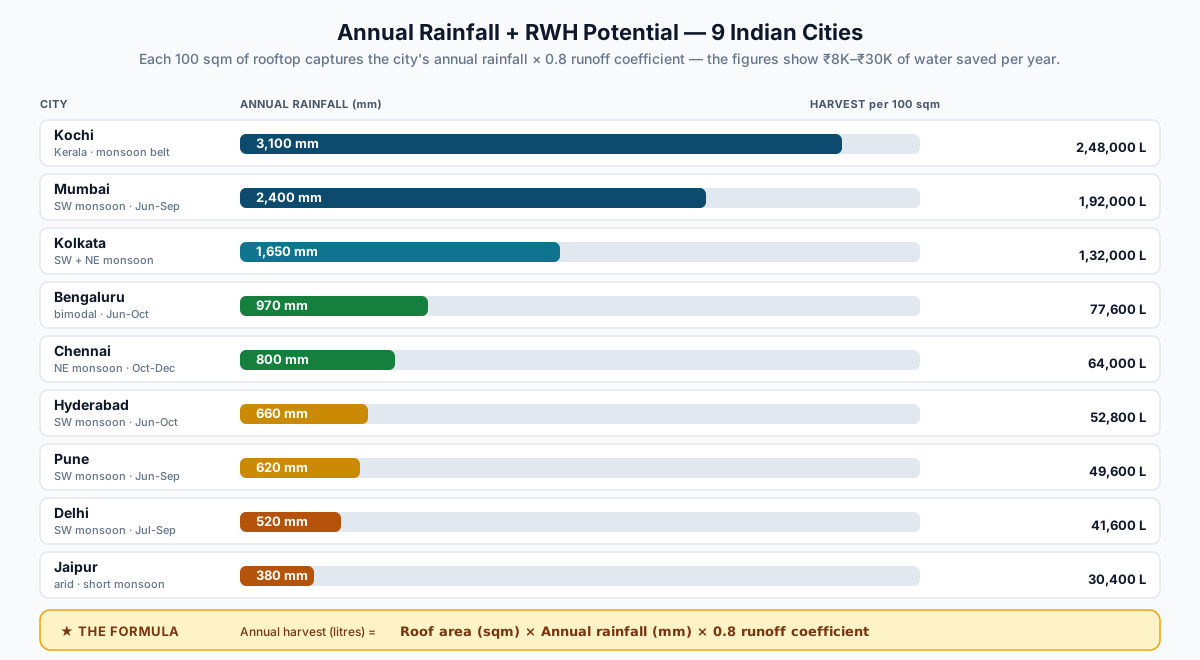
| City | Annual Rainfall (mm) | Rainy Days | Best Months | RWH Potential (per 100 sq.m roof) |
|---|---|---|---|---|
| Bengaluru | 970 | 60 | Jun-Oct | 77,600 L |
| Chennai | 800 | 55 | Oct-Dec | 64,000 L |
| Mumbai | 2,400 | 75 | Jun-Sep | 192,000 L |
| Delhi | 520 | 35 | Jul-Sep | 41,600 L |
| Hyderabad | 660 | 45 | Jun-Oct | 52,800 L |
| Kochi | 3,100 | 130 | Jun-Nov | 248,000 L |
| Jaipur | 380 | 25 | Jul-Sep | 30,400 L |
| Pune | 620 | 50 | Jun-Sep | 49,600 L |
| Kolkata | 1,650 | 70 | Jun-Sep | 132,000 L |
Formula: Annual harvest (litres) = Roof area (sq.m) × Annual rainfall (mm) × Runoff coefficient (0.8 for concrete/tile roofs)
Is RWH Mandatory in Your City?
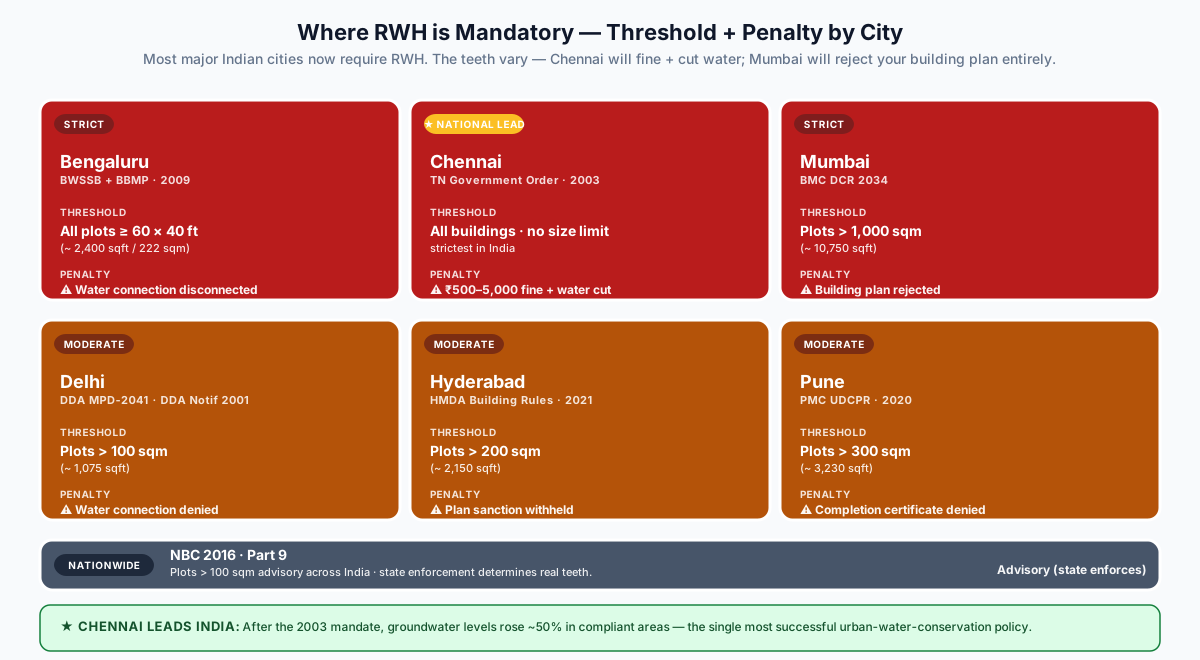
Rainwater harvesting is now mandatory in most Indian cities. Penalties for non-compliance range from water supply disconnection to building plan rejection.
| City | Mandatory For | Regulation | Penalty |
|---|---|---|---|
| Bengaluru | All buildings on plots ≥ 60 × 40 ft | BWSSB notification 2009, BBMP Bye-Laws | Water connection disconnected |
| Chennai | All buildings (no size limit) | TN Government Order 2003 | ₹500-5000 fine + water cut |
| Mumbai | Plots > 1000 sq.m | BMC DCR 2034 | Building plan rejected |
| Delhi | Plots > 100 sq.m (DDA MPD-2041) | DDA notification 2001 | Water connection denied |
| Hyderabad | Plots > 200 sq.m | HMDA Building Rules 2021 | Plan sanction withheld |
| Pune | Plots > 300 sq.m | PMC UDCPR 2020 | Completion certificate denied |
| All India | Plots > 100 sq.m | NBC 2016, Part 9 | Advisory (state enforcement) |
Chennai leads India in RWH enforcement. After the 2003 mandate, the city saw groundwater levels rise by 50% in areas with good compliance. This is the single most successful water conservation policy in urban India.
Types of Rainwater Harvesting Systems
1. Rooftop Collection + Storage Tank
The most common system for urban homes. Rainwater from the roof is collected via gutters, filtered, and stored in a tank for domestic use.
Best for: Homes that want to reduce water bills and have space for a storage tank.
2. Rooftop Collection + Groundwater Recharge
Rainwater is directed into a recharge pit or borewell to replenish the water table. No storage tank needed.
Best for: Homes with existing borewells, or areas with dropping groundwater levels.
3. Combined System (Storage + Recharge)
The ideal setup: store what you can use, recharge the overflow. This is what NBC 2016 recommends.
Best for: All urban homes — maximises both immediate use and long-term groundwater health.
System Design — Components Explained
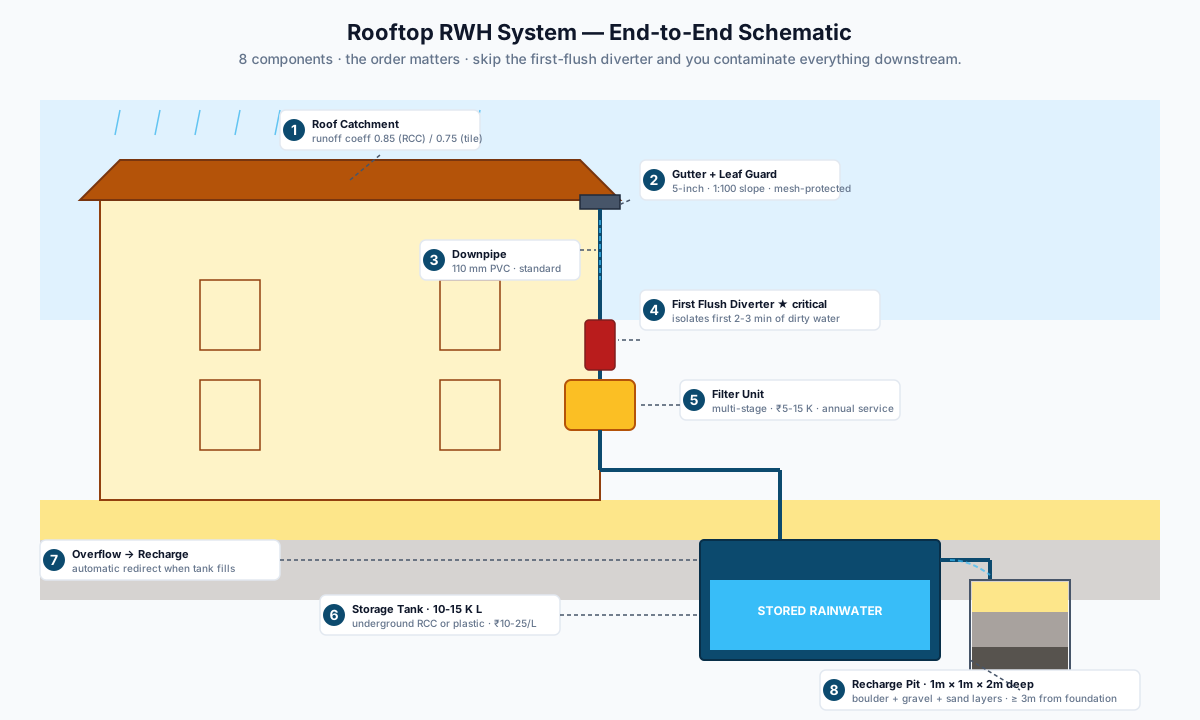
Catchment Area (Roof)
- Concrete/RCC roof: Best — runoff coefficient 0.85-0.90
- Tiled roof: Good — runoff coefficient 0.75-0.85
- Green/garden roof: Poor for RWH — runoff coefficient 0.3-0.5
Gutters and Downpipes
- Material: PVC (most common, ₹50-80/ft), GI (durable, ₹100-150/ft), or aluminium
- Size: Minimum 5-inch half-round for roofs up to 100 sq.m
- Gradient: 1:100 minimum slope towards downpipe
- Leaf guards: Essential — prevents clogging
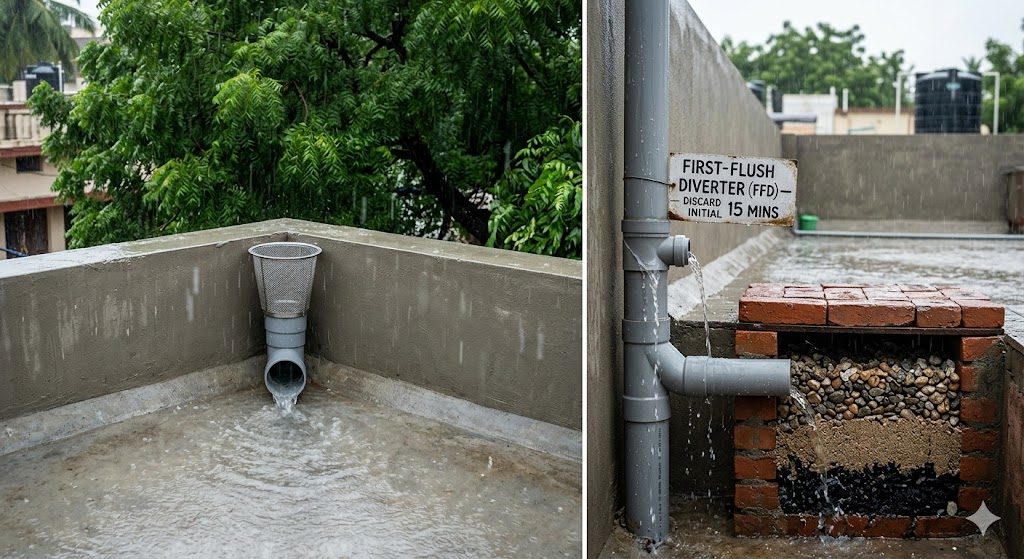
First Flush Diverter
The first 2-3 minutes of rain wash dust, bird droppings, and pollutants off the roof. The first flush diverter captures and diverts this dirty water away from your storage tank.
Rule of thumb: First flush = 1 litre per sq.m of roof area
DIY option: A simple T-pipe with a ball valve — the first flush fills a small pipe, the ball floats up and seals it, clean water then flows to the tank.
Filter Unit
| Filter Type | How It Works | Cost | Maintenance |
|---|---|---|---|
| Sand-gravel filter | Layers of sand, gravel, charcoal | ₹3,000-5,000 | Clean every 3 months |
| Charcoal filter | Activated charcoal removes impurities | ₹2,000-4,000 | Replace charcoal annually |
| Mesh/net filter | Simple screen to remove debris | ₹500-1,000 | Clean monthly |
| Commercial filter (Rainy, Aqua) | Ready-made multi-stage filter | ₹5,000-15,000 | Annual cartridge change |
Recommendation for urban homes: Commercial filter unit (Rainy FL-500 or equivalent) + first flush diverter. Easy to maintain, reliable, and fits in small spaces.
Storage Tank
| Tank Type | Capacity | Cost | Pros | Cons |
|---|---|---|---|---|
| Underground RCC | 5000-50000L | ₹15-25/litre | Durable, no space above ground | Expensive, needs waterproofing |
| Underground ferrocement | 5000-20000L | ₹10-15/litre | Cost-effective, flexible shapes | Skilled labour needed |
| Plastic (Sintex/Roto) | 500-10000L | ₹5-8/litre | Quick install, lightweight | UV degradation, limited size |
| Overhead concrete | 1000-5000L | ₹12-18/litre | Gravity-fed distribution | Structural load on building |
Recharge Pit
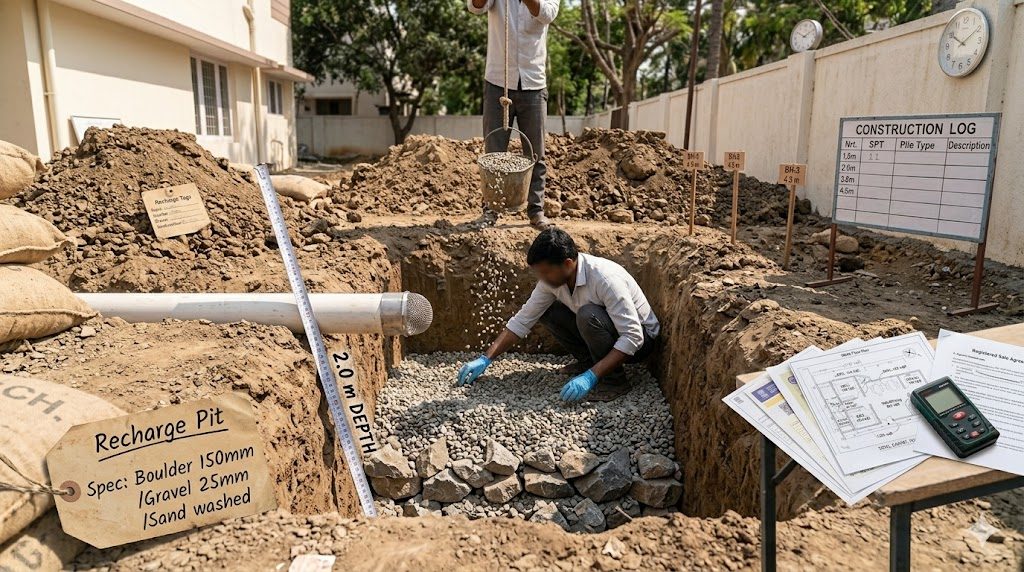
- Size: Minimum 1m × 1m × 2m deep (for plots up to 300 sq.m)
- Filling: Layers of boulder (bottom), gravel (middle), sand (top)
- Location: Minimum 3m from building foundation, 5m from septic tank
- Recharge rate: 200-500 litres per hour depending on soil
Recharge Borewell
- When: Soil has poor permeability (clay-heavy), or recharge pit alone is insufficient
- Depth: Typically 6-10m into the aquifer
- Cost: ₹8,000-15,000 for drilling + casing
- Caution: Must have a filter before the borewell to prevent contamination
Tank Sizing — How Big Should Your Tank Be?
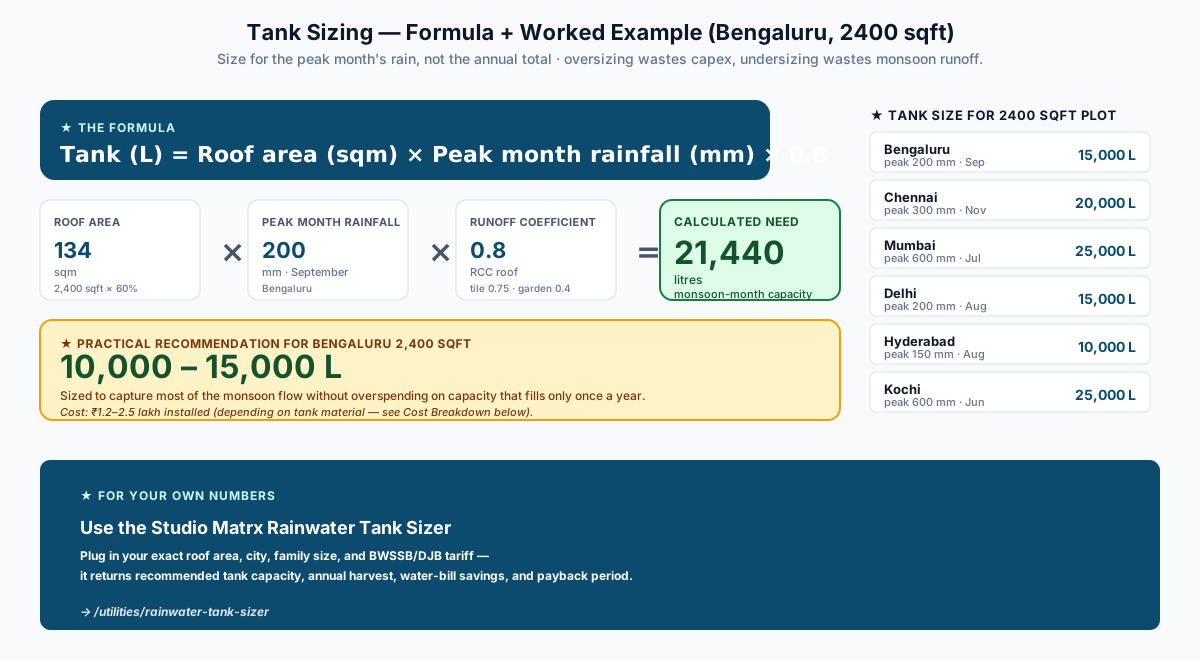
Quick Calculation
Tank size (litres) = Roof area (sq.m) × Monthly rainfall (mm) × 0.8
For a 2400 sq.ft plot in Bengaluru with 1440 sq.ft roof (134 sq.m), peak month (September, ~200mm rainfall):
- Tank size = 134 × 200 × 0.8 = 21,440 litres
- Practical recommendation: 10,000-15,000 litre tank (captures most rainfall, manageable cost)
👉 Plug in your own numbers — our free Rainwater Tank Sizer takes your roof area, city, family size, and water tariff and returns the recommended tank capacity, annual harvest in litres, and payback period in under a minute.
City-Wise Recommended Tank Sizes (for 2400 sq.ft plot)
| City | Peak Monthly Rainfall | Calculated Need | Practical Tank Size | Estimated Cost |
|---|---|---|---|---|
| Bengaluru | 200 mm (Sep) | 21,440 L | 15,000 L | ₹1.2-2.5 L |
| Chennai | 300 mm (Nov) | 32,160 L | 20,000 L | ₹1.5-3.0 L |
| Mumbai | 600 mm (Jul) | 64,320 L | 25,000 L | ₹2.0-4.0 L |
| Delhi | 200 mm (Aug) | 21,440 L | 15,000 L | ₹1.2-2.5 L |
| Hyderabad | 150 mm (Aug) | 16,080 L | 10,000 L | ₹0.8-2.0 L |
| Kochi | 600 mm (Jun) | 64,320 L | 25,000 L | ₹2.0-4.0 L |
Cost Breakdown — What Does It Really Cost?
Complete RWH System for a 2400 sq.ft Urban Home
| Component | Specification | Cost Range |
|---|---|---|
| Gutters + downpipes | PVC, 100ft total | ₹5,000-8,000 |
| First flush diverter | Commercial unit | ₹2,000-4,000 |
| Filter unit | Commercial multi-stage | ₹5,000-12,000 |
| Storage tank (underground) | 10,000 L ferrocement | ₹10,000-15,000 |
| Recharge pit | 1m × 1m × 2m | ₹5,000-8,000 |
| Piping + fittings | PVC pipes, valves | ₹3,000-5,000 |
| Pump (if needed) | 0.5 HP submersible | ₹4,000-8,000 |
| Labour + installation | ₹5,000-10,000 | |
| Total | ₹35,000-65,000 |
Return on Investment
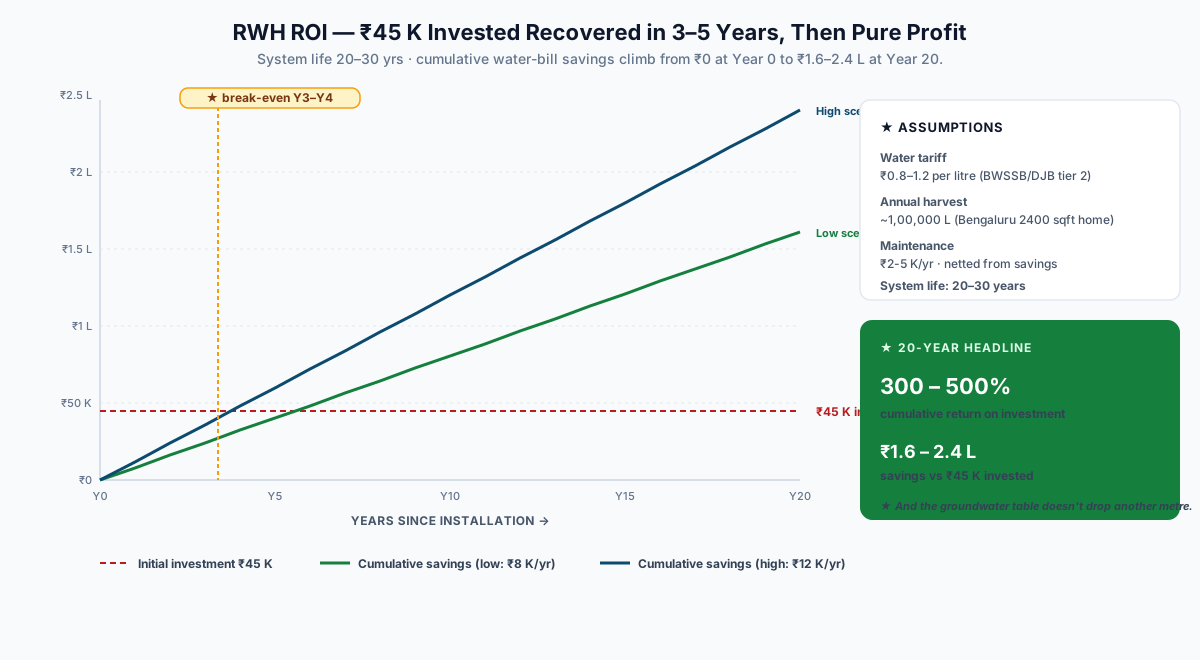
Whether a rainwater system "pays for itself" turns on one number the brochures almost never state honestly: what a litre of water actually costs you. Get it right and the answer splits cleanly in two.
If you are on subsidised BWSSB piped water. BWSSB's 2025 domestic tariff runs from ₹15 per kilolitre (the first 8 kL a month) to ₹100 for the heaviest users — that is ₹0.015 to ₹0.10 per litre, not the ₹0.80-1.20 figure that circulated in earlier versions of this guide and much of the trade literature. At those rates a rooftop system trims a typical Bengaluru home's bill by roughly ₹2,000-3,000 a year before upkeep — and once you subtract the ₹1,000-2,000 a year it costs to clean filters and desilt, the net saving is small enough that ₹45,000 never repays within the system's 20-30 year life. On the piped bill alone, it does not pay for itself, and no honest spreadsheet says otherwise.
If you buy tanker water, the picture reverses. Private tankers charge ₹80-150 per kilolitre — ten to a hundred times the piped rate. A home displacing tanker water saves ₹8,000-15,000 a year, and the same system repays itself in four to seven years, then keeps saving for two more decades. If your street runs dry every summer, harvesting is one of the best investments you can make in the house.
| Your water source | Net annual saving | Payback on ₹45,000 |
|---|---|---|
| BWSSB piped only (₹15-100/kL) | ₹1,000-1,500 | Beyond the system's life |
| Mixed — piped plus summer tankers | ₹5,000-8,000 | 7-12 years |
| Tanker-dependent (₹80-150/kL) | ₹8,000-13,000 | 4-7 years |
But the bill is usually not the main reason, and shouldn't be. Rainwater harvesting is mandatory across most Indian cities (see above) — on many plots the real question is compliance, not payback. Beyond that, a tank is water security: it keeps the taps running the week the mains fails or the borewell drops. And a recharge pit puts water back into the aquifer that everyone on your street draws from — a shared benefit no personal payback can capture. Install it for those reasons, and treat any saving on piped water as a modest bonus rather than the case for the whole system.
Government Incentives & Subsidies
| City/State | Incentive | Details |
|---|---|---|
| Bengaluru (BWSSB) | Water cess rebate | 50% rebate on water cess for homes with functional RWH |
| Chennai | Property tax rebate | 5% property tax rebate for RWH-compliant buildings |
| Delhi (DJB) | Water bill rebate | 10% rebate on water bills for RWH homes |
| Rajasthan | Capital subsidy | Up to ₹1 lakh subsidy for RWH in arid zones |
| Tamil Nadu | TNSCB subsidy | Subsidy for economically weaker sections |
| Central (CGWB) | Technical guidance | Free design assistance from CGWB regional offices |
Step-by-Step Implementation Guide
Step 1: Assess Your Roof (Day 1)
- Measure total roof area (including sloped surfaces)
- Identify existing downpipe locations
- Note roof material (concrete, tile, metal)
- Check for obstructions (water tanks, AC units)
Step 2: Calculate Potential (Day 1)
- Use formula: Roof area (sq.m) × Annual rainfall (mm) × 0.8
- Determine storage tank size (1-2 months of peak rainfall)
- Decide: storage only, recharge only, or combined
Step 3: Get Designs (Week 1)
- Consult a plumber experienced in RWH (ask for references)
- Or hire through your architect if building new
- Get 2-3 quotations
Step 4: Obtain Permissions (Week 1-2)
- For existing buildings: usually no permission needed (it's mandatory anyway)
- For new buildings: RWH plan is part of building plan submission
- BWSSB/BWSSB/local authority may need to be notified
Step 5: Installation (Week 2-3)
1. Install gutters and downpipes
2. Install first flush diverter
3. Excavate and install storage tank or recharge pit
4. Install filter unit
5. Connect overflow to recharge pit
6. Test the system (use a garden hose on the roof)
Step 6: Certification (Week 3-4)
- Some cities require RWH certification for occupancy certificate
- BWSSB sends inspectors to verify installation
- Keep photographs and receipts for compliance records
Maintenance Schedule
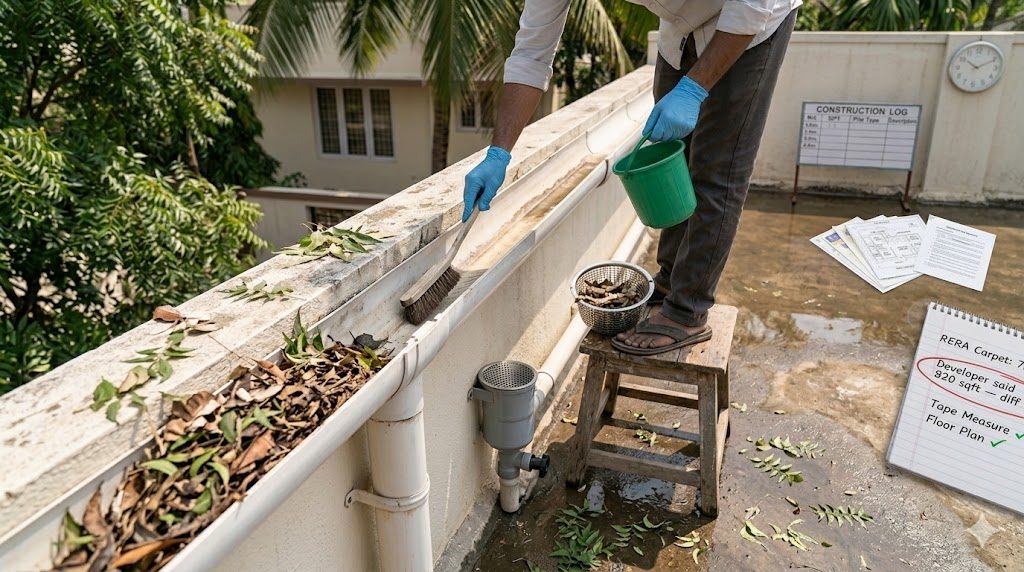
| Task | Frequency | Time Required | Cost |
|---|---|---|---|
| Clean gutters (remove leaves/debris) | Monthly | 30 minutes | Free (DIY) |
| Check first flush diverter | Monthly | 10 minutes | Free |
| Clean/backwash filter | Every 3 months | 1 hour | Free (DIY) |
| Inspect tank for sediment | Every 6 months | 30 minutes | Free |
| Pump out tank sediment | Annually | 2 hours | ₹1,000-2,000 |
| Replace filter media/cartridge | Annually | 1 hour | ₹500-2,000 |
| Inspect recharge pit | Annually | 30 minutes | Free |
| Professional system check | Every 2 years | 2 hours | ₹2,000-3,000 |
Total annual maintenance cost: ₹2,000-5,000 — less than 1% of the system cost.
Common Mistakes to Avoid
1. No first flush diverter — Without it, the first dirty water contaminates your entire tank. This is the #1 mistake.
2. Undersized gutters — Gutters overflow during heavy rain, wasting water. Size for your city's peak rainfall intensity.
3. Tank not covered properly — Open or poorly sealed tanks breed mosquitoes. Use a tight-fitting lid with mosquito mesh on all openings.
4. Recharge pit too close to foundation — Can cause foundation settlement. Maintain minimum 3m distance.
5. No overflow mechanism — Tank overflows flood the compound. Always connect overflow to a recharge pit or storm drain.
6. Ignoring maintenance — A neglected system fails within 2-3 years. Set calendar reminders for monthly and quarterly tasks.
7. Using harvested water directly for drinking — Rooftop water is suitable for washing, flushing, gardening, and vehicle cleaning. For drinking, additional treatment (UV or RO) is required.
Quality of Harvested Rainwater
| Parameter | Typical Rooftop Rainwater | WHO Limit | Suitable For |
|---|---|---|---|
| pH | 6.5-7.5 | 6.5-8.5 | All non-drinking uses |
| Turbidity | 5-15 NTU (after filter) | 5 NTU | Washing, gardening |
| TDS | 20-50 mg/L | 500 mg/L | Excellent quality |
| Coliform | Present (bird droppings) | Absent | Needs treatment for drinking |
| Heavy metals | Negligible | Below limits | Safe |
Recommended uses without treatment: Washing clothes, mopping, flushing toilets, gardening, vehicle washing, construction.
Needs additional treatment for: Drinking, cooking, bathing (UV filter recommended).
Vastu and RWH
For homeowners who follow Vastu Shastra:
- Storage tank: Northeast (Ishaan) corner is considered best for water storage
- Recharge pit: North or East direction preferred
- Overhead tank: Southwest is traditionally recommended
- Downpipes: Avoid directing water flow from South to North
Practical note: While Vastu preferences are respected, the system design should prioritise gravity flow and proximity to the roof downpipes. A qualified plumber can usually accommodate both engineering requirements and Vastu preferences.
Key Takeaways
- RWH is mandatory in most Indian cities for plots above 100-300 sq.m — non-compliance can result in water disconnection or plan rejection
- A typical 2400 sq.ft home can harvest 1+ lakh litres of rainwater annually — enough for 6-7 months of a family's non-drinking water needs
- Total system cost is ₹35,000-65,000 with a 20-30 year lifespan; on subsidised piped water it does not repay on the bill alone, but if you buy tanker water it breaks even in 4-7 years (see Return on Investment)
- Monthly maintenance takes 30-60 minutes — set calendar reminders for gutters, filters, and tank inspection
- Always install a first flush diverter — this is the single most important component for water quality
- Combined system (storage + recharge) is the best approach for urban homes — use what you can, recharge the rest
References:
- National Building Code of India 2016, Part 9 — Plumbing Services (BIS SP 7:2016)
- Central Ground Water Board — Manual on Artificial Recharge of Ground Water (2007, revised 2019)
- India Meteorological Department — Rainfall Statistics of India (2023)
- BWSSB Notification on Mandatory RWH — Bengaluru (2009)
- Tamil Nadu Government Order on RWH — G.O. Ms. No. 111 (2003)
- NITI Aayog — Composite Water Management Index (2019)
- CGWB — Dynamic Ground Water Resources of India (2023)
- Bureau of Indian Standards — IS 15797:2008 (Roof Top Rainwater Harvesting)
Export this guide
Related Guides — Deep-dive reading
Rainwater Harvesting Regulations Across India
Where harvesting rain is the law, not just a good idea: city-by-city rules, thresholds, penalties and how to get signed off
Building Regulations & ComplianceRooftop Rainwater Harvesting Rules in India: Where It's the Law
In much of India, a rooftop rainwater harvesting system is not a green extra — it is a condition of your building sanction, completion and occupancy certificate. What the rule typically requires, the standard it points to (IS 15797), who designs and certifies it, and why the exact threshold, rebate and penalty are set by your city, not the country.
RoofingRainwater Filtration & First-Flush in India: Cleaning Rain Before You Store or Recharge It
A homeowner's guide to the step that makes or breaks a rainwater harvesting system — diverting the dirty first flush, screening leaves, desilting, and choosing the right filter before the water reaches your tank or recharge pit.
PlumbingRelated Tools — Try Free
Rainwater Tank Sizer
How big should your rainwater tank be? Computes annual harvest, recommended tank capacity in litres, water-bill savings, and payback — for 10 Indian cities.
RWH CalculatorProperty Tax Calculator — 10 Indian Cities
Estimate annual municipal property tax across BBMP / MCD / MCGM / GHMC / GCC / KMC / PMC / AMC / TMC / PCMC — with self-occupied, tenanted, and age-rebate adjustments.
Property TaxRainwater Harvesting Calculator
Estimate how much rainwater a roof can harvest in a year from its area, your annual rainfall and a collection coefficient.
Plumbing Calculator